Baloney Inspection Report: Claim #1146 · Inspected Oct 10, 2026, 4:31 PM PDT · Scoring model v2
 18%
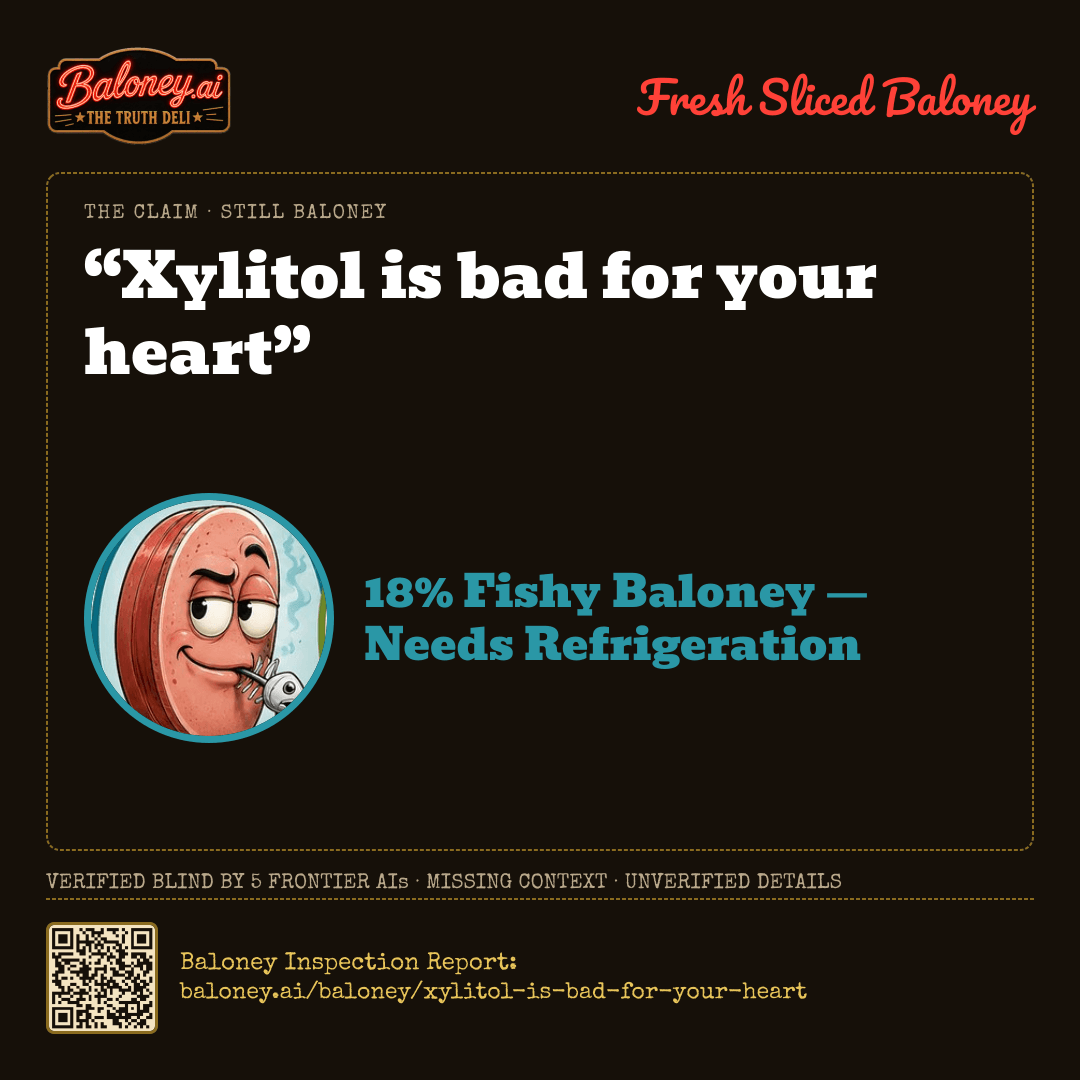
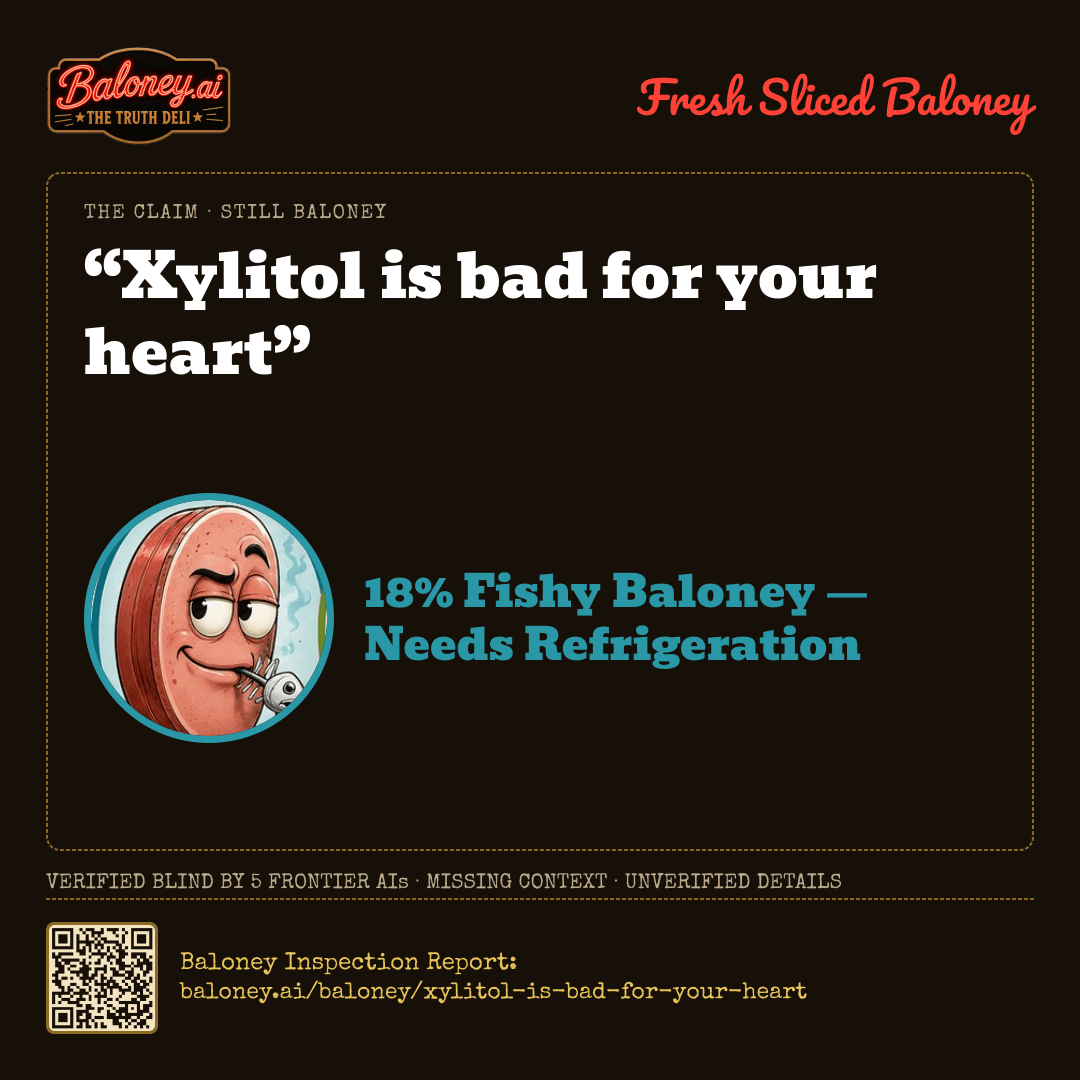
“Xylitol is bad for your heart”
18%Fishy Baloney — Needs Refrigeration
Something smells off…
Missing contextUnverified detailsSuspicious framingMay be exaggerated
Serve It Fresh
Ready to Serve11 servings
Serve it the way you want it
The Verdict
 “Xylitol is bad for your heart”18% Fishy Baloney — Needs RefrigerationVerified blind by 5 frontier AIs · Baloney Inspection Report: baloney.ai/baloney/xylitol-is-bad-for-your-heart
The Baloney Sampler
The 2024 European Heart Journal study found that higher circulating xylitol was associated with a greater three-year risk of major cardiovascular events. It also reported increased platelet reactivity and clotting potential in laboratory, animal, and small human experiments. The National Heart, Lung, and Blood Institute described these findings as an observational association and said more research is needed.
The evidence does not show that ordinary dietary xylitol causes heart attacks or strokes. The main study measured blood levels rather than verified intake and involved people undergoing cardiovascular evaluation; its human experiment included 10 adults given an acute 30 g dose and measured platelet markers, not clinical events. The U.S. Electronic Code of Federal Regulations still permits xylitol’s use in food, so general cardiotoxicity is not an established regulatory conclusion.
Resting on European Heart Journal · National Heart, Lung, and Blood Institute, NIH · U.S. National Library of Medicine, PubMed · U.S. Electronic Code of Federal Regulations
Original Claim Source https://www.webmd.com/vitamins-supplements/xylitol
Other ways to slice it — phrasings that might have changed the rating
- “Higher circulating xylitol levels are associated with increased three-year cardiovascular-event risk in adults undergoing cardiac evaluation.” This matches the study population and its observational finding without claiming that xylitol consumption causes heart disease in everyone.
- “A single 30 g dose of xylitol may temporarily increase platelet reactivity in healthy adults.” The reports describe a 10-person acute-ingestion experiment measuring short-term platelet responses rather than heart attacks or strokes.
- “Typical amounts of xylitol in gum and foods have not been shown to cause heart attacks or strokes in the general population.” The reports state that intake was not measured, ordinary exposure was not established as harmful, and the main cohorts were high-risk patients rather than the general population.
Written from the panel’s reports by Perplexity · sonar-pro. Nothing here changed the score.
The Order Ticket
23:31:55CLAIM RECEIVED — QUEUED FOR INSPECTION✓
23:32:47claude-opus-5 REPORTED — SCORE 32, CONFIDENCE 72✓
23:32:23gpt-5.5 REPORTED — SCORE 18, CONFIDENCE 82✓
23:32:29gemini-3.1-pro-preview REPORTED — SCORE 5, CONFIDENCE 90✓
23:32:05sonar-pro REPORTED — SCORE 16, CONFIDENCE 91✓
23:33:26grok-4.6 REPORTED — SCORE 18, CONFIDENCE 80✓
23:33:49PRIMARY MASTER PERPLEXITY — SCORE 18✓
23:33:51BLIND VALIDATION GROK — SCORE 18✓
23:34:06AGREEMENT CONFIRMED — DELTA 0✓
23:34:06SCORING MODEL V2 — MEDIAN OF 5 COUNTED LAB SCORES: 32, 18, 5, 16, 18 → 18.✓
23:34:06SOURCE RULE — LABS CITED 19 SOURCES: 0 DISCARDED FOR HAVING NO URL, 3 DISCARDED AS DEAD LINKS (404/410), 5 COULD NOT BE OPENED BY US AND ARE MARKED UNVERIFIED.✓
23:34:06SOURCE RULE — PRIMARY MASTER RULED ON 14 SOURCES: 0 DISCARDED FOR HAVING NO URL, 1 DISCARDED AS DEAD LINKS, 3 MARKED UNVERIFIED, 10 VERIFIED.✓
How This One Was Sliced
Station 1 · Blind Inspection — Five Graders, Zero Peeking
Each lab scored the claim independently, without seeing the others. Open a breakdown for its evidence, its sources, and how sure it was.
Anthropic · EQUAL WEIGHT · 51.4s
claude-opus-5
32%BALONEY
ROUND-1 BREAKDOWN
Evidence offered for the claim- A 2024 study led by Stanley Hazen's group at the Cleveland Clinic, published in the European Heart Journal ('Xylitol is prothrombotic and associated with cardiovascular risk'), found that higher fasting plasma xylitol levels were associated with a roughly 50-60% increased 3-year risk of major adverse cardiovascular events (heart attack, stroke, death) in two independent patient cohorts totaling over 3,000 people.
- The same paper reported mechanistic, not merely correlational, findings: xylitol enhanced platelet reactivity and clot formation in vitro and in a mouse arterial-injury model, and drinking a xylitol-sweetened beverage (~30 g) acutely raised plasma xylitol ~1,000-fold and increased measures of platelet aggregation in healthy volunteers.
- An earlier 2023 Nature Medicine study from the same lab found a closely parallel signal for erythritol, another sugar alcohol, suggesting a possible class effect for polyol sweeteners on thrombosis risk.
- Xylitol is unambiguously dangerous to dogs (severe hypoglycemia, liver failure), as FDA warns, so 'xylitol is harmful' is true in at least one well-established context — though that is species-specific and not cardiac.
- Regulatory agencies have begun re-examining polyol sweeteners in light of this literature, implying the safety question is genuinely open rather than settled in xylitol's favor.
Evidence against the claim- The human data are observational and measured blood xylitol levels, not xylitol consumption. Dietary intake was never recorded, so the association cannot be attributed to eating xylitol.
- Humans produce xylitol endogenously via the pentose-phosphate/glucuronate pathway, and levels rise with hyperglycemia, obesity, diabetes and kidney dysfunction — all strong independent cardiovascular risk factors. Elevated plasma xylitol may therefore be a marker of metabolic disease rather than a cause of cardiac events (reverse causation / confounding).
- The study cohorts were patients already undergoing cardiac evaluation (high-risk, not general population), limiting generalizability.
- The interventional arm used a single 30 g bolus in 10 healthy volunteers and measured platelet biomarkers, not clinical outcomes; typical real-world exposure from chewing gum or mints is a fraction of a gram to a few grams, and such biomarker changes have not been shown to translate into heart attacks or strokes.
- No food-safety authority (FDA, EFSA, Health Canada, JECFA) has concluded that xylitol harms the human heart or changed its approved-additive status; xylitol remains generally recognized as safe at normal intakes.
- Prior randomized trials and reviews of polyols have generally shown neutral or favorable effects on blood glucose, lipids and dental caries, with the main documented adverse effect being gastrointestinal (bloating, laxation) at high doses.
- Independent commentators and several nutrition scientists urged caution about the 2024 findings, noting that one research group has generated most of the signal and that replication by other laboratories is lacking.
- The claim as written is an unqualified, universal statement ('is bad for your heart'), which overstates a single-lab, hypothesis-generating association into established causation.
How sure this lab was72/100 — the lab’s own confidence in the score above, not a second reading of the claim.
SourcesEuropean Heart Journal (Oxford University Press) — Witkowski/Hazen et al., 'Xylitol is prothrombotic and associated with cardiovascular risk'journal · 93 · PubMed / U.S. National Library of Medicine (indexed record and related literature for the xylitol-thrombosis paper)gov · 92 · Nature Medicine — 'The artificial sweetener erythritol and cardiovascular event risk' (companion polyol study from the same group)journal · 94 · U.S. Food and Drug Administration — consumer update on xylitol toxicity in dogs (establishes species-specific harm, not human cardiac harm)gov · 95 · Harvard T.H. Chan School of Public Health, The Nutrition Source — overview of sugar substitutes and the state of the evidenceedu · 88
OpenAI · EQUAL WEIGHT · 27.9s
gpt-5.5
18%BALONEY
ROUND-1 BREAKDOWN
Evidence offered for the claim- A 2024 Nature Medicine paper reported that higher circulating xylitol levels were associated with increased 3-year risk of major adverse cardiovascular events in people being evaluated for cardiac risk, and lab/animal experiments found xylitol increased platelet reactivity and thrombosis potential. This is the strongest evidence supporting a possible heart-related concern.
- Cleveland Clinic, whose researchers led the study, summarized the finding as a link between the common low-calorie sweetener xylitol and higher risk of heart attack and stroke, while also noting that more research is needed.
- Mechanistic evidence in the Nature Medicine study makes the concern more plausible than a mere correlation: after xylitol ingestion in healthy volunteers, blood xylitol rose sharply and markers of platelet responsiveness increased, suggesting a potential clotting pathway relevant to heart attack and stroke.
Evidence against the claim- The key human evidence is observational for long-term outcomes, so it cannot prove that eating xylitol causes heart disease or heart attacks; high blood xylitol could be a marker of underlying metabolic or cardiovascular risk rather than the cause.
- The study population used for the main association was not a general healthy population; participants were undergoing cardiovascular evaluation, so the result may not apply equally to all consumers or to occasional low-dose xylitol exposure.
- Regulators have permitted xylitol for use in foods; the U.S. Code of Federal Regulations lists xylitol as a food additive permitted for direct addition to food, which argues against a settled conclusion that normal food use is broadly cardiotoxic.
- WHO guidance on non-sugar sweeteners does not directly resolve xylitol risk because the guideline excludes polyols such as xylitol; therefore broad claims about xylitol being bad for the heart go beyond what major public-health guidance has concluded.
- Independent expert reaction collected by the Science Media Centre emphasized caution: the study raises a plausible safety signal but does not establish causation and should not be interpreted as definitive proof that xylitol consumption causes cardiovascular events.
How sure this lab was82/100 — the lab’s own confidence in the score above, not a second reading of the claim.
SourcesNature Medicinejournal · 95 · U.S. Electronic Code of Federal Regulationsgov · 90 · World Health Organizationgov · 92
Google · EQUAL WEIGHT · 33.5s
gemini-3.1-pro-preview
5%BALONEY
ROUND-1 BREAKDOWN
Evidence offered for the claim- A landmark June 2024 study published in the European Heart Journal by Cleveland Clinic researchers found that higher circulating levels of xylitol in the blood are associated with an elevated risk of major adverse cardiovascular events (MACE), such as heart attacks and strokes.
- The study provided strong mechanistic evidence demonstrating that xylitol directly increases platelet reactivity and thrombosis (blood clotting) potential in both human plasma and animal models.
- In a dietary intervention arm of the study, healthy volunteers who consumed a drink sweetened with a typical amount of xylitol showed significant spikes in blood xylitol levels and a measurable increase in blood clotting risk immediately following consumption.
Evidence against the claim- The large-scale human data linking xylitol to adverse heart outcomes is primarily observational; while it adjusts for various health factors, observational data shows correlation rather than definitive causation.
- Xylitol is not an entirely foreign artificial chemical; it is a naturally occurring sugar alcohol found in small amounts in fruits and vegetables, and is naturally produced in the human body during normal glucose metabolism.
- Major global regulatory bodies, including the U.S. Food and Drug Administration (FDA), currently classify xylitol as Generally Recognized As Safe (GRAS) for consumption, and it is widely endorsed by dental associations for preventing tooth decay.
How sure this lab was90/100 — the lab’s own confidence in the score above, not a second reading of the claim.
SourcesEuropean Heart Journaljournal · 95 · CNNnews · 85
Perplexity · EQUAL WEIGHT · 9.7s
sonar-pro
16%BALONEY
ROUND-1 BREAKDOWN
Evidence offered for the claim- A 2024 European Heart Journal study found that people with higher fasting plasma xylitol had a higher subsequent risk of major adverse cardiovascular events; after adjustment for cardiovascular risk factors, the highest-risk group had an adjusted hazard ratio of 1.57 (95% CI 1.12–2.21) over approximately three years. The study was observational, so it shows association rather than proof that xylitol caused the events. [https://academic.oup.com/eurheartj/article/45/27/2439/7683453]
- The same study reported mechanistic evidence that xylitol increased platelet reactivity in laboratory experiments, enhanced thrombosis in animal models, and increased platelet responses after 30 g of xylitol in a small intervention involving 10 healthy adults. These findings provide biological plausibility for a cardiovascular concern but do not establish that ordinary long-term dietary intake causes heart attacks or strokes. [https://academic.oup.com/eurheartj/article/45/27/2439/7683453]
- The U.S. National Heart, Lung, and Blood Institute described the finding as an association between elevated circulating xylitol and later major cardiovascular events, particularly in adults many of whom already had cardiovascular disease. [https://www.nhlbi.nih.gov/news/2024/common-sweetener-linked-potential-cardiovascular-risks]
Evidence against the claim- The strongest human evidence identified is observational: blood xylitol levels may reflect endogenous metabolism, underlying illness, diet, or other factors, and the study did not prove that consuming xylitol causes cardiovascular disease. [https://academic.oup.com/eurheartj/article/45/27/2439/7683453]
- The human ingestion experiment was very small—10 healthy volunteers—and measured short-term platelet reactivity rather than heart attacks, strokes, or long-term cardiovascular outcomes. [https://academic.oup.com/eurheartj/article/45/27/2439/7683453]
- The study's findings concern elevated circulating levels and a 30 g acute dose; they do not establish that typical amounts in gum, toothpaste, or foods produce the same cardiovascular risk. The available evidence therefore does not justify the unqualified statement that xylitol is definitively bad for everyone's heart. [https://www.nhlbi.nih.gov/news/2024/common-sweetener-linked-potential-cardiovascular-risks]
- Xylitol remains permitted for use in foods and oral-care products by the U.S. Food and Drug Administration; authorization is not proof of cardiovascular safety, but it indicates that the claim is not an established regulatory conclusion that xylitol is generally unsafe. [https://www.ecfr.gov/current/title-21/chapter-I/subchapter-B/part-172/section-172.395]
How sure this lab was91/100 — the lab’s own confidence in the score above, not a second reading of the claim.
SourcesEuropean Heart Journaljournal · 96 · U.S. National Library of Medicine, PubMedgov · 94 · National Heart, Lung, and Blood Institute, NIHgov · 97 · U.S. Electronic Code of Federal Regulations, FDA food-additive regulationgov · 91
xAI · EQUAL WEIGHT · 91.3s
grok-4.6
18%BALONEY
ROUND-1 BREAKDOWN
Evidence offered for the claim- A 2024 Cleveland Clinic-led study in the European Heart Journal found higher plasma xylitol was associated with greater 3-year risk of major adverse cardiovascular events (heart attack, stroke, or death) among patients undergoing cardiac evaluation.
- The same research reported that xylitol increased platelet reactivity and thrombosis potential in human intervention experiments (xylitol ingestion) and in preclinical models, a plausible mechanism for cardiovascular harm.
- These findings parallel earlier work from the same group on the related sugar alcohol erythritol and circulating polyols.
Evidence against the claim- Xylitol has been used in foods, gum, and oral-care products for decades and remains FDA GRAS; established human adverse effects are mainly dose-dependent gastrointestinal symptoms, not proven heart disease in general populations.
- Observational links came from a high-risk referral cohort; circulating xylitol reflects both diet and endogenous production, so levels may mark metabolic illness rather than xylitol intake causing events.
- Typical consumer exposures (gum, modest food use) may not sustain the plasma concentrations tied to risk; authors and commentators have called for more research rather than treating harm as proven.
- Xylitol has documented dental-caries benefits and a lower glycemic impact than sugar, so a blanket 'bad for your heart' claim omits dose, population, and risk-benefit context.
How sure this lab was80/100 — the lab’s own confidence in the score above, not a second reading of the claim.
SourcesCleveland Clinicother · 86 · European Heart Journaljournal · 96
Station 2 · The Masters
Primary Master · drawn at random
sonar-pro
18% BALONEY
The statement has a real evidentiary basis but is too broad and causal as written. The 2024 European Heart Journal study found that higher circulating xylitol was associated with greater three-year risk of major adverse cardiovascular events, with an adjusted hazard ratio of 1.57, and reported increased platelet reactivity and thrombosis potential in laboratory, animal, and small human intervention experiments. However, the main human evidence was observational, involved people undergoing cardiovascular evaluation, and measured circulating xylitol rather than verified dietary intake. The intervention involved only 10 healthy adults, used an acute 30 g dose, and measured platelet biomarkers rather than heart attacks or strokes. Thus, the evidence supports a plausible cardiovascular safety concern, not the universal conclusion that xylitol is bad for everyone’s heart. Regulatory permission and longstanding use do not prove safety, but they reinforce that general cardiotoxicity is not an established regulatory conclusion. The panel’s scores ranged from 5 to 32; I place the result near the middle of the Fishy Baloney band because the underlying signal is credible while the wording substantially overstates what has been demonstrated.
All five evaluators agreed that the 2024 study found an association between higher circulating xylitol and later cardiovascular events and that mechanistic experiments showed increased platelet reactivity or thrombosis potential. They also agreed that the principal human outcome evidence was observational, the study population was high-risk, and the small ingestion experiment did not establish long-term clinical harm from ordinary intake. They disagreed mainly on how strongly to translate the mechanistic findings into the claim: one evaluator treated the claim as nearly true, another rated it highly misleading, and the remaining reports placed it in the middle because the signal is concerning but not proof of general cardiovascular harm. Several reports also differed over whether the paper was published in the European Heart Journal or Nature Medicine; the European Heart Journal citation is the directly supported primary-study citation in the gathered evidence, so the Nature Medicine attributions were discounted.
Blind Validation Master · never saw the Primary’s work
grok-4.6
18% BALONEY
The claim overstates a 2024 Cleveland Clinic/EHJ observational association (higher plasma xylitol linked to ~1.5–1.6x 3-year MACE in high-risk cardiac-evaluation cohorts) plus mechanistic platelet/thrombosis data (in vitro, mouse, and a 10-person 30 g acute-ingestion experiment) as if xylitol is proven cardiotoxic. Those findings raise a plausible safety signal and parallel the same group’s erythritol work, but they do not establish that typical dietary xylitol (gum, modest food use) causes heart attacks or strokes: circulating xylitol is also endogenous and tracks metabolic disease, intake was not measured, the main cohorts were not the general population, and regulators still list xylitol as GRAS with no label or approval change. An unqualified universal statement therefore exaggerates a hypothesis-generating association and omits dose, confounding, and risk-benefit context (dental benefit, GI effects as the established adverse reaction).
AGREEMENT TEST PASSED — BOTH MASTERS SCORED 18% · BLIND VALIDATION CONFIRMED THIS SCORE · NO RE-EVALUATION REQUIRED
How the number was reached · scoring model v2 · how our models work
- Median of 5 counted lab scores: 32, 18, 5, 16, 18 → 18.
The Evidence
Evidence offered for the claim
- Higher circulating levels predicted cardiovascular events The 2024 European Heart Journal study found that participants with higher fasting plasma xylitol had greater three-year risk of major adverse cardiovascular events; the adjusted hazard ratio for the highest versus lowest group was 1.57 (95% CI 1.12–2.21). This supports an association, not proof that consuming xylitol caused the events.
- Mechanistic clotting signal The study reported increased platelet reactivity and thrombosis potential in laboratory and animal experiments, and increased platelet responses after an acute 30 g xylitol dose in 10 healthy adults. These findings make a cardiovascular concern biologically plausible but do not demonstrate heart attacks, strokes, or long-term harm from ordinary intake.
- The wording implies established universal harm DEBUNKED — The claim says xylitol is bad for the heart without specifying dose, population, exposure, or uncertainty. The evidence does not establish that typical amounts in gum, toothpaste, or foods cause cardiovascular disease in the general population.
Evidence against the claim
- Observational evidence cannot establish causation The main human study measured circulating xylitol rather than confirmed dietary consumption. Xylitol is also produced by the body, and elevated levels may reflect underlying metabolic or cardiovascular illness, confounding, or reverse causation.
- High-risk population limits generalization The cohorts consisted of adults undergoing cardiac evaluation, many with existing cardiovascular disease or risk factors. Their results may not apply to healthy people using occasional or low-dose xylitol.
- The intervention was small and acute Only 10 healthy volunteers received about 30 g and were assessed for short-term platelet responses. The experiment did not measure heart attacks, strokes, or long-term cardiovascular outcomes, and the dose may exceed ordinary exposure from gum or mints.
- Established human harms are mainly gastrointestinal The reports describe decades of food, gum, and oral-care use, FDA-permitted food use, and dose-dependent gastrointestinal effects as the established adverse effect profile. Regulatory permission is not proof of cardiovascular safety, but no cited food-safety authority has concluded that xylitol generally harms the human heart.
- Benefits and context are omitted Xylitol has dental-caries benefits and a lower glycemic impact than sugar. A blanket statement about heart harm omits the dose, population, uncertainty, and potential benefit context.
Sources · Reliability · Why Accepted or Discounted
| Source | Type | Reliability | Ruling |
|---|
| European Heart Journalunverified | journal | 96 | ACCEPTED — This is the primary peer-reviewed study directly reporting the xylitol association and mechanistic experiments. Its findings support a concern but also require the observational and small-intervention limitations to be stated. |
| European Heart Journalunverified | journal | 96 | ACCEPTED — This is the full journal article citation for the primary study and provides the adjusted risk estimate and experimental details. |
| U.S. National Library of Medicine, PubMed | gov | 94 | ACCEPTED — The indexed abstract independently confirms the study’s association, thrombosis findings, and call for further cardiovascular-safety research. |
| National Heart, Lung, and Blood Institute, NIH | gov | 97 | ACCEPTED — This government summary accurately characterizes the findings as an observational association and notes that many participants already had heart disease and that more research is needed. |
| U.S. Electronic Code of Federal Regulations | gov | 91 | ACCEPTED — The regulation documents permitted food use of xylitol. It is relevant regulatory context, though it cannot by itself establish cardiovascular safety. |
| U.S. Electronic Code of Federal Regulations | gov | 90 | ACCEPTED — This is another evaluator-cited presentation of the food-additive rule and supports the same limited regulatory point. |
| Nature Medicine | journal | 95 | DISCOUNTED — The evaluator attributed the xylitol study to Nature Medicine, but the directly identified primary xylitol paper is the 2024 European Heart Journal article. The general caution remains consistent, but this URL is not used as the primary citation here. |
| CNN | news | 85 | DISCOUNTED — It is secondary reporting and adds no stronger evidence than the peer-reviewed study and NIH summaries. |
| Cleveland Clinicunverified | other | 86 | DISCOUNTED — The institutional release accurately summarizes the researchers’ findings but is a study-team communication rather than independent evidence and uses stronger public-facing framing than the causal evidence warrants. |
| Nature Medicine | journal | 94 | DISCOUNTED — This is the cited companion erythritol study, not direct evidence about xylitol. It may provide context about related polyols but cannot establish the claim being scored. |
| U.S. Food and Drug Administration | gov | 95 | DISCOUNTED — It establishes severe xylitol toxicity in dogs, but that species-specific evidence does not establish human cardiovascular harm. |
| Harvard T.H. Chan School of Public Health | edu | 88 | ACCEPTED — The cited overview is useful contextual evidence that the broader sweetener evidence remains unsettled, though it is not specific enough to resolve xylitol’s cardiovascular effects. |
| World Health Organization | gov | 92 | ACCEPTED — The cited WHO guidance is relevant chiefly because it excludes polyols such as xylitol and therefore does not resolve xylitol’s cardiovascular risk. It supports caution against claiming that broad public-health guidance has settled the issue. |
Every link was opened when this claim was inspected. A dead link was discarded before publication; “unverified” means the site refused our automated check and the link is the one the panel cited. A source without a URL was never kept.
Serve It Fresh
Ready to Serve11 servings
Serve it the way you want it
The Verdict
“Xylitol is bad for your heart”18% Fishy Baloney — Needs RefrigerationVerified blind by 5 frontier AIs · Baloney Inspection Report: baloney.ai/baloney/xylitol-is-bad-for-your-heart