Baloney Inspection Report: Claim #1148 · Inspected Oct 30, 2026, 9:58 PM PDT · Scoring model v2
 79%
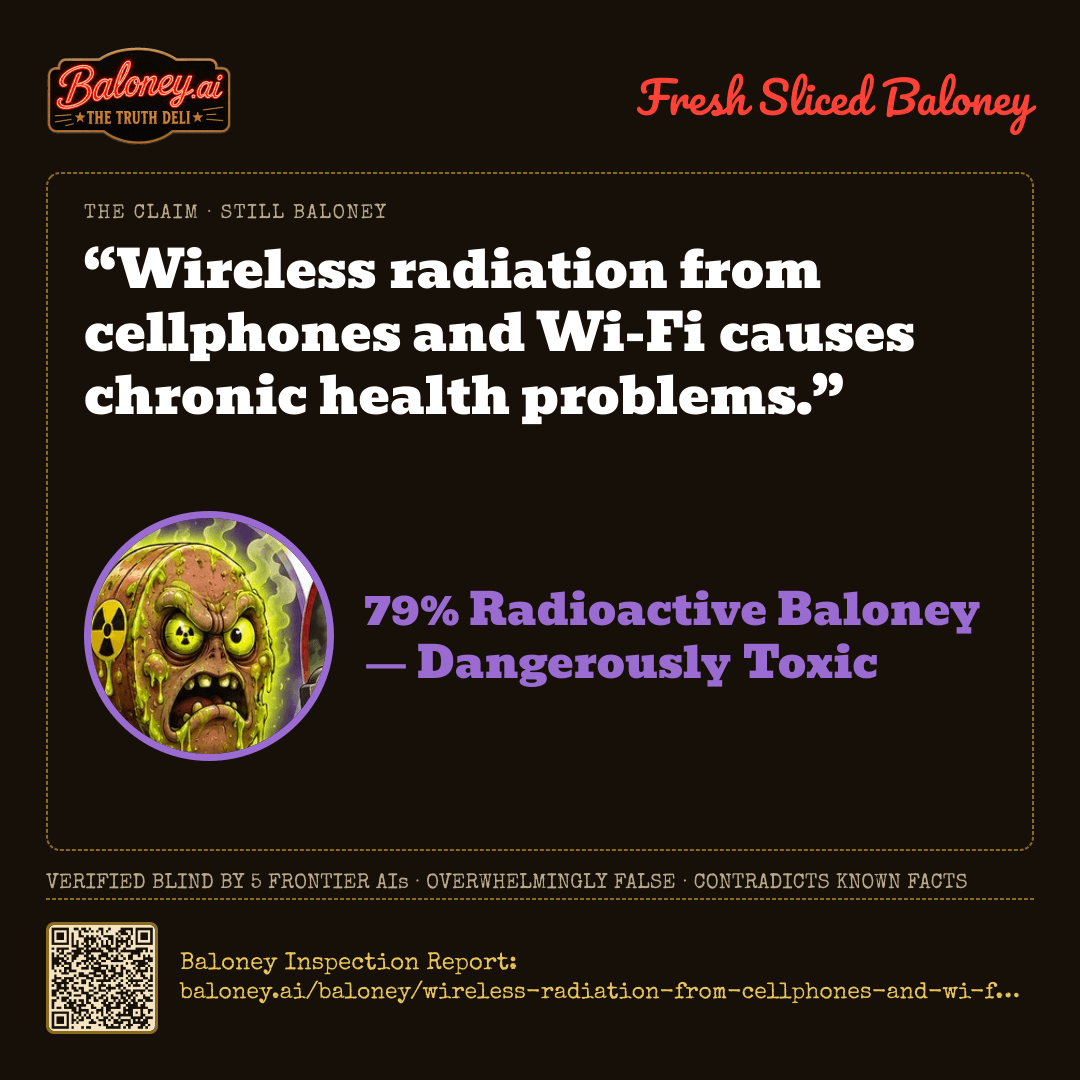
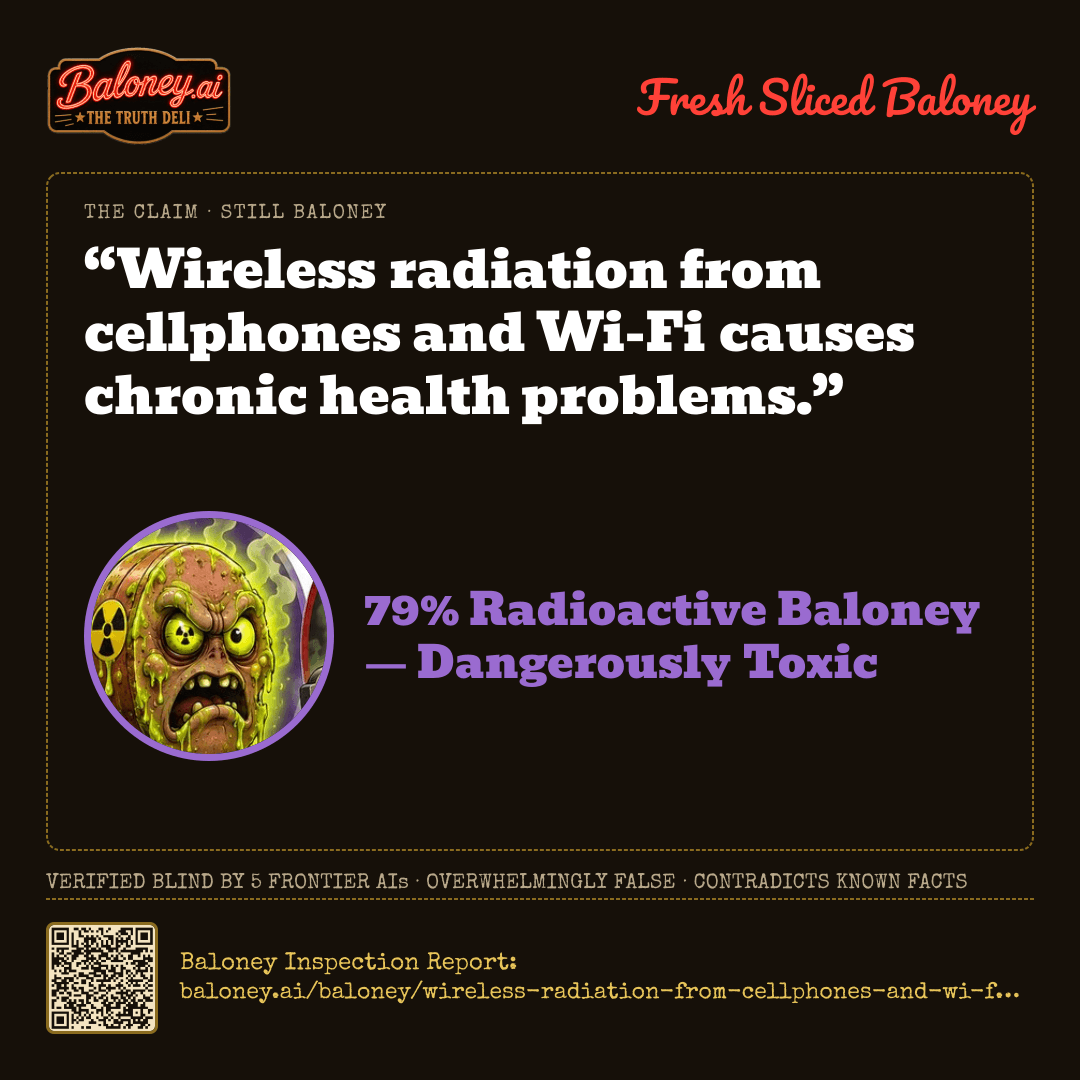
“Wireless radiation from cellphones and Wi-Fi causes chronic health problems.”
79%Radioactive Baloney — Dangerously Toxic
Dangerously misleading.
Overwhelmingly falseContradicts known factsPromotes false beliefsPotential for harm
Serve It Fresh
Ready to Serve12 servings
Serve it the way you want it
The Verdict
 “Wireless radiation from cellphones and Wi-Fi causes chronic health problems.”79% Radioactive Baloney — Dangerously ToxicVerified blind by 5 frontier AIs · Baloney Inspection Report: baloney.ai/baloney/wireless-radiation-from-cellphones-and-wi-fi-causes-chronic
The Baloney Sampler
The panel found no support for a flat causal claim. Cellphone and Wi-Fi radiation is non-ionizing and lacks the photon energy to break chemical bonds or damage DNA, and no non-thermal mechanism of chronic harm has been confirmed. The World Health Organization, the US National Cancer Institute and the US Food and Drug Administration all conclude that no adverse health effects are established at exposures below international limits, which Wi-Fi exposures sit far beneath, as set out in the ICNIRP guidelines.
The human data agree: large cohort and case-control studies, including the Danish nationwide subscriber cohort published in the BMJ, found no increase in glioma, meningioma or acoustic neuroma, and brain-tumour rates in national registries stayed flat through three decades of phone adoption. The residual uncertainty is thin — IARC's Group 2B tier shares space with aloe vera extract and pickled vegetables, and the National Toxicology Program rat tumours followed whole-body lifetime doses unlike human use.
Resting on World Health Organization · National Cancer Institute · U.S. Food and Drug Administration · National Toxicology Program (NIEHS)
Original Claim Source https://childrenshealthdefense.org/emr/take-action-our-campaigns/
Other ways to slice it — phrasings that might have changed the rating
- “Radiofrequency electromagnetic fields are classified by IARC as possibly carcinogenic to humans, a hazard that has not been ruled out.” This is factually what the 2011 Group 2B classification says, and the panel accepted the IARC press release while noting the tier denotes limited evidence rather than demonstrated risk.
- “High-intensity radiofrequency exposure above international limits causes biological harm through tissue heating.” All five reports accept thermal effects at high intensity as the established mechanism around which FCC and ICNIRP exposure limits were built.
- “Wi-Fi routers in homes and schools cause chronic illness in people exposed to them daily.” Reports note Wi-Fi exposures are hundreds to thousands of times below international limits, making this the weakest version of the claim, and blinded provocation studies find hypersensitive individuals cannot detect fields better than chance.
Written from the panel’s reports by Anthropic · claude-opus-5. Nothing here changed the score.
The Order Ticket
04:58:34CLAIM RECEIVED — QUEUED FOR INSPECTION✓
04:59:41claude-opus-5 REPORTED — SCORE 80, CONFIDENCE 87✓
04:59:19gpt-5.5 REPORTED — SCORE 72, CONFIDENCE 88✓
04:58:56gemini-3.1-pro-preview REPORTED — SCORE 99, CONFIDENCE 98✓
04:58:38sonar-pro REPORTED — SCORE 79, CONFIDENCE 94✓
05:00:05grok-4.6 REPORTED — SCORE 52, CONFIDENCE 78✓
05:01:38PRIMARY MASTER CLAUDE — SCORE 80✓
05:00:14BLIND VALIDATION GEMINI — SCORE 99✓
05:02:10AGREEMENT MODERATE DISAGREEMENT — DELTA 20✓
05:02:10SCORING MODEL V2 — MEDIAN OF 5 COUNTED LAB SCORES: 80, 72, 99, 79, 52 → 79.✓
05:02:10SOURCE RULE — LABS CITED 36 SOURCES: 0 DISCARDED FOR HAVING NO URL, 4 DISCARDED AS DEAD LINKS (404/410), 10 COULD NOT BE OPENED BY US AND ARE MARKED UNVERIFIED.✓
05:02:10SOURCE RULE — PRIMARY MASTER RULED ON 20 SOURCES: 0 DISCARDED FOR HAVING NO URL, 0 DISCARDED AS DEAD LINKS, 6 MARKED UNVERIFIED, 14 VERIFIED.✓
How This One Was Sliced
Station 1 · Blind Inspection — Five Graders, Zero Peeking
Each lab scored the claim independently, without seeing the others. Open a breakdown for its evidence, its sources, and how sure it was.
Anthropic · EQUAL WEIGHT · 66.8s
claude-opus-5
80%BALONEY
ROUND-1 BREAKDOWN
Evidence offered for the claim- The International Agency for Research on Cancer (IARC) classified radiofrequency electromagnetic fields as 'possibly carcinogenic to humans' (Group 2B) in May 2011, based on limited evidence linking heavy mobile phone use to glioma and acoustic neuroma — the classification has not been formally withdrawn.
- The IARC Interphone study found an elevated odds ratio for glioma (~1.40) in the highest decile of cumulative call time, and some case-control studies by the Hardell group in Sweden reported increased glioma risk with long-term heavy use.
- The U.S. National Toxicology Program's $30 million rodent study (2018) reported 'clear evidence' of malignant schwannomas of the heart in male rats exposed to high-level, whole-body GSM/CDMA radiation, plus some evidence of brain gliomas; the Ramazzini Institute reported a similar schwannoma finding at far lower field strengths.
- High-intensity RF exposure unquestionably causes biological harm via tissue heating; this is why exposure limits (FCC, ICNIRP) exist at all, and non-compliant or defective transmitters can in principle exceed them.
- A minority of people report 'electromagnetic hypersensitivity' with real, sometimes disabling symptoms (headache, fatigue, sleep disturbance), and WHO acknowledges the symptoms are genuine even while disputing the attributed cause.
- Some experimental studies report small, measurable effects on EEG patterns and sleep architecture from RF exposure, though the health significance is unestablished.
Evidence against the claim- Wi-Fi and cellphone radiation is non-ionizing and, at ordinary exposure levels, carries far too little photon energy to break chemical bonds or damage DNA directly; no confirmed non-thermal mechanism of chronic harm has been demonstrated.
- A 2024 WHO-commissioned systematic review of 63 studies across 22 countries (Karipidis et al., Environment International) found no association between mobile phone use — including heavy use and use for 10+ years — and brain or head-and-neck cancers.
- Brain tumour incidence has remained essentially flat in national cancer registries (US, UK, Australia, Nordic countries) across three decades of near-universal mobile phone adoption, which is inconsistent with a meaningful causal effect.
- Large prospective cohorts — the Danish cohort of 358,000 subscribers (BMJ 2011), the UK Million Women Study, and the international COSMOS cohort (2024) — found no increased risk of glioma, meningioma or acoustic neuroma.
- The NTP rodent findings are widely regarded as not translatable: exposures were whole-body, 9 hours/day for 2 years at levels up to 4x the human SAR limit sufficient to raise body temperature; exposed male rats paradoxically lived *longer* than controls, and females and mice showed no clear effect. The FDA reviewed the data and stated it does not support a safety concern for humans.
- Wi-Fi exposure levels are typically hundreds to thousands of times below ICNIRP/FCC limits — a Wi-Fi router delivers a tiny fraction of the RF dose of holding a phone to the head, making 'Wi-Fi causes chronic disease' the weakest version of the claim.
- Dozens of double-blind provocation studies (and systematic reviews of them) show that self-identified electromagnetically hypersensitive individuals cannot detect the presence of RF fields better than chance, and symptoms track belief in exposure rather than actual exposure (nocebo effect).
- Major health and regulatory agencies — WHO, US FDA, FCC, National Cancer Institute, Cancer Research UK, ARPANSA, and the EU SCHEER/SCENIHR committees — all conclude the current evidence does not establish adverse health effects from exposure below international limits.
- IARC Group 2B is a low-evidentiary bar shared with aloe vera extract and pickled vegetables; it denotes a hazard that cannot be ruled out, not a demonstrated risk.
How sure this lab was87/100 — the lab’s own confidence in the score above, not a second reading of the claim.
SourcesUS National Cancer Institutegov · 96 · US Food and Drug Administrationgov · 92 · US Federal Communications Commissiongov · 85 · National Toxicology Program (NIEHS)gov · 93 · BMJ (Frei et al., Danish cohort study)journal · 92 · Cancer Research UKother · 88 · Australian Radiation Protection and Nuclear Safety Agencygov · 90 · ICNIRP RF Guidelines 2020journal · 90 · IARC Monographs classification listgov · 94
OpenAI · EQUAL WEIGHT · 44.6s
gpt-5.5
72%BALONEY
ROUND-1 BREAKDOWN
Evidence offered for the claim- The strongest support is not evidence that ordinary cellphone or Wi-Fi exposure causes chronic illness, but evidence that radiofrequency electromagnetic fields remain scientifically plausible enough to monitor: IARC classified RF electromagnetic fields as Group 2B, "possibly carcinogenic to humans," based mainly on limited human evidence for glioma and acoustic neuroma among heavy cellphone users.
- The U.S. National Toxicology Program reported "clear evidence" of malignant heart schwannomas in male rats and some evidence of brain gliomas after long-term, whole-body 2G/3G RF exposure. However, the exposures were controlled animal exposures, generally higher and not directly comparable to typical consumer cellphone or Wi-Fi exposure.
- The Ramazzini Institute reported increased heart schwannomas in male rats exposed lifelong to 1.8 GHz RF fields at levels intended to resemble environmental base-station exposure, which is notable because it overlaps with the tumor type seen in NTP rats; replication and human relevance remain disputed.
- Some case-control studies, including the INTERPHONE study, found elevated glioma risk estimates in the highest cumulative call-time category, but the authors warned that biases and errors limited causal interpretation and the overall study did not show increased glioma or meningioma risk.
Evidence against the claim- Major public-health agencies including WHO, FDA, NCI, and ARPANSA state that no adverse health effects have been established from cellphone or Wi-Fi RF exposures that comply with current limits.
- Radiofrequency radiation from cellphones and Wi-Fi is non-ionizing; it does not have enough photon energy to break chemical bonds or damage DNA in the way ionizing radiation can. The well-established hazard at high levels is tissue heating, and exposure limits are designed around that mechanism.
- Large epidemiological evidence has not shown a consistent chronic-disease signal. The Danish nationwide cohort update found no increased brain-tumor risk among mobile-phone subscribers, and NCI notes that population brain-cancer rates have not risen in step with the enormous growth in cellphone use.
- For Wi-Fi specifically, measured exposures are typically far below international limits, and ARPANSA states there is no established scientific evidence that low-level RF exposure from Wi-Fi adversely affects health.
- People who report electromagnetic hypersensitivity can have real symptoms, but blinded provocation-study reviews have not found reliable evidence that RF exposure itself triggers those symptoms.
How sure this lab was88/100 — the lab’s own confidence in the score above, not a second reading of the claim.
SourcesInternational Agency for Research on Cancergov · 92 · U.S. National Toxicology Programgov · 90 · Environmental Researchjournal · 84 · International Journal of Epidemiologyjournal · 88 · U.S. Food and Drug Administrationgov · 93 · National Cancer Institutegov · 94 · Australian Radiation Protection and Nuclear Safety Agencygov · 91 · BMJjournal · 90 · Bioelectromagneticsjournal · 86 · International Commission on Non-Ionizing Radiation Protection / Health Physicsjournal · 90
Google · EQUAL WEIGHT · 21.5s
gemini-3.1-pro-preview
99%BALONEY
ROUND-1 BREAKDOWN
Evidence offered for the claim- In 2011, the World Health Organization's International Agency for Research on Cancer (IARC) classified radiofrequency electromagnetic fields as 'possibly carcinogenic to humans' (Group 2B) based on limited evidence from some observational studies regarding a possible association with glioma.
- A 2018 study by the US National Toxicology Program (NTP) found some evidence of heart schwannomas (a rare tumor) in male rats exposed to extremely high, continuous levels of 2G and 3G cell phone radiation over their entire lifespans.
Evidence against the claim- Wireless radiation from cellphones and Wi-Fi is non-ionizing, meaning it inherently lacks the energy required to break chemical bonds, strip electrons, or damage DNA, which is the primary mechanism by which ionizing radiation (like X-rays) causes cancer.
- The FDA, National Cancer Institute, and World Health Organization all state there is no consistent or credible scientific evidence demonstrating that non-ionizing radiation from cell phones or Wi-Fi causes chronic health problems in humans at everyday exposure levels.
- Decades of epidemiological data show that despite an exponential, widespread increase in global cell phone use since the 1990s, incidence rates of brain cancer and other central nervous system cancers have remained flat.
- The 2018 NTP study on rats involved radiation exposure levels and durations that vastly exceeded what humans experience. The researchers explicitly cautioned that the findings cannot be extrapolated to human cellphone use.
- The IARC's 'Group 2B' classification means there is limited or inadequate evidence of carcinogenicity; this same category includes aloe vera extract and pickled vegetables.
How sure this lab was98/100 — the lab’s own confidence in the score above, not a second reading of the claim.
SourcesNational Cancer Institutegov · 98 · Food and Drug Administrationgov · 95
Perplexity · EQUAL WEIGHT · 4.4s
sonar-pro
79%BALONEY
ROUND-1 BREAKDOWN
Evidence offered for the claim- The International Agency for Research on Cancer classified radiofrequency electromagnetic fields as “possibly carcinogenic to humans” (Group 2B) in 2011, based on limited evidence linking wireless-phone use with glioma and acoustic neuroma; this category does not establish causation and evidence for other cancers was inadequate.[1]
- Some animal and epidemiological findings have suggested possible associations under particular exposure conditions, but results have been inconsistent and often have not been independently replicated.[2]
Evidence against the claim- The World Health Organization states that no adverse health effects from low-level, long-term radiofrequency exposure have been confirmed and that current evidence does not confirm health consequences from low-level electromagnetic fields.[3]
- The U.S. National Cancer Institute says evidence to date suggests cellphone use does not cause brain or other cancers, and that no other clearly established dangerous health effects have been identified.[4]
- The U.S. FDA concludes that the weight of scientific evidence has not linked cellphone radiofrequency radiation with health problems, including among children and teenagers.[5]
- The claim covers both cellphones and Wi-Fi and asserts broad chronic health problems, but available evidence does not establish a consistent causal link for such a broad range of conditions; the strongest official conclusions concern lack of confirmed harm at typical low-level exposures.[3][4][5]
How sure this lab was94/100 — the lab’s own confidence in the score above, not a second reading of the claim.
SourcesInternational Agency for Research on Cancergov · 96 · World Health Organizationgov · 98 · U.S. National Cancer Institutegov · 98 · U.S. Food and Drug Administrationgov · 97 · Federal Communications Commissiongov · 94 · National Library of Medicinejournal · 90
xAI · EQUAL WEIGHT · 91.4s
grok-4.6
52%BALONEY
ROUND-1 BREAKDOWN
Evidence offered for the claim- IARC classified RF-EMF as Group 2B (possibly carcinogenic to humans) in 2011 based on limited epidemiological evidence for glioma and acoustic neuroma.
- The U.S. NTP reported some evidence of carcinogenic activity (malignant heart schwannomas) in male rats after high, whole-body RF exposures approximating older cell-phone signals.
- Some in-vitro, animal, and observational studies have reported associations with oxidative stress, sperm-quality changes, or self-reported symptoms sometimes labeled electromagnetic hypersensitivity.
Evidence against the claim- WHO states that no adverse health effects have been established as caused by mobile-phone use; similar conclusions apply to typical Wi-Fi exposures, which are far lower.
- FDA, NCI, and ACS reviews find the weight of human evidence does not show that cell-phone or Wi-Fi RF causes cancer or other chronic disease at everyday levels.
- Large cohort and case-control studies (Interphone, Danish cohort, Million Women Study, COSMOS) have not demonstrated consistent, replicable increases in brain tumors or other chronic outcomes.
- RF from these sources is non-ionizing; accepted effects are thermal, and typical exposures stay well below ICNIRP/FCC limits with no confirmed non-thermal mechanism for chronic disease. Blinded provocation studies do not support EMF as the cause of electromagnetic-hypersensitivity symptoms.
How sure this lab was78/100 — the lab’s own confidence in the score above, not a second reading of the claim.
SourcesNational Cancer Institutegov · 94 · U.S. Food and Drug Administrationgov · 90 · International Agency for Research on Cancergov · 90 · National Toxicology Programgov · 88 · American Cancer Societyother · 85
Station 2 · The Masters
Primary Master · drawn at random
claude-opus-5
80% BALONEY
The claim is a flat causal assertion — that wireless radiation from cellphones and Wi-Fi *causes* chronic health problems — and it is not supported by the body of evidence the panel assembled. The decisive points, raised independently by all five evaluators, are: (1) the radiation is non-ionizing and lacks photon energy to break chemical bonds, with no confirmed non-thermal mechanism of chronic harm; (2) large prospective and case-control studies (Danish nationwide cohort, Million Women Study, INTERPHONE, COSMOS) have not shown consistent increases in glioma, meningioma or acoustic neuroma; (3) brain-tumour incidence in national registries has stayed flat across three decades of near-universal phone adoption; (4) WHO, FDA, NCI, FCC, ARPANSA, Cancer Research UK and the American Cancer Society all conclude no adverse health effects are established below international limits; and (5) blinded provocation studies find self-identified electromagnetically hypersensitive people cannot detect fields better than chance. Against that, the genuine residual uncertainty is real but thin: IARC's 2011 Group 2B classification is explicitly a 'cannot be ruled out' hazard tier shared with aloe vera extract and pickled vegetables, and the NTP and Ramazzini rodent findings involved whole-body lifetime exposures far above human conditions, with the NTP's exposed male rats paradoxically outliving controls. That uncertainty justifies continued monitoring; it does not support the claim as written. I therefore place this at the lower end of the 'overwhelmingly false' band rather than at the top. I discounted Report 1's score of 99: that band is reserved for claims with a moon-landing-grade debunk history and no live scientific question, and the IARC classification plus ongoing agency review mean this does not qualify. I also discounted Report 4's 52, which treats unreplicated animal and in-vitro findings as though they offset a null human epidemiological literature spanning millions of subscribers. Reports 2, 3 and 5 clustered at 72-80 and their reasoning best matches the weight of sources.
All five evaluators agreed on the core factual picture: IARC's Group 2B classification exists and is a weak evidentiary tier; the NTP rat study is real but not translatable to human exposures; the radiation is non-ionizing; and every major health agency concludes no adverse effects are established at everyday exposure levels. Every evaluator judged the claim false as written. They disagreed sharply on how far false: one scored it 99 (zombie), three clustered at 72-80, and one at 52. The low scorer gave more weight to unreplicated oxidative-stress, sperm-quality and symptom-report studies; the high scorer gave essentially no weight to the IARC classification or the rodent findings. Three evaluators noted specifically that the Wi-Fi half of the claim is the weaker half, since Wi-Fi exposures are hundreds to thousands of times below limits and far below those from a handset held to the head.
Blind Validation Master · never saw the Primary’s work
gemini-3.1-pro-preview
99% BALONEY
The claim that wireless radiation from cellphones and Wi-Fi causes chronic health problems is overwhelmingly contradicted by decades of extensive scientific research and the consensus of major global health organizations, including the WHO, FDA, and National Cancer Institute. Cellphone and Wi-Fi radiation is non-ionizing, meaning it inherently lacks the photon energy required to break chemical bonds or directly damage DNA. Furthermore, despite the exponential, near-universal increase in global cell phone use since the 1990s, extensive epidemiological data and large-scale cohort studies demonstrate that incidence rates of brain and central nervous system cancers have remained flat. While the IARC classified radiofrequency fields as a 'Group 2B' possible carcinogen, this denotes limited or inadequate evidence and is a low evidentiary bar shared with aloe vera and pickled vegetables. Studies finding adverse effects in animals, such as the U.S. NTP rodent study, involved massive, whole-body radiation exposures that vastly exceed typical human limits and cannot be extrapolated to everyday use. Because this claim is fundamentally contradicted by the weight of scientific evidence yet continues to circulate widely, it firmly qualifies as Zombie Baloney.
AI EVALUATORS SHOWED MODERATE DISAGREEMENT — MASTERS SCORED 80% AND 99% · REVIEW THE EVIDENCE CAREFULLY
How the number was reached · scoring model v2 · how our models work
- Median of 5 counted lab scores: 80, 72, 99, 79, 52 → 79.
The Evidence
Evidence offered for the claim
- IARC calls RF 'possibly carcinogenic' DEBUNKED — The International Agency for Research on Cancer classified radiofrequency electromagnetic fields as Group 2B in 2011, on limited evidence linking heavy mobile-phone use to glioma and acoustic neuroma. The panel notes Group 2B denotes a hazard that cannot be ruled out, not a demonstrated risk, and the same tier contains aloe vera extract and pickled vegetables.
- NTP rat study found heart tumours DEBUNKED — The US National Toxicology Program's $30m study reported clear evidence of malignant heart schwannomas in male rats. The panel notes exposures were whole-body, nine hours a day for two years at up to four times the human SAR limit and sufficient to raise body temperature; females and mice showed no clear effect, exposed male rats outlived controls, and the FDA reviewed the data and found it does not indicate a human safety concern.
- Ramazzini Institute replication DEBUNKED — The Ramazzini Institute reported increased heart schwannomas in male rats exposed lifelong to 1.8 GHz fields at lower, base-station-like levels — notable for overlapping with the NTP tumour type. Evaluators noted replication and human relevance both remain disputed, and the finding has not been carried into human data.
- INTERPHONE's highest-use decile DEBUNKED — INTERPHONE found an elevated glioma odds ratio of roughly 1.40 in the highest decile of cumulative call time, and Swedish case-control work by the Hardell group reported raised glioma risk with long-term heavy use. The INTERPHONE authors themselves warned that bias and recall error precluded causal interpretation, and the study overall showed no increase in glioma or meningioma.
- Electromagnetic hypersensitivity reports DEBUNKED — A minority of people report headache, fatigue and sleep disturbance they attribute to RF fields, and WHO accepts the symptoms are genuine. Blinded provocation studies and systematic reviews of them find sufferers cannot detect fields better than chance and symptoms track belief in exposure rather than exposure itself.
- High-intensity RF does cause harm At high intensity, RF unquestionably causes biological harm through tissue heating — which is precisely why FCC and ICNIRP exposure limits exist. Consumer cellphone and Wi-Fi exposures sit far below those thermal thresholds.
Evidence against the claim
- The radiation is non-ionizing RF from phones and Wi-Fi carries far too little photon energy to break chemical bonds, strip electrons or damage DNA directly. The only established mechanism of harm is tissue heating, and no non-thermal mechanism of chronic disease has been demonstrated.
- Brain cancer rates never rose National cancer registries in the US, UK, Australia and the Nordic countries show brain and central-nervous-system tumour incidence essentially flat across three decades of near-universal mobile phone adoption — inconsistent with a meaningful causal effect.
- Large cohorts found nothing The Danish nationwide cohort of 358,000 subscribers (BMJ 2011), the UK Million Women Study and the international COSMOS cohort found no increased risk of glioma, meningioma or acoustic neuroma.
- 2024 WHO-commissioned review A systematic review of 63 studies across 22 countries found no association between mobile phone use — including heavy use and use for ten years or more — and brain or head-and-neck cancers.
- Unanimous agency conclusions WHO, the FDA, the National Cancer Institute, the FCC, ARPANSA, Cancer Research UK, the American Cancer Society and the EU SCHEER/SCENIHR committees all conclude the evidence does not establish adverse health effects from exposure below international limits.
- Wi-Fi is the weakest case Measured Wi-Fi exposures are typically hundreds to thousands of times below ICNIRP and FCC limits, and a router delivers a tiny fraction of the RF dose of a handset held to the head; ARPANSA states there is no established evidence that Wi-Fi exposure harms health.
- Hypersensitivity fails blinded testing Dozens of double-blind provocation studies show self-identified sensitive individuals cannot tell when fields are present, pointing to a nocebo effect rather than a physical exposure response.
Sources · Reliability · Why Accepted or Discounted
| Source | Type | Reliability | Ruling |
|---|
| National Cancer Institute | gov | 97 | ACCEPTED — Cited by all five evaluators; the standard synthesis of human epidemiological evidence on cellphone RF. |
| Food and Drug Administration | gov | 95 | ACCEPTED — Primary regulator statement on the weight of evidence. |
| International Agency for Research on Cancer | gov | 96 | ACCEPTED — The primary document behind the Group 2B classification; accepted and read in full, including its explicit limits. |
| World Health Organization | gov | 98 | ACCEPTED — Global health authority statement on low-level long-term RF exposure. |
| U.S. Food and Drug Administration | gov | 97 | ACCEPTED — Regulator consumer guidance consistent with its scientific review page. |
| Federal Communications Commissionunverified | gov | 94 | ACCEPTED — Authoritative on exposure limits and compliance margins, which are central to the Wi-Fi part of the claim. |
| National Library of Medicine | journal | 90 | ACCEPTED — Peer-reviewed literature cited for the inconsistency and non-replication of positive findings; consistent with the rest of the record. |
| US Food and Drug Administration | gov | 92 | ACCEPTED — Cited by three evaluators, including for the FDA's specific review of the NTP rodent data. |
| US Federal Communications Commissionunverified | gov | 85 | ACCEPTED — Consumer-facing regulator guidance; lower weight than the technical RF-safety page but consistent with it. |
| National Toxicology Program (NIEHS) | gov | 93 | ACCEPTED — Primary source for the rodent findings most often cited in support of the claim; accepted for both the findings and the exposure caveats. |
| BMJ (Frei et al., Danish cohort study)unverified | journal | 92 | ACCEPTED — Large nationwide subscriber cohort; one of the strongest null results in the literature. |
| Cancer Research UK | other | 88 | ACCEPTED — Major independent cancer charity addressing this exact controversy, including Wi-Fi. |
| Australian Radiation Protection and Nuclear Safety Agencyunverified | gov | 90 | ACCEPTED — National radiation regulator outside the US, providing independent corroboration. |
| ICNIRP RF Guidelines 2020 | journal | 90 | ACCEPTED — The international exposure limits themselves, essential for judging how far below threshold consumer exposures sit. |
| IARC Monographs classification list | gov | 94 | ACCEPTED — Verifies what Group 2B means and what else sits in it — directly relevant to how the classification is being used. |
| International Agency for Research on Cancer | gov | 91 | ACCEPTED — The original 2011 IARC press release PDF; primary document for the classification. |
| American Cancer Society | other | 85 | ACCEPTED — Independent non-governmental review reaching the same conclusion as the agencies. |
| U.S. National Toxicology Program (TR-595 full report) | gov | 90 | ACCEPTED — The full technical report, superior to summary pages for checking exposure conditions and survival data. |
| Environmental Research (Ramazzini Institute)unverified | journal | 84 | ACCEPTED — Peer-reviewed primary source for the Ramazzini schwannoma finding; accepted as evidence for the claim, with its replication and relevance disputes noted. |
| International Journal of Epidemiology (INTERPHONE)unverified | journal | 88 | ACCEPTED — Primary publication of the INTERPHONE results, including the authors' own caveats on bias. |
Every link was opened when this claim was inspected. A dead link was discarded before publication; “unverified” means the site refused our automated check and the link is the one the panel cited. A source without a URL was never kept.
Serve It Fresh
Ready to Serve12 servings
Serve it the way you want it
The Verdict
“Wireless radiation from cellphones and Wi-Fi causes chronic health problems.”79% Radioactive Baloney — Dangerously ToxicVerified blind by 5 frontier AIs · Baloney Inspection Report: baloney.ai/baloney/wireless-radiation-from-cellphones-and-wi-fi-causes-chronic