Baloney Inspection Report: Claim #1054 · Inspected Sep 29, 2026, 6:37 PM PDT · Scoring model v2 · Earlier report, model v1
 68%
“Video games are bad for your brain.”
68%Radioactive Baloney — Dangerously Toxic
Dangerously misleading.
Overwhelmingly falseContradicts known factsPromotes false beliefsPotential for harm
Serve It Fresh
Ready to Serve13 servings
Serve it the way you want it
The Verdict
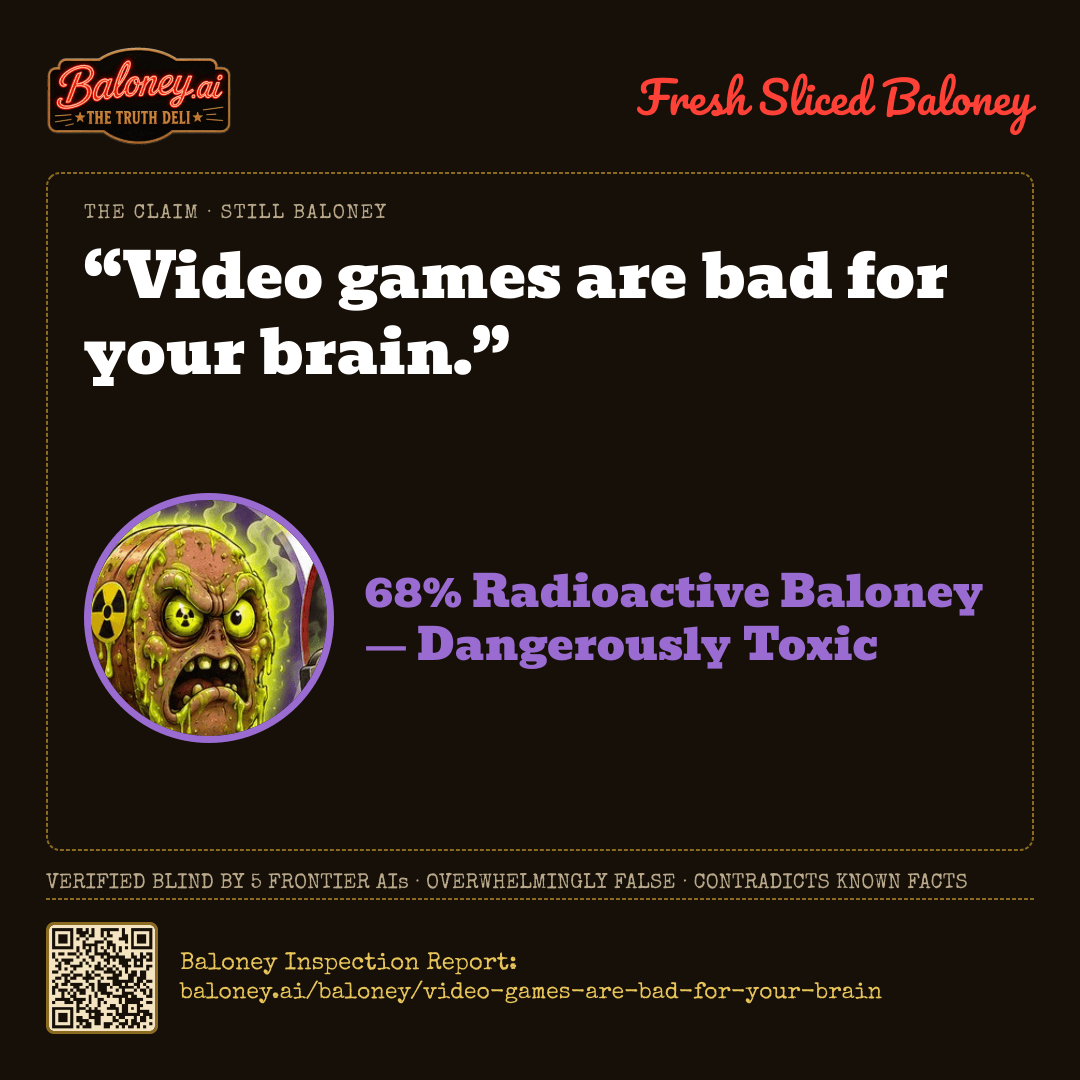
 “Video games are bad for your brain.”68% Radioactive Baloney — Dangerously ToxicVerified blind by 5 frontier AIs · Baloney Inspection Report: baloney.ai/baloney/video-games-are-bad-for-your-brain
The Baloney Sampler
The claim is too broad. The World Health Organization identifies gaming disorder as a serious problem for a minority whose gaming involves impaired control and significant disruption to daily functioning, while the reports found that excessive play can displace sleep, exercise, and other activities. Those risks concern problematic use, particular content, or vulnerable people—not video games generally.
The National Institutes of Health and JAMA Network Open reported that children who played at least three hours daily performed better on impulse-control and working-memory tasks, although the observational study cannot show that gaming caused the difference. American Psychological Association reviews likewise found benefits for selected skills, and neural changes may reflect learning or adaptation rather than damage.
Resting on World Health Organization · National Institutes of Health · JAMA Network Open · American Psychological Association
Original Claim Source https://www.apa.org/topics/video-games
Other ways to slice it — phrasings that might have changed the rating
- “Excessive or compulsive video-game use can harm some people’s health and functioning.” The reports support risks involving gaming disorder, impaired control, sleep displacement, and disruption of other activities, while limiting those risks to a minority or to problematic use.
- “Some violent video games may produce small, short-term increases in aggressive thoughts or behavior.” The reports describe small aggressive effects associated with some violent-game content but say evidence does not support claims about criminal or lethal violence.
- “How does playing video games for three or more hours a day relate to cognition in children?” The NIH and JAMA Network Open findings concerned children at that playtime threshold and reported better impulse-control and working-memory performance, while noting that the observational design does not establish causation.
Written from the panel’s reports by Perplexity · sonar-pro. Nothing here changed the score.
The Order Ticket
01:37:30CLAIM RECEIVED — QUEUED FOR INSPECTION✓
01:38:07claude-opus-5 REPORTED — SCORE 68, CONFIDENCE 86✓
01:38:04gpt-5.5 REPORTED — SCORE 58, CONFIDENCE 88✓
01:37:58gemini-3.1-pro-preview REPORTED — SCORE 99, CONFIDENCE 95✓
01:37:40sonar-pro REPORTED — SCORE 78, CONFIDENCE 93✓
01:39:08grok-4.6 REPORTED — SCORE 28, CONFIDENCE 72✓
01:39:34PRIMARY MASTER PERPLEXITY — SCORE 78✓
01:39:44BLIND VALIDATION GROK — SCORE 72✓
01:39:55AGREEMENT CONFIRMED — DELTA 10✓
01:39:55SCORING MODEL V2 — MEDIAN OF 5 COUNTED LAB SCORES: 68, 58, 99, 78, 28 → 68.✓
01:39:55SOURCE RULE — LABS CITED 33 SOURCES: 0 DISCARDED FOR HAVING NO URL, 2 DISCARDED AS DEAD LINKS (404/410), 13 COULD NOT BE OPENED BY US AND ARE MARKED UNVERIFIED.✓
01:39:55SOURCE RULE — PRIMARY MASTER RULED ON 20 SOURCES: 0 DISCARDED FOR HAVING NO URL, 0 DISCARDED AS DEAD LINKS, 7 MARKED UNVERIFIED, 13 VERIFIED.✓
How This One Was Sliced
Station 1 · Blind Inspection — Five Graders, Zero Peeking
Each lab scored the claim independently, without seeing the others. Open a breakdown for its evidence, its sources, and how sure it was.
Anthropic · EQUAL WEIGHT · 37.6s
claude-opus-5
68%BALONEY
ROUND-1 BREAKDOWN
Evidence offered for the claim- Gaming disorder is recognized as a diagnosable condition in WHO's ICD-11, indicating that for a minority of players, loss of control over gaming impairs personal, family, social, educational and occupational functioning.
- Neuroimaging reviews report that individuals with internet gaming disorder show structural and functional differences in reward-related and prefrontal control circuits resembling patterns seen in substance addictions, with some evidence of reduced impulse control.
- Excessive gaming displaces sleep, physical activity and study time; short sleep and sedentary behavior are independently associated with poorer cognitive and mental-health outcomes in children and adolescents.
- Some longitudinal work links very heavy screen/game use in youth with attention problems and depressive symptoms, though effect sizes are typically small and causality is contested.
- A minority of studies (e.g., work by West and colleagues on habitual action-shooter players using response-learning navigation strategies) has reported lower hippocampal grey matter in some player subgroups, suggesting effects are not uniformly positive.
Evidence against the claim- The claim is a blanket generalization; the research literature does not support 'video games' as a category being harmful to the brain, and most people who play show no adverse cognitive effects.
- A large NIH-funded ABCD Study analysis of ~2,000 children (published in JAMA Network Open, 2022) found that children who played video games 3+ hours per day performed BETTER than non-gamers on tasks of impulse control and working memory, with corresponding differences in brain activity.
- Classic experimental work (Green & Bavelier, Nature 2003) showed action video game play improves visual selective attention, and training studies show causal transfer to attentional and visuospatial skills.
- A randomized training study (Kühn et al., Molecular Psychiatry 2014) found that two months of Super Mario 64 play produced INCREASES in grey matter in the hippocampus, prefrontal cortex and cerebellum — the opposite of brain damage.
- Large-scale objective-playtime research (Oxford Internet Institute / Royal Society Open Science, 2021) found game time was slightly POSITIVELY associated with well-being, not negatively.
- The American Psychological Association's 2020 resolution states there is insufficient evidence to link violent video game use with criminal violence or delinquency, undercutting the strongest 'harm' framings.
- Harms that do exist are concentrated in a small share of players with compulsive/excessive use patterns; dose, content, and displacement — not gaming per se — drive the negative findings.
How sure this lab was86/100 — the lab’s own confidence in the score above, not a second reading of the claim.
SourcesNational Institutes of Healthgov · 96 · JAMA Network Open (Chaarani et al., 2022)journal · 94 · Nature (Green & Bavelier, 2003)journal · 93 · Molecular Psychiatry (Kühn et al., 2014)journal · 90 · World Health Organizationgov · 95 · Royal Society Open Science (Johannes, Vuorre & Przybylski, 2021)journal · 88 · American Psychological Associationother · 88 · Frontiers in Human Neuroscience (Palaus et al., 2017)journal · 80
OpenAI · EQUAL WEIGHT · 34.7s
gpt-5.5
58%BALONEY
ROUND-1 BREAKDOWN
Evidence offered for the claim- A narrower claim is supported for excessive or compulsive gaming: the World Health Organization recognizes gaming disorder as a pattern of impaired control, prioritizing gaming over other activities, and continuing despite negative consequences, causing significant impairment.
- The American Psychiatric Association lists Internet Gaming Disorder as a condition needing further study, describing symptoms such as preoccupation, withdrawal-like symptoms, loss of control, and jeopardizing relationships or opportunities because of gaming.
- Violent video games have been linked in APA reviews to small increases in aggressive behavior/cognitions and decreases in prosocial behavior, though APA also says evidence does not support claims that violent games cause criminal or lethal violence.
- For a small susceptible minority, flashing or patterned visual stimuli in games can trigger photosensitive seizures; this is a real neurological risk but not evidence that video games are generally harmful to all brains.
- Some epidemiological research associates problematic gaming with depression, anxiety, poorer sleep, and psychosomatic symptoms, but these findings mainly concern heavy/problematic use and often cannot prove that gaming caused the problems.
Evidence against the claim- The statement is overbroad: evidence does not show that video games as a category are bad for the brain. The strongest harms are tied to excessive/problematic use, particular content, or vulnerable individuals.
- NIH reported that in the ABCD study, children who played video games for 3 or more hours per day performed better on tests of impulse control and working memory than non-gamers; the authors cautioned that causation was not established.
- A JAMA Network Open study using brain imaging found video gaming was associated with better cognitive performance in children, not global brain harm.
- Controlled and meta-analytic research finds some games, especially action games, can improve aspects of visual attention, spatial cognition, and cognitive control.
- Research on older adults found a custom video-game training intervention improved multitasking and cognitive control, suggesting games can be used therapeutically or for cognitive training.
- Large-scale well-being studies using objective gameplay data have found little or no evidence that ordinary time spent playing games meaningfully worsens well-being.
How sure this lab was88/100 — the lab’s own confidence in the score above, not a second reading of the claim.
SourcesWorld Health Organizationgov · 92 · American Psychiatric Associationother · 86 · American Psychological Associationother · 85 · Cyberpsychology, Behavior, and Social Networkingjournal · 78 · National Institutes of Healthgov · 91 · JAMA Network Openjournal · 90 · Nature Neurosciencejournal · 89 · Psychological Bulletinjournal · 90 · Proceedings of the National Academy of Sciencesjournal · 89 · Royal Society Open Sciencejournal · 86
Google · EQUAL WEIGHT · 28.2s
gemini-3.1-pro-preview
99%BALONEY
ROUND-1 BREAKDOWN
Evidence offered for the claim- The World Health Organization (WHO) formally recognizes 'Gaming Disorder' as a clinical behavioral addiction. In cases of severe, compulsive gaming, the behavior can negatively impact the brain's reward pathways and neurotransmitter systems in ways similar to substance abuse.
- Excessive video gaming can lead to significant sleep displacement. Sleep deprivation is known to acutely impair cognitive function, memory consolidation, and executive control.
- Some longitudinal studies have raised concerns that excessive screen time and rapid-reward media consumption could be correlated with shorter attention spans in young children, though causality is complex and heavily debated.
Evidence against the claim- A massive 2022 neuroimaging study published in JAMA Network Open, supported by the NIH, analyzed nearly 2,000 children and found that video gamers performed significantly better on cognitive tests measuring impulse control and working memory compared to non-gamers.
- Decades of research aggregated by the American Psychological Association (APA) demonstrates that video games—particularly fast-paced action games—enhance cognitive skills such as spatial navigation, mental rotation, reasoning, and perception.
- Far from being inherently 'bad' for the brain, video games are actively used in neurological therapies. In 2020, the FDA authorized the marketing of EndeavorRx, the first prescription video game approved as a medical treatment to actively improve attention function in children with ADHD.
- Neuroplasticity research indicates that playing video games acts as a complex cognitive training exercise, with MRI studies often showing increased gray matter in areas of the brain responsible for fine motor skills, memory formulation, and strategic planning.
How sure this lab was95/100 — the lab’s own confidence in the score above, not a second reading of the claim.
SourcesJAMA Network Openjournal · 95 · National Institutes of Healthgov · 98 · American Psychological Associationother · 95 · World Health Organizationgov · 95
Perplexity · EQUAL WEIGHT · 10.0s
sonar-pro
78%BALONEY
ROUND-1 BREAKDOWN
Evidence offered for the claim- Some forms of video-game use are associated with potentially harmful brain and behavioral outcomes. A systematic review reported brain-structure and brain-function changes associated with gaming, including findings involving reward, impulse-control, and attention-related regions; it also noted that effects vary by game type and that effects in children remain unclear. https://pmc.ncbi.nlm.nih.gov/articles/PMC6826942/
- A systematic review of extensive gaming found structural and functional alterations in several brain regions among professional gamers and people with gaming disorder. These findings are associations and do not establish that ordinary gaming damages the brain. https://games.jmir.org/2021/3/e25793/
- Evidence for cognitive harm is limited and inconsistent: a meta-analysis of video-game interventions in older adults found only small significant effects for updating memory and no detectable effects for several other cognitive functions, with substantial heterogeneity across studies. https://www.tandfonline.com/doi/abs/10.1080/13607863.2019.1574710
Evidence against the claim- The statement is too broad because effects depend on factors such as game genre, amount of play, age, and whether gaming is recreational, therapeutic, or disordered. A systematic review concluded that video gaming can benefit the brain, although benefits vary by game type and effects in children were unclear. https://pmc.ncbi.nlm.nih.gov/articles/PMC6826942/
- A systematic review of adult studies found evidence that video-game training may improve processing speed, memory, task switching, visuospatial rotation, and emotional skills, especially in young adults. https://www.frontiersin.org/journals/psychology/articles/10.3389/fpsyg.2018.02127/full
- A 2022 NIH summary of an observational study of nearly 2,000 children reported that children who played at least three hours per day performed better on impulse-control and working-memory tests than children who reported no gaming; imaging also showed greater activity in attention- and memory-related regions. The study was correlational, so it cannot show that gaming caused the better performance. https://www.nih.gov/news-events/news-releases/video-gaming-may-be-associated-better-cognitive-performance-children
- A systematic review of neural studies found that gaming is associated with measurable neural changes, but such changes are not inherently harmful and may reflect learning or adaptation. The review included 116 articles, including studies of both functional and structural changes. https://www.frontiersin.org/journals/human-neuroscience/articles/10.3389/fnhum.2017.00248/full
How sure this lab was93/100 — the lab’s own confidence in the score above, not a second reading of the claim.
SourcesNational Library of Medicine / Frontiers in Human Neurosciencejournal · 93 · JMIR Serious Gamesjournal · 91 · Aging & Mental Health / Taylor & Francisjournal · 90 · Frontiers in Psychologyjournal · 91 · National Institutes of Healthgov · 96 · Frontiers in Human Neurosciencejournal · 92
xAI · EQUAL WEIGHT · 98.8s
grok-4.6
28%BALONEY
ROUND-1 BREAKDOWN
Evidence offered for the claim- WHO recognizes gaming disorder involving loss of control, gaming taking priority over other activities, and continued play despite harm, which can impair functioning and mental health.
- Some neuroimaging studies of people with internet/gaming disorder report differences in reward, impulse-control, and decision-making circuitry similar to other addictive behaviors.
- Very high amounts of play can displace sleep, exercise, and in-person interaction, which are important for brain health, especially in children and teens.
- A subset of research links heavy play of certain violent games to small, short-term increases in aggressive thoughts or physiological arousal (causation and lasting brain effects remain contested).
Evidence against the claim- Controlled studies (including a Super Mario 64 training experiment) have found increases in gray matter in regions tied to spatial navigation, memory, and planning after video-game play.
- Action and strategy games have repeatedly been associated with gains in visuospatial attention, processing speed, and cognitive flexibility rather than impairment.
- Reviews in psychology (e.g., Granic et al.) document benefits for problem-solving, motivation, and certain social-cognitive skills; games are also used in cognitive rehabilitation.
- Effects are strongly dose-, game-type-, and person-dependent; moderate play is often linked to neutral or positive cognitive outcomes, not general brain damage.
- The absolute claim ignores that sedentary time, sleep loss, or addiction—not video games as a category—are the main documented risks.
How sure this lab was72/100 — the lab’s own confidence in the score above, not a second reading of the claim.
SourcesWorld Health Organizationgov · 95 · Molecular Psychiatryjournal · 90 · American Psychological Associationjournal · 88
Station 2 · The Masters
Primary Master · drawn at random
sonar-pro
78% BALONEY
The statement is an absolute generalization. The panel consistently found that ordinary gaming can be neutral or beneficial for some cognitive abilities, while credible evidence supports narrower risks involving gaming disorder, excessive use, sleep displacement, certain content, and vulnerable individuals. WHO recognition of gaming disorder supports harm for a minority, not universal brain damage. Reviews report neural and cognitive changes, but these are heterogeneous, often correlational, and can reflect learning or adaptation rather than injury. The NIH/JAMA child study was observational and therefore cannot establish that gaming caused better performance, but it directly weighs against generalized harm. The strongest accepted evidence supports a conditional formulation—problematic or excessive gaming can be harmful—rather than the claim as written. I accepted the cited government, peer-reviewed, and professional-organization sources where they addressed the relevant population and outcome. I discounted no cited source entirely, but treated observational findings, neuroimaging associations, and older or heterogeneous reviews as limited evidence rather than definitive causal proof.
All five evaluators agreed that the blanket claim is too broad and that harms are concentrated in excessive, compulsive, content-specific, or otherwise vulnerable-use patterns. They also agreed that gaming can be associated with cognitive or neural benefits. Their disagreement concerned severity: Reports 1 and 2 emphasized the evidence against the claim and assigned high scores, Reports 3 and 5 judged the claim substantially misleading and assigned low scores, and Report 4 took the middle position. They differed mainly in how much weight to give gaming-disorder research, sleep displacement, violent-game effects, and the distinction between neural change and brain damage.
Blind Validation Master · never saw the Primary’s work
grok-4.6
72% BALONEY
The claim is an absolute generalization that the presented evidence contradicts. Multiple high-quality sources (JAMA Network Open/ABCD ~2,000 children; NIH summary; APA reviews; Green & Bavelier; Kühn Super Mario gray-matter RCT; FDA-authorized EndeavorRx) show ordinary and even substantial play associated with better impulse control, working memory, visuospatial attention, processing speed, and increased gray matter in relevant regions—not global brain harm. Documented downsides (WHO gaming disorder, reward-circuit differences, sleep/exercise displacement, small contested attention or aggression effects) are concentrated in a minority with compulsive/excessive use or specific content, not video games as a category. Neural changes are often learning/adaptation rather than damage. The statement as written is therefore overwhelmingly false.
AGREEMENT TEST PASSED — MASTERS SCORED 78% AND 72% · BLIND VALIDATION CONFIRMED THIS SCORE · NO RE-EVALUATION REQUIRED
How the number was reached · scoring model v2 · how our models work
- Median of 5 counted lab scores: 68, 58, 99, 78, 28 → 68.
The Evidence
Evidence offered for the claim
- Gaming disorder can impair functioning WHO recognizes gaming disorder as impaired control over gaming, prioritizing it over other activities, and continuing despite negative consequences. The condition can harm personal, family, social, educational, or occupational functioning, but it applies to a minority with disordered use rather than to video games generally.
- Excessive play can displace sleep and activity Very heavy gaming can displace sleep, exercise, study, and in-person interaction. Sleep deprivation and sedentary behavior are associated with poorer cognitive and mental-health outcomes, but these risks arise from excessive use and displacement rather than from gaming as a category.
- Some gaming-related neural differences are associated with problematic use Reviews report structural and functional differences in reward, attention, impulse-control, and decision-making circuits among people with internet-gaming disorder or extensive gaming. These findings are mainly associations and do not establish that ordinary gaming damages the brain.
- Some violent games are linked to small aggressive outcomes APA reviews report small associations between violent-game use and aggressive thoughts or behaviors, while finding insufficient evidence for causal links to criminal violence, delinquency, or lethal violence. This concerns particular content and outcomes, not general brain damage.
- Photosensitive seizures affect a susceptible minority Flashing or patterned visual stimuli in games can trigger seizures in susceptible people. This is a specific neurological risk and does not support the claim that video games are broadly harmful to all brains.
- Heavy screen or game use has been linked with attention and mood problems Some longitudinal and epidemiological research links very heavy use with attention problems, depression, anxiety, poorer sleep, or psychosomatic symptoms. Reported effects are generally limited or contested, and causality is unclear.
Evidence against the claim
- The claim wrongly treats all gaming as harmful Effects vary by genre, dose, age, player characteristics, and whether use is recreational, therapeutic, or disordered. The panel found no basis for treating video games as a single category that is inherently bad for the brain.
- Some games improve cognitive skills Controlled studies and reviews associate action, strategy, and other games with improvements in visual attention, processing speed, visuospatial ability, task switching, working memory, reasoning, and cognitive flexibility. Effects are not uniform, but the evidence contradicts universal impairment.
- Gaming is associated with measurable neural adaptation Neuroimaging reviews report changes in gray matter, brain activity, and functional connectivity associated with gaming. In training studies, some changes accompanied improved performance, indicating that neural change is not synonymous with injury.
- The NIH/JAMA child study found better test performance among frequent players A 2022 analysis of nearly 2,000 children reported better impulse-control and working-memory performance among those playing at least three hours daily than among non-gamers, alongside differences in attention- and memory-related brain activity. Because the study was observational, it cannot show that gaming caused the advantage.
- Video games can be therapeutic or used for cognitive training The panel cited FDA authorization of EndeavorRx for improving attention in children with ADHD, cognitive-rehabilitation applications, and training studies reporting gains in attention, multitasking, processing speed, memory, or visuospatial skills.
- Objective-playtime research found little evidence of ordinary gaming harming well-being Large-scale research using objective gameplay data reported little or no meaningful deterioration in well-being from ordinary gaming time, with one cited study finding a slight positive association.
Sources · Reliability · Why Accepted or Discounted
| Source | Type | Reliability | Ruling |
|---|
| JAMA Network Openunverified | journal | 95 | ACCEPTED — Peer-reviewed study directly relevant to children’s gaming, cognition, and brain imaging; its observational design requires cautious causal interpretation. |
| National Institutes of Healthunverified | gov | 98 | ACCEPTED — Government summary of the relevant child study and its limitations; useful for reporting the association without treating it as causal. |
| American Psychological Association | other | 95 | ACCEPTED — Professional-organization summary supporting cognitive benefits, though broad claims are appropriately limited to particular games and skills. |
| World Health Organization | gov | 95 | ACCEPTED — Authoritative source for the clinical definition and functional impairment associated with gaming disorder. |
| National Library of Medicine / Frontiers in Human Neuroscience | journal | 93 | ACCEPTED — Systematic review directly addressing brain structure and function; its findings support heterogeneous effects and explicitly caution that child effects remain unclear. |
| JMIR Serious Games | journal | 91 | ACCEPTED — Systematic review relevant to structural and functional findings in extensive or disordered gaming; associations are not proof of damage. |
| Aging & Mental Health / Taylor & Francisunverified | journal | 90 | ACCEPTED — Meta-analysis relevant to cognitive interventions in older adults; heterogeneous and modest effects limit generalization. |
| Frontiers in Psychology | journal | 91 | ACCEPTED — Systematic review supporting benefits in processing, memory, task switching, spatial skills, and emotional skills, while allowing for variation across studies. |
| Frontiers in Human Neuroscience | journal | 92 | ACCEPTED — Systematic neural review documenting both structural and functional changes and their links with attention, cognitive control, visuospatial skills, and reward processing. |
| World Health Organization | gov | 92 | ACCEPTED — Authoritative clarification of gaming disorder as a condition involving impaired control and significant functional impairment. |
| American Psychiatric Association | other | 86 | ACCEPTED — Professional source describing Internet Gaming Disorder symptoms and its status as a condition requiring further study. |
| American Psychological Association | other | 85 | ACCEPTED — Relevant professional policy distinguishing small aggressive outcomes from unsupported claims about criminal or lethal violence. |
| Cyberpsychology, Behavior, and Social Networkingunverified | journal | 78 | ACCEPTED — Peer-reviewed source cited for problematic-gaming associations, but older evidence and correlational limits reduce its weight. |
| Nature Neuroscience | journal | 89 | ACCEPTED — Peer-reviewed training research relevant to cognitive and attentional effects of gaming. |
| Psychological Bulletinunverified | journal | 90 | ACCEPTED — High-level review or meta-analytic evidence relevant to video-game cognitive effects, though outcomes depend on task and game type. |
| Proceedings of the National Academy of Sciencesunverified | journal | 89 | ACCEPTED — Peer-reviewed intervention evidence relevant to cognitive training and control outcomes. |
| Royal Society Open Scienceunverified | journal | 86 | ACCEPTED — Large-scale well-being research using objective gameplay data; relevant to ordinary play, though observational associations remain limited. |
| Molecular Psychiatry | journal | 90 | ACCEPTED — Controlled training study cited for gray-matter increases following Super Mario 64 play; relevant evidence that neural change can accompany training rather than damage. |
| American Psychological Association | other | 88 | ACCEPTED — Duplicate citation of the APA resolution; retained because the evaluator supplied it and it supports the limited conclusion about violent-game effects. |
| Frontiers in Human Neuroscience | journal | 80 | ACCEPTED — Duplicate or alternate URL for the cited neural systematic review; retained exactly as supplied and interpreted with the review’s methodological limitations. |
Every link was opened when this claim was inspected. A dead link was discarded before publication; “unverified” means the site refused our automated check and the link is the one the panel cited. A source without a URL was never kept.
Serve It Fresh
Ready to Serve13 servings
Serve it the way you want it
The Verdict
“Video games are bad for your brain.”68% Radioactive Baloney — Dangerously ToxicVerified blind by 5 frontier AIs · Baloney Inspection Report: baloney.ai/baloney/video-games-are-bad-for-your-brain