Baloney Inspection Report: Claim #1176 · Inspected Oct 31, 2026, 8:15 AM PDT · Scoring model v2
 49%
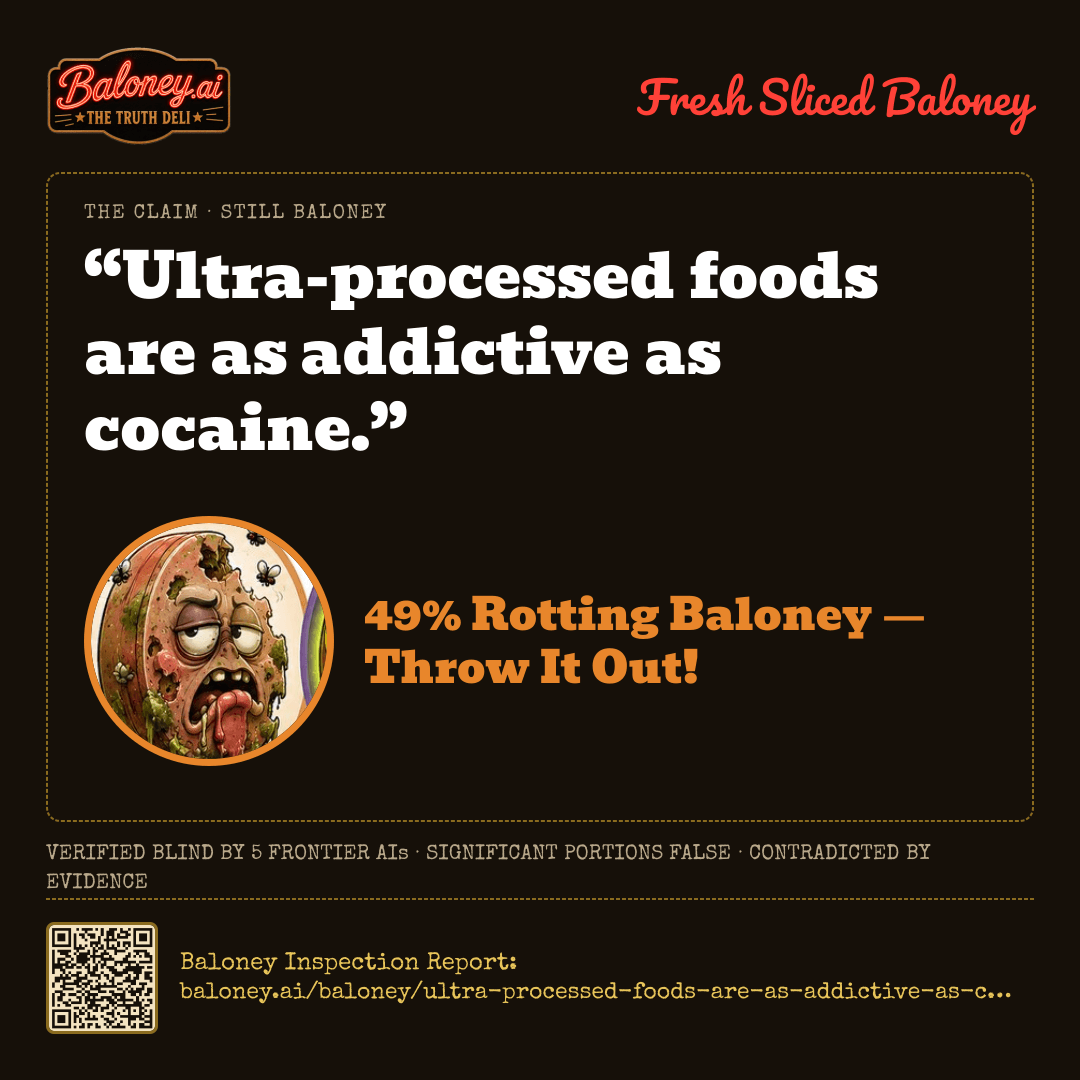
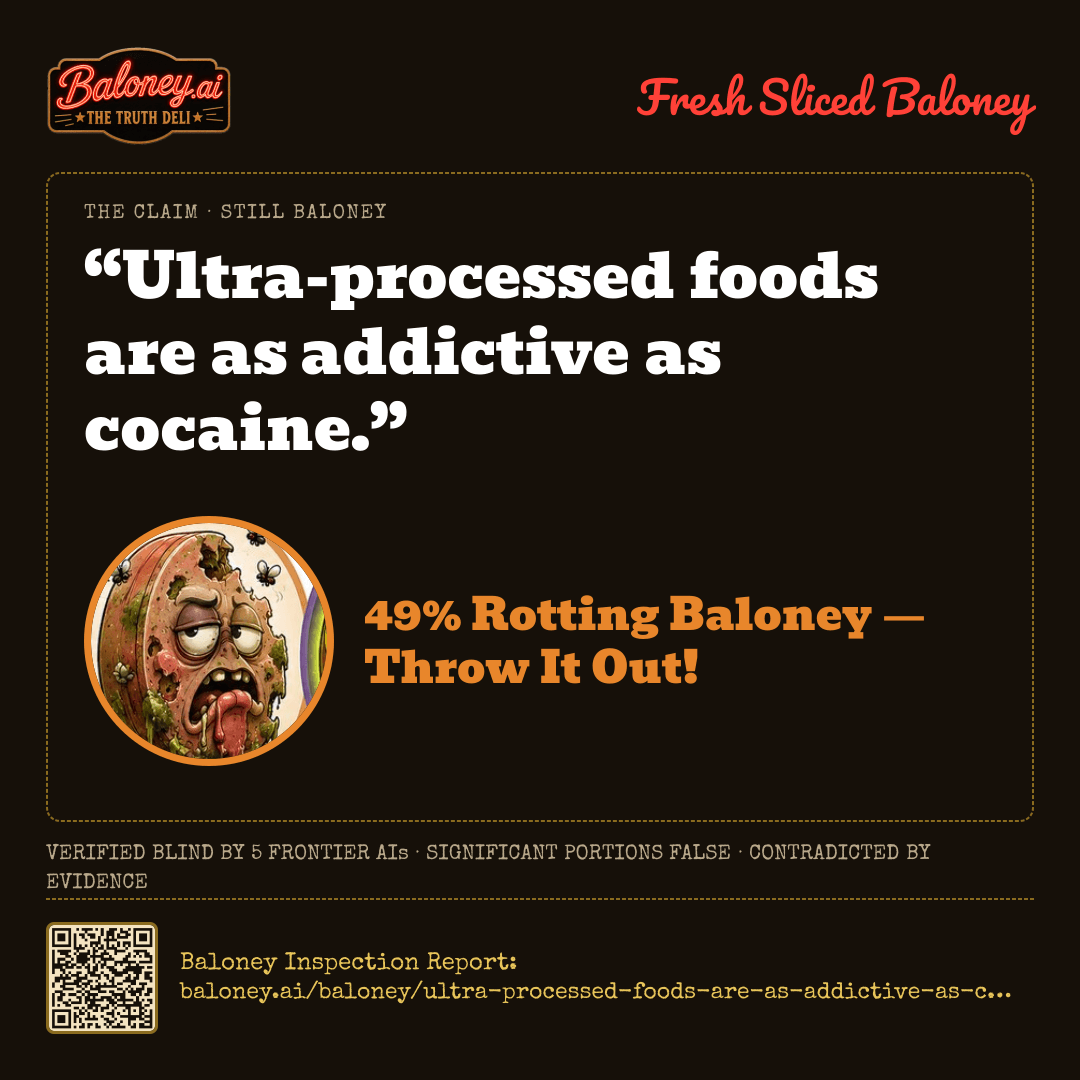
“Ultra-processed foods are as addictive as cocaine.”
49%Rotting Baloney — Throw It Out!
Most of this claim has spoiled.
Significant portions falseContradicted by evidenceUnsupported assertionsDeceptive narrative
Serve It Fresh
Ready to Serve19 servings
Serve it the way you want it
The Verdict
 “Ultra-processed foods are as addictive as cocaine.”49% Rotting Baloney — Throw It Out!Verified blind by 5 frontier AIs · Baloney Inspection Report: baloney.ai/baloney/ultra-processed-foods-are-as-addictive-as-cocaine
The Baloney Sampler
No study has ever measured ultra-processed foods and cocaine on a common human scale of addictiveness, so the equivalence has no direct support. The BMJ analysis most often cited for food addiction benchmarks these foods against tobacco, not cocaine, and a BMJ rapid response rejects the cocaine comparison outright, noting those drugs produce dopamine increases of roughly 300-1000%. The National Institute on Drug Abuse documents cocaine's intoxication, overdose risk and withdrawal; the American Psychiatric Association recognises cocaine use disorder, while food addiction is not a recognised diagnosis.
The softer version of the claim is real science. The BMJ analysis estimates addictive-like eating in about 14% of adults and 12% of children on the Yale Food Addiction Scale, and Cell Metabolism's controlled feeding trial, summarised by the National Institutes of Health, found people ate about 500 extra calories a day on an ultra-processed diet. The famous rat study in PLOS ONE used non-caloric saccharin water under restricted access, not ultra-processed food, and is routinely over-extended.
Resting on The BMJ · National Institute on Drug Abuse · Cell Metabolism (Hall et al., 2019) · PLOS ONE (Lenoir et al., 2007)
Original Claim Source https://www.reddit.com/r/Zepbound/comments/1uq0d0m/some_ultraprocessed_foods_are_as_addictive_as/
Other ways to slice it — phrasings that might have changed the rating
- “Some ultra-processed foods high in refined carbohydrates and fat can produce addiction-like eating in a minority of people.” All five reports accept this narrower proposition, supported by Yale Food Addiction Scale findings of roughly 14% of adults and 12% of children.
- “Ultra-processed foods meet the same scientific criteria used to classify tobacco as addictive.” This is the comparison Gearhardt and DiFeliceantonio actually make in The BMJ, and the University of Michigan piece from the same group also uses smoking rather than cocaine.
- “In a 2007 experiment, most rats offered a choice between intravenous cocaine and sweetened water chose the sweet taste.” This restates the Lenoir PLOS ONE finding accurately as saccharin preference in rats under restricted access, rather than extending it to ultra-processed foods in humans.
Written from the panel’s reports by Anthropic · claude-opus-5. Nothing here changed the score.
The Order Ticket
15:15:12CLAIM RECEIVED — QUEUED FOR INSPECTION✓
15:16:07claude-opus-5 REPORTED — SCORE 55, CONFIDENCE 80✓
15:15:40gpt-5.5 REPORTED — SCORE 49, CONFIDENCE 86✓
15:15:42gemini-3.1-pro-preview REPORTED — SCORE 45, CONFIDENCE 95✓
15:15:18sonar-pro REPORTED — SCORE 73, CONFIDENCE 91✓
15:17:39grok-4.6 REPORTED — SCORE 27, CONFIDENCE 78✓
15:19:25PRIMARY MASTER CLAUDE — SCORE 66✓
15:17:50BLIND VALIDATION CHATGPT — SCORE 58✓
15:19:42AGREEMENT MODERATE DISAGREEMENT — DELTA 17✓
15:19:42SCORING MODEL V2 — MEDIAN OF 5 COUNTED LAB SCORES: 55, 49, 45, 73, 27 → 49.✓
15:19:42SOURCE RULE — LABS CITED 27 SOURCES: 0 DISCARDED FOR HAVING NO URL, 0 DISCARDED AS DEAD LINKS (404/410), 8 COULD NOT BE OPENED BY US AND ARE MARKED UNVERIFIED.✓
15:19:42SOURCE RULE — PRIMARY MASTER RULED ON 20 SOURCES: 0 DISCARDED FOR HAVING NO URL, 0 DISCARDED AS DEAD LINKS, 6 MARKED UNVERIFIED, 14 VERIFIED.✓
How This One Was Sliced
Station 1 · Blind Inspection — Five Graders, Zero Peeking
Each lab scored the claim independently, without seeing the others. Open a breakdown for its evidence, its sources, and how sure it was.
Anthropic · EQUAL WEIGHT · 54.3s
claude-opus-5
55%BALONEY
ROUND-1 BREAKDOWN
Evidence offered for the claim- A 2023 BMJ analysis by Gearhardt and DiFeliceantonio argued that ultra-processed foods (UPFs) high in refined carbohydrates plus fat meet the standard criteria used to classify a substance as addictive — they deliver rapid, unnaturally high doses of reinforcing agents to the brain, trigger strong cravings and compulsive use, and are consumed despite harm — and estimated roughly 14% of adults and 12% of children show addictive-like consumption on the Yale Food Addiction Scale, a prevalence comparable to that of alcohol or tobacco use disorder in adults.
- Animal work provides the most-cited basis for the cocaine comparison: Lenoir et al. (PLoS ONE, 2007) found that the large majority of rats offered a choice between intravenous cocaine and sweetened (saccharin or sucrose) water chose the sweet taste, including rats already sensitized or dependent on cocaine.
- Neuroimaging and preclinical studies show that palatable, energy-dense foods engage the same mesolimbic dopamine/reward circuitry (nucleus accumbens, striatal D2 receptor changes) implicated in drug addiction, which underpins the 'food addiction' construct.
- Controlled feeding research (Hall et al., Cell Metabolism, 2019) showed people ate ~500 kcal/day more on an ultra-processed diet than on a matched unprocessed diet and gained weight, demonstrating that UPFs drive overconsumption beyond conscious intent — consistent with, though not proof of, addictive properties.
Evidence against the claim- The BMJ authors' own comparison is to tobacco, not cocaine; no peer-reviewed study has measured UPF and cocaine addictiveness on a common human scale, so a claim of equivalence has no direct empirical support.
- Pharmacologically, cocaine is a direct monoamine-reuptake blocker producing an acute intoxicating dopamine surge far larger and faster than any food response; UPFs produce no intoxication, no comparable overdose/lethality risk, and no well-established physiological withdrawal syndrome in humans.
- 'Food addiction' is not a recognized diagnosis in DSM-5 or ICD-11 (only binge-eating disorder is), whereas cocaine use disorder is an established, extensively validated diagnosis. Instruments like the YFAS measure addictive-like behavior, not a formally accepted disorder.
- Prominent critics (Ziauddeen, Farooqi & Fletcher, Nature Reviews Neuroscience 2012; Fletcher & Kenny, Neuropsychopharmacology 2018; Westwater et al., European Journal of Nutrition 2016) conclude the human evidence for substance-style addiction to food or sugar is weak, that overlapping reward circuitry is expected for any natural reinforcer, and that the behavioral pattern may better fit a behavioral/eating disorder model.
- The rat studies most often invoked used intensely sweet solutions (often non-caloric saccharin), not ultra-processed foods, and involved limited cocaine doses and delivery schedules; they do not establish that UPFs rival cocaine's dependence liability in humans.
- Expert drug-harm rankings (e.g., Nutt et al., The Lancet 2007) place cocaine among the substances with the highest dependence liability; nothing comparable has been demonstrated for food, and most people who eat UPFs daily do not develop compulsive-use pathology.
How sure this lab was80/100 — the lab’s own confidence in the score above, not a second reading of the claim.
SourcesThe BMJ (Gearhardt & DiFeliceantonio, 2023)journal · 92 · PLOS ONE (Lenoir et al., 2007)journal · 80 · Nature Reviews Neuroscience (Ziauddeen, Farooqi & Fletcher, 2012)journal · 93 · Neuropsychopharmacology (Fletcher & Kenny, 2018)journal · 90 · European Journal of Nutrition (Westwater, Fletcher & Ziauddeen, 2016)journal · 85 · Cell Metabolism (Hall et al., 2019, NIH)journal · 92 · National Institute on Drug Abuse (NIH)gov · 95 · The Lancet (Nutt et al., 2007)journal · 88
OpenAI · EQUAL WEIGHT · 27.4s
gpt-5.5
49%BALONEY
ROUND-1 BREAKDOWN
Evidence offered for the claim- Some peer-reviewed researchers argue that many ultra-processed foods—especially products high in rapidly absorbed refined carbohydrates and added fats—can produce addiction-like patterns in some people, including cravings, impaired control, continued use despite harm, and relapse-like behavior. A 2023 BMJ analysis estimated ultra-processed food addiction at about 14% of adults and 12% of children using Yale Food Addiction Scale criteria.
- A PLOS ONE study found that foods rated as more processed, higher in fat, and higher in glycemic load were more strongly associated with addictive-like eating reports, supporting the idea that not all foods are equally implicated.
- Animal research sometimes cited in support of the cocaine comparison found that intense sweetness could surpass cocaine reward in rats. This supports the narrower claim that sweet taste can be highly reinforcing in animal models, but it does not prove that ultra-processed foods are equally addictive to cocaine in humans.
Evidence against the claim- The statement says ultra-processed foods are “as addictive as cocaine,” which implies a demonstrated equivalence in addictive potential. That equivalence has not been established in human clinical evidence. Cocaine is a pharmacologically active stimulant with well-characterized addictive effects; ultra-processed foods are heterogeneous products, not a single drug-like substance.
- Food addiction or ultra-processed food addiction is not currently recognized as a formal substance-use disorder in the way cocaine/stimulant use disorder is recognized. The Yale Food Addiction Scale measures addiction-like eating symptoms, but it is not the same as proving that foods have cocaine-level addictive liability.
- Reviews skeptical of the food-addiction framing argue that evidence is stronger for addictive-like eating behavior than for a specific addictive substance in food. Unlike cocaine, food is necessary for survival, and the boundary between high palatability, compulsive eating, binge-eating disorder, and substance addiction remains scientifically contested.
- The rat sweetness-versus-cocaine finding is often overextended. It involved controlled animal models and sweet solutions, not real-world ultra-processed foods, human addiction rates, withdrawal syndromes, dose-response toxicity, or direct comparison with cocaine dependence in people.
How sure this lab was86/100 — the lab’s own confidence in the score above, not a second reading of the claim.
SourcesBMJjournal · 90 · PLOS ONEjournal · 83 · PLOS ONEjournal · 82 · National Institute on Drug Abusegov · 95 · American Psychiatric Associationother · 86 · Obesity Reviews / PubMedjournal · 82 · Neuroscience & Biobehavioral Reviews / PubMedjournal · 82 · National Institutes of Healthgov · 94
Google · EQUAL WEIGHT · 29.6s
gemini-3.1-pro-preview
45%BALONEY
ROUND-1 BREAKDOWN
Evidence offered for the claim- Ultra-processed foods (UPFs), particularly those high in refined carbohydrates and added fats, stimulate the brain's dopamine reward system in a manner similar to addictive substances.
- The claim often stems from a heavily publicized 2007 animal study published in PLOS One, which found that rats given a choice between sweet water and intravenous cocaine overwhelmingly preferred the intense sweetness, popularizing the narrative that sugar is more addictive than cocaine.
- A 2023 analysis published in The BMJ argued that UPFs meet the established scientific criteria for addiction, estimating that 14% of adults exhibit addictive eating behaviors toward these foods (a rate comparable to tobacco addiction).
Evidence against the claim- Major psychiatric and diagnostic guidelines, including the DSM-5, do not recognize 'food addiction' as a clinical diagnosis, drawing a line between compulsive eating behaviors and true substance use disorders.
- Neuroscientists and behavioral experts note that animal studies showing sugar preference over cocaine rely on strict intermittent fasting protocols; when rats have continuous, free access to sugar, the severe addiction-like behaviors and neurochemical changes do not manifest.
- Equating food to cocaine creates a false equivalence that ignores the profound pharmacological toxicity, extreme physiological withdrawal symptoms, and acute life-destroying behavioral disruptions uniquely caused by illicit drugs.
How sure this lab was95/100 — the lab’s own confidence in the score above, not a second reading of the claim.
SourcesThe BMJjournal · 95 · PLOS Onejournal · 85 · European Journal of Nutrition / PubMed Centraljournal · 95
Perplexity · EQUAL WEIGHT · 5.7s
sonar-pro
73%BALONEY
ROUND-1 BREAKDOWN
Evidence offered for the claim- Some ultra-processed foods can produce addiction-like patterns—craving, loss of control, compulsive consumption, and continued use despite harm—measured using the Yale Food Addiction Scale. A BMJ-linked analysis of 281 studies estimated clinically significant food-addiction symptoms in about 14% of adults and 12% of children, though this is not equivalent to proving cocaine-level pharmacological addiction.[4]
- A peer-reviewed review reports that highly processed foods may engage reward, craving, and impulse-control mechanisms that overlap with substance-use disorders, particularly when foods combine refined carbohydrates and fat and are rapidly absorbed.[5]
- The comparison has some behavioral plausibility: both drug addiction and food addiction can involve craving, impaired control, and persistent use despite adverse consequences. However, behavioral similarity does not establish equal addictive potency or biological equivalence.[5]
Evidence against the claim- The claim says ultra-processed foods are as addictive as cocaine, but available evidence generally concerns addiction-like eating or a proposed food-addiction construct—not a head-to-head demonstration that UPFs produce cocaine-equivalent dependence, reinforcement, withdrawal, or harm.[5][6]
- A peer-reviewed commentary explicitly rejects comparing these foods directly with cocaine or amphetamine, noting that those drugs produce much larger dopamine increases; the cited estimate was roughly 300%-1000%.[3]
- Food addiction is not currently an official psychiatric diagnosis, and the Yale Food Addiction Scale applies substance-use-disorder criteria to eating behavior; a positive score therefore indicates clinically significant symptoms, not proof that a food is pharmacologically equivalent to cocaine.[4][6]
- Ultra-processed food is a broad category that includes nutritionally and pharmacologically diverse products. Evidence suggesting higher addictive potential for some foods—especially highly rewarding foods rich in refined carbohydrate and fat—cannot validly be generalized to every ultra-processed food.[5]
- The strongest evidence is largely observational, self-reported, or based on animal and mechanistic research, which limits causal conclusions and direct comparisons with cocaine.[2][5]
How sure this lab was91/100 — the lab’s own confidence in the score above, not a second reading of the claim.
SourcesBMJjournal · 94 · National Institutes of Health / Current Neuropharmacologyjournal · 91 · University of Michiganedu · 88 · McGill University Office for Science and Societyedu · 83 · Springer Nature / Current Addiction Reportsjournal · 70
xAI · EQUAL WEIGHT · 147.0s
grok-4.6
27%BALONEY
ROUND-1 BREAKDOWN
Evidence offered for the claim- A 2007 rat study found intense sweetness (saccharin) was preferred over cocaine, showing highly palatable substances can outcompete cocaine in some reward paradigms.
- Highly processed foods rich in fat, sugar, and salt can activate overlapping dopamine/reward circuitry and are more strongly linked to addiction-like eating (craving, loss of control) than minimally processed foods on tools such as the Yale Food Addiction Scale.
- Some addiction researchers argue ultra-processed foods meet formal scientific criteria for addictive substances due to rapid nutrient delivery, hyper-palatability, and compulsive use in a subset of people.
Evidence against the claim- Cocaine is a potent pharmacological stimulant with high addiction liability, rapid dependence, severe withdrawal, overdose risk, and DSM-recognized cocaine use disorder; ultra-processed foods do not produce equivalent clinical, pharmacological, or population-level effects.
- Food addiction is not an official substance-use diagnosis in DSM-5 or ICD; most people regularly eat ultra-processed foods without developing cocaine-comparable compulsive disorders.
- Headline comparisons typically over-interpret limited animal preference studies and do not establish equal addictiveness, potency, or harm in humans.
- Prevalence of clinically significant food-addiction scores is far lower than would be expected if ultra-processed foods matched cocaine’s addiction potential.
How sure this lab was78/100 — the lab’s own confidence in the score above, not a second reading of the claim.
SourcesPLOS ONEjournal · 88 · PLOS ONEjournal · 88 · Harvard T.H. Chan School of Public Healthedu · 90
Station 2 · The Masters
Primary Master · drawn at random
claude-opus-5
66% BALONEY
The statement makes a specific comparative claim — equivalence of addictive potential between ultra-processed foods (UPFs) and cocaine — and that equivalence is the thing being scored, not the weaker and better-supported proposition that some UPFs can be consumed in addiction-like ways. On that specific point all five evaluators, including the two most favourable, agreed that no study has ever measured UPF and cocaine addictiveness on a common human scale. The researchers most associated with the UPF-addiction case (Gearhardt and DiFeliceantonio, BMJ 2023) explicitly benchmark UPFs against tobacco, not cocaine, and a BMJ rapid response cited by one evaluator rejects the cocaine/amphetamine comparison outright on the grounds that those drugs produce dopamine increases of roughly 300-1000%, far beyond any food response. Against the claim stand a recognised DSM-5/ICD-11 diagnosis for cocaine use disorder versus no recognised food-addiction diagnosis; cocaine's acute intoxication, overdose lethality and withdrawal syndrome, none of which UPFs produce; and the fact that UPFs are a heterogeneous food category rather than a single pharmacological agent. The single most-quoted prop for the claim — Lenoir et al.'s 2007 rats preferring saccharin water to intravenous cocaine — used a non-caloric sweet solution under restricted access schedules, not ultra-processed food, and three evaluators independently flagged it as routinely over-extended. I weighted the pharmacology and diagnostic-status evidence most heavily because the claim is an equivalence claim and those are the dimensions on which equivalence would have to be shown. I did not push the score to the top of the band because there is a genuine, live scientific literature behind the softer version of the claim: YFAS-measured addictive-like eating at ~14% of adults, overlapping mesolimbic reward activation, and Hall et al.'s controlled feeding trial showing ~500 kcal/day of extra intake on a UPF diet. The claim is therefore not a fabrication; it is a real finding inflated into a false equivalence that also trivialises cocaine dependence, which is where the harm potential lies. I scored above the panel median (49) because the three mid-range evaluators were effectively scoring the defensible paraphrase rather than the sentence as written; Report 2's 27 in particular is hard to reconcile with its own list of counter-evidence.
All five evaluators agreed on the substance: some ultra-processed foods — particularly those combining rapidly absorbed refined carbohydrate with fat — produce addiction-like eating in a minority of people; 'food addiction' is not a recognised DSM-5 or ICD-11 diagnosis; the Lenoir 2007 rat study is the origin of the cocaine comparison and does not support it; and no head-to-head human comparison of UPF and cocaine addictiveness exists. They disagreed sharply on how much credit the claim deserves for its defensible core: one scored it 73 (radioactive), one 27 (stinky), with three clustered at 45-55, a spread that reflects whether the evaluator judged the literal word 'cocaine' or the looser 'UPFs can be addictive' reading. All five nonetheless rejected the equivalence as stated.
Blind Validation Master · never saw the Primary’s work
gpt-5.5
58% BALONEY
The evidence supports a narrower claim: some ultra-processed foods, especially those high in refined carbohydrates and fats, can produce addiction-like eating patterns in a subset of people, and they engage reward/craving circuitry also involved in substance use disorders. Yale Food Addiction Scale studies and the 2023 BMJ analysis give this idea some empirical basis. However, the statement as written makes a much stronger equivalence claim: that ultra-processed foods are as addictive as cocaine. The reports show no direct human evidence comparing UPFs and cocaine on a common addiction-liability scale. Cocaine is a potent pharmacological stimulant with a recognized DSM substance-use disorder, acute intoxication, strong dopamine effects, dependence liability, and serious toxicity; food addiction is not an official diagnosis and is often measured via behavioral self-report tools. The rat studies often cited involved sweet solutions, not real-world UPFs, and do not establish cocaine-level addictiveness in humans. UPFs are also a broad, heterogeneous category. So the claim contains a kernel of truth about addiction-like eating but substantially overstates the evidence and creates a misleading cocaine equivalence.
AI EVALUATORS SHOWED MODERATE DISAGREEMENT — MASTERS SCORED 66% AND 58% · REVIEW THE EVIDENCE CAREFULLY
How the number was reached · scoring model v2 · how our models work
- Median of 5 counted lab scores: 55, 49, 45, 73, 27 → 49.
The Evidence
Evidence offered for the claim
- Rats chose sweetness over cocaine DEBUNKED — Lenoir et al. (PLOS ONE, 2007) found most rats offered a choice between intravenous cocaine and sweetened water took the sweet taste, including cocaine-sensitised rats. REFUTED as support for this claim: the solution was usually non-caloric saccharin, not ultra-processed food, the cocaine doses and delivery schedules were limited, and evaluators noted the addiction-like effects largely disappear when rats have continuous rather than intermittent access.
- UPFs meet addiction criteria, say some researchers A 2023 BMJ analysis argued UPFs high in refined carbohydrate plus fat deliver rapid, unnaturally high doses of reinforcing agents, trigger craving and compulsive use, and are consumed despite harm — estimating addictive-like consumption in about 14% of adults and 12% of children on the Yale Food Addiction Scale. The authors' own benchmark, however, is tobacco and alcohol, not cocaine.
- Shared brain reward circuitry DEBUNKED — Neuroimaging and preclinical work show palatable energy-dense foods engage the same mesolimbic dopamine pathways (nucleus accumbens, striatal D2 changes) implicated in drug addiction. REFUTED as evidence of equivalence: critics including Ziauddeen, Farooqi & Fletcher note that any natural reinforcer engages this circuitry, and a BMJ rapid response records that cocaine and amphetamine raise dopamine by roughly 300-1000%, far beyond any food response.
- UPF diets drive measurable overeating Hall et al. (Cell Metabolism, 2019; NIH) found people ate about 500 kcal/day more and gained weight on an ultra-processed diet than on a calorie- and nutrient-matched unprocessed diet, showing UPFs drive consumption beyond conscious intent — consistent with, but not proof of, addictive properties.
Evidence against the claim
- No head-to-head comparison exists No peer-reviewed study has measured ultra-processed food and cocaine addictiveness on a common human scale, so an equivalence claim has no direct empirical support of any kind.
- Pharmacologically nothing alike Cocaine is a direct monoamine-reuptake blocker producing acute intoxication, overdose and lethality risk, and a well-characterised dependence syndrome. Ultra-processed foods produce no intoxication, no comparable overdose risk, and no established physiological withdrawal syndrome in humans.
- Only one of the two is a diagnosis Cocaine use disorder is an established, extensively validated DSM-5 diagnosis. 'Food addiction' appears in neither DSM-5 nor ICD-11; the Yale Food Addiction Scale applies substance-use criteria to eating and measures addiction-like symptoms, not a recognised disorder.
- Even the pro-addiction camp says tobacco, not cocaine The BMJ authors who argue UPFs qualify as addictive explicitly benchmark the ~14% prevalence against tobacco and alcohol use disorder. A BMJ rapid response rejects the cocaine and amphetamine comparison directly, citing those drugs' far larger dopamine surges.
- 'Ultra-processed' is not one substance The category spans nutritionally and pharmacologically diverse products. Evidence of addictive potential attaches to a subset — high glycaemic load plus fat, rapidly absorbed — and cannot be generalised to every ultra-processed food, unlike a single defined drug.
- Dependence liability is not comparable Expert drug-harm rankings place cocaine among the substances with the highest dependence liability; nothing comparable has been shown for food. Most people eat ultra-processed foods daily without developing compulsive-use pathology, and clinically significant food-addiction scores remain far below what cocaine-level liability would predict.
- Contested even as a behavioural model Reviews by Ziauddeen, Farooqi & Fletcher (2012), Fletcher & Kenny (2018) and Westwater et al. (2016) conclude the human evidence for substance-style addiction to food or sugar is weak and that the behaviour may fit a behavioural or eating-disorder model — closer to binge-eating disorder than to substance dependence.
Sources · Reliability · Why Accepted or Discounted
| Source | Type | Reliability | Ruling |
|---|
| The BMJ (Gearhardt & DiFeliceantonio, 2023)unverified | journal | 92 | ACCEPTED — The central document for the pro-addiction case, cited by four of five evaluators; notably it compares UPFs to tobacco, not cocaine. |
| BMJ (rapid response)unverified | journal | 94 | ACCEPTED — Correspondence rather than a peer-reviewed article, so weighted as expert commentary — but it is the clearest on-record rejection of the cocaine comparison and of the dopamine-magnitude parallel. |
| PLOS ONE (Lenoir et al., 2007) | journal | 85 | ACCEPTED — Genuine and well-conducted, and the actual origin of the claim; accepted as evidence about saccharin preference in rats, not about ultra-processed foods in humans. |
| PLOS ONE (processed foods and addictive-like eating) | journal | 88 | ACCEPTED — Supports the graded finding that processing, fat and glycaemic load track addictive-like eating reports — which cuts against treating all UPFs as one substance. |
| Nature Reviews Neuroscience (Ziauddeen, Farooqi & Fletcher, 2012) | journal | 93 | ACCEPTED — High-quality critical review directly addressing whether food meets substance-addiction criteria. |
| Neuropsychopharmacology (Fletcher & Kenny, 2018) | journal | 90 | ACCEPTED — Peer-reviewed assessment of the food-addiction construct by addiction neuroscientists. |
| European Journal of Nutrition (Westwater, Fletcher & Ziauddeen, 2016) | journal | 85 | ACCEPTED — Directly examines the sugar-addiction evidence base, including the access-schedule dependence of the animal findings. |
| European Journal of Nutrition via PubMed Central | journal | 95 | ACCEPTED — Open-access version of the same review line; corroborates the intermittent-access caveat on the rat studies. |
| Cell Metabolism (Hall et al., 2019)unverified | journal | 92 | ACCEPTED — Randomised controlled feeding trial; the strongest causal human evidence that UPFs drive overconsumption, though it tests intake, not addiction. |
| National Institutes of Healthunverified | gov | 94 | ACCEPTED — Official summary of the Hall trial from the funding agency. |
| National Institute on Drug Abuse | gov | 95 | ACCEPTED — Authoritative baseline on cocaine's pharmacology, dependence liability and harms — the comparator the claim depends on. |
| National Institute on Drug Abuse | gov | 95 | ACCEPTED — Same agency, consumer-facing factsheet; consistent with the research page. |
| The Lancet (Nutt et al., 2007)unverified | journal | 88 | ACCEPTED — Widely used expert ranking of dependence liability; places cocaine near the top and has no food comparator, which is itself the point. |
| American Psychiatric Association | other | 86 | ACCEPTED — Primary authority on what does and does not constitute a recognised substance use disorder. |
| Harvard T.H. Chan School of Public Health | edu | 90 | ACCEPTED — Reliable secondary synthesis on processed foods; used for context rather than for the addiction comparison. |
| National Institutes of Health / Current Neuropharmacology | journal | 91 | ACCEPTED — Peer-reviewed review of reward and impulse-control overlap between highly processed foods and substance use. |
| University of Michiganunverified | edu | 88 | ACCEPTED — University communications piece from the group behind the YFAS; accepted as an accurate restatement of their position — note its own analogy is smoking. |
| McGill University Office for Science and Society | edu | 83 | ACCEPTED — Science-communication explainer, not primary research, but accurately summarises the limits of the food-addiction construct. |
| Obesity Reviews (via PubMed) | journal | 82 | ACCEPTED — Peer-reviewed review supporting the sceptical reading that evidence favours addictive-like eating over an addictive substance in food. |
| Neuroscience & Biobehavioral Reviews (via PubMed) | journal | 82 | ACCEPTED — Peer-reviewed review on the same question; consistent with the other critical literature. |
Every link was opened when this claim was inspected. A dead link was discarded before publication; “unverified” means the site refused our automated check and the link is the one the panel cited. A source without a URL was never kept.
Serve It Fresh
Ready to Serve19 servings
Serve it the way you want it
The Verdict
“Ultra-processed foods are as addictive as cocaine.”49% Rotting Baloney — Throw It Out!Verified blind by 5 frontier AIs · Baloney Inspection Report: baloney.ai/baloney/ultra-processed-foods-are-as-addictive-as-cocaine