Baloney Inspection Report: Claim #1167 · Inspected Oct 31, 2026, 7:44 AM PDT · Scoring model v2
 45%
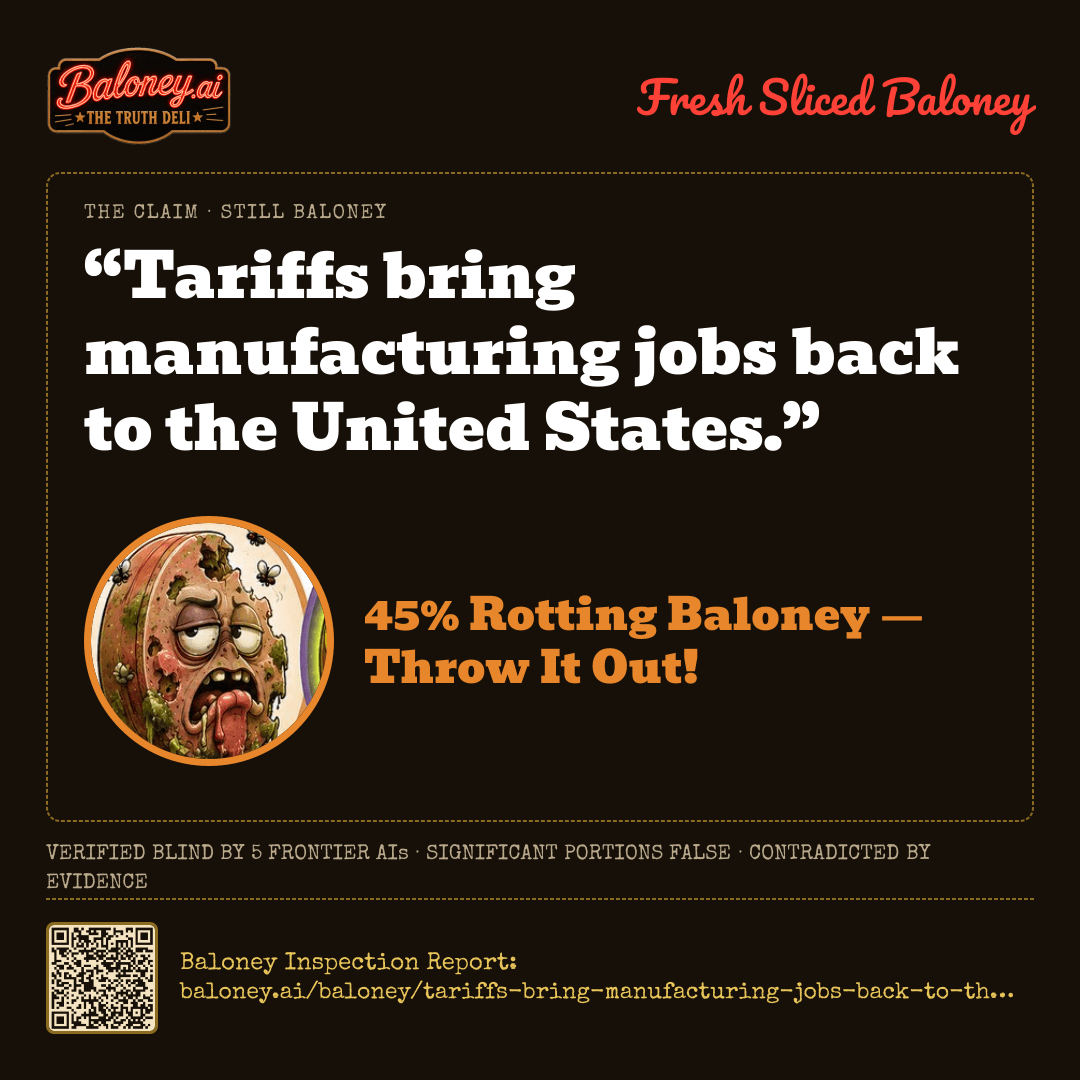
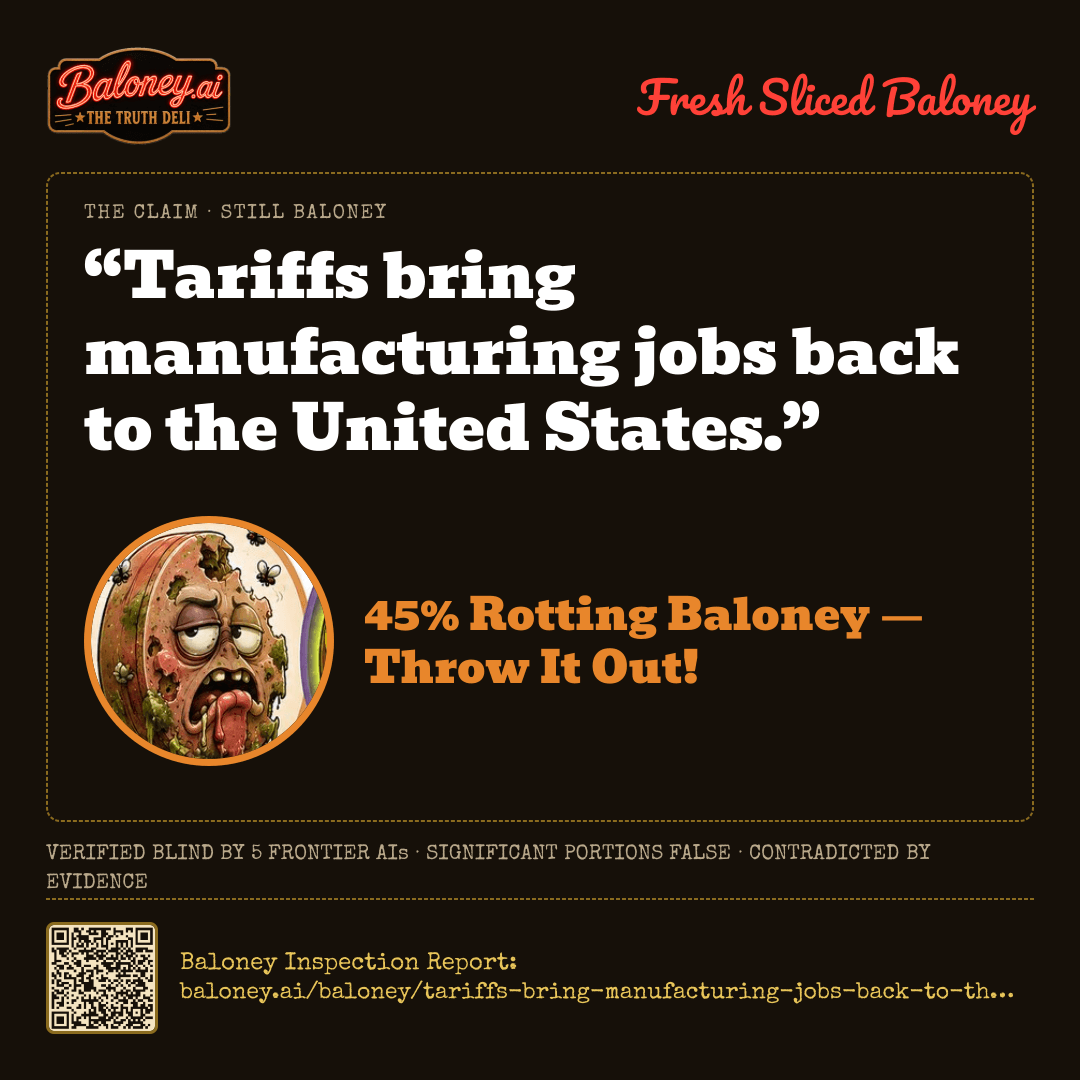
“Tariffs bring manufacturing jobs back to the United States.”
45%Rotting Baloney — Throw It Out!
Most of this claim has spoiled.
Significant portions falseContradicted by evidenceUnsupported assertionsDeceptive narrative
Serve It Fresh
Ready to Serve18 servings
Serve it the way you want it
The Verdict
 “Tariffs bring manufacturing jobs back to the United States.”45% Rotting Baloney — Throw It Out!Verified blind by 5 frontier AIs · Baloney Inspection Report: baloney.ai/baloney/tariffs-bring-manufacturing-jobs-back-to-the-united-states
The Baloney Sampler
Tariffs do pull some production into protected corners of the economy. The American Economic Review documented Samsung and LG building U.S. washing-machine plants after the 2018 safeguard tariffs, roughly 1,800 jobs, and the U.S. International Trade Commission found Section 232 tariffs raised steel and aluminum output by about $2.2 billion in 2021. The same USITC review found downstream manufacturers that buy those metals lost about $3.4 billion in output — and they employ far more workers.
On the headline claim, the evidence runs the other way. The Federal Reserve Board's study of the 2018–19 tariffs found industries more exposed to them suffered relative employment declines, as higher input costs and foreign retaliation swamped the protection effect. NBER work found no employment gain in targeted sectors or areas. Bureau of Labor Statistics payroll data show manufacturing employment roughly flat through 2018 and falling in 2019. Some Reserve Bank modelling shows modest manufacturing gains alongside falling total employment — a narrow, conditional kernel.
Resting on Board of Governors of the Federal Reserve System · U.S. International Trade Commission · American Economic Review · U.S. Bureau of Labor Statistics
Original Claim Source https://www.whitehouse.gov/research/2026/10/the-state-of-american-manufacturing/
Other ways to slice it — phrasings that might have changed the rating
- “Targeted safeguard tariffs can induce foreign manufacturers to open U.S. plants in the specific protected product line.” The peer-reviewed American Economic Review study of the washing-machine safeguard documents exactly this relocation effect at Samsung's and LG's new U.S. plants.
- “Tariffs on steel and aluminum created more manufacturing jobs in the protected metals industries than they destroyed in the industries that buy those metals.” The USITC review puts upstream output gains at about $2.2 billion against downstream losses of about $3.4 billion in industries employing far more workers, making this a testable and much narrower proposition.
- “Under modelled tariff scenarios, U.S. manufacturing employment rises modestly while total U.S. employment falls.” The San Francisco Fed's 2025 analysis estimated manufacturing employment could rise by up to 1.1% while overall employment declined, and a 2025 NBER working paper finds long-run manufacturing gains under some assumptions.
Written from the panel’s reports by Anthropic · claude-opus-5. Nothing here changed the score.
The Order Ticket
14:44:13CLAIM RECEIVED — QUEUED FOR INSPECTION✓
14:45:11claude-opus-5 REPORTED — SCORE 55, CONFIDENCE 88✓
14:44:52gpt-5.5 REPORTED — SCORE 47, CONFIDENCE 88✓
14:44:33gemini-3.1-pro-preview REPORTED — SCORE 45, CONFIDENCE 90✓
14:44:18sonar-pro REPORTED — SCORE 34, CONFIDENCE 96✓
14:46:12grok-4.6 REPORTED — SCORE 34, CONFIDENCE 75✓
14:47:41PRIMARY MASTER CLAUDE — SCORE 47✓
14:46:14BLIND VALIDATION PERPLEXITY — SCORE 48✓
14:48:00AGREEMENT CONFIRMED — DELTA 3✓
14:48:00SCORING MODEL V2 — MEDIAN OF 5 COUNTED LAB SCORES: 55, 47, 45, 34, 34 → 45.✓
14:48:00SOURCE RULE — LABS CITED 27 SOURCES: 0 DISCARDED FOR HAVING NO URL, 2 DISCARDED AS DEAD LINKS (404/410), 4 COULD NOT BE OPENED BY US AND ARE MARKED UNVERIFIED.✓
14:48:00SOURCE RULE — PRIMARY MASTER RULED ON 18 SOURCES: 0 DISCARDED FOR HAVING NO URL, 0 DISCARDED AS DEAD LINKS, 2 MARKED UNVERIFIED, 16 VERIFIED.✓
How This One Was Sliced
Station 1 · Blind Inspection — Five Graders, Zero Peeking
Each lab scored the claim independently, without seeing the others. Open a breakdown for its evidence, its sources, and how sure it was.
Anthropic · EQUAL WEIGHT · 58.5s
claude-opus-5
55%BALONEY
ROUND-1 BREAKDOWN
Evidence offered for the claim- Targeted safeguard tariffs have demonstrably induced some domestic production: after the 2018 washing-machine safeguard tariffs, Samsung (Newberry, SC) and LG (Clarksville, TN) opened U.S. plants, creating roughly 1,800 jobs — a real, measurable reshoring effect documented in a peer-reviewed American Economic Review study.
- The U.S. International Trade Commission's 2023 statutory review found Section 232 steel and aluminum tariffs reduced imports and increased U.S. production of those metals by about $2.2 billion in 2021, with prices and output rising in the protected industries — the mechanism through which protected-sector employment can grow.
- Primary-metals and steel-sector employment did tick up modestly in 2018–2019 after the Section 232 tariffs, and several mills announced restarts/expansions (e.g., U.S. Steel Granite City), showing tariffs can shift employment toward the protected industry.
- Protectionist advocates note that tariff threats have coincided with large announced U.S. factory investments (autos, semiconductors, pharmaceuticals) in 2025, though most such announcements are pledges rather than realized jobs and often overlap with subsidy programs like the CHIPS Act.
Evidence against the claim- The most rigorous study of the 2018–19 tariffs — by Federal Reserve Board economists Flaaen and Pierce — found that U.S. manufacturing industries more exposed to the new import tariffs experienced *relative declines* in employment, because the cost of imported inputs rose and foreign retaliation cut exports; the small positive 'protection' effect was swamped by those two negatives.
- Aggregate data do not show a manufacturing jobs boom: U.S. manufacturing employment was roughly flat (~12.8 million) from early 2018 through 2019 despite broad tariffs, and declined in 2019 as the trade war escalated (BLS/FRED series MANEMP).
- The jobs that were created were extraordinarily expensive: the washing-machine tariffs raised consumer costs by roughly $1.5 billion a year, implying over $800,000 in consumer cost per job created.
- Multiple peer-reviewed studies (Amiti–Redding–Weinstein, JEP 2019; Fajgelbaum et al., QJE 2020) find the tariffs' cost was passed almost completely to U.S. importers and consumers, producing net real-income losses — a drag on overall demand and manufacturing competitiveness rather than a jobs engine.
- The USITC found that while Section 232 tariffs raised metal-producing output by ~$2.2 billion, they reduced output in downstream steel- and aluminum-consuming manufacturing industries by ~$3.4 billion — downstream manufacturers employ far more workers than the protected primary-metals sector.
- U.S. manufacturing employment has been declining as a share of total jobs for 50+ years primarily because of automation and productivity growth, not only trade; tariffs do not address that dominant driver, so even successful import substitution yields far fewer jobs than the output involved would once have required.
- Retaliatory tariffs on U.S. exports (agriculture, machinery, motorcycles) directly cost U.S. manufacturing and farm jobs, and the 2018–19 farm bailout exceeded $23 billion, offsetting claimed gains.
- The 2002 Bush steel tariffs are the closest historical analogue: contemporaneous studies attributed net job losses in steel-consuming industries exceeding total steel-industry employment gains, and the tariffs were withdrawn in under two years.
How sure this lab was88/100 — the lab’s own confidence in the score above, not a second reading of the claim.
SourcesBoard of Governors of the Federal Reserve System (FEDS Working Paper 2019-086, Flaaen & Pierce)gov · 95 · American Economic Review (Flaaen, Hortaçsu & Tintelnot, 'The Production Relocation and Price Effects of US Trade Policy: The Case of Washing Machines')journal · 96 · Journal of Economic Perspectives (Amiti, Redding & Weinstein, 'The Impact of the 2018 Tariffs on Prices and Welfare')journal · 95 · Quarterly Journal of Economics (Fajgelbaum, Goldberg, Kennedy & Khandelwal, 'The Return to Protectionism')journal · 95 · U.S. International Trade Commission, 'Economic Impact of Section 232 and 301 Tariffs on U.S. Industries' (Pub. 5405)gov · 93 · Federal Reserve Bank of St. Louis (FRED) — All Employees, Manufacturinggov · 97 · U.S. Bureau of Labor Statistics — Manufacturing employment (CES)gov · 97 · Federal Reserve Bank of New York — Liberty Street Economicsgov · 92 · Tax Foundationother · 78
OpenAI · EQUAL WEIGHT · 38.8s
gpt-5.5
47%BALONEY
ROUND-1 BREAKDOWN
Evidence offered for the claim- Tariffs can protect particular import-competing industries by raising the price of foreign goods. The U.S. International Trade Commission estimated that the 2018 section 232 and section 301 tariffs reduced imports and increased domestic production in some directly protected sectors such as steel and aluminum, which can preserve or create some jobs in those narrow sectors.
- Manufacturing employment rose during part of the Trump tariff period: BLS data show U.S. manufacturing payrolls increased from roughly 12.36 million in January 2017 to roughly 12.85 million in January 2019 before flattening and then falling. This is evidence advocates cite, though it does not prove tariffs caused the increase.
Evidence against the claim- The strongest empirical evidence does not show broad manufacturing job reshoring from recent U.S. tariffs. A Federal Reserve study of the 2018-2019 tariffs found that any import-protection benefit was offset by higher input costs and retaliatory tariffs, and that the tariffs were associated with relative reductions in manufacturing employment.
- A 2024 NBER study of the Trump tariffs found that import tariffs did not raise employment in the protected sectors or local areas they targeted, while foreign retaliation hurt employment in exposed sectors.
- The USITC found that while protected upstream sectors could gain output, downstream U.S. industries that used tariffed inputs faced higher costs and lower output. Because many manufacturers use imported components, tariffs can destroy or prevent jobs in other manufacturing firms even while helping a protected industry.
- Economic research in the Quarterly Journal of Economics found that the costs of the 2018 U.S. tariffs were borne substantially by U.S. consumers and firms through higher prices. Higher input prices make U.S. manufacturers less competitive and weaken the case that tariffs generally bring jobs back.
- Overall, the statement is too broad. Tariffs can shift some production toward protected industries, but recent U.S. evidence shows little or no net manufacturing employment gain and significant costs, retaliation, and harm to downstream manufacturers.
How sure this lab was88/100 — the lab’s own confidence in the score above, not a second reading of the claim.
SourcesU.S. International Trade Commissiongov · 96 · National Bureau of Economic Researchother · 90 · U.S. Bureau of Labor Statisticsgov · 98 · Quarterly Journal of Economicsjournal · 95
Google · EQUAL WEIGHT · 19.9s
gemini-3.1-pro-preview
45%BALONEY
ROUND-1 BREAKDOWN
Evidence offered for the claim- Targeted tariffs can provide temporary protection to specific domestic industries, occasionally incentivizing foreign companies to build U.S. facilities to avoid the import taxes (e.g., Section 201 washing machine tariffs led to new U.S. manufacturing plants by Samsung and LG).
- Tariffs on raw materials, such as the 2018 Section 232 tariffs on steel and aluminum, can create or save a modest number of jobs specifically within those primary metal extraction and refining sectors.
Evidence against the claim- A comprehensive 2019 study by Federal Reserve economists found that the 2018-2019 tariffs were actually associated with a relative reduction in U.S. manufacturing employment, as the job losses from higher input costs and retaliation completely offset the gains in protected industries.
- Tariffs act as a tax on imported raw materials and intermediate components. This raises production costs for downstream U.S. manufacturers (like automakers and heavy machinery producers), making them less globally competitive and forcing them to cut jobs.
- When the U.S. implements tariffs, trading partners typically respond with retaliatory tariffs. These retaliatory measures reduce international demand for U.S. exports, leading to job losses in export-dependent manufacturing and agricultural sectors.
How sure this lab was90/100 — the lab’s own confidence in the score above, not a second reading of the claim.
SourcesFederal Reserve Boardgov · 95 · National Bureau of Economic Research (NBER)edu · 95 · Brookings Institutionother · 85
Perplexity · EQUAL WEIGHT · 5.2s
sonar-pro
34%BALONEY
ROUND-1 BREAKDOWN
Evidence offered for the claim- Some economic models find that tariffs can increase U.S. manufacturing employment, at least temporarily, by shifting spending from imports toward domestic production. A 2025 San Francisco Fed analysis estimated manufacturing employment could rise by up to 1.1% under a modeled tariff scenario, while total U.S. employment would fall.[8]
- A 2025 NBER working paper finds tariffs can increase overall manufacturing employment in the long run under some assumptions, although effects vary substantially by sector and policy design.[2]
- The evidence supports a narrower version of the claim: tariffs may protect or expand employment in selected import-competing industries, especially upstream industries, under particular conditions.[2][8]
Evidence against the claim- A Federal Reserve Board study of the 2018-2019 tariffs found that industries more exposed to tariff increases experienced relative employment declines because higher input costs and foreign retaliation outweighed the benefits of import protection.[1]
- Minneapolis Fed researchers summarize estimates that the 2018-2019 tariffs caused about 230,000 U.S. manufacturing job losses through higher input costs, with no direct employment benefit in the more-protected industries.[9]
- Tariffs can raise costs for U.S. manufacturers that rely on imported materials and components, while retaliation reduces export demand. These effects mean protection for one industry can harm downstream manufacturers and the wider economy.[1][9]
- The NBER analysis concludes that tariffs often cause worker reallocation among manufacturing sectors rather than broad reindustrialization, and that some tariff designs reduce overall goods-sector employment.[10]
- The statement is too categorical: whether tariffs bring jobs back depends on tariff scope, trading-partner retaliation, supply-chain exposure, time horizon, and the industry affected. Evidence from the 2018-2019 trade war does not show a general manufacturing-job revival.[1][9]
How sure this lab was96/100 — the lab’s own confidence in the score above, not a second reading of the claim.
SourcesBoard of Governors of the Federal Reserve Systemgov · 97 · Federal Reserve Bank of San Franciscogov · 96 · Federal Reserve Bank of Minneapolisgov · 96 · National Bureau of Economic Researchjournal · 91 · National Bureau of Economic Researchjournal · 91
xAI · EQUAL WEIGHT · 119.6s
grok-4.6
34%BALONEY
ROUND-1 BREAKDOWN
Evidence offered for the claim- 2018 Section 232 steel and aluminum tariffs were followed by higher domestic output and some employment gains inside those narrowly protected industries.
- A subset of firms have announced U.S. plant expansions or relocations and have cited tariff avoidance or the threat of further tariffs as one factor.
- Trade-policy shocks (together with COVID-era supply-chain disruptions) coincided with a rise in publicly reported reshoring announcements in some manufacturing sub-sectors.
Evidence against the claim- Federal Reserve research on the 2018–19 tariffs found they were associated with relative reductions in overall manufacturing employment because higher input costs and retaliation outweighed gains in protected sectors.
- BLS/FRED series show manufacturing employment remains far below late-20th-century peaks; the modest 2017–19 uptick occurred in a strong overall labor market and was not a sustained reversal attributable to tariffs.
- Tariffs raise the price of imported intermediates used by the large majority of U.S. manufacturers (autos, machinery, construction products, etc.), reducing their competitiveness and employment.
- Economists’ consensus, reflected in peer-reviewed work and expert surveys, is that tariffs do not produce a net increase in manufacturing jobs and function as a tax on downstream producers and consumers.
How sure this lab was75/100 — the lab’s own confidence in the score above, not a second reading of the claim.
SourcesFederal Reserve Bank of St. Louis (FRED)gov · 98 · U.S. Bureau of Labor Statisticsgov · 99 · Federal Reserve Boardgov · 95 · American Economic Association / Journal of Economic Perspectivesjournal · 96
Station 2 · The Masters
Primary Master · drawn at random
claude-opus-5
47% BALONEY
All five evaluators converged on the same underlying picture and differed only on how harshly to score the wording: tariffs demonstrably do pull some production into protected niches, but the best available evidence shows no net return of manufacturing jobs, and in the most-studied episode a net loss. I weighted most heavily the causal, quasi-experimental work cited by four of five panellists — the Federal Reserve Board study of the 2018-19 tariffs (relative employment declines in more-exposed manufacturing industries, as input-cost and retaliation channels swamped the protection channel), the USITC statutory review (upstream output up ~$2.2bn, downstream output down ~$3.4bn), and the NBER work finding no employment gain in targeted sectors or localities. Against that, the genuine reshoring evidence is real but narrow and expensive: the Samsung and LG plants after the washing-machine safeguard are a documented relocation effect in a peer-reviewed AER paper, worth roughly 1,800 jobs at an implied consumer cost above $800,000 per job. Aggregate BLS/FRED data show manufacturing payrolls roughly flat through 2018 and falling in 2019, which is fatal to the claim as a general statement. Two panellists noted model-based scenarios (SF Fed, a 2025 NBER paper) in which manufacturing employment rises modestly while total employment falls — that is a real but heavily qualified kernel of truth, and it keeps this out of the 'overwhelmingly false' band. The statement as written is an unconditional causal assertion about aggregate manufacturing employment; the narrow sectoral kernel is true, the headline proposition is contradicted by the evidence. That is squarely 'significant portions false' territory. I landed at 47, close to the panel median of 45 and the mean of 43, slightly above the two lowest scores because the reshoring mechanism is genuinely documented rather than imaginary.
Unanimous on substance: every evaluator accepted that tariffs can raise output and employment inside narrowly protected sectors, and every evaluator accepted the Federal Reserve Board finding that the 2018-19 tariffs were associated with relative declines in manufacturing employment overall. Disagreement was confined to severity of scoring (34 to 55) and emphasis. The lower scorers (34, 34) treated the claim as a defensible-but-overstated directional argument with some model support; the higher scorers (45, 47, 55) emphasised that the claim as written asserts a net aggregate effect that the data contradict. One evaluator uniquely stressed the cost-per-job arithmetic of the washing-machine tariffs and the 2002 Bush steel tariff precedent; another uniquely surfaced 2025 modelling work (SF Fed, NBER) showing conditional manufacturing-employment gains alongside total-employment losses. No evaluator argued the claim is straightforwardly true, and none argued it is wholly baseless.
Blind Validation Master · never saw the Primary’s work
sonar-pro
48% BALONEY
The claim is too broad as written. The reports consistently find that tariffs can increase or preserve jobs in narrowly protected industries, such as steel, aluminum, or washing-machine production, and can sometimes induce specific firms to build U.S. facilities. However, the strongest evidence from the 2018–2019 tariffs indicates that higher input costs and foreign retaliation offset or exceeded those gains, producing relative declines or no meaningful net increase in manufacturing employment. Tariffs also shift jobs among sectors rather than reliably bringing manufacturing jobs back overall, while automation and productivity remain major causes of long-term manufacturing employment decline. Thus, the statement contains a limited kernel of truth for targeted industries but misleadingly implies a broad, proven national effect.
AGREEMENT TEST PASSED — MASTERS SCORED 47% AND 48% · BLIND VALIDATION CONFIRMED THIS SCORE · NO RE-EVALUATION REQUIRED
How the number was reached · scoring model v2 · how our models work
- Median of 5 counted lab scores: 55, 47, 45, 34, 34 → 45.
The Evidence
Evidence offered for the claim
- Washing-machine tariffs brought two plants After the 2018 Section 201 safeguard, Samsung opened in Newberry, SC and LG in Clarksville, TN — roughly 1,800 jobs, a genuine relocation effect documented in a peer-reviewed American Economic Review study. The same study's price findings imply consumer costs of roughly $1.5bn a year, over $800,000 per job created.
- Steel and aluminum output rose under Section 232 DEBUNKED — The USITC found the metals tariffs cut imports and raised protected-sector production by about $2.2bn in 2021. The same review found downstream steel- and aluminum-consuming industries lost about $3.4bn of output — and those downstream industries employ far more workers than primary metals.
- Manufacturing payrolls rose during the tariff period DEBUNKED — BLS payrolls went from about 12.36 million in January 2017 to about 12.85 million in January 2019. But the gains predate the tariffs, employment was roughly flat through 2018 in a strong overall labour market, and manufacturing employment fell in 2019 as the trade war escalated.
- Models show a conditional manufacturing-employment gain A 2025 San Francisco Fed analysis estimated manufacturing employment could rise by up to 1.1% under a modelled tariff scenario, and a 2025 NBER working paper finds long-run manufacturing gains under some assumptions — but in both cases total U.S. employment falls and effects vary sharply by sector and tariff design.
- 2025 investment announcements follow tariff threats DEBUNKED — Large U.S. factory investments in autos, semiconductors and pharmaceuticals were announced alongside 2025 tariff threats. The panel notes these are pledges rather than realised jobs, and most overlap with separate subsidy programmes such as the CHIPS Act, making attribution to tariffs unreliable.
Evidence against the claim
- Tariff-exposed industries lost jobs, not gained them The Federal Reserve Board's study of the 2018-19 tariffs found U.S. manufacturing industries more exposed to the new import tariffs experienced relative employment declines: the small protection benefit was outweighed by rising imported-input costs and foreign retaliation cutting exports.
- Roughly 230,000 manufacturing jobs lost Minneapolis Fed researchers summarise estimates that the 2018-19 tariffs cost about 230,000 U.S. manufacturing jobs through higher input costs, with no measurable direct employment benefit in the more-protected industries.
- No employment gain in targeted sectors or places A 2024 NBER study of the Trump tariffs found import tariffs did not raise employment in the protected sectors or the local labour markets they targeted, while foreign retaliation measurably reduced employment in exposed sectors.
- Most manufacturers are tariff losers, not winners Tariffs tax imported raw materials and components. Automakers, machinery producers and construction-products firms face higher costs and lose competitiveness; the USITC confirmed downstream output losses exceeded upstream gains under Section 232.
- Costs fell on U.S. buyers Peer-reviewed work in the Quarterly Journal of Economics and the Journal of Economic Perspectives found the 2018 tariffs were passed through almost completely to U.S. importers and consumers, producing net real-income losses rather than a demand boost for domestic industry.
- Aggregate payroll data show no boom BLS and FRED series show manufacturing employment roughly flat at about 12.8 million from early 2018 through 2019 despite broad tariffs, then declining, and still far below late-20th-century peaks.
- Retaliation hit exporters and farmers Retaliatory tariffs on U.S. machinery, motorcycles and agricultural exports cost manufacturing and farm jobs directly; the 2018-19 farm bailout exceeded $23 billion, offsetting claimed gains.
- The 2002 steel tariffs are the cautionary precedent Contemporaneous studies of the Bush steel tariffs attributed net job losses in steel-consuming industries exceeding total steel-industry employment gains; the measures were withdrawn in under two years.
- Automation, not imports, drives the long decline Manufacturing's falling employment share over 50-plus years is driven primarily by productivity growth and automation. Tariffs do not address that driver, so even successful import substitution yields far fewer jobs than the same output once required.
Sources · Reliability · Why Accepted or Discounted
| Source | Type | Reliability | Ruling |
|---|
| Board of Governors of the Federal Reserve System (FEDS WP 2019-086, Flaaen & Pierce) | gov | 95 | ACCEPTED — Central-bank research staff working paper, the most-cited causal study of the 2018-19 tariffs; cited independently by three evaluators. |
| Board of Governors of the Federal Reserve System (landing page for the same study) | gov | 97 | ACCEPTED — Official abstract page for the Flaaen-Pierce study; consistent with the PDF cited by other evaluators. |
| American Economic Review (Flaaen, Hortaçsu & Tintelnot, washing machines) | journal | 96 | ACCEPTED — Top-tier peer-reviewed economics; the single best-documented case of tariff-induced plant relocation, and the source of the pro-claim evidence. |
| Journal of Economic Perspectives (Amiti, Redding & Weinstein) | journal | 95 | ACCEPTED — Peer-reviewed pass-through analysis cited by two evaluators; methods and findings widely replicated. |
| Quarterly Journal of Economics (Fajgelbaum, Goldberg, Kennedy & Khandelwal)unverified | journal | 95 | ACCEPTED — Leading peer-reviewed study of tariff incidence; cited independently by two evaluators. |
| U.S. International Trade Commission (Pub. 5405)unverified | gov | 96 | ACCEPTED — Statutorily mandated government review providing the key upstream-versus-downstream output figures; cited by two evaluators and supplies evidence on both sides. |
| Federal Reserve Bank of St. Louis (FRED, All Employees: Manufacturing) | gov | 98 | ACCEPTED — Primary official time series; directly tests the aggregate version of the claim. |
| U.S. Bureau of Labor Statistics (CES manufacturing series) | gov | 98 | ACCEPTED — Source data behind the employment counts both supporters and critics of the claim rely on. |
| U.S. Bureau of Labor Statistics (Employment Situation, Table B-1) | gov | 99 | ACCEPTED — Official monthly payroll table; corroborates the FRED and CES series. |
| Federal Reserve Bank of San Francisco | gov | 96 | ACCEPTED — Reserve Bank economic letter; the clearest statement of the conditional case FOR the claim, and accepted precisely because it cuts against the panel's overall conclusion. |
| Federal Reserve Bank of Minneapolis | gov | 96 | ACCEPTED — Reserve Bank summary of the two job-loss channels with a quantified estimate; consistent with the underlying academic literature. |
| National Bureau of Economic Research (working paper 34236) | journal | 91 | ACCEPTED — Working paper, not yet peer reviewed, so weighted below published journal work — but accepted because it supplies the strongest modelled case for the claim rather than against it. |
| National Bureau of Economic Research (working paper 34236, full text) | journal | 91 | ACCEPTED — Full text of the same working paper; same weighting applied. |
| National Bureau of Economic Research (working paper 25638) | edu | 95 | ACCEPTED — Widely cited trade-war incidence work; later published in the peer-reviewed literature. |
| National Bureau of Economic Research (working paper 32082) | other | 90 | ACCEPTED — Working-paper status noted, but its finding of no employment gain in targeted sectors or localities is independently corroborated by the Fed Board and USITC results. |
| Federal Reserve Bank of New York, Liberty Street Economics | gov | 92 | ACCEPTED — Reserve Bank staff blog rather than refereed work, so treated as supporting context for the consumer-cost channel only. |
| Tax Foundation | other | 78 | ACCEPTED — Advocacy-adjacent think tank with a known anti-tariff prior; accepted only as a tracker of tariff coverage and cost arithmetic, and it carries no weight in this verdict that the government and journal sources do not already carry. |
| Brookings Institution | other | 85 | ACCEPTED — Think-tank synthesis rather than primary research; used as a summary of findings that the Fed, USITC and NBER sources establish directly. |
Every link was opened when this claim was inspected. A dead link was discarded before publication; “unverified” means the site refused our automated check and the link is the one the panel cited. A source without a URL was never kept.
Serve It Fresh
Ready to Serve18 servings
Serve it the way you want it
The Verdict
“Tariffs bring manufacturing jobs back to the United States.”45% Rotting Baloney — Throw It Out!Verified blind by 5 frontier AIs · Baloney Inspection Report: baloney.ai/baloney/tariffs-bring-manufacturing-jobs-back-to-the-united-states