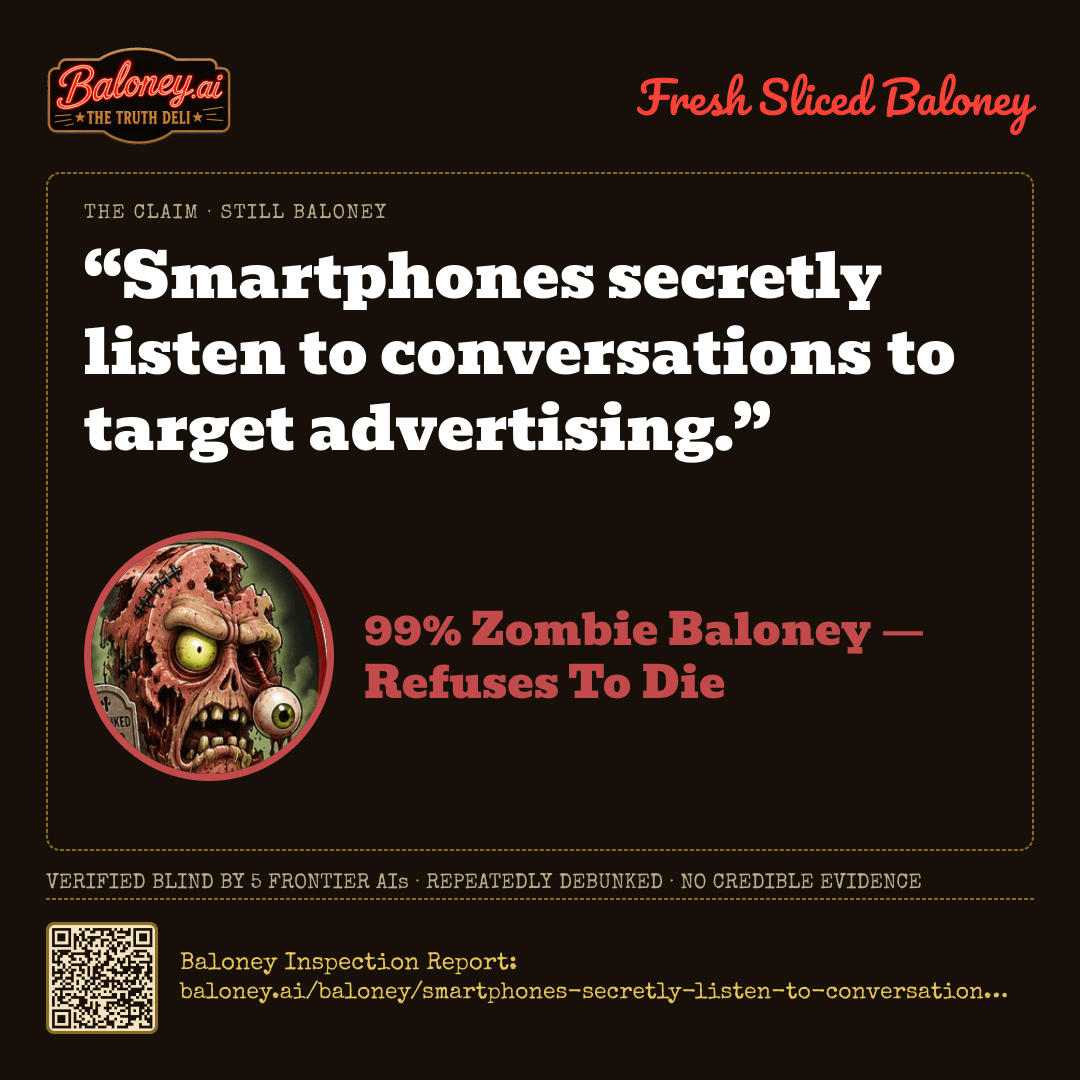
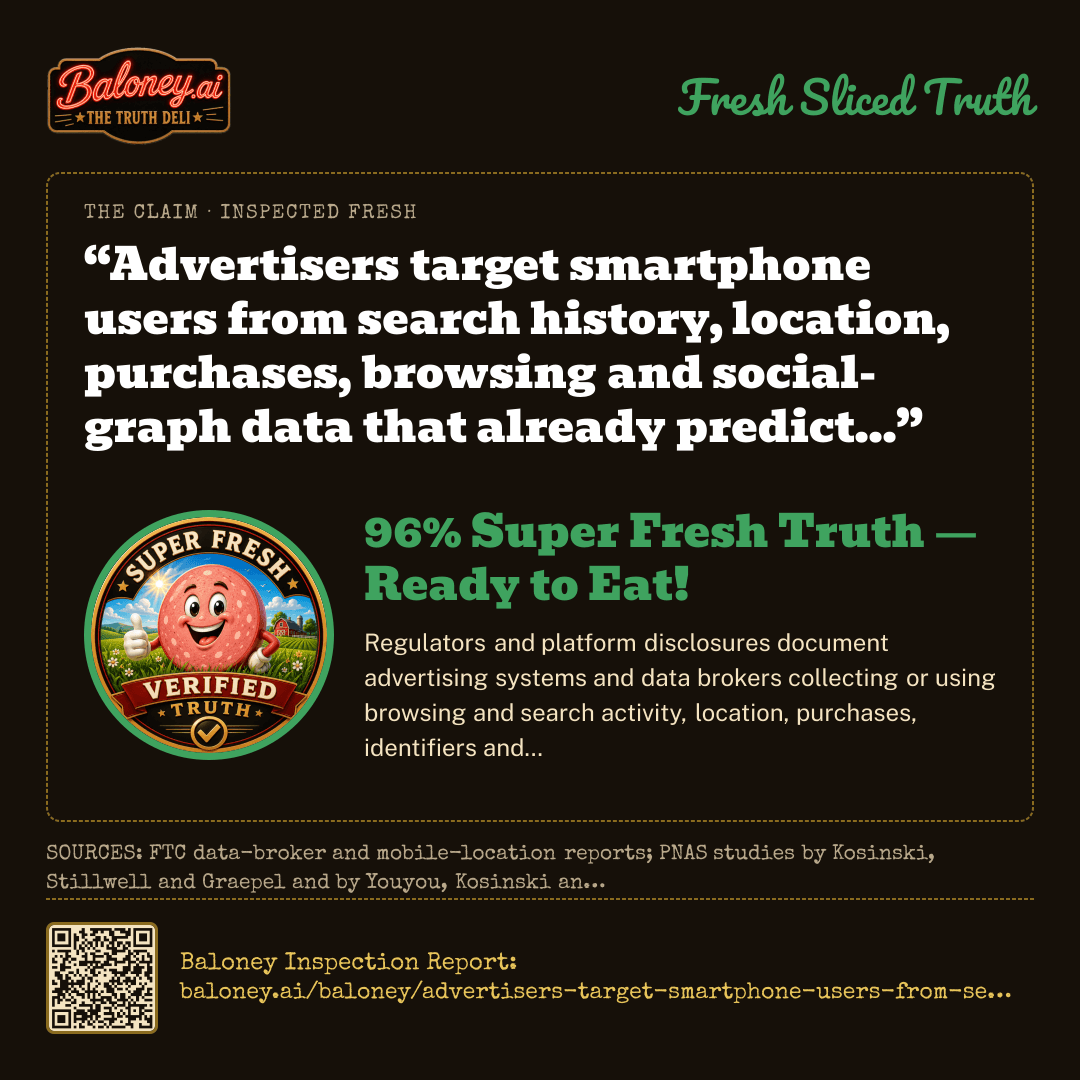
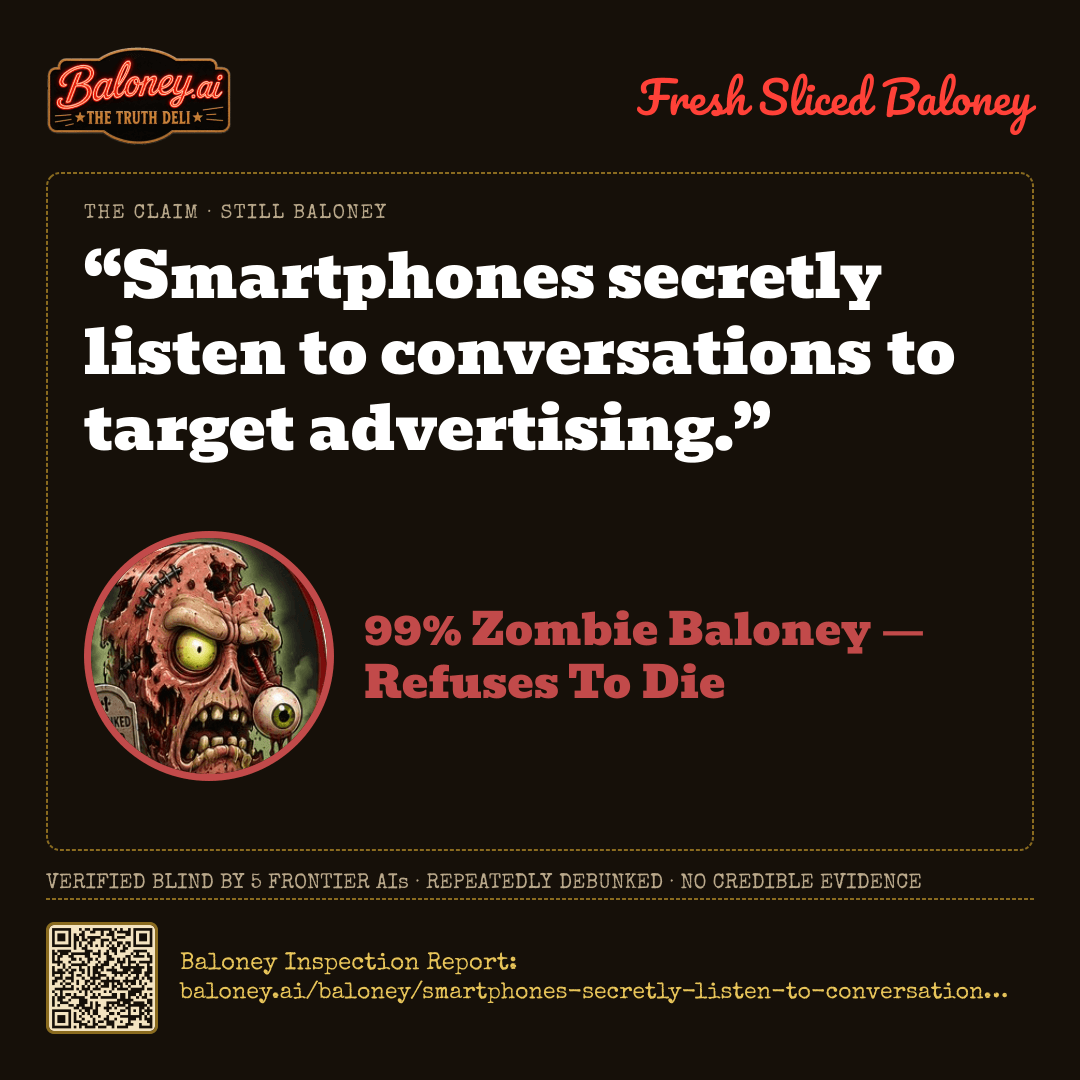
“Smartphones secretly listen to conversations to target advertising.”99% Zombie Baloney — Refuses To DieVerified blind by 5 frontier AIs · Baloney Inspection Report: baloney.ai/baloney/smartphones-secretly-listen-to-conversations-to-target
The Rating Card
The correction — what is actually true
The Baloney Sampler
Smartphones do not secretly listen to ordinary conversations to target ads. The peer-reviewed Panoptispy study in Proceedings on Privacy Enhancing Technologies monitored more than 17,000 Android apps and found zero covert audio recording and exfiltration, while detecting other leaks such as screenshots. Continuous capture would produce obvious battery, data and network signatures that researchers have not found. Reuters and BBC News reach the same conclusion.
Uncanny ads after a spoken mention come from search, location, purchases, browsing and social connections plus confirmation bias, as Vox and BBC News describe. Cox Media Group marketed Active Listening, but Google, Amazon and Meta denied using secret audio and dropped the firm. The U.S. Federal Trade Commission and The New York Times documented apps listening for TV audio beacons, not human conversation. The Guardian found accidental Siri recordings were reviewed for assistant quality, not ads.
Other ways to slice it — phrasings that might have changed the rating
“Smartphones do not secretly listen to ordinary conversations in order to target advertising.” The Panoptispy traffic study and repeated checks of network, battery and microphone-indicator data found no covert conversation-to-ad pipeline, which is the finding that contradicts the original claim.
“Some smartphone apps have used the microphone to detect inaudible television audio beacons for advertising.” The U.S. Federal Trade Commission warned developers about SilverPush code and The New York Times documented Alphonso software doing this, a real but non-conversational use of the mic.
“People see ads for products they recently mentioned because platforms already infer those interests from location, purchases, browsing and social connections.” The reports found that this behavioural targeting plus confirmation bias accounts for the coincidences without any secret audio capture.
Written from the panel’s reports by xAI · grok-4.6. Nothing here changed the score.
16:04:14SCORING MODEL V2 — MEDIAN OF 5 COUNTED LAB SCORES: 85, 88, 99, 75, 84 → 85. ZOMBIE RULE: THE PRIMARY MASTER FLAGS A LONG DEBUNK HISTORY, THE BLIND MASTER SCORES 88, THE COUNTED MEDIAN IS 85 — PUBLISHED AS 99.✓
16:04:14SOURCE RULE — LABS CITED 25 SOURCES: 0 DISCARDED FOR HAVING NO URL, 8 DISCARDED AS DEAD LINKS (404/410), 4 COULD NOT BE OPENED BY US AND ARE MARKED UNVERIFIED.✓
16:04:14SOURCE RULE — PRIMARY MASTER RULED ON 16 SOURCES: 0 DISCARDED FOR HAVING NO URL, 0 DISCARDED AS DEAD LINKS, 4 MARKED UNVERIFIED, 12 VERIFIED.✓
How This One Was Sliced
Station 1 · Blind Inspection — Five Graders, Zero Peeking
Each lab scored the claim independently, without seeing the others. Open a breakdown for its evidence, its sources, and how sure it was.
Anthropic · EQUAL WEIGHT · 86.4s
claude-opus-5
85%BALONEY
ROUND-1 BREAKDOWN
Evidence offered for the claim
A 2024 leaked pitch deck from Cox Media Group (CMG) marketed an 'Active Listening' product that claimed to capture 'real-time intent data' from voice conversations picked up by phones and smart devices, and listed Google, Amazon and Facebook as clients — showing at minimum that ad firms advertise this capability. (Google dropped CMG from its Partners Program and Meta said it was reviewing the arrangement; no technical proof the product actually worked as described was ever produced.)
Some apps genuinely have used the microphone for ad-related purposes: the FTC sent warning letters in 2016 to a dozen Android developers embedding SilverPush code that silently listened for inaudible 'audio beacons' in TV ads to track viewing, and the New York Times documented Alphonso software in hundreds of games using the mic to identify TV shows and ads for targeting.
Voice assistants do record audio, sometimes without an intentional wake word. The Guardian revealed in 2019 that Apple contractors routinely heard confidential conversations captured by accidental Siri activations; Apple apologized and changed the program. Similar false-activation leaks affected Google Assistant and Amazon Alexa.
Academic work (e.g., research on the Amazon smart-speaker ecosystem) has found that voice-interaction data from smart assistants is used to build advertising profiles — so audio-derived data entering ad systems is not purely hypothetical, even when the audio is from deliberate commands rather than ambient eavesdropping.
Smartphones are technically capable of continuous on-device audio processing — always-on wake-word detection already runs constantly — so the claim is not physically impossible, which keeps it plausible to users.
Widespread, persistent anecdotal reports of 'I talked about X and immediately saw an ad for X' from millions of users constitute weak but non-zero circumstantial evidence.
Evidence against the claim
The most rigorous empirical test — the Northeastern University 'Panoptispy' study (PoPETs 2018), which automatically exercised 17,260 Android apps while monitoring all network traffic and media API access — found ZERO instances of an app covertly recording audio and exfiltrating it. (It did find apps leaking screenshots and video, demonstrating the method would have detected audio leaks had they existed.)
Continuous speech capture and upload would be detectable: raw or compressed audio streaming 24/7 would show up in network traffic analysis, battery drain, and data usage. Independent researchers, journalists and security firms monitoring packet flows have repeatedly failed to find such traffic.
Modern mobile OSes make covert mic use hard to hide: iOS (since 14) and Android (since 12) display a mandatory orange/green microphone indicator whenever the mic is active, plus per-app permission logs. Mass covert listening by major apps would be trivially visible.
No whistleblower, leaked internal document, court filing, or regulator has ever produced evidence that Meta, Google, Apple or a major ad network transcribes ambient conversations for targeting — despite enormous financial and legal incentives (GDPR, FTC, state wiretap laws) for such evidence to surface. The CMG deck is a vendor sales claim, not demonstrated capability, and CMG's partners publicly distanced themselves from it.
A far simpler explanation fits the anecdotes: ad platforms infer interests from location data, shared Wi-Fi/IP networks, contact-graph and 'people you may know' style linkage, cross-device identifiers, purchase and browsing data sold by data brokers, and look-alike modeling of people you spend time with. Combined with the frequency illusion (Baader-Meinhof) and confirmation bias — users remember hits and forget thousands of irrelevant ads — this produces 'uncanny' coincidences without any audio.
Scale/economics argue against it: transcribing billions of hours of speech daily would be enormously expensive and far less accurate for intent prediction than the behavioral data advertisers already possess cheaply.
The documented microphone abuses that DID occur (SilverPush, Alphonso) listened for machine-readable TV audio signatures, not human conversation, and were disclosed in privacy policies — and were shut down after regulatory and press attention.
Company denials under legal jeopardy: Mark Zuckerberg testified under oath to Congress in April 2018 that Facebook does not use phone microphones to target ads; a false statement would expose the company to perjury and FTC consent-decree liability.
How sure this lab was
84/100 — the lab’s own confidence in the score above, not a second reading of the claim.
There is documented precedent for phones/apps using microphones for tracking-related purposes without users clearly understanding it: in 2016 the FTC warned app developers about Silverpush software that could use a phone microphone to detect inaudible TV audio beacons and infer TV-viewing behavior. This supports technical plausibility, but it was beacon detection, not semantic eavesdropping on private conversations.
Some advertising-industry actors have claimed to offer products resembling the claim. 404 Media reported on Cox Media Group marketing materials for 'Active Listening' that claimed smartphones/smart speakers could be used to target ads based on spoken conversations. This is evidence that such services have been marketed or proposed, but not proof that major platforms secretly do this at scale.
Voice assistants can sometimes capture and transmit audio after false wake-word activations, and news reporting has shown contractors reviewed some Siri recordings. That shows accidental/limited audio capture can occur, but the cited evidence concerns assistant quality review, not ad targeting based on ordinary conversations.
Evidence against the claim
The strongest public technical evidence weighs against the claim as a general practice: a peer-reviewed Northeastern/IMDEA study of more than 17,000 Android apps found no evidence that the tested apps were covertly recording audio and sending it out for advertising, though it did find other privacy issues such as screen recording.
Modern iOS and Android require app microphone permissions and provide microphone-use indicators/permission controls. This does not make abuse impossible, but it makes continuous, covert, large-scale microphone collection by ordinary apps harder to hide and easier for researchers, OS vendors, and users to detect.
The claim is broader than the evidence. Real ad targeting is already explainable through search history, browsing, app activity, location, purchases, contacts/social graphs, data brokers, and look-alike modeling; no large-scale verified evidence shows smartphones routinely analyze private conversations for ads.
Meta/Facebook has explicitly denied using phone microphones for ads or News Feed stories. Because Meta is an interested party, this is not decisive by itself, but it is consistent with independent technical findings that have not found covert audio exfiltration at scale.
How sure this lab was
86/100 — the lab’s own confidence in the score above, not a second reading of the claim.
Millions of users frequently experience the phenomenon of seeing digital advertisements for highly specific products or topics immediately after talking about them, creating a strong anecdotal correlation.
Smartphones possess the hardware capabilities to listen continuously; virtual assistants rely on always-on microphone buffering to detect wake words like 'Hey Siri' or 'OK Google'.
A 2024 pitch deck from marketing firm Cox Media Group (CMG) claimed the company offered 'Active Listening' software capable of targeting ads based on ambient conversations, which recently reignited public suspicion.
Many popular applications routinely request microphone permissions during installation, leading users to believe the access is being exploited in the background.
Evidence against the claim
Independent cybersecurity studies, such as extensive network traffic analysis by mobile security firm Wandera, have found no evidence of secret audio streams or hidden voice files being transmitted to tech companies like Meta or Google.
Continuously recording, uploading, and processing audio from billions of devices would require massive server infrastructure, while causing severe, easily detectable spikes in users' battery drain and cellular data usage.
Tech companies do not need to listen to ambient audio to serve highly accurate ads. They utilize massive data brokering networks combining search history, real-time location tracking, purchase data, predictive algorithms, and cross-referencing with friends' and family's data, which accurately predicts user behavior and creates the 'illusion of listening.'
Modern mobile operating systems (Apple's iOS and Google's Android) have implemented strict hardware and software safeguards, including persistent visual indicators (green or orange dots in the status bar) whenever the microphone is actively accessed by any app.
In response to the CMG 'Active Listening' claims, major tech partners like Google, Amazon, and Meta formally denied involvement, stating their ad networks do not allow targeting via secret audio recordings and subsequently removed CMG from their partner programs.
How sure this lab was
98/100 — the lab’s own confidence in the score above, not a second reading of the claim.
A 2023 ESADE-hosted report describes an observational study in which 27 participants discussed tourism-related topics near phones and subsequently received related advertisements in all reported observations. However, this is an association study, and the available result does not establish that conversation audio caused the ads.[1]
Some apps and services can access microphones when users grant permission, and documented cases exist of microphone use for limited purposes such as detecting television audio; this shows that audio-based tracking is technically possible, but does not prove routine secret recording of private conversations for ad targeting.[2]
Evidence against the claim
A Northeastern University investigation of roughly 17,000 Android apps found no evidence that apps secretly recorded and transmitted ambient audio to advertising networks. The researchers identified extensive non-audio data collection that could explain highly personalized ads.[2]
Controlled testing of iPhone and Samsung devices exposed to repeated pet-food advertising audio reportedly found no resulting pet-food ads and no meaningful differences in battery use, data consumption, or background activity compared with silent-room controls.[3]
The strongest available evidence supports a different explanation: advertisers use searches, locations, purchases, social connections, browsing behavior, and predictive algorithms, which can make ads appear to reflect private conversations without requiring microphone eavesdropping.[2][4]
The claim is too broad because phones do listen in specific, disclosed contexts, including wake-word detection, voice assistants, calls, voice notes, and apps with microphone permission; that is not equivalent to secretly recording ordinary conversations for advertising.[2][4]
How sure this lab was
86/100 — the lab’s own confidence in the score above, not a second reading of the claim.
Large numbers of users report ads appearing shortly after they mentioned a product or topic only in spoken conversation, which they interpret as microphone-based targeting.
Phones have microphones that apps can access if the user granted permission, and some apps have been found using the mic in the background or in unexpected ways.
Ad-tech firms have obtained patents describing analysis of ambient audio or speech for commercial targeting.
A minority of apps and third-party SDKs (including some using inaudible ultrasonic beacons for cross-device tracking) have used the microphone without users fully understanding that use.
Evidence against the claim
Google, Meta, Apple and other major platforms have repeatedly stated they do not use microphone audio or conversation transcripts to target ads.
Continuous capture, on-device speech recognition of ordinary conversation, and upload to ad systems would produce obvious battery, data, thermal and network signatures; OS privacy indicators, battery stats and independent traffic analysis do not show this happening at scale.
Researchers examining app behavior and network traffic have not found systematic transmission of conversation content to advertising backends.
Existing targeting already uses browsing, apps, location, purchases and social graph data that closely match what people later talk about, which plus confirmation bias and coincidence fully explains the anecdotes.
Fact-checkers and journalists who ran controlled tests (discussing obscure products never searched or typed) generally did not receive corresponding ads.
How sure this lab was
76/100 — the lab’s own confidence in the score above, not a second reading of the claim.
The statement as written asserts a general, secret conversation-to-ad pipeline. That is overwhelmingly false. The decisive evidence is empirical and technical, not anecdotal: the peer-reviewed Panoptispy traffic study found zero covert audio exfiltration across a huge Android corpus while catching other leaks; continuous capture would produce obvious battery, data and network signatures that researchers have not found; modern iOS and Android microphone indicators make mass covert use visible; and existing search, location, purchase, browsing and social-graph data already predict what people talk about, which plus confirmation bias fully explains the coincidences. Vendor marketing (the CMG 'Active Listening' deck), wake-word buffers, accidental assistant recordings, and historical TV-beacon SDKs (SilverPush, Alphonso) are real adjacent facts but do not establish secret semantic eavesdropping for ads—partners denied CMG, beacons are not speech, and assistant review is not ad targeting. Anecdotes and a tiny uncontrolled ESADE write-up cannot outweigh that record. The claim has been investigated and publicly debunked for years and still circulates, which is why it sits at the top of the scale.
All five evaluators judged the core claim false and converged on the same rebuttals: no covert audio in large app-traffic studies, detectable cost of continuous listening, OS mic indicators, and ordinary behavioral targeting plus bias. They split on residual weight: one scored 99 as a zombie myth; others (75–88) gave more credit to CMG marketing, past beacon SDKs, wake-word hardware and anecdotes without treating those as proof of the claim.
ZOMBIE FLAG: TRUE — DEBUNK HISTORY ON RECORD
Blind Validation Master · never saw the Primary’s work
claude-opus-5
88% BALONEY
Four of five reports converge on 75-88 with one outlier at 99, and the underlying evidence base is consistent: the claim as written — that smartphones secretly listen to ordinary conversations in order to target ads — is overwhelmingly unsupported. The strongest direct test, the peer-reviewed Northeastern/IMDEA 'Panoptispy' analysis of ~17,000 Android apps with full network-traffic and media-API monitoring, found zero instances of covert audio recording and exfiltration, while successfully detecting other leaks (screenshots/video), demonstrating the method would have caught audio. Controlled journalistic tests found no resulting ads and no anomalous battery/data/network signatures. Continuous capture and transcription at scale would be economically irrational and trivially detectable, and modern iOS/Android mic indicators and permission logs make mass covert listening hard to conceal. No whistleblower, leak, court filing or regulatory action has ever substantiated the practice despite enormous incentives, and the anecdotes are fully explained by behavioural/location/social-graph/data-broker targeting plus frequency illusion and confirmation bias. I stop short of the 99 'Zombie' tier because the reports document real, non-trivial adjacent facts: the FTC's 2016 SilverPush warning letters and the Alphonso SDK show apps genuinely used microphones for ad-related tracking (of TV audio beacons, not conversation); the leaked Cox Media Group 'Active Listening' pitch deck shows ad-tech firms have marketed exactly this capability; and voice assistants do capture audio on false activations that humans have reviewed. These make the claim technically plausible and partially rooted in real incidents rather than pure fabrication, so it sits at the upper end of 'Radioactive Baloney' rather than the fully-debunked-zombie floor.
AI EVALUATORS SHOWED MODERATE DISAGREEMENT — MASTERS SCORED 99% AND 88% · REVIEW THE EVIDENCE CAREFULLY
Median of 5 counted lab scores: 85, 88, 99, 75, 84 → 85.
Zombie rule: the Primary Master flags a long debunk history, the Blind Master scores 88, the counted median is 85 — published as 99.
The Evidence
Evidence offered for the claim
Ads appear right after spoken mentionsDEBUNKED — Many users report seeing ads for things they only discussed aloud. Controlled tests, traffic analysis and the richness of non-audio targeting show this is coincidence plus confirmation bias, not microphone capture.
Cox Media Group sold 'Active Listening'DEBUNKED — A 2024 CMG pitch deck claimed to target ads from ambient conversations and named major platforms as clients. Google, Amazon and Meta denied secret audio targeting and distanced themselves; no technical proof the product worked was produced.
Phones already keep the microphone onDEBUNKED — Wake-word detection buffers audio on-device for 'Hey Siri' or 'OK Google.' That is disclosed assistant behavior, not covert transcription of ordinary talk for advertising, and status-bar indicators appear when the mic is actually used.
Some apps have used the mic for trackingDEBUNKED — SilverPush and Alphonso listened for inaudible TV audio beacons, and the FTC warned developers in 2016. Those systems identified TV ads, not private speech, and were shut down after regulatory and press attention.
A small study reported related ads after talkDEBUNKED — An ESADE-hosted write-up of 27 people discussing tourism then seeing related ads is an uncontrolled association and does not show that conversation audio caused the ads.
Evidence against the claim
Huge app-traffic study found no secret audio The peer-reviewed Panoptispy investigation automatically exercised about 17,000 Android apps while monitoring network traffic and media APIs and found zero covert recording and upload of ambient audio, while it did detect other leaks such as screenshots.
Always-on listening would be obvious Capturing, uploading and transcribing conversation audio at phone scale would spike battery, data use and network traffic. Independent monitors have not found those signatures.
Operating systems flag microphone use iOS and Android show a persistent orange or green indicator and keep permission logs whenever any app uses the microphone, so mass covert listening by major apps would be visible to users and researchers.
Ordinary tracking already predicts what people say Search, location, purchases, browsing, shared networks, contact graphs and look-alike models infer interests so closely that ads often match later conversations without any audio.
No leak or regulator has shown ambient ad transcription Despite GDPR, FTC rules and wiretap laws, no whistleblower or filing has shown Meta, Google or Apple transcribing ordinary conversations for ads. Mark Zuckerberg testified under oath in 2018 that Facebook does not use phone microphones to target ads.
Sources · Reliability · Why Accepted or Discounted
ACCEPTED — Secondary recap of a controlled device test that found no conversation-triggered ads; weaker than the journal study but directionally consistent.
ACCEPTED — Direct fact check of the conversation-listening claim, consistent with the technical studies.
Every link was opened when this claim was inspected. A dead link was discarded before publication; “unverified” means the site refused our automated check and the link is the one the panel cited. A source without a URL was never kept.
“Smartphones secretly listen to conversations to target advertising.”99% Zombie Baloney — Refuses To DieVerified blind by 5 frontier AIs · Baloney Inspection Report: baloney.ai/baloney/smartphones-secretly-listen-to-conversations-to-target
Support The Truth Deli
Buy The Truth Deli Merch
“Democracy Makes America Great”
Veritate Libertas — Latin for “Through Truth, Liberty.”
Democracy is what makes America great. But without truth — honest, real, scientifically validated truth — democracy fails. The baloney slicer is on: feeding fresh sliced truth to protect what makes America great. Democracy.