Baloney Inspection Report: Claim #1159 · Inspected Oct 31, 2026, 7:38 AM PDT · Scoring model v2
 35%
“School vouchers improve education by forcing schools to compete.”
35%Stinky Baloney — Seriously Off
That’s not the whole story…
Important facts omittedMisleading implicationsCherry-picked infoSpins the truth
Serve It Fresh
Ready to Serve10 servings
Serve it the way you want it
The Verdict
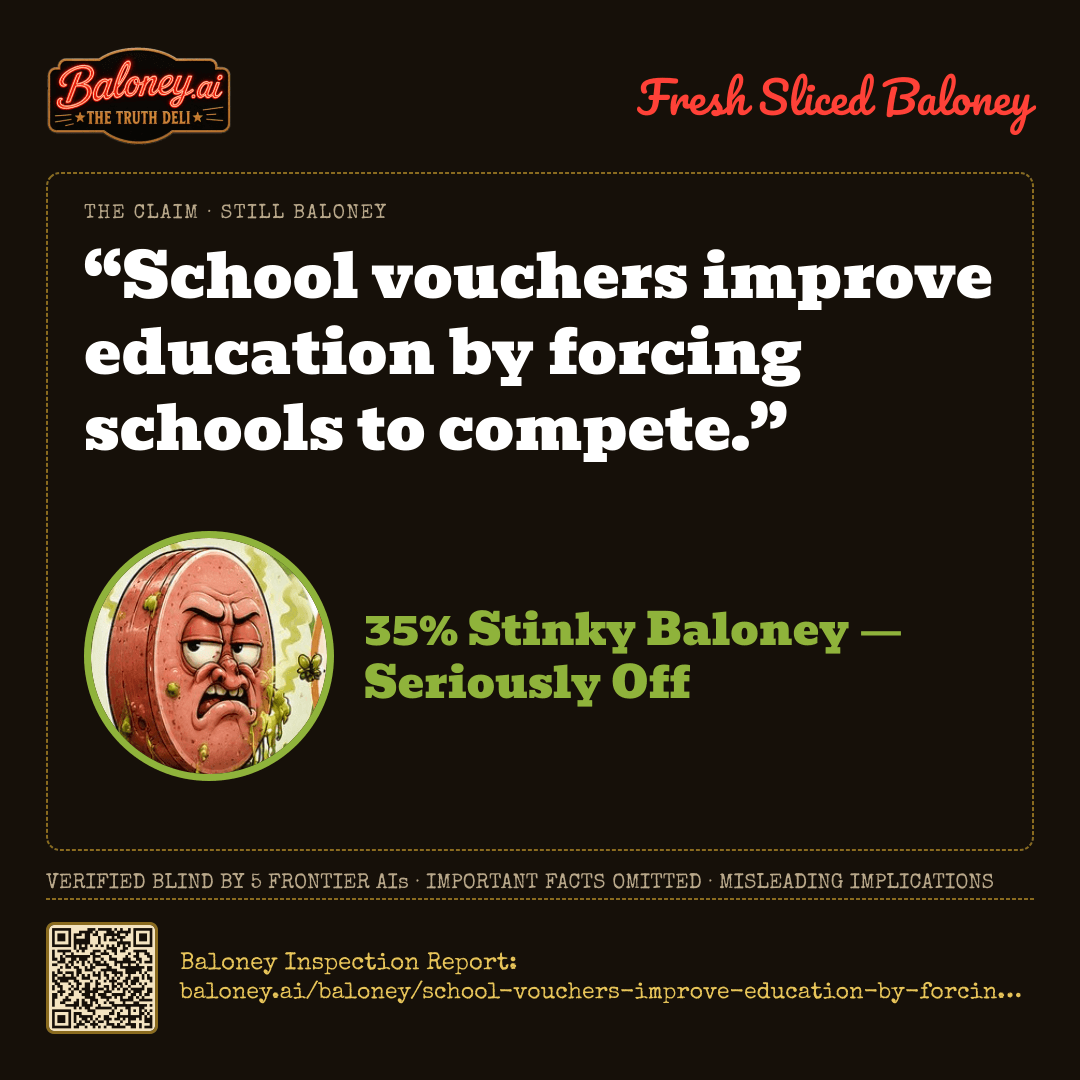
 “School vouchers improve education by forcing schools to compete.”35% Stinky Baloney — Seriously OffVerified blind by 5 frontier AIs · Baloney Inspection Report: baloney.ai/baloney/school-vouchers-improve-education-by-forcing-schools-to
The Baloney Sampler
The claim overstates the evidence. Accepted work from the American Economic Association and the National Bureau of Economic Research finds that voucher-style competition can produce small gains in nearby public schools in some settings, especially Florida. Government evaluations by the Institute of Education Sciences found some D.C. benefits such as graduation or satisfaction, but not a clear general test-score boost.
Against that, the strongest evidence shows vouchers do not reliably improve education. National Bureau of Economic Research, American Economic Association, and Institute of Education Sciences evaluations of Louisiana, Indiana, Ohio, and later D.C. found no academic benefit or significant score declines for voucher users. American Economic Association reviews describe effects as mixed, modest, and context-dependent, with the competition channel hard to isolate.
Resting on American Economic Association · National Bureau of Economic Research · National Bureau of Economic Research · Institute of Education Sciences, U.S. Dept. of Education
Original Claim Source https://www.reddit.com/r/DeepStateCentrism/comments/1wx0cas/the_liberal_center_should_embrace_school_choice/
Other ways to slice it — phrasings that might have changed the rating
- “Florida's tax-credit scholarship program produced modest gains for students who remained in nearby public schools by increasing private-school competition.” The reports cite Florida studies finding small test-score and behavioral improvements in public schools facing more private-school competition.
- “Large statewide voucher programs in Louisiana, Indiana, and Ohio harmed test-score outcomes for students who used vouchers to move to private schools.” The reports identify rigorous evaluations in those states finding significant math declines and sometimes reading declines for voucher users.
- “School vouchers can improve some non-test outcomes without reliably improving test scores.” The reports note D.C. findings on graduation, satisfaction, or safety, while later D.C. and other evaluations found no clear achievement gains.
Written from the panel’s reports by OpenAI · gpt-5.5. Nothing here changed the score.
The Order Ticket
14:38:06CLAIM RECEIVED — QUEUED FOR INSPECTION✓
14:39:11claude-opus-5 REPORTED — SCORE 45, CONFIDENCE 78✓
14:38:45gpt-5.5 REPORTED — SCORE 36, CONFIDENCE 84✓
14:38:48gemini-3.1-pro-preview REPORTED — SCORE 35, CONFIDENCE 95✓
14:38:11sonar-pro REPORTED — SCORE 24, CONFIDENCE 94✓
14:39:31grok-4.6 REPORTED — SCORE 27, CONFIDENCE 72✓
14:40:13PRIMARY MASTER CHATGPT — SCORE 35✓
14:39:48BLIND VALIDATION GROK — SCORE 33✓
14:40:35AGREEMENT CONFIRMED — DELTA 2✓
14:40:35SCORING MODEL V2 — MEDIAN OF 5 COUNTED LAB SCORES: 45, 36, 35, 24, 27 → 35.✓
14:40:35SOURCE RULE — LABS CITED 28 SOURCES: 0 DISCARDED FOR HAVING NO URL, 1 DISCARDED AS DEAD LINKS (404/410), 9 COULD NOT BE OPENED BY US AND ARE MARKED UNVERIFIED.✓
14:40:35SOURCE RULE — PRIMARY MASTER RULED ON 20 SOURCES: 0 DISCARDED FOR HAVING NO URL, 0 DISCARDED AS DEAD LINKS, 7 MARKED UNVERIFIED, 13 VERIFIED.✓
How This One Was Sliced
Station 1 · Blind Inspection — Five Graders, Zero Peeking
Each lab scored the claim independently, without seeing the others. Open a breakdown for its evidence, its sources, and how sure it was.
Anthropic · EQUAL WEIGHT · 64.2s
claude-opus-5
45%BALONEY
ROUND-1 BREAKDOWN
Evidence offered for the claim- Several rigorous studies of 'competitive effects' find small positive gains for students who REMAIN in public schools when voucher/scholarship programs expand nearby. Figlio & Hart (American Economic Journal: Applied Economics, 2014) found that Florida public schools facing more private-school competition from the Florida Tax Credit Scholarship raised student test scores modestly, with larger gains where competition was most intense.
- Figlio, Hart & Karbownik (NBER WP 26758, 2020) found that as Florida's private-choice program scaled up, public-school students' achievement improved and suspensions/absences fell — i.e., effects got more positive, not less, as the program grew, consistent with a competition channel.
- Hoxby's foundational work on Tiebout choice and inter-district competition (NBER WP 4979; AER 2000) argued that greater school competition is associated with higher achievement and lower per-pupil spending, providing the theoretical/empirical basis often cited for voucher-competition arguments.
- Some voucher programs show positive effects on non-test outcomes: the DC Opportunity Scholarship Program evaluation found higher parental satisfaction and perceptions of school safety, and earlier NYC experimental work (Chingos & Peterson) found college-enrollment gains for some African-American participants.
- Ohio's EdChoice evaluation (Figlio & Karbownik, Fordham Institute, 2016) found that public schools threatened with vouchers improved their performance, even though voucher users themselves did worse — a direct, if partial, confirmation of the competition mechanism.
Evidence against the claim- The largest and most credible recent evaluations find NEGATIVE achievement effects for voucher users. Louisiana's statewide program caused large declines in math and reading scores (Abdulkadiroğlu, Pathak & Walters, NBER WP 21839 / AEJ: Applied 2018) — among the biggest negative effects in the school-choice literature.
- The federally mandated evaluation of the DC Opportunity Scholarship Program (IES/NCEE, 2018–2019) found statistically significant negative math impacts after one year and no significant positive achievement impacts after two to three years.
- Indiana's voucher program (Waddington & Berends, JPAM 2018) and Ohio's EdChoice program (Figlio & Karbownik 2016) both found persistent losses in math for students who used vouchers to move to private schools.
- The claim's causal mechanism is contested: measured competitive effects, where positive, are small, context-specific (mostly Florida), and difficult to separate from accountability pressure, demographic sorting, and concurrent reforms. Hoxby's instrumental-variable results were disputed by Rothstein (AER 2007), who found the effects did not replicate.
- Market-competition theory depends on conditions that rarely hold in schooling — full information, low switching costs, excess high-quality supply, and non-selective admissions. Economists surveyed by the IGM/Chicago Booth panel and reported by the NYT Upshot were broadly skeptical that an unregulated education market would improve outcomes.
- Universal/near-universal voucher and ESA programs (Arizona, Florida, Indiana) have largely subsidized students already enrolled in private school, weakening the 'competition for enrollment' pressure the claim assumes while driving large unbudgeted state costs.
- Private schools in voucher markets often respond by raising tuition or adding selective admissions rather than by improving instruction, blunting the hypothesized competitive discipline.
- The statement is framed as settled fact ('improve education by forcing schools to compete'), while the empirical record is mixed-to-negative for participants and small-and-mixed for competitive spillovers — a level of certainty the evidence does not support.
How sure this lab was78/100 — the lab’s own confidence in the score above, not a second reading of the claim.
SourcesAmerican Economic Journal: Applied Economics (Figlio & Hart, 'Competitive Effects of Means-Tested School Vouchers')journal · 94 · National Bureau of Economic Research (Figlio, Hart & Karbownik, 'Effects of Scaling Up Private School Choice Programs on Public School Students')journal · 92 · National Bureau of Economic Research (Abdulkadiroğlu, Pathak & Walters, 'Free to Choose: Can School Choice Reduce Student Achievement?')journal · 93 · National Bureau of Economic Research (Hoxby, 'Does Competition Among Public Schools Benefit Students and Taxpayers?')journal · 88 · Institute of Education Sciences, U.S. Dept. of Education — DC Opportunity Scholarship Program impact evaluationgov · 95 · The New York Times (The Upshot, Susan Dynarski)news · 82 · Brookings Institution (Dynarski, 'On negative effects of vouchers')edu · 83 · EdChoice (pro-voucher research compilation; useful for the affirmative case, advocacy-aligned)other · 50
OpenAI · EQUAL WEIGHT · 38.9s
gpt-5.5
36%BALONEY
ROUND-1 BREAKDOWN
Evidence offered for the claim- There is credible evidence that some voucher or voucher-like programs can create competitive pressure on nearby public schools and produce modest test-score gains. For example, studies of Florida's tax-credit scholarship program and Milwaukee's voucher program found that public schools facing more private-school competition improved somewhat, consistent with the competition mechanism.
- Some participant outcomes have improved in certain programs. The federally evaluated DC Opportunity Scholarship Program found higher high-school graduation rates for students offered vouchers, although it did not find clear test-score gains and did not prove that competition was the mechanism.
- Economic reviews find the competition theory plausible and supported in some settings, especially where public schools face meaningful enrollment or funding pressure from private-school alternatives.
Evidence against the claim- The claim is too broad as written. High-quality studies do not show that vouchers reliably improve education overall; results vary by program, grade, outcome, and design.
- Several rigorous studies of voucher users find no academic improvement or significant test-score harm. Louisiana's voucher program produced large negative achievement effects in early years, and Indiana voucher users saw math declines after switching to private schools.
- The DC federal evaluation found higher graduation but no statistically significant overall test-score improvement, which undercuts a simple claim that vouchers improve education through competition.
- Major research reviews conclude that competitive effects are usually modest and context-dependent, and that evidence from small or targeted programs does not justify sweeping claims that vouchers generally improve education.
- The mechanism is oversimplified: many voucher markets are constrained by transportation, tuition top-ups, private-school admissions capacity, religious preferences, and uneven accountability, so schools are not always 'forced' into effective competition.
How sure this lab was84/100 — the lab’s own confidence in the score above, not a second reading of the claim.
SourcesJournal of Public Economicsjournal · 90 · Journal of Public Economicsjournal · 88 · Institute of Education Sciences, U.S. Department of Educationgov · 95 · Quarterly Journal of Economicsjournal · 94 · Institute of Education Sciences, U.S. Department of Educationgov · 95 · Journal of Policy Analysis and Managementjournal · 88 · Journal of Economic Literaturejournal · 93
Google · EQUAL WEIGHT · 41.3s
gemini-3.1-pro-preview
35%BALONEY
ROUND-1 BREAKDOWN
Evidence offered for the claim- Proponents of school vouchers argue that introducing market forces forces public schools to improve their educational offerings to retain enrolled students and their associated per-pupil funding.
- Some empirical research supports the theory of positive competitive effects. For example, a 2020 study by the National Bureau of Economic Research evaluating Florida's Tax Credit Scholarship Program found that as private school competition increased, nearby public schools saw modest gains in student test scores and decreased absenteeism.
- Earlier, smaller-scale studies of voucher programs in places like Milwaukee and Washington D.C. indicated minor positive effects on high school graduation rates for students utilizing the vouchers.
Evidence against the claim- The claim treats a highly debated economic theory as an absolute fact, ignoring recent rigorous research that contradicts it. Large-scale evaluations of modern statewide voucher programs in Louisiana, Indiana, and Ohio have shown substantial, sometimes unprecedented, negative impacts on math and reading test scores for the students who actually use the vouchers to move to private schools.
- Critics and researchers point out that 'competition' can backfire by draining critical funding from public school districts, degrading the quality of education for the vast majority of students who remain in the public system.
- The competitive field is inherently uneven. Private schools receiving voucher funds are frequently exempt from the rigorous state testing standards, public transparency requirements, and special education mandates that public schools are legally required to fulfill, meaning outcomes cannot be easily compared or competitively driven.
How sure this lab was95/100 — the lab’s own confidence in the score above, not a second reading of the claim.
SourcesNational Bureau of Economic Researchedu · 95 · National Bureau of Economic Researchedu · 95 · Wikipediaother · 75
Perplexity · EQUAL WEIGHT · 4.9s
sonar-pro
24%BALONEY
ROUND-1 BREAKDOWN
Evidence offered for the claim- A systematic review of 21 studies found that voucher- or tuition-tax-credit-induced competition had neutral to positive effects on public-school student academic outcomes, with more rigorous studies using regression-discontinuity designs.[1]
- A systematic review and meta-analysis found small positive overall effects of school-choice competition on student achievement, although effects varied by policy type and student population.[2]
- A review by the National Bureau of Economic Research concluded that evidence from both small- and large-scale programs suggests voucher-induced competition can lead public schools to improve.[3]
- A meta-analysis of randomized controlled trials found moderate evidence of positive achievement effects for students receiving private-school vouchers, though effects differed substantially across programs and years.[4]
Evidence against the claim- The NBER review also concluded that awarding students vouchers is not a systematically reliable way to improve educational outcomes; many studies found insignificant effects.[3]
- A review in the Annual Review of Economics found that the best evidence showed relatively small voucher achievement gains, most of which were not statistically different from zero.[5]
- The same review found limited evidence that competitive pressure from vouchers produces large improvements in public schools and warned against expecting major gains from comprehensive voucher systems.[5]
- The evidence concerns different mechanisms: some studies examine effects on voucher recipients, while others examine competitive effects on public schools. Therefore, positive findings for individual recipients do not establish that competition itself is the cause or that vouchers broadly improve education.[1][2][3]
How sure this lab was94/100 — the lab’s own confidence in the score above, not a second reading of the claim.
SourcesU.S. Department of Education ERIC; Journal of School Choicegov · 90 · Educational Policyjournal · 94 · National Bureau of Economic Researchedu · 96 · School Effectiveness and School Improvementjournal · 90 · Annual Review of Economicsjournal · 97
xAI · EQUAL WEIGHT · 84.8s
grok-4.6
27%BALONEY
ROUND-1 BREAKDOWN
Evidence offered for the claim- Some lottery-based evaluations (notably the federally funded D.C. Opportunity Scholarship Program) found higher high-school graduation rates and modest reading gains among voucher users.
- Studies of competitive pressure, including Figlio & Hart on Florida's tax-credit scholarships, found small test-score improvements in public schools facing a greater voucher threat.
- Economic theory (Friedman) and a subset of older city-level programs (Milwaukee, early D.C.) are consistent with the idea that private-school options can induce public schools to raise performance.
Evidence against the claim- Large, high-quality studies of statewide programs in Louisiana (Abdulkadiroğlu, Pathak & Walters), Indiana and Ohio found statistically significant declines in math (and sometimes reading) scores for students who switched to private schools with vouchers, effects that often persisted for years.
- The 2017 Journal of Economic Literature survey of the economics literature concluded that voucher effects are mixed, modest at best, and highly context-dependent rather than a reliable improvement.
- Vouchers frequently produce cream-skimming, fiscal losses for remaining public-school students, and selection of private schools that are not higher-performing; recent large-scale expansions have not produced clear system-wide academic gains.
- Results vary sharply by program design, location and subgroup, so a blanket causal claim that vouchers improve education by forcing competition overstates the evidence.
How sure this lab was72/100 — the lab’s own confidence in the score above, not a second reading of the claim.
SourcesAmerican Economic Associationjournal · 95 · American Economic Associationjournal · 95 · American Economic Associationjournal · 95 · Institute of Education Sciences, U.S. Department of Educationgov · 90
Station 2 · The Masters
Primary Master · drawn at random
gpt-5.5
35% BALONEY
I weighted the peer-reviewed studies, government evaluations, and research reviews most heavily, especially lottery, quasi-experimental, and statewide program evaluations. Those sources show that voucher-induced competition can produce modest gains in nearby public schools in some settings, especially Florida, and that some older or targeted programs reported benefits such as graduation gains. But the statement as written is broad and causal: it says vouchers improve education by forcing schools to compete. The panel evidence does not support that as a general rule. Several large, rigorous evaluations of Louisiana, Indiana, Ohio, and later D.C. voucher programs found no academic benefit or significant test-score declines for voucher users. Major reviews describe the evidence as mixed, modest, and highly dependent on program design and local conditions. I therefore score it in the Stinky Baloney range: not baseless, because the competition mechanism has some empirical support, but misleading because it presents a limited and context-dependent finding as a general fact. I discounted general background or advocacy sources such as Wikipedia and EdChoice for the core verdict, while using news/commentary sources only for context, not as primary evidence.
The evaluators broadly agreed that there is credible evidence for small positive competitive effects in some places, particularly Florida, but also agreed that voucher effects are mixed and often negative for students who use vouchers. They differed mainly in how much weight to give the competition studies: Report 3 gave the strongest credit to the competitive-pressure evidence, while Reports 1 and 2 put more emphasis on research reviews and negative statewide voucher findings. None of the five treated the blanket claim as established fact.
Blind Validation Master · never saw the Primary’s work
grok-4.6
33% BALONEY
The claim is presented as a settled causal fact, but the evidence across the reports is mixed, modest, highly context-dependent, and often negative. Some studies (especially Florida tax-credit programs) find small test-score or behavioral gains for students remaining in public schools facing more private-school pressure, and a few lottery evaluations (e.g., D.C. Opportunity Scholarship) show graduation or satisfaction benefits for voucher users. However, the largest and most rigorous evaluations of statewide programs (Louisiana, Indiana, Ohio) find statistically significant and persistent declines in math (and sometimes reading) for students who switch to private schools with vouchers. Systematic reviews and the 2017 JEL survey conclude effects are not systematically positive, competitive spillovers are small and hard to isolate from other reforms, and market conditions required for the Friedman-style mechanism (information, capacity, non-selective supply, funding pressure) frequently do not hold. Cream-skimming, fiscal drain on remaining public-school students, and private-school responses such as tuition increases further weaken the 'forcing competition improves education' story. The statement therefore omits material contrary evidence and overstates both the reliability of improvement and the competition channel.
AGREEMENT TEST PASSED — MASTERS SCORED 35% AND 33% · BLIND VALIDATION CONFIRMED THIS SCORE · NO RE-EVALUATION REQUIRED
How the number was reached · scoring model v2 · how our models work
- Median of 5 counted lab scores: 45, 36, 35, 24, 27 → 35.
The Evidence
Evidence offered for the claim
- Some competitive effects Studies of Florida's tax-credit scholarship program found modest test-score improvements, and in some analyses lower absences and suspensions, among public-school students exposed to more private-school competition.
- Targeted-program benefits Earlier or smaller programs, including D.C., Milwaukee, and some city-level voucher studies, reported benefits such as higher graduation rates, parental satisfaction, perceptions of safety, or modest reading gains, though these do not prove a general competition effect.
- Review-level support Some systematic reviews and meta-analyses found neutral-to-positive or small positive average effects from school-choice competition, but they also reported variation by policy type, population, and setting.
- Market theory DEBUNKED — The Friedman-style theory says vouchers pressure schools to improve to retain students and funding, but the panel found that real voucher markets often lack the conditions needed for clean competition, such as full information, low switching costs, ample high-quality supply, and comparable accountability.
Evidence against the claim
- Statewide harms Large, rigorous evaluations of Louisiana, Indiana, and Ohio found significant declines in math, and sometimes reading, for students who switched to private schools using vouchers.
- Mixed reviews Major reviews in the Journal of Economic Literature and Annual Review of Economics characterized voucher effects as mixed, modest, often statistically insignificant, and highly context-dependent.
- Mechanism not proven Positive outcomes for voucher recipients, such as graduation or satisfaction, do not by themselves show that schools improved because they were forced to compete.
- Small spillovers Where competitive effects on public schools are found, they tend to be modest and concentrated in particular programs, especially Florida, rather than evidence of reliable system-wide improvement.
- Market constraints Transportation, tuition top-ups, admissions limits, religious preferences, accountability differences, and private-school capacity can blunt or distort the competitive pressure the claim assumes.
Sources · Reliability · Why Accepted or Discounted
Every link was opened when this claim was inspected. A dead link was discarded before publication; “unverified” means the site refused our automated check and the link is the one the panel cited. A source without a URL was never kept.
Serve It Fresh
Ready to Serve10 servings
Serve it the way you want it
The Verdict
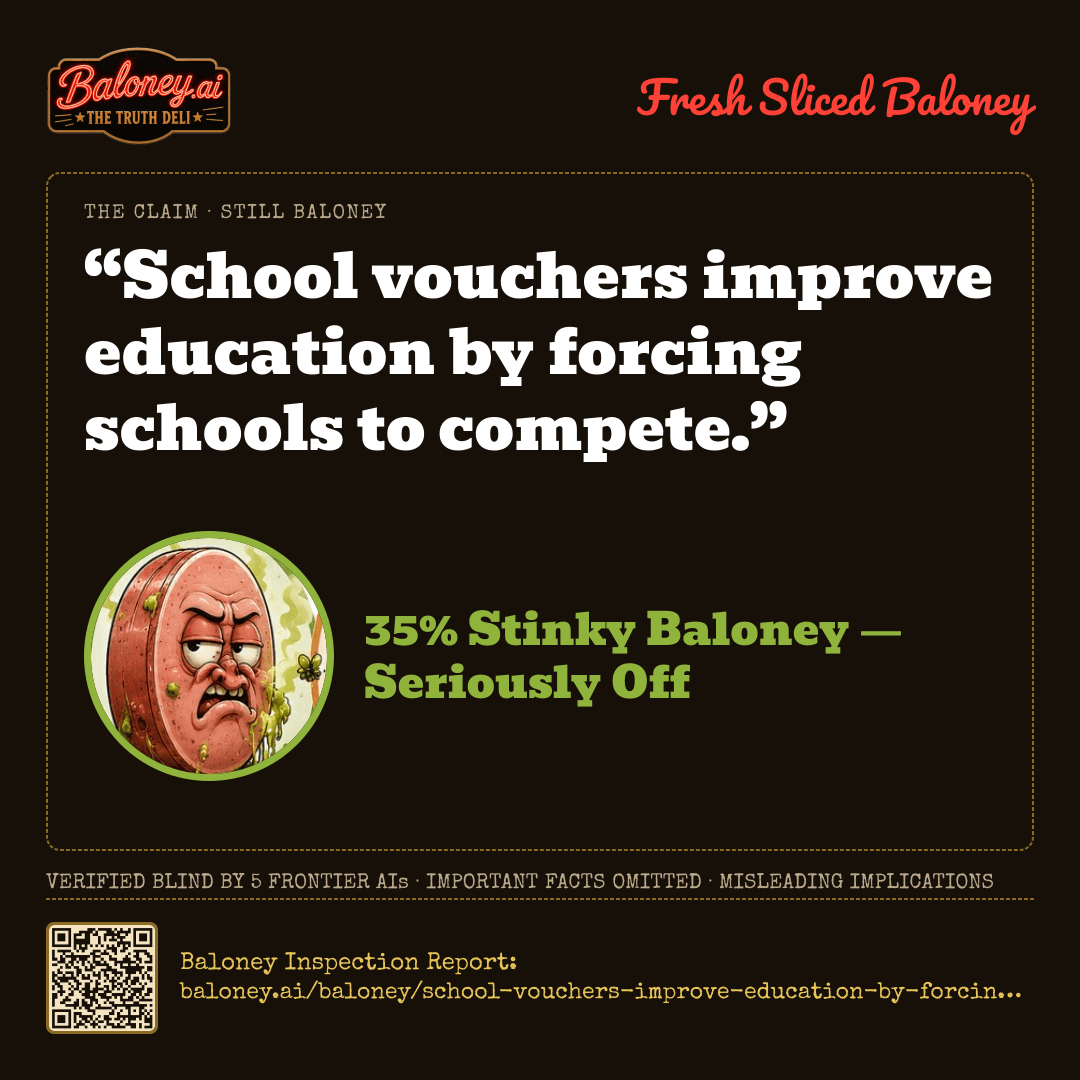
“School vouchers improve education by forcing schools to compete.”35% Stinky Baloney — Seriously OffVerified blind by 5 frontier AIs · Baloney Inspection Report: baloney.ai/baloney/school-vouchers-improve-education-by-forcing-schools-to