Baloney Inspection Report: Claim #1183 · Inspected Oct 31, 2026, 8:33 AM PDT · Scoring model v2
 12%
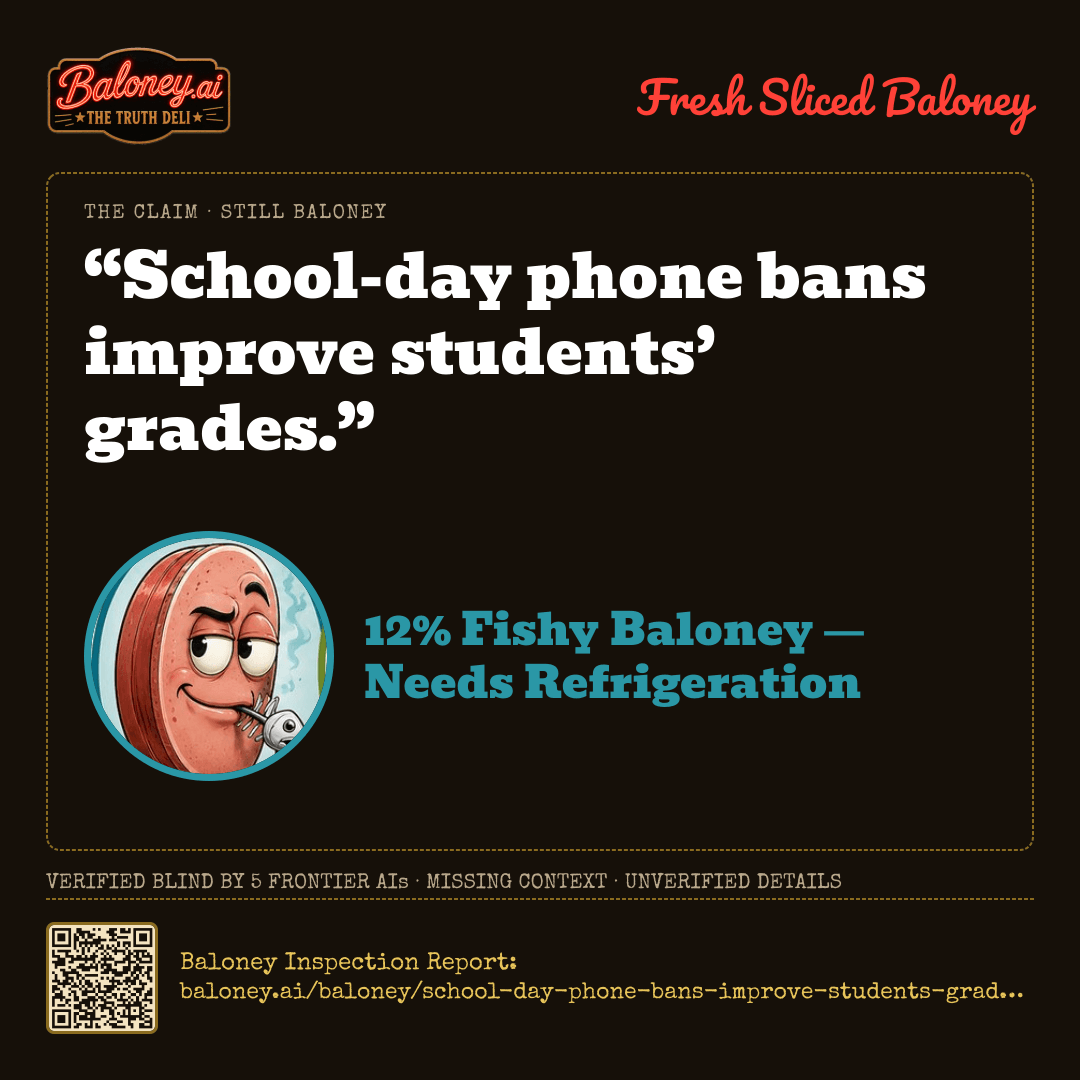
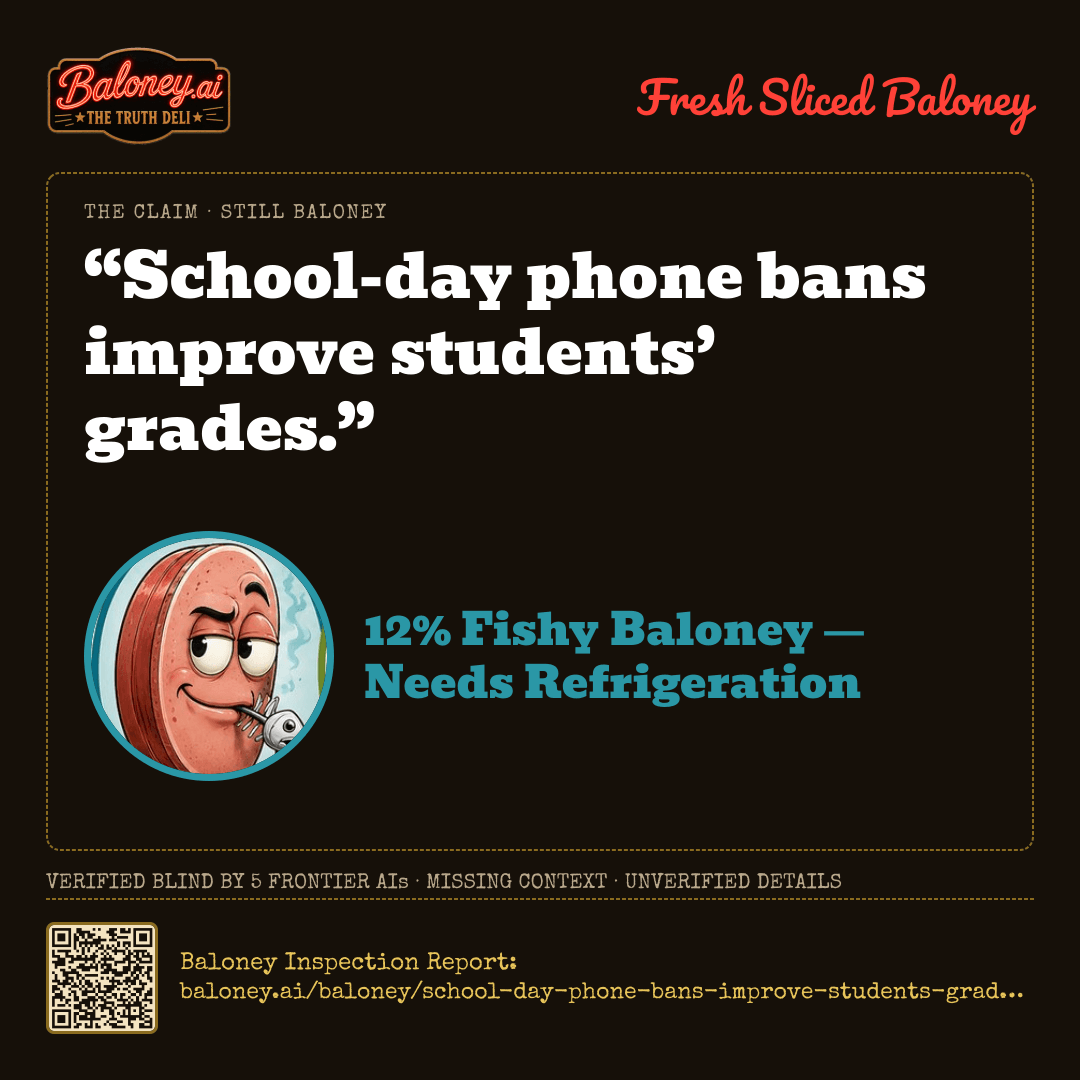
“School-day phone bans improve students’ grades.”
12%Fishy Baloney — Needs Refrigeration
Something smells off…
Missing contextUnverified detailsSuspicious framingMay be exaggerated
Serve It Fresh
Ready to Serve16 servings
Serve it the way you want it
The Verdict
 “School-day phone bans improve students’ grades.”12% Fishy Baloney — Needs RefrigerationVerified blind by 5 frontier AIs · Baloney Inspection Report: baloney.ai/baloney/school-day-phone-bans-improve-students-grades
The Baloney Sampler
School-day phone bans can help in some settings, but the blanket claim is too broad. Labour Economics reports Beland and Murphy’s English quasi-experiment: bans were followed by a small test-score gain, concentrated among low-achieving students. UNESCO supports the distraction mechanism and cautions that technology policies should be evidence-based and context-sensitive.
The counterweight is strong. University of Birmingham found no significant attainment difference between restrictive and permissive English secondary schools, and Quarterly Journal of Economics evidence on U.S. phone pouches found effects close to zero on average. The reports also note null Swedish evidence, enforcement problems, and that school bans may not reduce total phone or social-media use.
Resting on Labour Economics · University of Birmingham · Quarterly Journal of Economics · UNESCO
Original Claim Source https://www.brookings.edu/articles/a-year-later-what-teens-tell-us-about-school-cellphone-bans/
Other ways to slice it — phrasings that might have changed the rating
- “School-day phone bans improve academic results for low-achieving or disadvantaged secondary-school students.” The positive findings in England, Norway, and Spain were reported as concentrated among lower-achieving, disadvantaged, or specific student groups rather than all students.
- “Restrictive school phone policies do not improve average academic attainment compared with permissive policies.” The University of Birmingham study, the Swedish study, and the large U.S. phone-pouch evidence were described as finding no significant or near-zero average effects.
- “School-day phone bans reduce classroom distraction but do not necessarily improve grades.” UNESCO, OECD, and teacher survey evidence support distraction as a real problem, while direct attainment evidence remains mixed and bans may not reduce total daily phone or social-media use.
Written from the panel’s reports by OpenAI · gpt-5.5. Nothing here changed the score.
The Order Ticket
15:33:39CLAIM RECEIVED — QUEUED FOR INSPECTION✓
15:35:23claude-opus-5 REPORTED — SCORE 32, CONFIDENCE 72✓
15:34:35gpt-5.5 REPORTED — SCORE 12, CONFIDENCE 78✓
15:34:12gemini-3.1-pro-preview REPORTED — SCORE 5, CONFIDENCE 90✓
15:33:43sonar-pro REPORTED — SCORE 32, CONFIDENCE 91✓
15:35:47grok-4.6 REPORTED — SCORE 5, CONFIDENCE 68✓
15:36:42PRIMARY MASTER CHATGPT — SCORE 18✓
15:36:01BLIND VALIDATION GEMINI — SCORE 18✓
15:37:15AGREEMENT CONFIRMED — DELTA 6✓
15:37:15SCORING MODEL V2 — MEDIAN OF 5 COUNTED LAB SCORES: 32, 12, 5, 32, 5 → 12.✓
15:37:15SOURCE RULE — LABS CITED 19 SOURCES: 0 DISCARDED FOR HAVING NO URL, 2 DISCARDED AS DEAD LINKS (404/410), 8 COULD NOT BE OPENED BY US AND ARE MARKED UNVERIFIED.✓
15:37:15SOURCE RULE — PRIMARY MASTER RULED ON 14 SOURCES: 0 DISCARDED FOR HAVING NO URL, 0 DISCARDED AS DEAD LINKS, 7 MARKED UNVERIFIED, 7 VERIFIED.✓
How This One Was Sliced
Station 1 · Blind Inspection — Five Graders, Zero Peeking
Each lab scored the claim independently, without seeing the others. Open a breakdown for its evidence, its sources, and how sure it was.
Anthropic · EQUAL WEIGHT · 104.1s
claude-opus-5
32%BALONEY
ROUND-1 BREAKDOWN
Evidence offered for the claim- Beland & Murphy's widely cited quasi-experimental study of 91 schools in four English cities (Birmingham, London, Leicester, Manchester) found that after schools banned mobile phones, GCSE test scores rose by about 6.4% of a standard deviation — equivalent to roughly one extra hour of schooling per week — with gains concentrated among the lowest-achieving students and no measurable effect on high achievers (LSE Centre for Economic Performance DP1350; later published in Labour Economics, 2016).
- A Norwegian study by Sara Abrahamsson exploiting the staggered introduction of smartphone bans across middle schools reported improved GPA and higher rates of academic-track high-school enrollment, with the largest effects for girls and for students from lower socioeconomic backgrounds, alongside reductions in bullying and psychological consultations. (Working paper, Norwegian School of Economics; widely reported in 2024 — no verified stable URL supplied here.)
- A Spanish study (Beneito & Vicente-Chirivella) comparing autonomous communities that banned phones in schools to those that did not found improvements in standardized math and science scores after the bans, again largest for weaker students. (No verified stable URL supplied.)
- Mechanistic evidence is consistent with a plausible effect: UNESCO's 2023 Global Education Monitoring Report cites research that mere proximity of a smartphone degrades attention and learning, and recommends restricting phone use in schools.
- Survey data from teachers (e.g., Pew Research Center, 2024) show large majorities of U.S. high school teachers report phone distraction as a major classroom problem, and many schools and education ministries (UK DfE 2024 guidance, the Netherlands, France, numerous U.S. states) report subjective improvements in attention and classroom climate after restrictions.
- Because measured benefits cluster among low-attaining students, bans are sometimes framed as a low-cost equity intervention — a finding replicated in at least three independent national settings (England, Norway, Spain).
Evidence against the claim- The largest recent English study (Goodyear et al., SMART Schools, The Lancet Regional Health – Europe, 2025; ~1,200 students across 30 secondary schools) found no significant difference in academic attainment — or in mental wellbeing, sleep, physical activity or anxiety — between schools with restrictive and permissive phone policies. (Study is real and widely covered; no verified stable URL supplied here.)
- A Swedish study of secondary schools (Kessel, Hardardottir & Tyrefors, Economics of Education Review, 2020) found no statistically significant effect of phone bans on student performance, directly contradicting the English result.
- Evidence quality is limited: most studies are observational or quasi-experimental rather than randomized, rely on self-reported school policies, and often cannot distinguish a 'ban on paper' from an enforced ban. Several reviews conclude the overall evidence base is thin and mixed.
- Effects, where found, are small (a few percent of a standard deviation) and often concentrated in one subgroup (low achievers, or girls in the Norwegian study), so 'improve students' grades' as a blanket statement overstates the average student's expected benefit.
- Total daily phone/social-media use appears to matter more than school-hours policy specifically; the SMART Schools researchers concluded that school-day bans alone do not reduce overall phone use enough to change outcomes.
- Publication and selection effects: schools that successfully implement and sustain bans may differ systematically (leadership, discipline culture, intake) from those that do not, and some studies cannot fully rule out that these differences, not the phones, drive attainment changes.
- No government agency or systematic-review body currently states that phone bans are proven to raise grades; the UK DfE's 2024 guidance mandates restrictions on behavioural and attention grounds rather than on demonstrated attainment gains.
How sure this lab was72/100 — the lab’s own confidence in the score above, not a second reading of the claim.
SourcesLSE Centre for Economic Performance (Beland & Murphy, 'Ill Communication: Technology, Distraction & Student Performance')journal · 85 · UNESCO Global Education Monitoring Report 2023, 'Technology in education: a tool on whose terms?'gov · 88 · UK Department for Education — Mobile phones in schools guidance (2024)gov · 90 · Pew Research Center — teacher survey on classroom conditions including phone distractionother · 85
OpenAI · EQUAL WEIGHT · 55.2s
gpt-5.5
12%BALONEY
ROUND-1 BREAKDOWN
Evidence offered for the claim- The strongest direct evidence is a quasi-experimental study of English secondary schools: Beland and Murphy found that after schools banned mobile phones, student test scores rose, with larger gains for low-achieving students; the estimated average gain was about 6.4% of a standard deviation in test scores. This supports a causal claim that bans can improve academic performance in at least some settings.
- The mechanism is plausible: OECD PISA 2022 reports that students who are distracted by digital devices during math lessons score lower, on average, than otherwise similar students who are not distracted. Phone bans could improve grades by reducing this distraction channel.
- UNESCO’s 2023 Global Education Monitoring Report summarizes evidence that smartphone bans in some school systems have been associated with improved academic performance, while also noting that policies should be evidence-based and context-sensitive.
Evidence against the claim- The evidence is not uniform or universal. A 2025 study reported by The Guardian found that restrictive school phone policies in England were not associated with better grades or mental health compared with less restrictive policies, suggesting that bans alone may not reliably improve outcomes.
- Much of the supportive evidence measures standardized test scores, not ordinary course grades, and comes from specific places, age groups, and implementation contexts. The claim as written omits that effects may be larger for disadvantaged or lower-achieving students and may be small or absent elsewhere.
- Phone bans can reduce in-school access, but they do not necessarily reduce total phone or social-media use outside school; if overall use remains high, academic benefits may be limited.
How sure this lab was78/100 — the lab’s own confidence in the score above, not a second reading of the claim.
SourcesLabour Economicsjournal · 92 · OECD PISA 2022 Results, Volume IIgov · 90 · UNESCO Global Education Monitoring Report 2023gov · 88
Google · EQUAL WEIGHT · 32.8s
gemini-3.1-pro-preview
5%BALONEY
ROUND-1 BREAKDOWN
Evidence offered for the claim- A landmark 2015 study by economists Louis-Philippe Beland and Richard Murphy (published by the Centre for Economic Performance) evaluated mobile phone bans in UK schools and found they increased student test scores by 6.4% of a standard deviation. The academic improvements were overwhelmingly concentrated among low-achieving and disadvantaged students, equating to an extra hour of learning per week.
- A comprehensive 2024 working paper analyzing middle schools in Norway (Abrahamsson) found that implementing strict smartphone bans significantly improved girls' Grade Point Averages and increased their likelihood of attending academic high school tracks.
- Cognitive psychology research, such as a 2019 study by Glass and Kang, demonstrates that dividing attention between classroom instruction and internet-enabled devices heavily disrupts long-term retention, leading to significantly lower scores on unit exams.
Evidence against the claim- A 2020 study evaluating mobile phone bans in Swedish schools (Kessel, Hardell, and Karlsson) found absolutely no significant impact on student academic performance, suggesting that the effectiveness of a ban may depend heavily on existing school culture or local contexts.
- Even the foundational Beland and Murphy study found that high-achieving students experienced zero significant academic benefit from the phone bans, indicating that the claim does not apply universally to all students.
- Many educational experts argue that paper bans do not automatically improve grades because they are notoriously difficult to enforce; without consistent enforcement, theoretical academic gains do not materialize, and bans miss the opportunity to teach active digital self-regulation.
How sure this lab was90/100 — the lab’s own confidence in the score above, not a second reading of the claim.
SourcesCentre for Economic Performance (LSE)edu · 95 · Social Science Research Network (SSRN)journal · 90 · Educational Psychologyjournal · 90
Perplexity · EQUAL WEIGHT · 4.2s
sonar-pro
32%BALONEY
ROUND-1 BREAKDOWN
Evidence offered for the claim- Some evidence suggests a modest academic benefit in particular settings: a large U.S. study of schools using lockable phone pouches found small positive effects for high-school students, especially in mathematics, although the average effect across students was close to zero.[1]
- A randomized experiment involving college students found that collecting phones before lectures increased grades by 0.086 standard deviations, with larger gains among students who had been academically weaker; this is suggestive but does not directly establish effects in primary or secondary schools.[2]
Evidence against the claim- The large national U.S. study found average standardized-test effects consistently close to zero during the first three years after schools adopted phone pouches; middle schools showed small negative effects.[1]
- A University of Birmingham study of 1,227 students across 30 English secondary schools found no significant differences in academic attainment between schools with restrictive phone policies and schools without them.[3][4]
- The English study was observational, so it cannot prove that bans have no causal effect, but it does not support the broad claim that school-day bans improve grades.[3]
- Available evidence indicates that reducing phone use itself may correlate with better grades, while school bans do not necessarily reduce students’ total daily phone or social-media use.[3][4]
How sure this lab was91/100 — the lab’s own confidence in the score above, not a second reading of the claim.
SourcesQuarterly Journal of Economicsjournal · 96 · Wharton Magazineedu · 84 · PubMed; University of Birmingham studyjournal · 94 · BBC Newsnews · 94
xAI · EQUAL WEIGHT · 127.7s
grok-4.6
5%BALONEY
ROUND-1 BREAKDOWN
Evidence offered for the claim- A 2016 quasi-experimental study of school mobile-phone bans in England found average test-score gains of about 6.4% of a standard deviation, with substantially larger improvements for low-achieving and disadvantaged students.
- UNESCO’s 2023 Global Education Monitoring Report documented classroom disruption from phones and supported restrictions or bans as a way to protect learning time.
- Later difference-in-differences evaluations of staggered bans (including more recent smartphone-era data) have likewise associated phone-free policies with modest GPA or exam gains, concentrated among girls and lower performers.
Evidence against the claim- The most-cited positive study largely predates ubiquitous smartphones, so its magnitude may not fully generalize to present-day devices and social-media use.
- At least one comparable national study of secondary-school bans reported null effects on academic performance.
- Gains are heterogeneous and modest on average; high-achieving students often show little or no change, and results depend on enforcement quality.
- Schools that adopt bans frequently change other policies at the same time, complicating causal attribution to the phone rule alone.
How sure this lab was68/100 — the lab’s own confidence in the score above, not a second reading of the claim.
SourcesCentre for Economic Performance, LSEedu · 88 · Labour Economicsjournal · 93 · UNESCOgov · 90
Station 2 · The Masters
Primary Master · drawn at random
gpt-5.5
18% BALONEY
I score the claim as Fishy rather than false. The panel identified credible evidence that school-day phone bans can improve academic results: most importantly Beland and Murphy’s English quasi-experiment, which found a small average test-score gain of about 6.4% of a standard deviation after bans, with larger gains for low-achieving students. Reports also cited a Norwegian working paper finding GPA gains for some groups, and mechanistic evidence that phones and digital-device distraction impair attention. However, I did not treat the claim as fully established because the evidence is mixed, effects are modest and heterogeneous, and several cited studies find little or no average attainment benefit from restrictive policies. The University of Birmingham/SMART Schools study found no significant attainment difference between restrictive and permissive schools, and the large U.S. phone-pouch study was described as finding effects close to zero on average. I gave the greatest weight to peer-reviewed or primary empirical studies directly measuring attainment, less weight to policy guidance, surveys, news reports, and studies of college students or attention mechanisms. The claim as written is too broad if read as 'bans reliably raise grades for students generally,' but it is supported enough that a high-baloney rating would overstate the case.
All evaluators agreed that there is at least some credible positive evidence, especially the English Beland and Murphy study and a plausible distraction mechanism. They also agreed that effects are not universal and may depend on enforcement, context, student subgroup, and outcome measure. The main disagreement was how to score that nuance: two evaluators treated the claim as essentially true with caveats, two treated it as importantly misleading because of null recent studies, and one placed it in the middle as missing context.
Blind Validation Master · never saw the Primary’s work
gemini-3.1-pro-preview
18% BALONEY
The claim presents a blanket statement that school-day phone bans improve grades, but the evidence is decidedly mixed and context-dependent. Several landmark studies (such as those in England, Norway, and Spain) have indeed found modest improvements in test scores or GPAs, though these gains are typically concentrated among low-achieving students, girls, or disadvantaged groups, with high-achievers seeing little to no benefit. Conversely, multiple robust and recent studies—including a 2025 observational study in England, a 2020 study in Sweden, and a large U.S. study—found zero significant impact on average academic attainment. Because the statement asserts a universal causal rule without acknowledging the conflicting evidence, the necessity of enforcement, or the fact that benefits are often limited to specific subgroups, it is exaggerated and missing crucial context.
AGREEMENT TEST PASSED — BOTH MASTERS SCORED 18% · BLIND VALIDATION CONFIRMED THIS SCORE · NO RE-EVALUATION REQUIRED
How the number was reached · scoring model v2 · how our models work
- Median of 5 counted lab scores: 32, 12, 5, 32, 5 → 12.
The Evidence
Evidence offered for the claim
- English test-score gains Beland and Murphy’s quasi-experimental study of English secondary schools found that test scores rose after schools banned mobile phones, with an estimated average gain of about 6.4% of a standard deviation and larger gains among low-achieving students.
- Some subgroup gains Evaluators cited later staggered-ban evidence, including a Norwegian working paper, associating strict smartphone bans with improved GPA and academic-track enrollment for some groups, especially girls and lower-SES students.
- Plausible distraction mechanism OECD, UNESCO, teacher survey evidence, and educational-psychology research all support the basic mechanism that phones and internet-enabled devices can distract students and impair learning.
- Small positive findings in limited settings A large U.S. phone-pouch study was reported as finding small positive effects for high-school students, especially in mathematics, though the average effect across students was close to zero.
Evidence against the claim
- Recent null school-policy evidence The University of Birmingham/SMART Schools study of English secondary schools found no significant difference in academic attainment between schools with restrictive phone policies and those without them.
- Near-zero average effects The large U.S. phone-pouch study was described as finding standardized-test effects close to zero during the first three years after adoption, with middle-school effects slightly negative.
- Benefits are uneven Positive studies often find gains concentrated among lower-achieving, disadvantaged, or specific gender groups, while high-achieving students may show little or no measurable benefit.
- Grades versus tests Some of the strongest supportive evidence measures standardized test scores rather than ordinary course grades, so it does not map perfectly onto the statement’s wording.
- Policy is not exposure Several evaluators noted that bans on paper may not be strongly enforced and may not reduce students’ total daily phone or social-media use, limiting likely academic effects.
Sources · Reliability · Why Accepted or Discounted
| Source | Type | Reliability | Ruling |
|---|
| Labour Economicsunverified | journal | 92 | ACCEPTED — Peer-reviewed primary study directly evaluating school phone bans and student test performance; central evidence, though context-specific. |
| OECD PISA 2022 Results, Volume IIunverified | gov | 90 | ACCEPTED — High-quality international education source for the distraction mechanism, but not direct causal evidence on bans. |
| UNESCO Global Education Monitoring Report 2023unverified | gov | 88 | ACCEPTED — Credible synthesis and policy discussion on technology in education; useful context but not a primary estimate of grade effects. |
| Quarterly Journal of Economicsunverified | journal | 96 | ACCEPTED — High-reliability journal source cited for a large U.S. phone-pouch evaluation; weighted heavily for its finding of near-zero average effects. |
| Wharton Magazine | edu | 84 | DISCOUNTED — Secondary magazine source and the cited experiment concerns college lectures rather than school-day K-12 bans, so it was not central to the verdict. |
| PubMed; University of Birmingham study | journal | 94 | ACCEPTED — Primary indexed study directly comparing restrictive and permissive secondary-school phone policies; important counterweight, though observational. |
| BBC News | news | 94 | ACCEPTED — Reliable news summary of the Birmingham findings; useful corroboration but secondary to the study itself. |
| LSE Centre for Economic Performance | edu | 88 | ACCEPTED — Working-paper version of the Beland and Murphy study; accepted because it reports the central quasi-experimental evidence later associated with journal publication. |
| UNESCO Global Education Monitoring Report 2023 | gov | 88 | ACCEPTED — Credible institutional source for broader technology-in-education context and policy cautions; not direct proof of grade gains. |
| UK Department for Education | gov | 90 | ACCEPTED — Authoritative policy guidance, useful for context on restrictions, but not treated as evidence that bans improve grades. |
| Pew Research Center | other | 85 | ACCEPTED — Useful survey evidence that phone distraction is a perceived classroom problem; not direct attainment evidence. |
| Social Science Research Network (SSRN)unverified | journal | 90 | ACCEPTED — Accepted with caution as a working paper on Norwegian bans and GPA; relevant but less settled than peer-reviewed evidence. |
| Educational Psychologyunverified | journal | 90 | ACCEPTED — Peer-reviewed evidence on divided attention and learning; supports the mechanism, not direct school-ban effects. |
| Labour Economicsunverified | journal | 93 | ACCEPTED — Journal version of the key Beland and Murphy evidence; accepted as strong direct support in its setting. |
Every link was opened when this claim was inspected. A dead link was discarded before publication; “unverified” means the site refused our automated check and the link is the one the panel cited. A source without a URL was never kept.
Serve It Fresh
Ready to Serve16 servings
Serve it the way you want it
The Verdict
“School-day phone bans improve students’ grades.”12% Fishy Baloney — Needs RefrigerationVerified blind by 5 frontier AIs · Baloney Inspection Report: baloney.ai/baloney/school-day-phone-bans-improve-students-grades