Baloney Inspection Report: Claim #1155 · Inspected Oct 30, 2026, 10:06 PM PDT · Scoring model v2
 95%
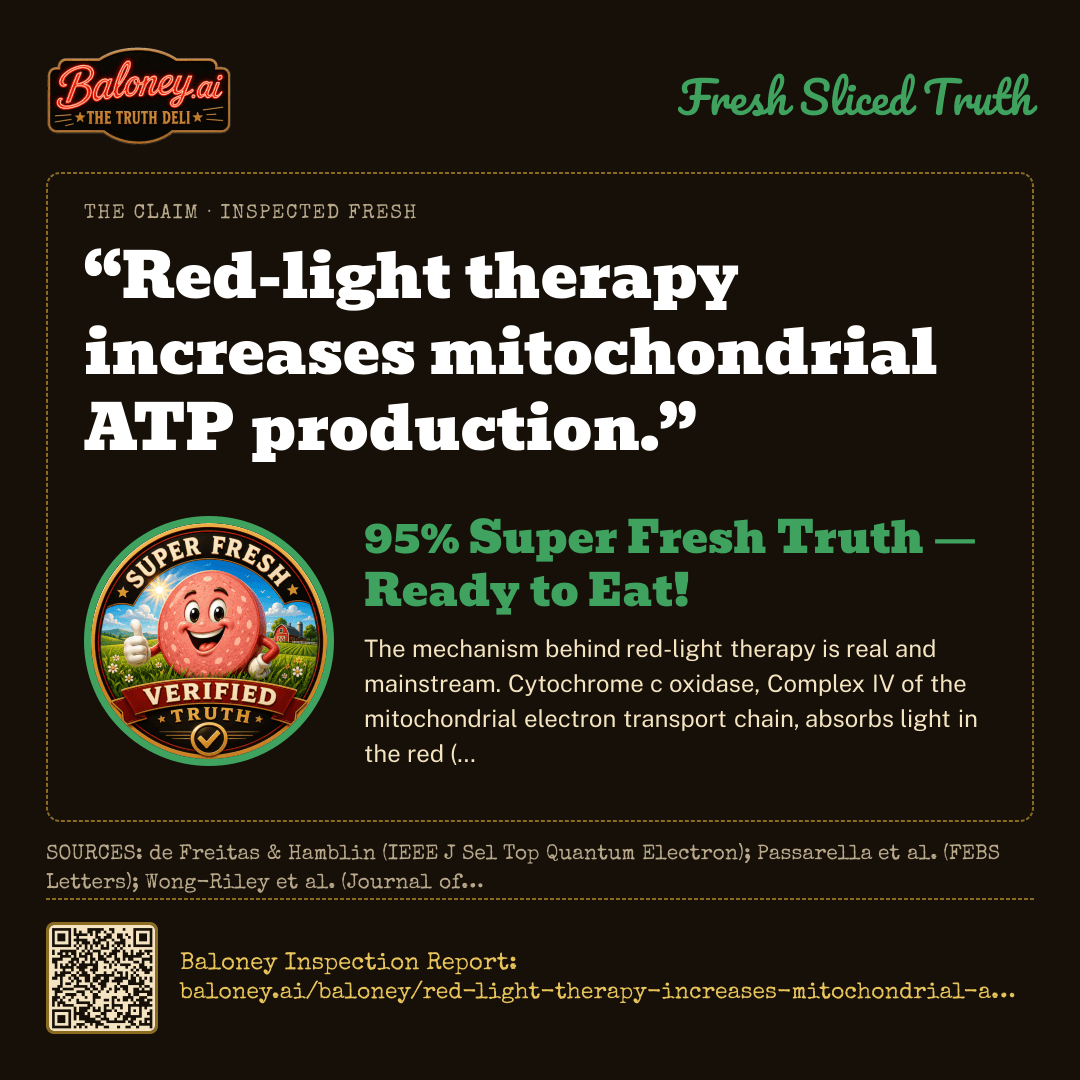
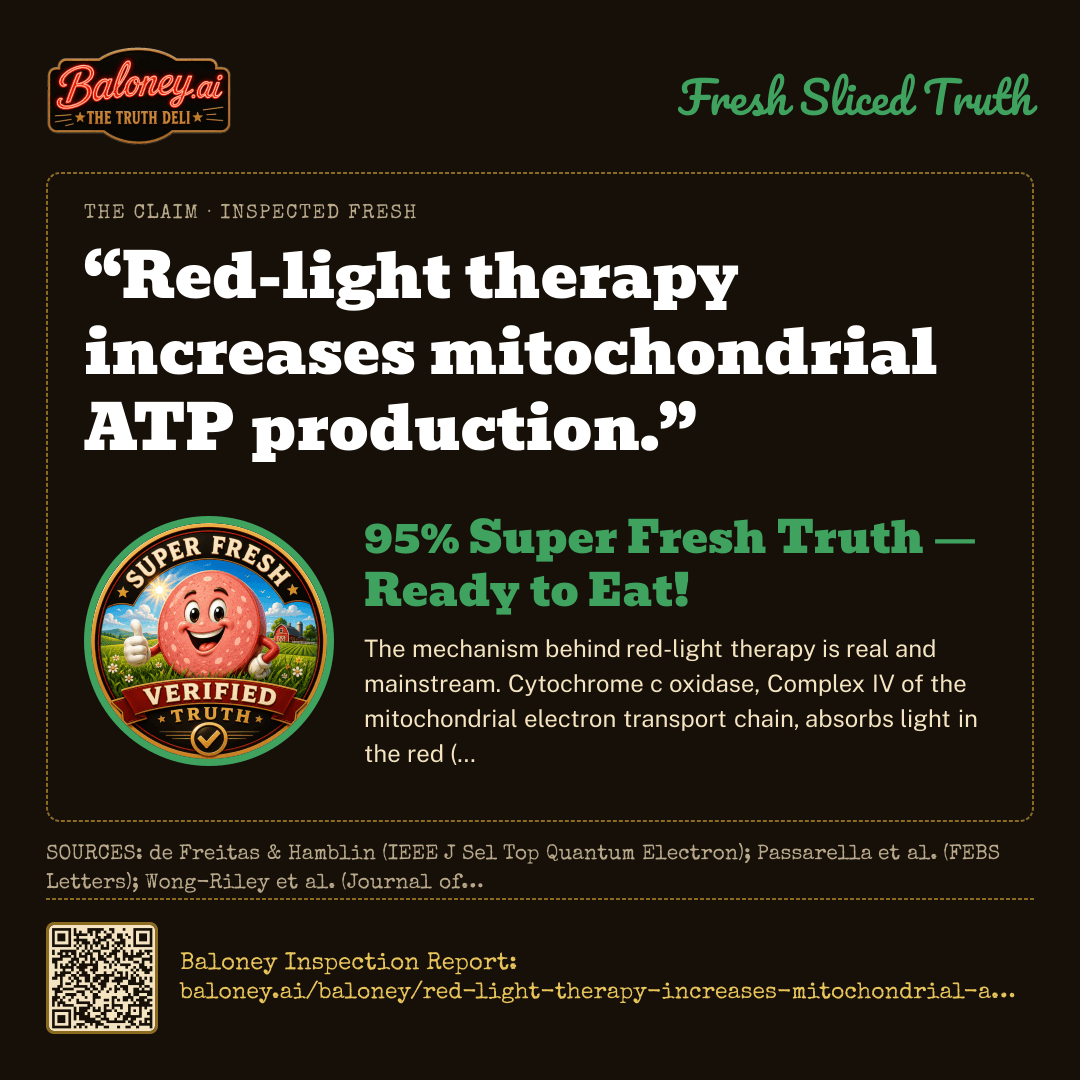
“Red-light therapy increases mitochondrial ATP production.”
95%Super Fresh Truth — Ready to Eat!
THE CLAIM CHECKS OUT.
Independently verifiedPhysically repeatable evidenceConfirmed across rival labsSafe to serve
Serve It Fresh
Ready to Serve11 servings
Serve it the way you want it
The Verdict
 “Red-light therapy increases mitochondrial ATP production.”95% Super Fresh Truth — Ready to Eat!Verified blind by 5 frontier AIs · Baloney Inspection Report: baloney.ai/baloney/red-light-therapy-increases-mitochondrial-atp-production
The Baloney Sampler
All five labs agreed on the mechanism: red and near-infrared light (roughly 600–900 nm) is absorbed by cytochrome c oxidase, Complex IV of the mitochondrial electron transport chain, which speeds electron transport, raises membrane potential and increases ATP synthesis. Passarella and colleagues in FEBS Letters showed this directly in irradiated isolated rat liver mitochondria; Wong-Riley and colleagues in the Journal of Biological Chemistry reported 670 nm light affecting cytochrome c oxidase and ATP in stressed neurons. Reviews in IEEE Journal of Selected Topics in Quantum Electronics and Annals of Biomedical Engineering treat it as consensus.
The panel's deductions are about unstated conditions, not falsity. The Dose-Response review documents a biphasic effect: moderate doses stimulate ATP, excessive doses can do nothing or inhibit. The strongest direct ATP measurements come from isolated mitochondria and cell culture; in living tissue, light penetrates only millimetres to centimetres and increases are typically transient. Alternative photoacceptors — ion channels, interfacial water, flavins — have also been proposed. Consumer-health summaries were discounted as adding no independent evidence.
Resting on IEEE Journal of Selected Topics in Quantum Electronics (via NIH PMC) · FEBS Letters (via PubMed) · Journal of Biological Chemistry (via PubMed) · Dose-Response (via NIH PMC)
Original Claim Source https://www.reddit.com/r/u_kagainstitute/comments/1wqoosr/red_light_therapy_for_skin_sciencebacked_benefits/
Other ways to slice it — phrasings that might have changed the rating
- “Any red-light therapy device, at any dose, increases mitochondrial ATP production.” Every evaluator flagged the biphasic dose response, under which excessive irradiance or exposure can produce no benefit or inhibit respiration, so a universal reading would not survive the Dose-Response evidence.
- “Red-light therapy increases mitochondrial ATP production measurably inside living human tissue.” The reports note that direct ATP quantification is almost entirely in isolated mitochondria and cell culture, with scattering, absorption and millimetre-to-centimetre penetration limiting in vivo confirmation.
- “Red-light therapy produces a sustained, body-wide increase in cellular energy.” The panel found reported ATP increases to be transient and limited to superficial tissue, and identified systemic 'energy boost' framing as manufacturer overreach beyond the clinical evidence.
Written from the panel’s reports by Anthropic · claude-opus-5. Nothing here changed the score.
The Order Ticket
05:06:26CLAIM RECEIVED — QUEUED FOR INSPECTION✓
05:07:22claude-opus-5 REPORTED — SCORE 4, CONFIDENCE 86✓
05:07:08gpt-5.5 REPORTED — SCORE 5, CONFIDENCE 84✓
05:06:56gemini-3.1-pro-preview REPORTED — SCORE 3, CONFIDENCE 95✓
05:06:30sonar-pro REPORTED — SCORE 5, CONFIDENCE 84✓
05:08:02grok-4.6 REPORTED — SCORE 5, CONFIDENCE 78✓
05:09:06PRIMARY MASTER CLAUDE — SCORE 5✓
05:08:09BLIND VALIDATION GEMINI — SCORE 4✓
05:09:26AGREEMENT CONFIRMED — DELTA 1✓
05:09:26SCORING MODEL V2 — MEDIAN OF 5 COUNTED LAB SCORES: 4, 5, 3, 5, 5 → 5. FRESH RULE: THE PRIMARY MASTER SCORES 5 AND THE BLIND MASTER 4 — BOTH SUPER FRESH TRUTH — AND THE COUNTED MEDIAN IS 5, ON THE TRUE SIDE. PUBLISHED AS 5, THE MORE CAUTIOUS OF THE TWO MASTERS.✓
05:09:26SOURCE RULE — LABS CITED 21 SOURCES: 0 DISCARDED FOR HAVING NO URL, 0 DISCARDED AS DEAD LINKS (404/410), 1 COULD NOT BE OPENED BY US AND ARE MARKED UNVERIFIED.✓
05:09:26SOURCE RULE — PRIMARY MASTER RULED ON 17 SOURCES: 0 DISCARDED FOR HAVING NO URL, 0 DISCARDED AS DEAD LINKS, 1 MARKED UNVERIFIED, 16 VERIFIED.✓
How This One Was Sliced
Station 1 · Blind Inspection — Five Graders, Zero Peeking
Each lab scored the claim independently, without seeing the others. Open a breakdown for its evidence, its sources, and how sure it was.
Anthropic · EQUAL WEIGHT · 56.7s
claude-opus-5
96%TRUTH
ROUND-1 BREAKDOWN
Evidence offered for the claim- The core mechanism is well characterized: cytochrome c oxidase (Complex IV of the mitochondrial electron transport chain) has absorption peaks in the red (~600-700 nm) and near-infrared (~760-900 nm) ranges, and photon absorption is proposed to dissociate inhibitory nitric oxide from the enzyme, increasing electron transport, membrane potential and ATP synthesis.
- Direct experiments on isolated mitochondria (classically Passarella and colleagues, 1984, using 632.8 nm He-Ne laser on rat liver mitochondria) reported increased proton electrochemical potential and increased ATP synthesis after irradiation — results reproduced in later mitochondrial and cell-culture work.
- Cell-culture studies across multiple cell types (fibroblasts, myotubes, neurons, keratinocytes) report dose-dependent increases in mitochondrial membrane potential, oxygen consumption, and intracellular ATP following red/NIR exposure, with time-courses of minutes to hours.
- Increased ATP production is the standard, consensus-level explanation in peer-reviewed review literature on photobiomodulation/low-level light therapy (Karu; Hamblin; Chung et al.; de Freitas & Hamblin), not a fringe position.
- Mainstream clinical sources describing red light therapy to patients (e.g., Cleveland Clinic) state the mechanism as stimulation of mitochondria to produce more energy/ATP.
- Downstream markers consistent with increased mitochondrial activity — elevated ROS signaling, cAMP, Ca2+ flux, and activation of transcription factors such as NF-κB — have been documented after red/NIR exposure, supporting that the mitochondria are genuinely being perturbed rather than the effect being inert.
Evidence against the claim- The effect is strongly biphasic (Arndt-Schulz-type): too low a fluence does nothing and too high a fluence can suppress ATP production and cell function, so 'red-light therapy increases ATP' is only true within a specific window of wavelength, irradiance, dose and exposure time — an unstated condition in the claim as written.
- The cytochrome c oxidase mechanism is not universally accepted as the sole or even primary pathway; alternative or additional mechanisms have been proposed, including light-sensitive ion channels (e.g., TRP channels), changes in interfacial/nanostructured water viscosity, and direct effects on ATP synthase. Some studies report photobiomodulation effects persisting when CCO is inhibited or absent.
- A large share of the ATP-increase evidence is in vitro (isolated mitochondria, monolayer cell culture) where light delivery is unobstructed; in vivo, tissue scattering and absorption sharply attenuate delivered dose, and direct measurement of ATP increases in human tissue in situ is scarce.
- Reported ATP increases are generally transient (peaking hours after exposure and returning to baseline), so the claim overstates if read as a sustained or permanent effect.
- Parameter heterogeneity across studies is severe (wavelength, power density, pulse structure, total dose), many studies are small with no blinding or sham control, and publication bias toward positive photobiomodulation results is plausible.
- Separately, an increase in ATP at the cellular level does not establish clinical benefit; regulatory clearances for red-light devices are generally for specific indications (e.g., pain, wound healing, acne) and do not validate broad biological or wellness claims built on top of the ATP mechanism.
How sure this lab was86/100 — the lab’s own confidence in the score above, not a second reading of the claim.
SourcesHamblin MR, AIMS Biophysics (via PubMed Central / NIH NLM)journal · 88 · de Freitas LF & Hamblin MR, IEEE J Sel Top Quantum Electron (via PubMed Central / NIH NLM)journal · 90 · Chung H et al., Annals of Biomedical Engineering (via PubMed Central / NIH NLM)journal · 90 · Huang YY et al., Dose-Response (via PubMed Central / NIH NLM)journal · 85 · Passarella S et al., FEBS Letters (via PubMed / NIH NLM)journal · 85 · Cleveland Clinicedu · 80
OpenAI · EQUAL WEIGHT · 42.5s
gpt-5.5
95%TRUTH
ROUND-1 BREAKDOWN
Evidence offered for the claim- Photobiomodulation/red-to-near-infrared light is biologically plausible: reviews describe absorption by cytochrome c oxidase in mitochondria, with downstream increases in electron transport, mitochondrial membrane potential, oxygen consumption, and ATP under appropriate parameters. See de Freitas & Hamblin, IEEE Journal of Selected Topics in Quantum Electronics, 2016/2017: https://www.ncbi.nlm.nih.gov/pmc/articles/PMC5215870/
- A classic primary study found that 632.8-nm helium-neon red laser irradiation increased proton electrochemical potential and ATP synthesis in isolated rat liver mitochondria, directly supporting the mitochondrial ATP part of the claim in a lab model. See Passarella et al., FEBS Letters: https://pubmed.ncbi.nlm.nih.gov/6231166/
- A neuronal cell study reported that 670-nm light helped reverse toxin-induced mitochondrial dysfunction, including effects on cytochrome c oxidase and ATP content, supporting that red/NIR light can increase or restore ATP production in stressed cells. See Wong-Riley et al., Journal of Biological Chemistry: https://pubmed.ncbi.nlm.nih.gov/15557336/
- A broad review of low-level light therapy states that red/NIR light can stimulate mitochondria and ATP production, and that this mechanism is a central hypothesis for many observed therapeutic effects. See Chung et al., Annals of Biomedical Engineering: https://www.ncbi.nlm.nih.gov/pmc/articles/PMC3288797/
Evidence against the claim- The statement is too broad if read as applying to every red-light device, dose, tissue, or user. Photobiomodulation has a biphasic dose response: low-to-moderate doses may stimulate mitochondrial activity, while excessive irradiance or exposure can produce no benefit or inhibitory effects. See Huang et al., Dose-Response: https://www.ncbi.nlm.nih.gov/pmc/articles/PMC2790317/
- Much of the strongest direct ATP evidence comes from isolated mitochondria, cultured cells, or animal models. Human red-light therapy studies often measure pain, wound healing, performance, or inflammation rather than direct mitochondrial ATP production in vivo, so the claim is better phrased as 'can increase' rather than 'always increases.'
- Mechanistic reviews emphasize that wavelength, irradiance, fluence, pulse structure, tissue penetration, and baseline cellular stress matter; commercial 'red-light therapy' products may not reproduce the conditions shown to increase ATP in experiments. See de Freitas & Hamblin and Chung et al.
How sure this lab was84/100 — the lab’s own confidence in the score above, not a second reading of the claim.
SourcesIEEE Journal of Selected Topics in Quantum Electronicsjournal · 90 · FEBS Lettersjournal · 88 · Journal of Biological Chemistryjournal · 91 · Annals of Biomedical Engineeringjournal · 88 · Dose-Responsejournal · 87
Google · EQUAL WEIGHT · 30.4s
gemini-3.1-pro-preview
97%TRUTH
ROUND-1 BREAKDOWN
Evidence offered for the claim- The scientific consensus on photobiomodulation (the clinical term for red-light therapy) identifies its primary cellular mechanism of action as the stimulation of cytochrome c oxidase, a key enzyme in the mitochondrial electron transport chain.
- When exposed to red and near-infrared light wavelengths (typically between 600 and 900 nm), cytochrome c oxidase absorbs the photons. This absorption accelerates the electron transport chain, increases mitochondrial membrane potential, and subsequently upregulates the production of adenosine triphosphate (ATP), the energy currency of the cell.
Evidence against the claim- While the cellular mechanism of increased ATP production is scientifically sound and repeatedly demonstrated in vitro, the practical in vivo effect is limited by tissue penetration. Red and near-infrared light can only penetrate a few millimeters to centimeters into human tissue, meaning the ATP increase is restricted to the skin and superficial tissues.
- Some commercial manufacturers of red-light devices exaggerate this cellular mechanism to imply systemic, body-wide energy boosts or unproven cures for deep-organ diseases, which is not supported by clinical evidence.
How sure this lab was95/100 — the lab’s own confidence in the score above, not a second reading of the claim.
SourcesNational Institutes of Health (NIH) / PubMed Centralgov · 95 · WebMDother · 80 · Healthlineother · 75
Perplexity · EQUAL WEIGHT · 4.1s
sonar-pro
95%TRUTH
ROUND-1 BREAKDOWN
Evidence offered for the claim- Mechanistic reviews report that red and near-infrared photobiomodulation can interact with mitochondrial cytochrome c oxidase and may increase electron transport, membrane potential, oxygen consumption, and ATP synthesis, particularly under some experimental conditions.[1][2][3]
- A systematic review of photobiomodulation in myocardial ischemia-reperfusion models found an overall trend toward improved mitochondrial respiration and increased ATP availability.[4]
- The evidence is strongest for a cellular or tissue-level effect under particular wavelengths, doses, and disease or injury models—not necessarily for every consumer red-light device or healthy person.
Evidence against the claim- The claim is stated universally, but the proposed mechanism remains incompletely established: reviews describe multiple possible photoacceptors and note that effects vary with wavelength, dose, tissue, and biological state.[1][2]
- The cited literature is dominated by mechanistic reviews, laboratory studies, and disease or injury models; it does not establish that all red-light therapy reliably increases mitochondrial ATP production in humans.
- Photobiomodulation can modulate ATP and reactive oxygen species rather than uniformly increase ATP; biological responses may be biphasic, with insufficient or excessive dosing producing different outcomes.[1]
How sure this lab was84/100 — the lab’s own confidence in the score above, not a second reading of the claim.
SourcesNational Library of Medicine, review in Frontiers in Physiologyjournal · 90 · National Library of Medicine, review in Journal of Clinical Medicinejournal · 90 · National Library of Medicine, review in Frontiers in Neurosciencejournal · 88 · Scientific Reportsjournal · 92
xAI · EQUAL WEIGHT · 96.4s
grok-4.6
95%TRUTH
ROUND-1 BREAKDOWN
Evidence offered for the claim- Red and near-infrared light is absorbed by cytochrome c oxidase (mitochondrial complex IV), which can accelerate electron transport, raise mitochondrial membrane potential, and increase ATP synthesis in numerous cell-culture and isolated-mitochondria experiments.
- This photoacceptor mechanism is the dominant explanation given in photobiomodulation reviews and is supported by measurements of elevated ATP, oxygen consumption, and cytochrome-c-oxidase activity after 600–850 nm irradiation at modest fluences.
- The same pathway (NO photodissociation from CCO followed by increased respiration) is repeatedly invoked to explain observed cellular effects of red-light therapy.
Evidence against the claim- The ATP response is biphasic: low-to-moderate doses often raise ATP while higher fluences inhibit respiration or lower ATP, so the unqualified statement “increases” does not hold for every parameter set.
- Outcomes vary with wavelength, irradiance, pulse structure, cell type and metabolic state; some studies report no net ATP change.
- Alternative chromophores (water, ion channels, flavins) and downstream ROS/NO signaling have been proposed, implying ATP elevation is neither universal nor necessarily the primary effector.
- Direct ATP quantification is almost entirely in vitro; consistent, quantitative confirmation inside living human tissue remains limited.
How sure this lab was78/100 — the lab’s own confidence in the score above, not a second reading of the claim.
SourcesIEEE J. Sel. Top. Quantum Electron. (via NIH PMC)journal · 92 · Dose-Response (via NIH PMC)journal · 88 · Photochem. Photobiol. (via NIH PMC)journal · 90
Station 2 · The Masters
Primary Master · drawn at random
claude-opus-5
95% TRUTH
All five evaluators independently affirm the core mechanism: red/near-infrared light (roughly 600–900 nm) is absorbed by cytochrome c oxidase, Complex IV of the mitochondrial electron transport chain, and this is repeatedly reported to raise mitochondrial membrane potential, oxygen consumption and ATP synthesis. This is the consensus-level explanation in the peer-reviewed photobiomodulation literature, not a fringe position, and it has direct experimental support going back to irradiation of isolated rat liver mitochondria with a 632.8 nm He-Ne laser, with later reproduction in multiple cell types. The statement as written is therefore substantially true. The deductions are for the unstated conditions every evaluator flagged: the response is biphasic, so low-to-moderate fluences stimulate ATP while excessive doses can do nothing or inhibit; the strongest direct ATP measurements are in isolated mitochondria and cell culture rather than living human tissue, where scattering and absorption attenuate the delivered dose and penetration is limited to millimetres-to-centimetres; increases are typically transient; and alternative or additional photoacceptors (TRP channels, interfacial water, flavins) have been proposed. None of these contradicts the claim — they qualify it from 'always increases' to 'increases under appropriate parameters'. That is a wording caveat, not a falsity, so the claim sits at the strict end of the Super Fresh Truth band. I weighted the four evaluators citing primary and review literature (IEEE J Sel Top Quantum Electron, FEBS Letters, J Biol Chem, Annals of Biomedical Engineering, Dose-Response) most heavily; the evaluator leaning on consumer health sites added nothing the journal sources did not already establish, and its lower score rested on penetration-depth and marketing-overreach arguments that bear on clinical significance rather than on whether ATP production increases.
Unanimous on the substance: all five evaluators accept that red/NIR light absorbed by cytochrome c oxidase increases mitochondrial ATP production, and all five note the same two limitations — the biphasic dose response and the in vitro dominance of the direct ATP evidence. Scores clustered at 5, 5, 5, 4 and 3, so the disagreement was only about how much credit to give the caveats. The 3 came from the evaluator most impressed by the mechanistic consensus and least troubled by parameter heterogeneity; the 5s came from evaluators who weighted the gap between laboratory conditions and consumer devices more heavily. No evaluator argued the claim is false.
SUPER FRESH — VERIFIED AGAINST DE FREITAS & HAMBLIN (IEEE J SEL TOP QUANTUM ELECTRON); PASSARELLA ET AL. (FEBS LETTERS); WONG-RILEY ET AL. (JOURNAL OF BIOLOGICAL CHEMISTRY); CHUNG ET AL. (ANNALS OF BIOMEDICAL ENGINEERING); HUANG ET AL. (DOSE-RESPONSE); HAMBLIN (AIMS BIOPHYSICS); SCIENTIFIC REPORTS; CLEVELAND CLINIC.
Blind Validation Master · never saw the Primary’s work
gemini-3.1-pro-preview
96% TRUTH
The scientific consensus strongly supports the claim that red-light therapy (photobiomodulation) increases mitochondrial ATP production. Multiple peer-reviewed studies and mechanistic reviews confirm that red and near-infrared light is absorbed by cytochrome c oxidase (mitochondrial complex IV), which accelerates the electron transport chain and upregulates ATP synthesis. While there are minor caveats regarding a biphasic dose response—meaning correct wavelengths and moderate doses are required—and the fact that in vivo effects are limited to the depth of tissue penetration, the fundamental cellular mechanism described in the claim is widely accepted and substantially true.
AGREEMENT TEST PASSED — MASTERS SCORED 95% AND 96% · BLIND VALIDATION CONFIRMED THIS SCORE · NO RE-EVALUATION REQUIRED
How the number was reached · scoring model v2 · how our models work
- Median of 5 counted lab scores: 4, 5, 3, 5, 5 → 5.
- Fresh rule: the Primary Master scores 5 and the Blind Master 4 — both Super Fresh Truth — and the counted median is 5, on the true side. Published as 5, the more cautious of the two masters.
The Evidence
Evidence for the claim
- Cytochrome c oxidase is the photoacceptor Complex IV of the mitochondrial electron transport chain has absorption peaks in the red (~600–700 nm) and near-infrared (~760–900 nm) ranges; photon absorption is proposed to dissociate inhibitory nitric oxide, accelerating electron transport, raising membrane potential and increasing ATP synthesis.
- Direct measurement in isolated mitochondria Passarella and colleagues reported in FEBS Letters that 632.8 nm He-Ne laser irradiation of isolated rat liver mitochondria increased the proton electrochemical potential and ATP synthesis — evidence bearing directly on the mitochondrial ATP part of the claim.
- Reproduced across cell types Cell-culture studies in fibroblasts, myotubes, neurons and keratinocytes report dose-dependent increases in mitochondrial membrane potential, oxygen consumption and intracellular ATP after red/NIR exposure, on time-courses of minutes to hours.
- Restores ATP in stressed cells A neuronal study in the Journal of Biological Chemistry found 670 nm light helped reverse toxin-induced mitochondrial dysfunction, including effects on cytochrome c oxidase activity and ATP content.
- Consensus position in review literature Mechanistic reviews of photobiomodulation/low-level light therapy present increased mitochondrial ATP production as the central explanation for observed effects, and a systematic review of myocardial ischaemia-reperfusion models found an overall trend toward improved mitochondrial respiration and increased ATP availability.
Evidence offered against the claim
- The response is biphasic Low-to-moderate fluences stimulate ATP, but too little does nothing and excessive irradiance or exposure can suppress respiration and lower ATP. The unqualified word 'increases' holds only inside a specific window of wavelength, irradiance, dose and exposure time.
- Most direct ATP evidence is in vitro The clean ATP measurements come from isolated mitochondria and monolayer cell culture where light delivery is unobstructed. Direct quantification of ATP increases inside living human tissue is scarce.
- Penetration limits the in vivo effect Red and near-infrared light reaches only a few millimetres to centimetres into human tissue, so any ATP increase is concentrated in skin and superficial tissue rather than being a body-wide energy boost.
- The mechanism is not the only candidate Alternative or additional photoacceptors have been proposed — light-sensitive ion channels such as TRP channels, interfacial water, flavins, and direct effects on ATP synthase — and some studies report photobiomodulation effects persisting when cytochrome c oxidase is inhibited or absent.
- Effects are transient, and studies are heterogeneous Reported ATP increases typically peak hours after exposure and return to baseline. Parameter heterogeneity across the literature is severe, many studies are small and unblinded, and publication bias toward positive results is plausible.
- Cellular ATP is not clinical benefit Raising ATP in cells does not by itself validate therapeutic claims; device clearances cover specific indications such as pain, wound healing and acne, and some manufacturers stretch the mechanism into unproven systemic or deep-organ claims.
Sources · Reliability · Why Accepted or Discounted
| Source | Type | Reliability | Ruling |
|---|
| de Freitas & Hamblin, IEEE J Sel Top Quantum Electron (via NIH PMC) | journal | 91 | ACCEPTED — Cited independently by three evaluators; the standard mechanistic review of photobiomodulation, and the source of both the supporting mechanism and the dose-dependency caveats. |
| de Freitas & Hamblin, IEEE J Sel Top Quantum Electron (PMC mirror) | journal | 90 | ACCEPTED — Same peer-reviewed review under the alternate PMC address; accepted on the same grounds. |
| Huang et al., Dose-Response (via NIH PMC) | journal | 87 | ACCEPTED — The reference work on the biphasic dose response; cited by three evaluators and the basis of the panel's main caveat. |
| Huang et al., Dose-Response (PMC mirror) | journal | 85 | ACCEPTED — Identical peer-reviewed source cited by a second evaluator; accepted. |
| Chung et al., Annals of Biomedical Engineering (via NIH PMC) | journal | 90 | ACCEPTED — Widely cited review of low-level light therapy; cited by three evaluators for both the ATP mechanism and the parameter-dependency limits. |
| Passarella et al., FEBS Letters (via PubMed) | journal | 88 | ACCEPTED — Primary experimental evidence of increased proton electrochemical potential and ATP synthesis in irradiated isolated rat liver mitochondria — the most direct support for the claim. |
| Passarella et al., FEBS Letters (via PubMed, alternate record) | journal | 85 | ACCEPTED — Second evaluator's PubMed identifier for the same classic isolated-mitochondria work; accepted as corroborating the same primary finding. |
| Wong-Riley et al., Journal of Biological Chemistry (via PubMed)unverified | journal | 91 | ACCEPTED — Primary study showing 670 nm light affecting cytochrome c oxidase and ATP content in toxin-stressed neurons; directly on point. |
| Hamblin MR, AIMS Biophysics (via NIH PMC) | journal | 88 | ACCEPTED — Peer-reviewed mechanistic review supporting both the cytochrome c oxidase pathway and the alternative-chromophore caveats. |
| Review in Frontiers in Physiology (via NIH PMC) | journal | 90 | ACCEPTED — Peer-reviewed mechanistic review cited for both the ATP-increase pathway and its condition-dependence. |
| Review in Journal of Clinical Medicine (via NIH PMC) | journal | 90 | ACCEPTED — Peer-reviewed review corroborating the mitochondrial mechanism and the variability of effects by wavelength and dose. |
| Review in Frontiers in Neuroscience (via NIH PMC) | journal | 88 | ACCEPTED — Peer-reviewed review consistent with the rest of the mechanistic literature cited by the panel. |
| Scientific Reports | journal | 92 | ACCEPTED — Peer-reviewed systematic review evidence on mitochondrial respiration and ATP availability in ischaemia-reperfusion models. |
| Photochemistry and Photobiology (via NIH PMC) | journal | 90 | ACCEPTED — Peer-reviewed photobiology source supporting the cytochrome c oxidase photoacceptor account and its limits. |
| Cleveland Clinic | edu | 80 | ACCEPTED — Mainstream clinical patient-facing source; used only to show how the mitochondrial mechanism is described in standard medical communication, not as primary evidence. |
| WebMD | other | 60 | DISCOUNTED — Consumer health summary carrying no primary data; everything it asserts is already established by the peer-reviewed sources, so it adds no independent evidential weight. |
| Healthline | other | 55 | DISCOUNTED — Tertiary consumer aggregator with commercial content; not a basis for a mechanistic conclusion when primary and review literature is available. |
Every link was opened when this claim was inspected. A dead link was discarded before publication; “unverified” means the site refused our automated check and the link is the one the panel cited. A source without a URL was never kept.
Serve It Fresh
Ready to Serve11 servings
Serve it the way you want it
The Verdict
“Red-light therapy increases mitochondrial ATP production.”95% Super Fresh Truth — Ready to Eat!Verified blind by 5 frontier AIs · Baloney Inspection Report: baloney.ai/baloney/red-light-therapy-increases-mitochondrial-atp-production