Baloney Inspection Report: Claim #1145 · Inspected Oct 9, 2026, 4:11 PM PDT · Scoring model v2
98%
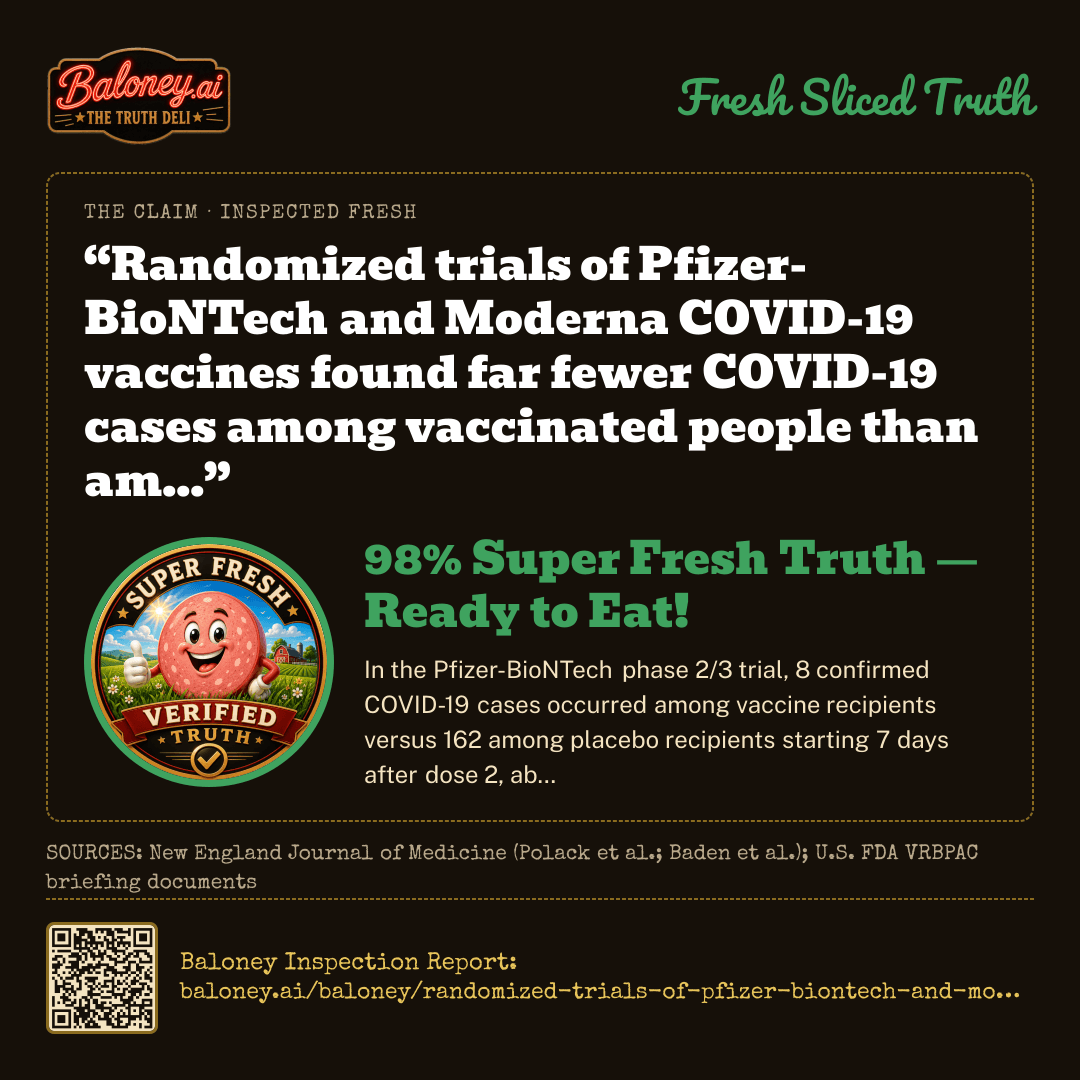
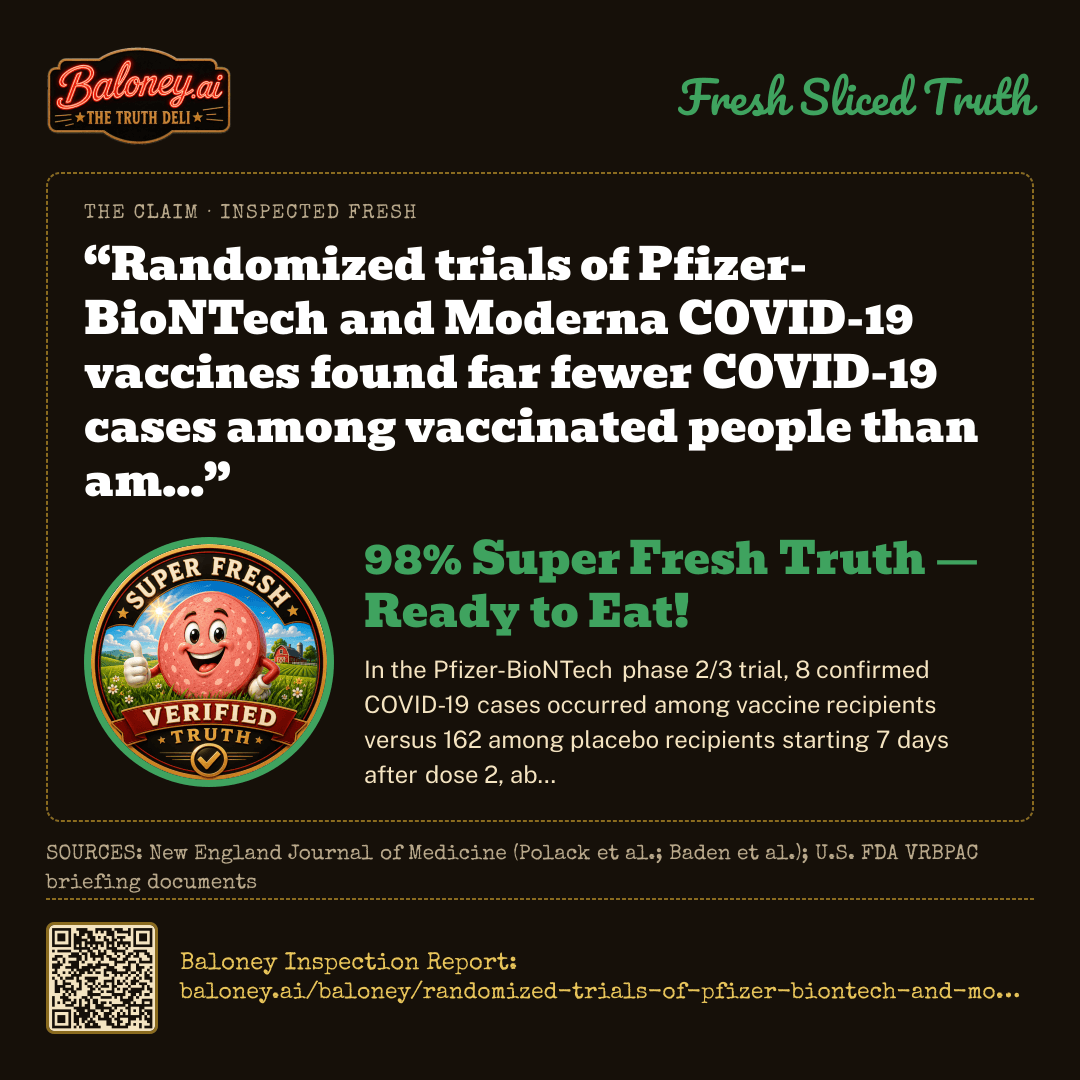
“Randomized trials of Pfizer-BioNTech and Moderna COVID-19 vaccines found far fewer COVID-19 cases among vaccinated people than among placebo recipients.”
98%Super Fresh Truth — Ready to Eat!
THE CLAIM CHECKS OUT.
Independently verifiedPhysically repeatable evidenceConfirmed across rival labsSafe to serve
“Randomized trials of Pfizer-BioNTech and Moderna COVID-19 vaccines found far fewer COVID-19 cases among vaccinated people than among placebo recipients.”98% Super Fresh Truth — Ready to Eat!Verified blind by 5 frontier AIs · Baloney Inspection Report: baloney.ai/baloney/randomized-trials-of-pfizer-biontech-and-moderna-covid-19
The Rating Card
The claim this refutes
The Baloney Sampler
Randomized, placebo-controlled trials of the Pfizer-BioNTech and Moderna COVID-19 vaccines found far fewer confirmed symptomatic COVID-19 cases among vaccinated people than among placebo recipients. The New England Journal of Medicine published 8 versus 162 cases after the Pfizer-BioNTech second dose and 11 versus 185 in the Moderna trial. The U.S. FDA presented the same counts in VRBPAC briefing documents before emergency authorization.
The Centers for Disease Control and Prevention and the National Institutes of Health reported those same large differences. FDA scientists and independent data safety monitoring boards reviewed the numbers. Critiques of suspected unconfirmed cases, one trial site, symptomatic endpoints, ancestral variants, and short blinded follow-up concern scope, not whether the vaccinated arms had far fewer cases.
Other ways to slice it — phrasings that might have changed the rating
“Randomized trials of Pfizer-BioNTech and Moderna COVID-19 vaccines found similar numbers of COVID-19 cases among vaccinated people and among placebo recipients.” The NEJM trial reports and FDA briefing documents recorded 8 versus 162 cases and 11 versus 185 cases, so this wording would reverse the published counts.
“Pfizer-BioNTech and Moderna COVID-19 vaccines prevent nearly all infections, including against later variants such as Delta and Omicron, for years after vaccination.” The reports said the trials measured symptomatic PCR-confirmed disease against ancestral or early variants in a short placebo-controlled window and were not designed to measure all infections, durability, or later variants.
“Randomized trials of Pfizer-BioNTech and Moderna COVID-19 vaccines found far fewer COVID-19 deaths among vaccinated people than among placebo recipients.” Evaluators noted the trials were not designed or powered to measure mortality, even though severe cases in the primary analyses were concentrated in the placebo arms.
Written from the panel’s reports by xAI · grok-4.6. Nothing here changed the score.
23:16:09SCORING MODEL V2 — MEDIAN OF 5 COUNTED LAB SCORES: 2, 2, 1, 3, 3 → 2. FRESH RULE: THE PRIMARY MASTER SCORES 2 AND THE BLIND MASTER 2 — BOTH SUPER FRESH TRUTH — AND THE COUNTED MEDIAN IS 2, ON THE TRUE SIDE. PUBLISHED AS 2, THE MORE CAUTIOUS OF THE TWO MASTERS.✓
23:16:09SOURCE RULE — LABS CITED 25 SOURCES: 0 DISCARDED FOR HAVING NO URL, 2 DISCARDED AS DEAD LINKS (404/410), 14 COULD NOT BE OPENED BY US AND ARE MARKED UNVERIFIED.✓
23:16:09SOURCE RULE — PRIMARY MASTER RULED ON 15 SOURCES: 0 DISCARDED FOR HAVING NO URL, 0 DISCARDED AS DEAD LINKS, 6 MARKED UNVERIFIED, 9 VERIFIED.✓
How This One Was Sliced
Station 1 · Blind Inspection — Five Graders, Zero Peeking
Each lab scored the claim independently, without seeing the others. Open a breakdown for its evidence, its sources, and how sure it was.
Anthropic · EQUAL WEIGHT · 34.3s
claude-opus-5
98%TRUTH
ROUND-1 BREAKDOWN
Evidence offered for the claim
The pivotal Pfizer-BioNTech trial (C4591001, ~43,500 participants) reported 8 cases of confirmed symptomatic COVID-19 among vaccine recipients versus 162 among placebo recipients at least 7 days after dose 2 — a 95.0% relative efficacy (95% CI 90.3–97.6), published in the New England Journal of Medicine (Polack et al., Dec 2020).
The pivotal Moderna trial (COVE, ~30,400 participants) reported 11 cases among vaccine recipients versus 185 among placebo recipients beginning 14 days after dose 2 — 94.1% efficacy (95% CI 89.3–96.8), published in NEJM (Baden et al., Dec 2020).
Severe COVID-19 showed the same pattern: in COVE, all 30 severe cases in the primary analysis occurred in the placebo group; in the Pfizer trial, severe cases were also concentrated in the placebo arm.
These case counts were independently reviewed by FDA scientists and presented in the VRBPAC briefing documents before Emergency Use Authorization, and by independent Data Safety Monitoring Boards — i.e., the numbers were not merely sponsor-reported claims.
Both trials were randomized, double-blind, placebo-controlled (saline placebo), the design that most directly supports the comparison the claim makes.
Later peer-reviewed follow-up publications of the same trials (e.g., 6-month follow-up of C4591001 and the blinded-phase COVE update) continued to show large case-count differences favoring the vaccine arms during the placebo-controlled period.
Evidence against the claim
Nothing in the published record contradicts the claim; the objections are about scope rather than accuracy.
The trials measured PCR-confirmed symptomatic COVID-19 (the pre-specified primary endpoint) during a limited placebo-controlled window against the ancestral/early variants; they were not designed or powered to measure infection, transmission, mortality, or durability, and efficacy against later variants (Delta, Omicron) and after waning is substantially lower than 95%.
Critics (notably Peter Doshi in The BMJ) argued that large numbers of 'suspected but unconfirmed' COVID-19 cases in both arms, and exclusions from the per-protocol population, mean the headline efficacy figure deserves scrutiny; this is a critique of the magnitude/precision, not of the existence of a large case-count difference.
Placebo groups were largely unblinded and offered vaccine after EUA, so the clean randomized comparison covers only a few months, limiting long-term randomized conclusions.
'Far fewer' is a qualitative characterization, but with 8 vs 162 and 11 vs 185 it is, if anything, understated.
How sure this lab was
97/100 — the lab’s own confidence in the score above, not a second reading of the claim.
Pfizer-BioNTech's randomized, placebo-controlled phase 2/3 trial reported 8 COVID-19 cases among vaccine recipients versus 162 among placebo recipients after the efficacy window began, corresponding to about 95% efficacy. That directly supports 'far fewer COVID-19 cases among vaccinated people.'
Moderna's randomized, placebo-controlled phase 3 trial reported 11 symptomatic COVID-19 cases among vaccine recipients versus 185 among placebo recipients in the primary efficacy analysis, corresponding to about 94.1% efficacy. This also directly supports the claim.
CDC/ACIP summaries of the Pfizer-BioNTech and Moderna trial evidence reported the same large differences in COVID-19 cases between vaccine and placebo groups.
Evidence against the claim
No substantive evidence contradicts the claim as written. The main caveat is scope: these trials primarily measured symptomatic, lab-confirmed COVID-19 during the trial period, before later variants such as Delta and Omicron, not all infections for all future variants.
How sure this lab was
99/100 — the lab’s own confidence in the score above, not a second reading of the claim.
The pivotal Phase 3 randomized, double-blind trial for the Pfizer-BioNTech COVID-19 vaccine (BNT162b2) involved over 43,000 participants. The published results showed 162 symptomatic cases of COVID-19 in the placebo group compared to only 8 cases in the vaccine group, resulting in a 95% efficacy rate.
The pivotal Phase 3 randomized, observer-blinded trial for the Moderna COVID-19 vaccine (mRNA-1273) involved over 30,000 participants. The published results showed 185 symptomatic cases of COVID-19 in the placebo group compared to only 11 cases in the vaccine group, resulting in a 94.1% efficacy rate.
These trial findings were independently evaluated and verified by the U.S. Food and Drug Administration (FDA) and other global health regulators, forming the basis for the Emergency Use Authorizations granted in December 2020.
Evidence against the claim
There is no credible scientific or historical evidence contradicting the recorded case counts of these pivotal Phase 3 randomized trials. While long-term real-world effectiveness against infection shifted due to waning immunity and the emergence of heavily mutated variants like Omicron, the claim strictly and accurately describes what the randomized trials themselves found at the time.
How sure this lab was
100/100 — the lab’s own confidence in the score above, not a second reading of the claim.
The claim is supported by randomized, placebo-controlled phase 3 trials. In the Pfizer-BioNTech trial, 8 COVID-19 cases occurred among vaccine recipients versus 162 among placebo recipients after the second dose, corresponding to 95% efficacy.[https://www.nejm.org/doi/full/10.1056/NEJMoa2034577]
In the Moderna trial, 11 symptomatic COVID-19 cases occurred in the vaccine group versus 185 in the placebo group, corresponding to 94.1% efficacy.[https://www.nejm.org/doi/full/10.1056/NEJMoa2035389]
The National Institutes of Health reported the Moderna trial's result as 94.1% lower incidence of symptomatic COVID-19 among vaccine recipients than placebo recipients.[https://www.nih.gov/news-events/research-matters/experimental-coronavirus-vaccine-highly-effective]
Evidence against the claim
The statement is accurate but lacks important scope. These trials primarily measured symptomatic, laboratory-confirmed COVID-19 during the original study periods; they did not establish that vaccination prevented all infections, including asymptomatic infections.[https://www.nejm.org/doi/full/10.1056/NEJMoa2110345]
The results were estimates for the studied populations, variants, follow-up periods, dosing schedules, and trial definitions. Later evidence showed that protection against infection changed over time and with newer variants, so the original trial results should not be generalized to every later context.
The wording says 'far fewer COVID-19 cases' without specifying that the strongest results concerned symptomatic disease after the relevant vaccination schedule; it does not quantify severe disease, asymptomatic infection, or long-term durability.
How sure this lab was
97/100 — the lab’s own confidence in the score above, not a second reading of the claim.
Pfizer-BioNTech phase 3 RCT (NEJM): 8 confirmed COVID-19 cases in the vaccine group vs 162 in placebo among participants with no prior infection, starting 7 days after dose 2 (~95% efficacy).
Moderna phase 3 RCT (NEJM): 11 confirmed COVID-19 cases in the vaccine group vs 185 in placebo (~94.1% efficacy). Both were large, randomized, observer-blind, placebo-controlled trials whose primary endpoint was symptomatic PCR-confirmed COVID-19.
Evidence against the claim
A BMJ report described alleged protocol deviations, unblinding, and data-quality problems at one Pfizer trial site (Ventavia), representing a small share of total enrollment; it did not reverse the overall published case counts.
Trials had short median follow-up (about two months), counted mainly symptomatic cases, and were not designed as all-cause mortality or transmission studies; later observational data showed waning and variant effects outside the original trial window.
How sure this lab was
90/100 — the lab’s own confidence in the score above, not a second reading of the claim.
All five evaluators independently matched the claim to the same primary RCT results: Pfizer-BioNTech 8 versus 162 cases (~95% efficacy) and Moderna 11 versus 185 cases (~94.1% efficacy), published in NEJM and reviewed by FDA/VRBPAC. Those counts are the claim. Caveats they raised—symptomatic PCR-confirmed endpoints, ancestral variants, short blinded follow-up, later waning, and BMJ critiques of suspected cases or one trial site—address generalization, not whether vaccinated arms had far fewer cases. I accepted the NEJM, FDA, CDC, NIH, PubMed, and ClinicalTrials.gov records as primary; BMJ pieces were kept as scope notes, not contradictions. Evaluators all landed in the true band (scores 1–3).
All five agreed the statement is true and directly supported by the Pfizer-BioNTech and Moderna phase 3 trials. They differed only on whether unstated limits (symptomatic disease, original variants, short follow-up) justified a 1 versus a 3.
SUPER FRESH — VERIFIED AGAINST NEW ENGLAND JOURNAL OF MEDICINE (POLACK ET AL.; BADEN ET AL.); U.S. FDA VRBPAC BRIEFING DOCUMENTS
Blind Validation Master · never saw the Primary’s work
claude-opus-5
98% TRUTH
All five evaluators converge on the same documented facts: the pivotal randomized, placebo-controlled trials reported 8 vs 162 COVID-19 cases (Pfizer-BioNTech, ~95% efficacy) and 11 vs 185 cases (Moderna, ~94.1% efficacy), published in NEJM and independently reviewed by FDA/VRBPAC and DSMBs. The claim as written describes exactly what the trials found and does not overstate it — 'far fewer' is, if anything, an understatement of a 20-fold difference. The caveats raised (symptomatic PCR-confirmed endpoint, short placebo-controlled window, ancestral variants, no transmission/mortality powering, Ventavia site issues, Doshi's suspected-case critique) concern scope and generalization to later periods, not the accuracy of the statement, which is explicitly limited to what the randomized trials found. Recommended scores clustered at 1-3; a score of 2 reflects a substantially and precisely true claim with only minor unstated scope limitations.
AGREEMENT TEST PASSED — BOTH MASTERS SCORED 98% · BLIND VALIDATION CONFIRMED THIS SCORE · NO RE-EVALUATION REQUIRED
Median of 5 counted lab scores: 2, 2, 1, 3, 3 → 2.
Fresh rule: the Primary Master scores 2 and the Blind Master 2 — both Super Fresh Truth — and the counted median is 2, on the true side. Published as 2, the more cautious of the two masters.
The Evidence
Evidence for the claim
Pfizer-BioNTech trial counts The randomized placebo-controlled phase 2/3 trial reported 8 confirmed COVID-19 cases among vaccine recipients versus 162 among placebo recipients after the efficacy window, about 95% efficacy.
Moderna trial counts The randomized placebo-controlled phase 3 trial reported 11 symptomatic COVID-19 cases among vaccine recipients versus 185 among placebo recipients, about 94.1% efficacy.
Independent regulatory review FDA scientists, VRBPAC briefing documents, and independent data-safety monitoring boards reviewed the same case counts before Emergency Use Authorization.
Trial design Both studies were large randomized, blinded, saline-placebo-controlled trials whose primary endpoint was symptomatic, lab-confirmed COVID-19.
Evidence offered against the claim
Endpoints and variants Trials measured PCR-confirmed symptomatic COVID-19 in a limited placebo-controlled window against ancestral/early variants, not all infections, transmission, or later variants such as Delta and Omicron.
Follow-up and durability Median blinded follow-up was short; placebo groups were later offered vaccine, and subsequent evidence showed waning and lower protection against infection with newer variants.
Analysis and site critiques Commentaries noted suspected but unconfirmed cases, per-protocol exclusions, and alleged problems at one Pfizer site; these did not reverse the published case-count differences.
Sources · Reliability · Why Accepted or Discounted
ACCEPTED — Report of alleged issues at one Pfizer trial site; evaluators noted it did not reverse overall published case counts.
Every link was opened when this claim was inspected. A dead link was discarded before publication; “unverified” means the site refused our automated check and the link is the one the panel cited. A source without a URL was never kept.
“Randomized trials of Pfizer-BioNTech and Moderna COVID-19 vaccines found far fewer COVID-19 cases among vaccinated people than among placebo recipients.”98% Super Fresh Truth — Ready to Eat!Verified blind by 5 frontier AIs · Baloney Inspection Report: baloney.ai/baloney/randomized-trials-of-pfizer-biontech-and-moderna-covid-19
Support The Truth Deli
Buy The Truth Deli Merch
“Democracy Makes America Great”
Veritate Libertas — Latin for “Through Truth, Liberty.”
Democracy is what makes America great. But without truth — honest, real, scientifically validated truth — democracy fails. The baloney slicer is on: feeding fresh sliced truth to protect what makes America great. Democracy.