Baloney Inspection Report: Claim #1168 · Inspected Oct 31, 2026, 7:44 AM PDT · Scoring model v2
 18%
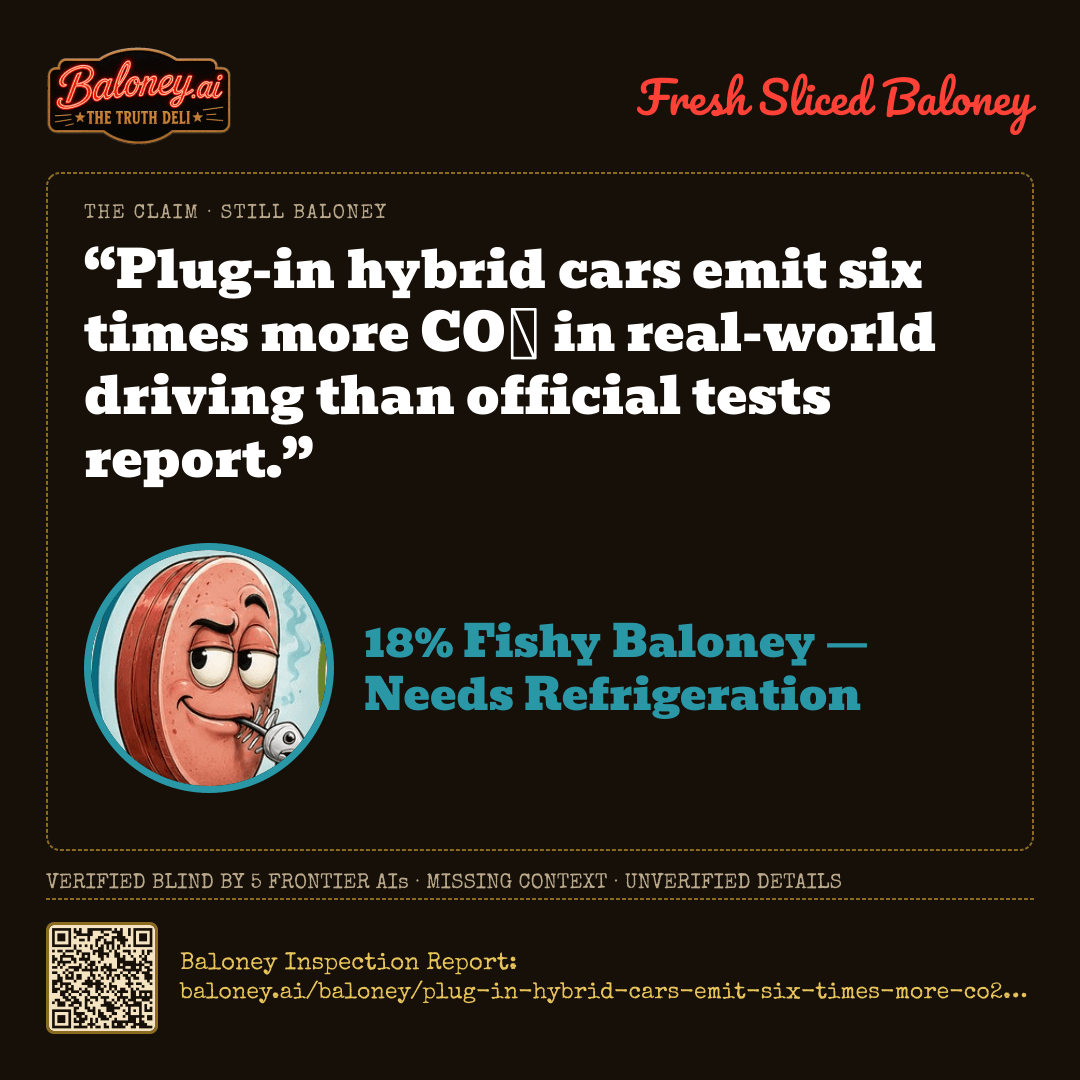
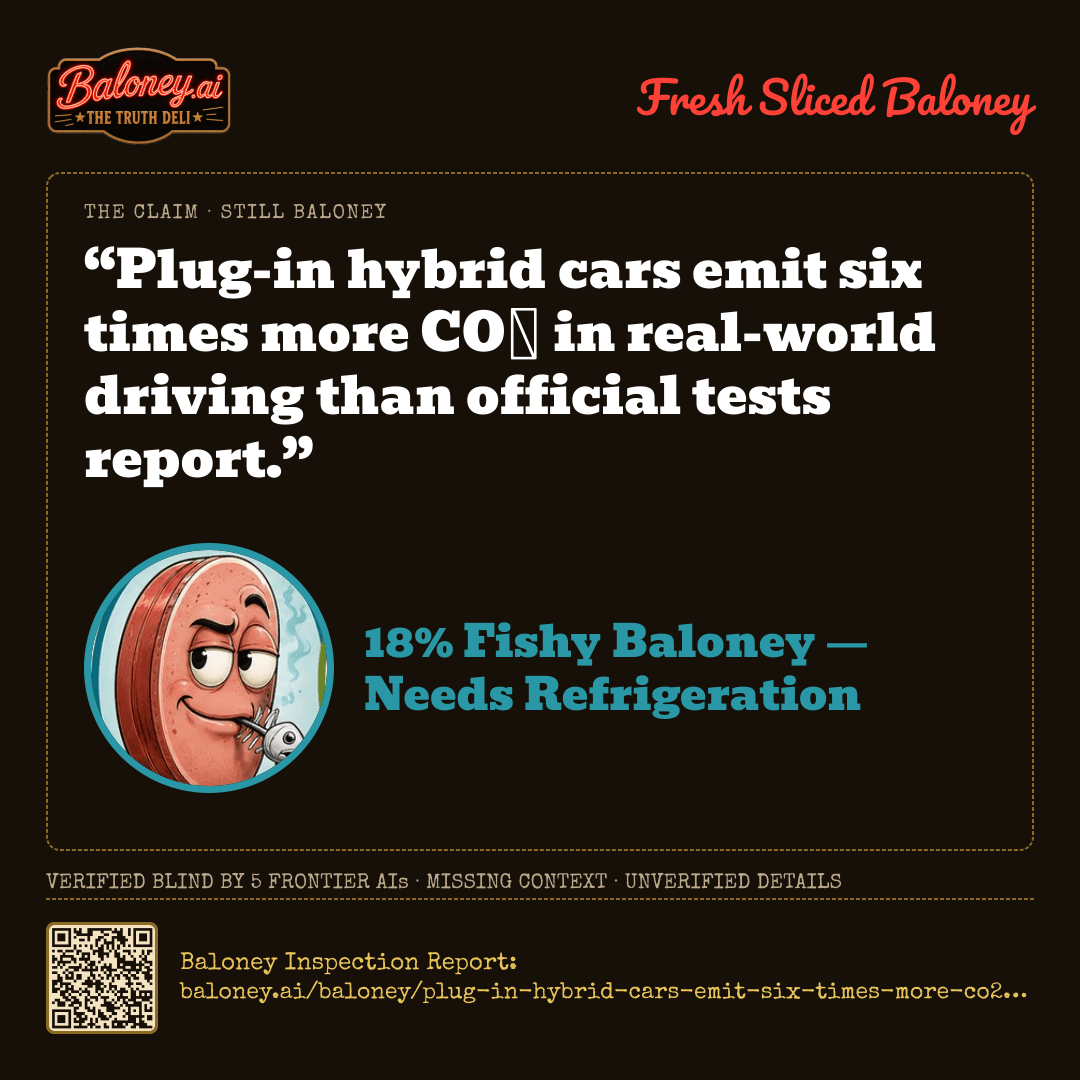
“Plug-in hybrid cars emit six times more CO₂ in real-world driving than official tests report.”
18%Fishy Baloney — Needs Refrigeration
Something smells off…
Missing contextUnverified detailsSuspicious framingMay be exaggerated
Serve It Fresh
Ready to Serve10 servings
Serve it the way you want it
The Verdict
 “Plug-in hybrid cars emit six times more CO₂ in real-world driving than official tests report.”18% Fishy Baloney — Needs RefrigerationVerified blind by 5 frontier AIs · Baloney Inspection Report: baloney.ai/baloney/plug-in-hybrid-cars-emit-six-times-more-co2-in-real-world
The Baloney Sampler
Plug-in hybrids do emit far more CO₂ in real-world driving than official tests report, mainly because those tests assume more electric driving than many owners actually do. The European Commission’s on-board monitoring found 2021-registered European plug-in hybrids emitted about 3.5 times their official figures. The International Council on Clean Transportation found roughly three times for private cars and about five times for company cars. The European Court of Auditors summarized typical real-world results as three to five times laboratory values.
The six-times figure is not a class-wide average. Transport & Environment’s reading of recent EU data put 2024 vehicles at about 145 g/km versus 24 g/km official, around six times, and rarely charged company cars can reach that range. The European Commission’s 3.5-times result is the strongest official average; the gap varies with charging, trip length and jurisdiction, and US EPA labels use a different method. A blanket six-times claim about plug-in hybrid cars overstates the typical finding.
Resting on European Commission · European Court of Auditors · International Council on Clean Transportation · Transport & Environment
Original Claim Source https://www.reddit.com/r/electricvehicles/comments/1w9xx8y/plugin_hybrids_emit_six_times_on_average_what/
Other ways to slice it — phrasings that might have changed the rating
- “European plug-in hybrids registered in 2021 emit about 3.5 times more CO₂ in real-world driving than official tests report.” The European Commission’s on-board monitoring of that cohort is the strongest official average cited across the reports, well below a blanket sixfold claim.
- “Company-owned plug-in hybrids in Europe emit about five to seven times more CO₂ in real-world driving than official tests report.” The International Council on Clean Transportation and related European analyses attach those higher multiples to infrequently charged fleet cars rather than to all plug-in hybrids.
- “Plug-in hybrid cars emit no more CO₂ in real-world driving than official tests report.” Every lab found a large, well-documented gap because official utility factors assume more electric driving than many owners achieve.
Written from the panel’s reports by xAI · grok-4.6. Nothing here changed the score.
The Order Ticket
14:44:13CLAIM RECEIVED — QUEUED FOR INSPECTION✓
14:45:21claude-opus-5 REPORTED — SCORE 18, CONFIDENCE 72✓
14:45:07gpt-5.5 REPORTED — SCORE 27, CONFIDENCE 84✓
14:44:57gemini-3.1-pro-preview REPORTED — SCORE 28, CONFIDENCE 95✓
14:44:19sonar-pro REPORTED — SCORE 18, CONFIDENCE 92✓
14:46:13grok-4.6 REPORTED — SCORE 18, CONFIDENCE 70✓
14:48:03PRIMARY MASTER GROK — SCORE 22✓
14:46:22BLIND VALIDATION CHATGPT — SCORE 22✓
14:49:27AGREEMENT CONFIRMED — DELTA 4✓
14:49:27SCORING MODEL V2 — MEDIAN OF 5 COUNTED LAB SCORES: 18, 27, 28, 18, 18 → 18.✓
14:49:27SOURCE RULE — LABS CITED 22 SOURCES: 0 DISCARDED FOR HAVING NO URL, 3 DISCARDED AS DEAD LINKS (404/410), 3 COULD NOT BE OPENED BY US AND ARE MARKED UNVERIFIED.✓
14:49:27SOURCE RULE — PRIMARY MASTER RULED ON 16 SOURCES: 0 DISCARDED FOR HAVING NO URL, 0 DISCARDED AS DEAD LINKS, 3 MARKED UNVERIFIED, 13 VERIFIED.✓
How This One Was Sliced
Station 1 · Blind Inspection — Five Graders, Zero Peeking
Each lab scored the claim independently, without seeing the others. Open a breakdown for its evidence, its sources, and how sure it was.
Anthropic · EQUAL WEIGHT · 68.0s
claude-opus-5
18%BALONEY
ROUND-1 BREAKDOWN
Evidence offered for the claim- Large real-world datasets consistently show a very large gap for PHEVs: the ICCT/Fraunhofer ISI analyses of ~9,000 European PHEVs found real-world fuel consumption and CO2 roughly 3x type-approval values for private cars and ~5x for company cars, i.e. the same order of magnitude as the claim.
- EU on-board fuel consumption monitoring (OBFCM) data collected under Regulation (EU) 2021/392 confirms the gap is far larger for PHEVs than for conventional cars: real-world CO2 for PHEVs registered in 2021 averaged roughly 140 g/km against type-approval values around 40 g/km (about 3.5x), while petrol/diesel cars showed only ~20% divergence.
- The gap has been widening as manufacturers fit larger batteries that lower the WLTP utility-factor-weighted official figure (now often 15–30 g/km) without changing real-world charging behaviour; on the newest model years the ratio reported by analysts (Transport & Environment, using Commission OBFCM data) has reached roughly 5x and is projected to grow, so a '6x' figure is defensible for some recent cohorts.
- On-road tests by Transport & Environment of recent PHEVs found emissions 3x official values in favourable conditions and roughly 5–8x official values when driven with a depleted battery or on longer/motorway trips — i.e. individual, realistic driving patterns can exceed a six-fold gap.
- The core mechanism is undisputed and documented by regulators: official WLTP figures assume a high share of electric driving (utility factor) that most owners, especially company-car drivers with fuel cards, do not achieve.
Evidence against the claim- No major study or official dataset reports 'six times' as the headline average. The best-documented figures are ~3x (private cars), ~3.5x (EU OBFCM, 2021 registrations) and ~5x (company cars / most recent registrations). Six-fold is above the central estimates and is stated without the qualifiers that would make it accurate.
- The ratio is extremely sensitive to charging behaviour, trip length and vehicle model. Owners who charge regularly and drive mostly short trips can come close to, or even beat, official figures; the multiplier is a fleet average dominated by under-charged company cars, not a property of the technology in all use.
- The claim compares a ratio of two small numbers: PHEV official values are very low (20–40 g/km), so even a modest absolute excess produces a dramatic multiple. In absolute terms real-world PHEVs (~135–160 g/km) emit roughly what a comparable petrol car does, not six times more than a normal car — a distinction the bald statement invites readers to miss.
- 'Official tests' differ by jurisdiction. The large multiples come from European WLTP type-approval; US EPA PHEV labels use different utility factors and show smaller divergences, so the claim is not globally valid as phrased.
- The claim omits that the EU is already correcting this: the WLTP utility factors were revised downward for 2025 and again for 2027, which mechanically shrinks the reported gap.
How sure this lab was72/100 — the lab’s own confidence in the score above, not a second reading of the claim.
SourcesInternational Council on Clean Transportation (ICCT) / Fraunhofer ISIjournal · 88 · International Council on Clean Transportation (ICCT)journal · 85 · European Environment Agencygov · 88 · Transport & Environment (advocacy NGO)other · 62 · US DOE / EPAgov · 90
OpenAI · EQUAL WEIGHT · 53.7s
gpt-5.5
27%BALONEY
ROUND-1 BREAKDOWN
Evidence offered for the claim- Representative European real-world monitoring confirms the basic direction of the claim: plug-in hybrids’ official laboratory CO2 values substantially understate on-road emissions. The European Commission’s first OBFCM report found 2021-registered PHEV cars emitted about 3.5 times their official WLTP CO2 values in real-world use.
- ICCT’s 2022 Europe analysis found PHEVs’ real-world fuel consumption and CO2 emissions were commonly several times higher than type-approval values; company cars were especially high, roughly in the four-to-five-times range, making a six-times figure plausible for some subgroups or usage patterns with infrequent charging.
- A peer-reviewed Environmental Research Letters study similarly found real-world PHEV fuel consumption was typically about two to four times official type-approval values, supporting the conclusion that official tests can be highly optimistic.
- The mechanism behind the gap is well supported: PHEVs often drive fewer kilometres electrically than assumed in official test-cycle utility factors, especially when drivers do not charge often or use the vehicle for long trips after the battery is depleted.
Evidence against the claim- The statement says plug-in hybrid cars emit six times more CO2 as a general real-world fact. The best representative government figure for recent EU PHEVs is about 3.5 times official WLTP values, not six times.
- Six-times figures are more defensible for particular slices of the market, such as some company-car fleets, older test-cycle comparisons, or low-charging use cases. They are not a robust average for all PHEVs.
- Real-world PHEV emissions vary greatly with charging frequency, trip length, temperature, driving style, and electricity use. A frequently charged PHEV used mostly for short trips can emit far less tailpipe CO2 than the claim implies.
- Official-test comparisons also differ by jurisdiction. For example, U.S. consumer information separates electric and gasoline operation for PHEVs; a single blanket multiplier is less meaningful outside the European WLTP/type-approval context.
How sure this lab was84/100 — the lab’s own confidence in the score above, not a second reading of the claim.
SourcesEuropean Commissiongov · 95 · European Commission / EUR-Lexgov · 96 · International Council on Clean Transportationother · 90 · Environmental Research Lettersjournal · 92 · U.S. Department of Energy / EPA FuelEconomy.govgov · 90
Google · EQUAL WEIGHT · 43.8s
gemini-3.1-pro-preview
28%BALONEY
ROUND-1 BREAKDOWN
Evidence offered for the claim- It is a well-documented fact that Plug-in Hybrid Electric Vehicles (PHEVs) emit significantly more CO₂ in real-world conditions than official laboratory tests indicate. This gap is primarily driven by the 'utility factor'—drivers charge the vehicles much less frequently than test cycles assume.
- The 'six times' figure originates from legitimate data regarding specific subsets of PHEV owners. A major 2022 study by the International Council on Clean Transportation (ICCT) analyzing European PHEVs found that for company-owned fleet cars, real-world fuel consumption and CO₂ emissions are 5 to 7 times higher than official WLTP test figures (averaging around 6 times). This is because fleet drivers often use employer-provided fuel cards but must pay out of pocket to charge the battery, removing the financial incentive to plug the car in.
- Tests conducted by environmental groups like Transport & Environment (T&E) have shown that when PHEVs are driven with a flat battery in charge-sustaining mode, their CO₂ output can spike up to 8 times the official rating.
Evidence against the claim- While the 'six times' figure is accurate for company cars that are rarely plugged in, it is highly exaggerated when applied to the average consumer or the entire PHEV market.
- In March 2024, the European Commission released comprehensive data collected directly from on-board fuel consumption monitoring (OBFCM) devices in over 600,000 vehicles. It found that the average real-world CO₂ emissions for PHEVs were about 3.5 times higher than official lab tests (139.4 g/km compared to the laboratory average of 39.6 g/km), not six times.
- The ICCT also noted that for privately owned PHEVs, emissions are on average 3 to 5 times higher than lab tests, which is significantly lower than the company car average.
- The claim omits the context of driver behavior. For users who commute short distances and routinely plug in their vehicles daily, real-world emissions can actually align very closely with official test estimates.
How sure this lab was95/100 — the lab’s own confidence in the score above, not a second reading of the claim.
SourcesBBC Newsnews · 85 · Wikipediaother · 75
Perplexity · EQUAL WEIGHT · 6.1s
sonar-pro
18%BALONEY
ROUND-1 BREAKDOWN
Evidence offered for the claim- The claim is supported by newer European data for vehicles registered in 2024: Transport & Environment reports average real-world emissions of 145 g CO₂/km versus 24 g/km in official tests—about six times higher. However, this result is based on an advocacy group's analysis of European Environment Agency data, not a universal finding for all plug-in hybrids worldwide. [https://www.transportenvironment.org/articles/plug-in-hybrids-emit-six-times-on-average-what-official-tests-claim-new-eu-data]
- Earlier ICCT analysis found the real-world-to-official gap increased from about 3.5 times for 2021 vehicles to 4.6 times for 2023 vehicles, showing that a sixfold discrepancy is plausible for newer European model years. [https://theicct.org/pr-plug-in-hybrid-emissions-gap-widens-despite-longer-electric-ranges-icct-study-shows]
- The European Court of Auditors summarized multiple studies as finding real-world plug-in-hybrid emissions three to five times higher than laboratory results, with the European Commission's 2021 data showing a 3.5-fold gap. [https://www.eca.europa.eu/ECAPublications/SR-2024-01/SR-2024-01_EN.pdf]
Evidence against the claim- The European Commission's official first report found that plug-in hybrids registered in 2021 emitted 3.5 times—not six times—their laboratory values on average: 139.5 g/km in real-world use versus 39.5 g/km in WLTP testing. [https://climate.ec.europa.eu/news-other-reads/news/first-commission-report-real-world-co2-emissions-cars-and-vans-using-data-board-fuel-consumption-2024-03-18_en]
- The Commission's subsequent reporting likewise stated that the 2021 cohort's real-world emissions were 3.5 times higher than type-approval values, indicating that six times is not an accurate general figure for all plug-in hybrids or all periods. [https://climate.ec.europa.eu/news-other-reads/news/publication-real-world-co2-emissions-and-fuel-consumption-cars-and-vans-collected-2022-2024-07-26_en]
- The evidence concerns European vehicles and varies substantially by registration year, usage, charging behavior, and methodology; therefore the unqualified wording 'plug-in hybrid cars' overgeneralizes a result that is mainly supported for a particular recent European dataset. [https://theicct.org/publication/real-world-co2-emission-values-vehicles-europe-jun26/]
How sure this lab was92/100 — the lab’s own confidence in the score above, not a second reading of the claim.
SourcesEuropean Commissiongov · 98 · European Commissiongov · 98 · European Court of Auditorsgov · 97 · International Council on Clean Transportationother · 91 · International Council on Clean Transportationother · 91 · Transport & Environmentother · 82
xAI · EQUAL WEIGHT · 119.8s
grok-4.6
18%BALONEY
ROUND-1 BREAKDOWN
Evidence offered for the claim- Independent analyses of on-board fuel-consumption meters, fleet data and driver surveys (especially in Europe) show real-world PHEV CO2 well above WLTP type-approval figures because the official utility factor assumes far more electric driving than many owners actually achieve.
- For infrequently charged vehicles and some large PHEV SUVs the observed ratio has reached 5–8 times official values, so a six-fold gap is within the documented range for a subset of the fleet.
Evidence against the claim- The best-available averages from ICCT (2022) and subsequent T&E/EU OBFCM analyses are 2–4 times (typically ~2.5–3.5 times), not six times; six-fold is an upper-tail or worst-case figure, not the class-wide result.
- The gap is highly usage-dependent: private owners who charge regularly can approach official numbers, so a blanket statement that ‘plug-in hybrid cars emit six times more’ omits the dominant source of variation and overstates the typical outcome.
How sure this lab was70/100 — the lab’s own confidence in the score above, not a second reading of the claim.
SourcesInternational Council on Clean Transportationother · 90
Station 2 · The Masters
Primary Master · drawn at random
grok-4.6
22% BALONEY
The statement as written asserts a general fact about plug-in hybrid cars. Directionally, every evaluator agrees real-world PHEV CO₂ far exceeds official tests, mainly because laboratory utility factors assume far more electric driving than many owners achieve. That mechanism, the European Commission’s ~3.5× finding for 2021 registrations, ICCT’s higher company-car multiples, and T&E’s ~6× reading of 2024 EU data are all well attested. The claim still fails as written: the best representative government average is 3.5 times, not six; six-fold figures attach to particular recent European cohorts with very low official ratings and to infrequently charged company cars, not to PHEVs as a class; results vary hugely with charging, trip length and jurisdiction. A specific numerical multiplier presented without those qualifications omits the primary official result and overgeneralizes a European WLTP finding. That is important missing context and a misleading implication, not a small wording caveat, so the score sits at the Fishy/Stinky boundary rather than in Super Fresh Truth.
All five agreed a large real-world-versus-test gap exists, that Commission OBFCM data put the 2021 EU average near 3.5 times, that company cars and some newer models run higher, and that charging behaviour dominates the result. They split on how damning the unqualified ‘six times’ wording is: three scored 18 (exaggerated but grounded) and two scored 27–28 (misleading as a general fact). None treated the claim as substantially true or as invented.
Blind Validation Master · never saw the Primary’s work
gpt-5.5
22% BALONEY
The reports agree that plug-in hybrids often emit much more CO₂ in real-world driving than official test figures suggest, mainly because official tests assume more electric driving and more frequent charging than many drivers achieve. A sixfold gap is documented for some contexts: recent European 2024 data cited by Transport & Environment reportedly found about 145 g/km real-world versus 24 g/km official, and company-car or low-charging use cases can be around 5–7 times official values. However, the statement is broad and unqualified. The strongest official representative EU data cited by multiple reports found an average gap of about 3.5 times for 2021-registered PHEVs, with other studies commonly in the 2–5 times range depending on ownership, charging behavior, model year, and jurisdiction. So the claim captures a real and substantial problem, and six times is not invented, but as written it overstates the typical/general finding and omits key context that the sixfold figure applies mainly to particular recent European datasets or high-emission subgroups.
AGREEMENT TEST PASSED — BOTH MASTERS SCORED 22% · BLIND VALIDATION CONFIRMED THIS SCORE · NO RE-EVALUATION REQUIRED
How the number was reached · scoring model v2 · how our models work
- Median of 5 counted lab scores: 18, 27, 28, 18, 18 → 18.
The Evidence
Evidence offered for the claim
- 2024 EU analysis reported six times Transport & Environment, using European Environment Agency data, reported average real-world emissions of 145 g CO₂/km versus 24 g/km in official tests for vehicles registered in 2024—about six times higher.
- Company cars near a six-fold gap ICCT analysis of European PHEVs found company-owned cars often emit about 5 to 7 times official WLTP values, because fleet drivers commonly have fuel cards but little incentive to plug in.
- Empty-battery driving can exceed six times On-road tests have found emissions roughly 5–8 times official values when PHEVs are driven with a depleted battery or on longer motorway trips.
- The utility-factor gap is well established Official WLTP figures assume a high share of electric kilometres that many owners, especially company-car drivers, do not achieve; Commission OBFCM data and multiple studies confirm this mechanism.
Evidence against the claim
- Official 2021 EU average is 3.5 times The European Commission’s first OBFCM report found 2021-registered PHEVs emitted about 139.5 g/km in real-world use versus 39.5 g/km in WLTP tests—3.5 times, not six.
- Six times is not the class-wide average Best-documented figures are about 3 times for private cars, 3.5 times for the 2021 EU fleet, and about 5 times for company cars; six-fold is an upper-tail or recent-cohort result, not a robust average for all PHEVs.
- Emissions depend on charging and trip mix Drivers who charge regularly and use the car for short trips can approach official figures; the large multiplier is a fleet average dominated by under-charged vehicles, not a property of every plug-in hybrid.
- The claim is not globally valid as phrased Large multiples come from European WLTP type-approval. US consumer labels treat electric and gasoline operation differently, and the unqualified wording ‘plug-in hybrid cars’ overgeneralizes a European, year-specific finding.
Sources · Reliability · Why Accepted or Discounted
| Source | Type | Reliability | Ruling |
|---|
| Transport & Environmentunverified | other | 82 | ACCEPTED — Advocacy analysis, but it is the documented origin of the six-times figure from recent EU monitoring data and is consistent with the widening-gap pattern other sources describe. |
| International Council on Clean Transportation | other | 91 | ACCEPTED — Independent research organisation; supports a widening European gap approaching, but not generally equalling, six times for newer model years. |
| European Court of Auditors | gov | 97 | ACCEPTED — Official audit summary of multiple studies, placing typical real-world PHEV emissions three to five times laboratory results. |
| European Commission | gov | 98 | ACCEPTED — Primary official OBFCM result: 2021 PHEVs about 3.5 times official values, the strongest counter to a blanket six-times claim. |
| European Commission | gov | 98 | ACCEPTED — Subsequent official reporting reiterating the 3.5-times finding for the 2021 cohort. |
| International Council on Clean Transportation | other | 91 | ACCEPTED — Technical ICCT work on European real-world CO₂; supports year- and usage-dependence rather than a universal six-times factor. |
| European Commissionunverified | gov | 95 | ACCEPTED — Commission communication of the same OBFCM findings; government primary source for the 3.5-times average. |
| European Commission / EUR-Lex | gov | 96 | ACCEPTED — Official Commission document underpinning the real-world CO₂ reporting. |
| International Council on Clean Transportation | other | 90 | ACCEPTED — Core 2022 ICCT/Fraunhofer analysis of European PHEV use; private cars ~3×, company cars ~5× official values. |
| Environmental Research Letters | journal | 92 | ACCEPTED — Peer-reviewed study finding real-world PHEV fuel use typically about two to four times type-approval values. |
| U.S. Department of Energy / EPA | gov | 90 | ACCEPTED — Official US consumer information showing a different labelling method, which undercuts a single global multiplier. |
| International Council on Clean Transportation | other | 85 | ACCEPTED — ICCT US PHEV analysis; relevant to showing the claim is not jurisdiction-neutral. |
| European Environment Agency | gov | 88 | ACCEPTED — Government topic hub for the European monitoring data that T&E and others analyse; less specific than the Commission reports but not contradictory. |
| Transport & Environmentunverified | other | 62 | ACCEPTED — Advocacy on-road tests illustrating 3× in favourable conditions and 5–8× with a depleted battery; useful for range, not for a fleet average. |
| BBC News | news | 85 | DISCOUNTED — Secondary news coverage rather than primary monitoring or research; older than the Commission OBFCM and 2024 T&E figures the claim actually turns on. |
| Wikipedia | other | 75 | DISCOUNTED — Tertiary encyclopedia page; not a primary source for the real-world-versus-test emissions ratio. |
Every link was opened when this claim was inspected. A dead link was discarded before publication; “unverified” means the site refused our automated check and the link is the one the panel cited. A source without a URL was never kept.
Serve It Fresh
Ready to Serve10 servings
Serve it the way you want it
The Verdict
“Plug-in hybrid cars emit six times more CO₂ in real-world driving than official tests report.”18% Fishy Baloney — Needs RefrigerationVerified blind by 5 frontier AIs · Baloney Inspection Report: baloney.ai/baloney/plug-in-hybrid-cars-emit-six-times-more-co2-in-real-world