Baloney Inspection Report: Claim #1060 · Inspected Sep 29, 2026, 3:44 PM PDT · Scoring model v2 · Earlier report, model v1
 99%
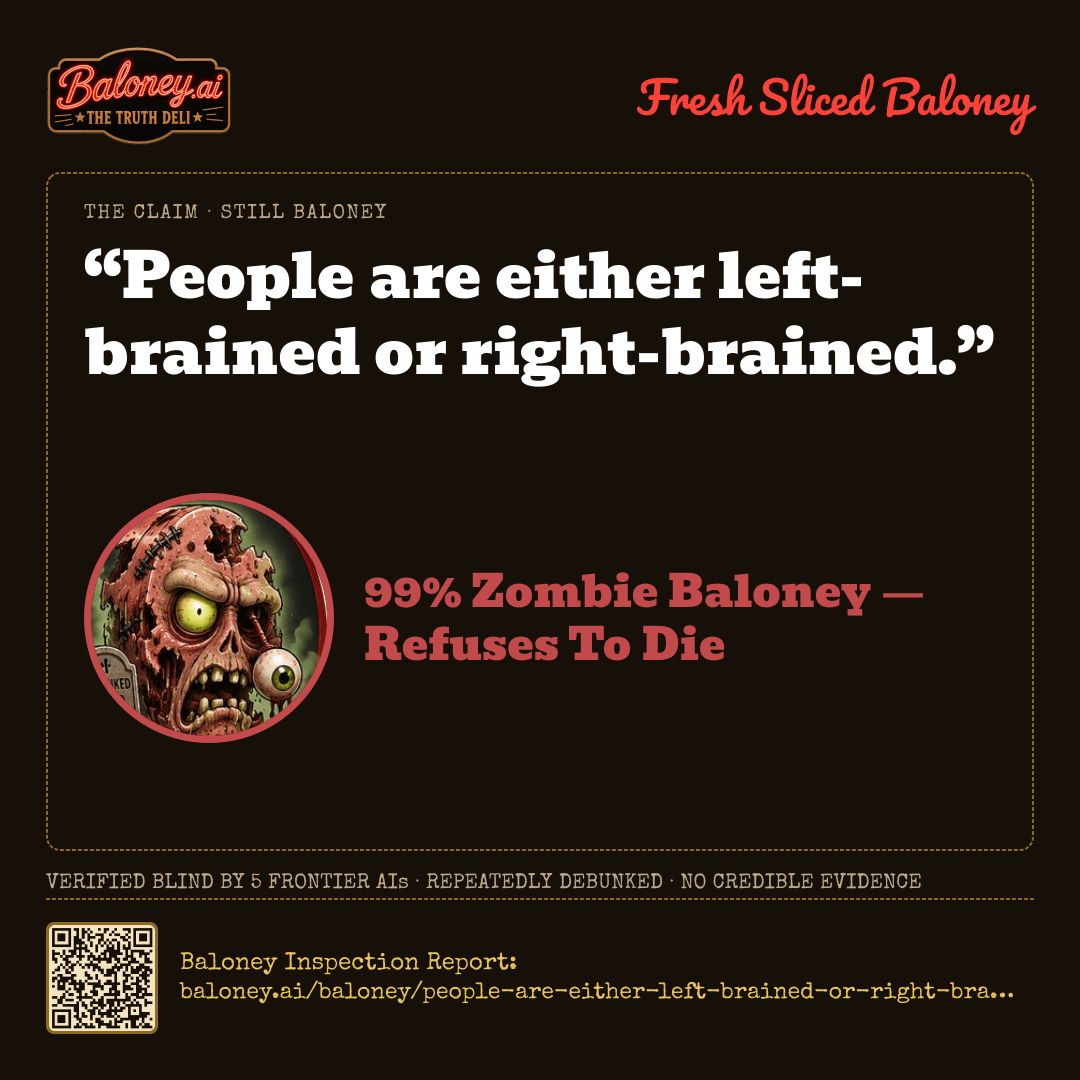
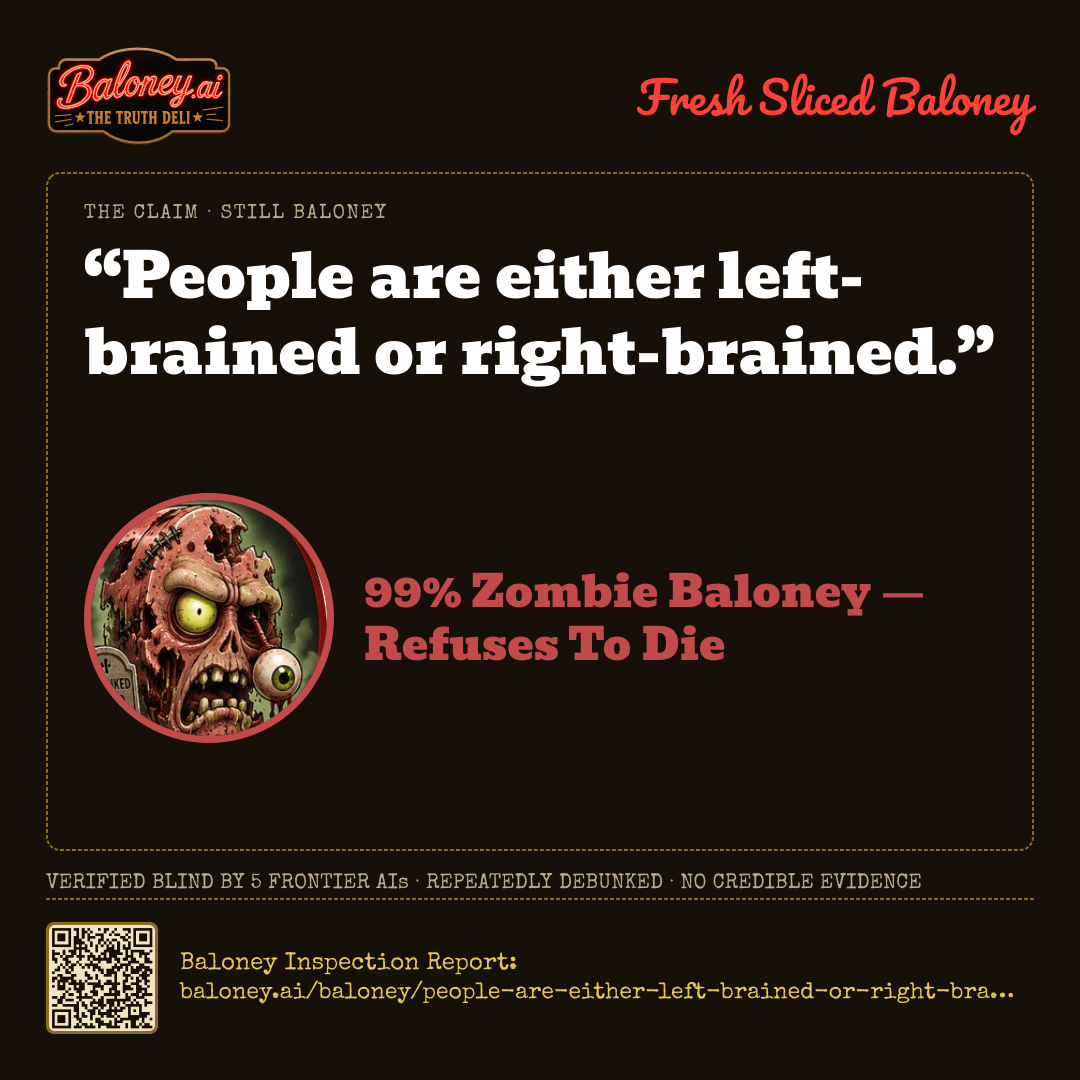
“People are either left-brained or right-brained.”
99%Zombie Baloney — Refuses To Die
DEAD. BURIED. STILL SHAMBLING AROUND.
Repeatedly debunkedNo credible evidenceRefuses to dieLives on in delusion
Serve It Fresh
Ready to Serve18 servings
Serve it the way you want it
The Verdict
 “People are either left-brained or right-brained.”99% Zombie Baloney — Refuses To DieVerified blind by 5 frontier AIs · Baloney Inspection Report: baloney.ai/baloney/people-are-either-left-brained-or-right-brained
The Baloney Sampler
The reports found that people do not divide into “left-brained” and “right-brained” types. The strongest evidence was PLOS ONE’s University of Utah fMRI study of 1,011 people, which found no whole-brain left- or right-dominant network pattern. PLOS Biology’s review explains why real hemispheric specialization does not become a person-wide label: lateralization is local, task-specific, and graded.
The kernel is real: language is often left-lateralized, while some visuospatial, face-processing, and attentional functions are often right-biased; split-brain work showed disconnected hemispheres can differ. But intact brains use both hemispheres together for complex tasks. Frontiers in Psychology and Nature Reviews Neuroscience support treating the learner/personality version—logical left, creative right—as an unsupported neuromyth.
Resting on PLOS ONE · PLOS Biology · Frontiers in Psychology · Nature Reviews Neuroscience
Original Claim Source https://healthcare.utah.edu/healthfeed/2017/10/left-brain-vs-right-brain-myth
Other ways to slice it — phrasings that might have changed the rating
- “Some cognitive functions are more lateralized to one hemisphere than the other.” The reports agree that hemispheric specialization is real, including typical left-lateralization for language and right-hemisphere bias for some visuospatial, attentional, and face-processing functions.
- “People vary in the degree and direction of lateralization for particular brain functions.” The reports note inter-individual variation, including some right-hemisphere or bilateral language dominance, while rejecting a whole-person left/right category.
- “Split-brain patients can show different competencies in their disconnected hemispheres.” The reports accept Sperry’s split-brain work as historical evidence for hemispheric differences, while stressing that it does not generalize to intact brains as a personality typology.
Written from the panel’s reports by OpenAI · gpt-5.5. Nothing here changed the score.
The Order Ticket
22:44:34CLAIM RECEIVED — QUEUED FOR INSPECTION✓
22:45:12claude-opus-5 REPORTED — SCORE 97, CONFIDENCE 96✓
22:45:03gpt-5.5 REPORTED — SCORE 95, CONFIDENCE 96✓
22:45:05gemini-3.1-pro-preview REPORTED — SCORE 99, CONFIDENCE 99✓
22:44:42sonar-pro REPORTED — SCORE 92, CONFIDENCE 98✓
22:45:25grok-4.6 REPORTED — SCORE 78, CONFIDENCE 90✓
22:46:20PRIMARY MASTER CHATGPT — SCORE 99✓
22:45:37BLIND VALIDATION CLAUDE — SCORE 96✓
22:46:33AGREEMENT CONFIRMED — DELTA 3✓
22:46:33SCORING MODEL V2 — MEDIAN OF 5 COUNTED LAB SCORES: 97, 95, 99, 92, 78 → 95. ZOMBIE RULE: THE PRIMARY MASTER FLAGS A LONG DEBUNK HISTORY, THE BLIND MASTER SCORES 96, THE COUNTED MEDIAN IS 95 — PUBLISHED AS 99.✓
22:46:33SOURCE RULE — LABS CITED 23 SOURCES: 0 DISCARDED FOR HAVING NO URL, 1 DISCARDED AS DEAD LINKS (404/410), 0 COULD NOT BE OPENED BY US AND ARE MARKED UNVERIFIED.✓
22:46:33SOURCE RULE — PRIMARY MASTER RULED ON 18 SOURCES: 0 DISCARDED FOR HAVING NO URL, 0 DISCARDED AS DEAD LINKS, 0 MARKED UNVERIFIED, 18 VERIFIED.✓
How This One Was Sliced
Station 1 · Blind Inspection — Five Graders, Zero Peeking
Each lab scored the claim independently, without seeing the others. Open a breakdown for its evidence, its sources, and how sure it was.
Anthropic · EQUAL WEIGHT · 38.2s
claude-opus-5
97%BALONEY
ROUND-1 BREAKDOWN
Evidence offered for the claim- Hemispheric specialization is genuinely real: language production is left-lateralized in roughly 95% of right-handers, while some visuospatial and face-processing functions show right-hemisphere bias — so the underlying idea of 'sided' brain functions has a factual kernel (Corballis, PLoS Biology 2014).
- Roger Sperry's Nobel-recognized split-brain research showed that when the corpus callosum is severed, the two hemispheres can process information independently and display different competencies, which is the historical origin of the popular claim.
- There is real inter-individual variation in the direction of lateralization — a minority of people (notably some left-handers) have right-hemisphere or bilateral language dominance — so 'which side is dominant' is not identical in everyone for a given function.
- The belief is extremely widespread among educators and the public, which is sometimes cited as informal support; surveys of teachers find majority endorsement of left/right-brain learner typologies (Dekker et al., Frontiers in Psychology 2012).
Evidence against the claim- A University of Utah fMRI study of resting-state functional connectivity in 1,011 people aged 7–29 found no evidence that individuals preferentially use a left-brain or right-brain network; lateralization patterns were consistent across people rather than sorting them into two types (Nielsen et al., PLoS ONE 2013).
- Lateralization is function-specific, not person-wide: an individual can be strongly left-lateralized for speech and right-lateralized for some spatial or prosodic tasks at the same time, so there is no coherent 'dominant hemisphere' for a whole person (Corballis, PLoS Biology 2014).
- Virtually all complex behavior — language, math, creativity, logic — recruits distributed networks in both hemispheres linked by the corpus callosum; 'creativity' and 'logic' have never been localized to one hemisphere.
- There is no evidence linking hemispheric asymmetry to personality traits, learning style, or aptitude; 'left-brained/right-brained' learning-style instruction is classified as a neuromyth by education-neuroscience researchers (Dekker et al. 2012).
- The claim's dichotomous framing ('either...or') is falsified by the data even where lateralization exists: asymmetry is a continuous, graded measure, not a binary category.
- Split-brain findings apply to patients with a surgically severed corpus callosum and do not generalize to intact brains, where the hemispheres exchange information continuously (Corballis 2014; Sperry's own work concerned commissurotomy patients).
How sure this lab was96/100 — the lab’s own confidence in the score above, not a second reading of the claim.
SourcesPLOS ONE (Nielsen, Zielinski, Ferguson, Lainhart & Anderson, 2013)journal · 92 · PLOS Biology (Corballis, 'Left Brain, Right Brain: Facts and Fantasies')journal · 93 · Frontiers in Psychology (Dekker et al., 'Neuromyths in Education')journal · 85 · The Nobel Prize (Roger Sperry Nobel Lecture, 1981)other · 88 · Live Sciencenews · 70 · Psychology Today (Christian Jarrett, 'Brain Myths')news · 65
OpenAI · EQUAL WEIGHT · 29.4s
gpt-5.5
95%BALONEY
ROUND-1 BREAKDOWN
Evidence offered for the claim- There is a real kernel of truth: human brains show hemispheric specialization. For example, language is usually more left-lateralized, while some visuospatial and attentional functions are often more right-lateralized; split-brain research also shows that the two hemispheres can process information differently.
- Brain lateralization can vary across individuals and tasks, so casual observations that someone has relatively stronger verbal, spatial, analytical, or creative skills may appear to align with the popular left/right-brain story.
Evidence against the claim- The claim as written says people are either one type or the other. A large resting-state fMRI study of 1,011 people found no evidence that individuals generally have stronger left-hemisphere or right-hemisphere brain networks; localized lateralization exists, but people do not sort into globally 'left-brained' or 'right-brained' categories.
- Peer-reviewed reviews describe the popular personality dichotomy—left brain as logical/analytical and right brain as creative/intuitive—as a myth or 'fantasy' built from real but limited hemispheric specialization.
- Normal cognition relies on distributed, interacting networks across both hemispheres. A person may show left-lateralization for one function and right-lateralization for another, which contradicts a simple either/or classification.
- Education research identifies 'left-brained/right-brained learners' as a common neuromyth, warning that using it to classify people or tailor instruction is unsupported.
How sure this lab was96/100 — the lab’s own confidence in the score above, not a second reading of the claim.
SourcesPLOS ONEjournal · 95 · PLOS Biologyjournal · 95 · Frontiers in Psychologyjournal · 88 · National Institute of Neurological Disorders and Strokegov · 92
Google · EQUAL WEIGHT · 31.3s
gemini-3.1-pro-preview
99%BALONEY
ROUND-1 BREAKDOWN
Evidence offered for the claim- The claim stems from a genuine neuroscientific concept known as 'brain lateralization,' which notes that certain cognitive processes are more localized to one side of the brain than the other.
- Nobel laureate Roger Sperry's famous 'split-brain' experiments in the 1960s demonstrated that the left hemisphere is typically more specialized for language and speech, while the right hemisphere is more involved in spatial processing and facial recognition.
- Popular psychology and self-help industries took these specific findings of localized function and exaggerated them to formulate the appealing, though unscientific, narrative of left- or right-brain 'dominance' dictating a person's entire personality.
Evidence against the claim- A comprehensive 2013 neuroimaging study by researchers at the University of Utah analyzed the resting brain scans of over 1,000 individuals and found no evidence of whole-brain hemispheric dominance (i.e., individuals did not have stronger left-sided or right-sided brain networks).
- Modern neuroscience shows that the brain functions as a highly interconnected network. Complex tasks—whether they are logical, mathematical, artistic, or creative—require continuous communication between both hemispheres across the corpus callosum.
- There is no empirical evidence to support the idea that logical, analytical people are 'left-brained' or that creative, artistic people are 'right-brained.' It is widely classified by neuroscientists as a 'neuromyth.'
How sure this lab was99/100 — the lab’s own confidence in the score above, not a second reading of the claim.
SourcesPubMed Central / PLOS ONEjournal · 95 · Healthlineother · 80
Perplexity · EQUAL WEIGHT · 8.4s
sonar-pro
92%BALONEY
ROUND-1 BREAKDOWN
Evidence offered for the claim- The claim has a limited basis in the scientifically established fact that the two cerebral hemispheres show functional specialization: language is often more left-lateralized, while some spatial and attentional functions are more right-lateralized.[2][6]
- Split-brain and other lateralization research supports the conclusion that the hemispheres do not have identical functions, so “left-brained” and “right-brained” can loosely describe some task-specific specialization.[2][6]
Evidence against the claim- The claim says people are either left-brained or right-brained, implying a person-level, overall dominance. A 2013 brain-imaging study of 1,011 people found no evidence that individuals preferentially use a globally stronger left- or right-hemisphere network.[3][6]
- The same research found that left- and right-lateralized connections were local properties of brain networks, not a whole-brain trait distinguishing people as left-brained or right-brained.[3]
- Research and expert reviews find little or no evidence that personality traits such as creativity, rationality, or intuition reside in one hemisphere or determine whether someone is left- or right-brained.[1][4]
- The brain normally operates through cooperation between both hemispheres; task-specific lateralization does not establish that a person uses one side overall.[1][10]
- The idea that scientific or logical people are left-brained and creative or intuitive people are right-brained is described as a myth or oversimplification rather than an anatomically accurate classification.[1][4][15]
How sure this lab was98/100 — the lab’s own confidence in the score above, not a second reading of the claim.
SourcesHarvard Health Publishingedu · 95 · PLOS Biology via PubMed Central and NIHjournal · 97 · PLOS ONE via PubMed Central and NIHjournal · 98 · University of Utah Healthedu · 94 · McGill University Office for Science and Societyedu · 93 · Frontiers in Psychology via PubMed Central and NIHjournal · 96 · Medical News Todaynews · 82
xAI · EQUAL WEIGHT · 51.1s
grok-4.6
78%BALONEY
ROUND-1 BREAKDOWN
Evidence offered for the claim- The two cerebral hemispheres are functionally specialized in most people (e.g., language production and some sequential/analytical processing more often left-lateralized; some visuospatial, attentional, and face-processing functions more often right-lateralized), established by lesion studies, Wada testing, and neuroimaging.
- Split-brain research (Sperry, Gazzaniga and others) showed that disconnected hemispheres can process information somewhat independently, which historically inspired the popular left/right-person typology.
- Individuals differ in degree of lateralization, and handedness is modestly related to language lateralization, so a weak individual-difference story exists even if it does not support two personality types.
Evidence against the claim- The claim as written is the popular typology that people are one type or the other (logical/analytical vs creative/intuitive) because one hemisphere dominates. Large-scale resting-state fMRI of more than 1,000 people found no evidence of a left- or right-dominant brain-wide connectivity pattern that would make someone 'left-brained' or 'right-brained'.
- In an intact brain the hemispheres work together; most complex functions including language, reasoning, and creativity recruit distributed bilateral networks, not a single dominant hemisphere.
- The mapping of personality and cognitive style onto left vs right hemispheres is not supported by neuroscience and is repeatedly classified as a neuromyth in education and cognitive neuroscience reviews.
- People therefore are not classifiable as either left-brained or right-brained; the binary is false even though some hemispheric specialization is real.
How sure this lab was90/100 — the lab’s own confidence in the score above, not a second reading of the claim.
SourcesPLOS ONEjournal · 88 · PLOS Biologyjournal · 93 · Nature Reviews Neurosciencejournal · 97
Station 2 · The Masters
Primary Master · drawn at random
gpt-5.5
99% BALONEY
I weighted the peer-reviewed neuroscience sources most heavily, especially the PLOS ONE resting-state fMRI study of 1,011 people and the PLOS Biology review on facts and fantasies of left/right-brain claims. Those sources directly address the statement as written: whether whole people sort into left-brained or right-brained categories. They find that hemispheric lateralization is real but local, task-specific, graded, and compatible with both hemispheres working together. I gave secondary university, government, and medical-education sources substantial but lesser weight because they consistently summarize the same scientific consensus. Popular sources such as Healthline, Medical News Today, Live Science, and Psychology Today were treated as supplementary public-facing summaries rather than decisive evidence. The one major citation issue was the PubMed Central URL in Report 2 ending in PMC3743827, which I did not rely on because the same cited study was supplied elsewhere with accepted PLOS ONE and PMC links. The claim contains a factual kernel—some brain functions are lateralized—but the statement says people are either left-brained or right-brained, which is the familiar debunked personality/learning-style dichotomy. That dichotomy is contradicted by the evidence.
All five evaluators agreed that hemispheric specialization is real but that it does not support classifying people as left-brained or right-brained. They also agreed that personality, creativity, logic, and learning-style claims based on left/right dominance are unsupported neuromyths. The main disagreement was severity: Report 3 recommended a lower score because it gave more mitigating weight to real lateralization and individual variation, while the other four treated the public either/or wording as an overwhelmingly false, repeatedly debunked claim.
ZOMBIE FLAG: TRUE — DEBUNK HISTORY ON RECORD
Blind Validation Master · never saw the Primary’s work
claude-opus-5
96% BALONEY
All five evaluators converge on the same verdict: the claim as written — that individuals sort into two types, 'left-brained' or 'right-brained' — is a textbook neuromyth. The kernel of truth is real but narrow: hemispheric specialization exists (language typically left-lateralized in ~95% of right-handers; some visuospatial, face-processing and attentional functions right-biased), and split-brain work (Sperry) showed disconnected hemispheres can operate semi-independently. That kernel, however, does not support the claim's actual assertion. The decisive evidence is Nielsen et al. (PLOS ONE 2013), a resting-state fMRI study of 1,011 people that found no whole-brain hemispheric dominance distinguishing individuals; lateralization is a local, function-specific property, so the same person can be left-lateralized for speech and right-lateralized for spatial or prosodic tasks. Corballis (PLOS Biology 2014) explicitly labels the popular personality dichotomy a 'fantasy,' and Dekker et al. (Frontiers in Psychology 2012) classify 'left-brained/right-brained learners' as a neuromyth widely endorsed by teachers. Two further structural problems: asymmetry is continuous and graded rather than binary, so the 'either...or' framing fails even where lateralization is strong; and split-brain findings apply to commissurotomy patients and do not generalize to intact brains, where the corpus callosum keeps both hemispheres in constant communication. There is no evidence linking hemispheric asymmetry to personality, creativity, logic, or learning style. This is not a wording quibble — the central assertion is false, has been repeatedly debunked, and continues to drive unsupported educational and self-help practices, which carries real-world harm. It sits at the top of Radioactive Baloney, just short of pure Zombie status only because a genuine (if misapplied) neuroscientific phenomenon underlies it. Median of peer recommendations (78, 92, 95, 97, 99) supports a score in the mid-90s; the lone outlier at 78 gives disproportionate weight to the lateralization kernel that the claim itself misstates.
AGREEMENT TEST PASSED — MASTERS SCORED 99% AND 96% · BLIND VALIDATION CONFIRMED THIS SCORE · NO RE-EVALUATION REQUIRED
How the number was reached · scoring model v2 · how our models work
- Median of 5 counted lab scores: 97, 95, 99, 92, 78 → 95.
- Zombie rule: the Primary Master flags a long debunk history, the Blind Master scores 96, the counted median is 95 — published as 99.
The Evidence
Evidence offered for the claim
- Real lateralization Some functions are more associated with one hemisphere than the other: language is often left-lateralized, while some visuospatial, attentional, and face-processing functions often show right-hemisphere bias. This supports only task-specific specialization, not person-wide left/right types.
- Split-brain findings DEBUNKED — Roger Sperry’s split-brain research showed that disconnected hemispheres can process information somewhat independently and display different competencies. But those findings came from commissurotomy patients and do not show that intact brains operate as one-sided personalities.
- Individual variation DEBUNKED — People can vary in the degree and direction of lateralization, and handedness is modestly related to language lateralization. That variation is function-specific and graded, not an either/or division of whole people.
Evidence against the claim
- No global dominance A 2013 resting-state fMRI study of 1,011 people found no evidence that individuals generally have stronger left-hemisphere or right-hemisphere brain networks.
- Task-specific, not person-wide Lateralization is local to particular functions and networks. A person may be left-lateralized for speech and right-lateralized for other functions, so there is no coherent single dominant hemisphere for the whole person.
- Both hemispheres cooperate Normal cognition relies on distributed networks across both hemispheres, connected by the corpus callosum. Complex activities such as language, reasoning, mathematics, and creativity recruit bilateral interacting systems.
- Personality claims unsupported The popular idea that logical or analytical people are left-brained while creative or intuitive people are right-brained has little or no empirical support and is repeatedly described as a neuromyth.
- Binary framing fails Even where asymmetry exists, it is continuous and task-dependent rather than a binary category. The statement’s 'either...or' wording is therefore misleading at its core.
Sources · Reliability · Why Accepted or Discounted
| Source | Type | Reliability | Ruling |
|---|
| Harvard Health Publishing | edu | 95 | ACCEPTED — Accepted as a reputable medical-education summary consistent with the peer-reviewed evidence. |
| PLOS Biology via PubMed Central and NIH | journal | 97 | ACCEPTED — Accepted as a peer-reviewed review directly addressing left-brain/right-brain facts and exaggerations. |
| PLOS ONE via PubMed Central and NIH | journal | 98 | ACCEPTED — Accepted as the central peer-reviewed neuroimaging study testing whole-brain left/right dominance. |
| University of Utah Health | edu | 94 | ACCEPTED — Accepted as an institutional summary of the University of Utah study, useful but secondary to the journal article. |
| McGill University Office for Science and Society | edu | 93 | ACCEPTED — Accepted as a university science-communication source on learning neuromyths, consistent with the primary literature. |
| Frontiers in Psychology via PubMed Central and NIH | journal | 96 | ACCEPTED — Accepted as peer-reviewed support for the broader conclusion that left/right learner typologies are neuromyths. |
| Medical News Today | news | 82 | ACCEPTED — Accepted only as a secondary public-facing summary; it was not weighted over peer-reviewed sources. |
| PubMed Central / PLOS ONE | journal | 50 | DISCOUNTED — Discounted because the URL as provided was not relied on for the cited Nielsen study; the same study was available through accepted PLOS ONE and PMC links supplied elsewhere. |
| Healthline | other | 80 | ACCEPTED — Accepted as a general-audience summary consistent with stronger sources, but given little independent evidentiary weight. |
| PLOS ONE | journal | 95 | ACCEPTED — Accepted as the peer-reviewed source most directly testing and rejecting global left/right-brain dominance. |
| PLOS Biology | journal | 95 | ACCEPTED — Accepted as a peer-reviewed review explaining the real basis of lateralization and the false popular extrapolation. |
| Nature Reviews Neuroscience | journal | 97 | ACCEPTED — Accepted as a high-quality review source supporting the classification of such claims as neuromyths. |
| Frontiers in Psychology | journal | 85 | ACCEPTED — Accepted as peer-reviewed evidence that left/right-brain learner typologies are a common unsupported neuromyth. |
| The Nobel Prize | other | 88 | ACCEPTED — Accepted for historical context on Sperry’s split-brain work, not as support for the popular personality dichotomy. |
| Live Science | news | 70 | ACCEPTED — Accepted as a secondary science-news explanation consistent with stronger evidence, but not treated as decisive. |
| Psychology Today | news | 65 | ACCEPTED — Accepted only as public-commentary evidence that the myth has circulated and been debunked for years; not used as a primary neuroscience source. |
| Frontiers in Psychology | journal | 88 | ACCEPTED — Accepted as the same peer-reviewed neuromyths-in-education source supplied through a different exact URL. |
| National Institute of Neurological Disorders and Stroke | gov | 92 | ACCEPTED — Accepted as a reliable government overview of brain organization and hemispheric interaction. |
Every link was opened when this claim was inspected. A dead link was discarded before publication; “unverified” means the site refused our automated check and the link is the one the panel cited. A source without a URL was never kept.
Serve It Fresh
Ready to Serve18 servings
Serve it the way you want it
The Verdict
“People are either left-brained or right-brained.”99% Zombie Baloney — Refuses To DieVerified blind by 5 frontier AIs · Baloney Inspection Report: baloney.ai/baloney/people-are-either-left-brained-or-right-brained