Baloney Inspection Report: Claim #1064 · Inspected Sep 21, 2026, 8:34 AM PDT · Scoring model v2 · Earlier report, model v1
 90%
“Muscle turns into fat when you stop exercising.”
90%Radioactive Baloney — Dangerously Toxic
Dangerously misleading.
Overwhelmingly falseContradicts known factsPromotes false beliefsPotential for harm
Serve It Fresh
Ready to Serve11 servings
Serve it the way you want it
The Verdict
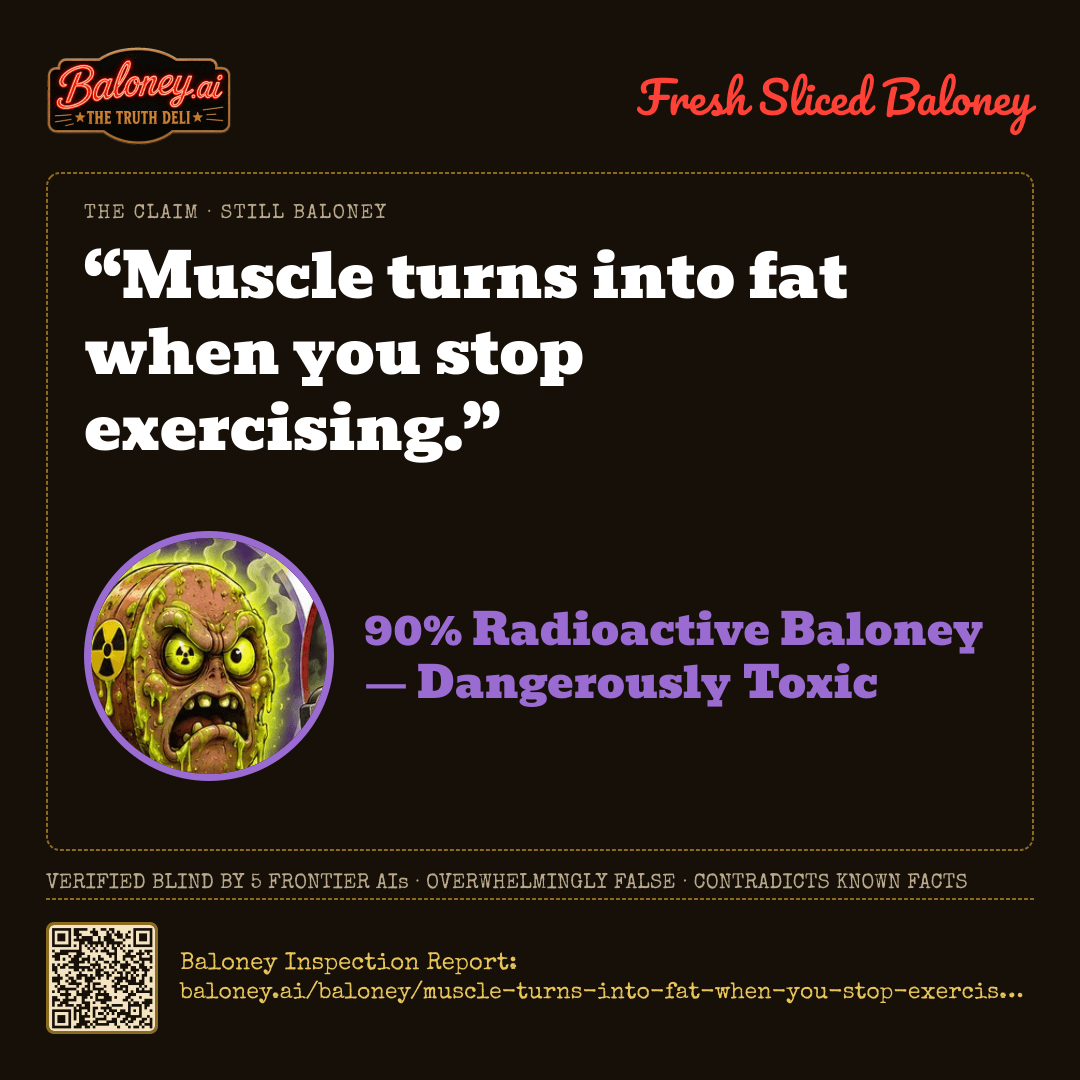
 “Muscle turns into fat when you stop exercising.”90% Radioactive Baloney — Dangerously ToxicVerified blind by 5 frontier AIs · Baloney Inspection Report: baloney.ai/baloney/muscle-turns-into-fat-when-you-stop-exercising
The Baloney Sampler
The panel found the claim false in its central mechanism. Muscle fibres and fat cells are distinct, terminally differentiated cell types, and no physiological pathway turns one into the other. What actually happens after you stop training is two separate things at once: disuse atrophy shrinks muscle, while unchanged eating against lower energy expenditure adds fat. MedlinePlus, the CDC, the Library of Congress, Mayo Clinic and the American College of Sports Medicine all treat the statement as a fitness myth.
The decisive point is that the two processes can be pulled apart: someone who stops training while eating at a deficit loses muscle and fat together, which conversion could not allow. One real kernel was credited — PubMed Central reviews and peer-reviewed ageing literature show fat infiltrating within and between disused muscle fibres, and muscle-resident progenitor cells turning into fat cells. Even so, that is newly deposited fat around shrinking fibres, not muscle protein becoming fat.
Original Claim Source https://www.acefitness.org/resources/everyone/blog/685/5-fitness-myths-that-can-damage-your-health/
Other ways to slice it — phrasings that might have changed the rating
- “When you stop exercising, fat accumulates within and between the fibres of disused muscle, making the muscle itself fattier.” The panel credited intramuscular adipose infiltration (myosteatosis) and the adipogenic differentiation of muscle-resident fibro-adipogenic progenitors as the one genuine kernel behind the myth.
- “If you stop exercising and keep eating the same amount, you will lose muscle mass and gain body fat at the same time.” All five reports described this parallel-process explanation — atrophy plus a calorie surplus from reduced expenditure — as what people are actually observing when they say muscle turned into fat.
- “Body fat turns into muscle when you start exercising.” Report 1 noted the reverse claim is rejected by the same physiology, since body composition consists of two independently regulated compartments.
Written from the panel’s reports by Anthropic · claude-opus-5. Nothing here changed the score.
The Order Ticket
15:34:00CLAIM RECEIVED — QUEUED FOR INSPECTION✓
15:34:29claude-opus-5 REPORTED — SCORE 88, CONFIDENCE 95✓
15:34:40gpt-5.5 REPORTED — SCORE 86, CONFIDENCE 94✓
15:34:31gemini-3.1-pro-preview REPORTED — SCORE 99, CONFIDENCE 98✓
15:34:14sonar-pro REPORTED — SCORE 95, CONFIDENCE 94✓
15:35:58grok-4.6 REPORTED — SCORE 90, CONFIDENCE 92✓
15:37:16PRIMARY MASTER CLAUDE — SCORE 95✓
15:36:17BLIND VALIDATION GROK — SCORE 92✓
15:37:16AGREEMENT CONFIRMED — DELTA 5✓
15:37:16SCORING MODEL V2 — MEDIAN OF 5 COUNTED LAB SCORES: 88, 86, 99, 95, 90 → 90.✓
How This One Was Sliced
Station 1 · Blind Inspection — Five Graders, Zero Peeking
Each lab scored the claim independently, without seeing the others. Open a breakdown for its evidence, its sources, and how sure it was.
Anthropic · EQUAL WEIGHT · 28.7s
claude-opus-5
88%BALONEY
ROUND-1 BREAKDOWN
Evidence offered for the claim- The claim reflects a real and commonly observed outcome: people who stop training often lose muscle mass (disuse atrophy begins within roughly 1-3 weeks of inactivity) while simultaneously gaining body fat, so the visible result can look like one tissue 'becoming' the other.
- Energy balance supports the appearance of conversion: detrained people typically keep eating the same amount while burning fewer calories, and lower muscle mass slightly lowers resting metabolic rate, so surplus energy is stored as adipose tissue.
- There is a genuine physiological phenomenon that superficially resembles the claim: with disuse, aging, or injury, fat can infiltrate within and between muscle fibers (intramuscular adipose tissue / myosteatosis), so imaging of a detrained or immobilized limb really does show more fat inside the muscle compartment.
- Muscle-resident cells (fibro-adipogenic progenitors, a satellite-cell-adjacent stem population) can differentiate into fat cells under conditions of injury or disuse — so new fat can arise from cells living in muscle tissue, which is the closest thing to a kernel of truth in the claim.
Evidence against the claim- Muscle and fat are histologically and biochemically distinct tissues. Skeletal muscle is composed of multinucleated myofibers built on contractile proteins (actin/myosin); adipocytes are unrelated cells storing triglycerides. There is no metabolic pathway by which a myofiber transforms into an adipocyte.
- Detraining causes muscle protein breakdown: amino acids are recycled into other proteins or oxidized/converted to glucose, and excess nitrogen is excreted as urea. Fat gain is a separate, parallel process driven by caloric surplus, not by the atrophied muscle itself.
- The two processes are experimentally dissociable: a person who stops training but maintains a caloric deficit loses muscle AND loses fat; someone who keeps training but overeats gains muscle AND fat. If conversion were real, these outcomes would be impossible.
- The reverse claim ('fat turns into muscle' with training) is equally false and is rejected by the same physiology — exercise science and clinical sources describe body composition as two independently regulated compartments.
- Even the fat infiltration seen in disused muscle is newly deposited adipose tissue occupying space between/within fibers, not converted muscle protein — the muscle is shrinking and fat is accumulating around it, two distinct events.
- Major clinical and exercise-science bodies (Mayo Clinic, Cleveland Clinic, Harvard Health, ACSM/ACE) explicitly list this as a fitness myth.
How sure this lab was95/100 — the lab’s own confidence in the score above, not a second reading of the claim.
SourcesMayo Clinicedu · 93 · Cleveland Clinic Health Essentialsedu · 86 · Harvard Health Publishingedu · 89 · National Institute on Aging (NIH)gov · 94 · MedlinePlus, U.S. National Library of Medicinegov · 93 · Journal of Applied Physiology (American Physiological Society) — bed-rest/disuse atrophy literaturejournal · 92 · American College of Sports Medicineother · 88 · American Council on Exerciseother · 74 · PubMed Central — reviews on intramuscular adipose tissue / fibro-adipogenic progenitorsjournal · 90
OpenAI · EQUAL WEIGHT · 39.6s
gpt-5.5
86%BALONEY
ROUND-1 BREAKDOWN
Evidence offered for the claim- Stopping exercise can produce the appearance that muscle has been replaced by fat: unused muscle can atrophy, and if food intake is not reduced, lower energy expenditure can promote fat gain.
- Detraining research shows that training-related adaptations are lost after exercise is reduced or stopped, which can include declines in muscle size/function and unfavorable body-composition changes.
- Inactivity and aging can increase fat infiltration within or around skeletal muscle, which may make muscle look or measure as 'fattier'; however, this is fat deposition/infiltration, not mature muscle tissue transforming into fat cells.
Evidence against the claim- The statement is biologically false as written: skeletal muscle tissue and adipose tissue are distinct tissues, and mature muscle fibers do not convert into fat cells when exercise stops.
- When exercise stops, muscle may shrink through atrophy from disuse, while fat mass may increase separately if calorie intake exceeds expenditure. These are parallel processes, not one tissue turning into another.
- Government and science-communication sources explicitly describe the claim as a myth: muscle does not 'turn into' fat; rather, people can lose muscle and gain fat at the same time.
How sure this lab was94/100 — the lab’s own confidence in the score above, not a second reading of the claim.
SourcesLibrary of Congressgov · 92 · MedlinePlus / U.S. National Library of Medicinegov · 95 · Scientific Americannews · 85 · Sports Medicinejournal · 88 · Journal of Nutrition, Health & Agingjournal · 86
Google · EQUAL WEIGHT · 30.5s
gemini-3.1-pro-preview
99%BALONEY
ROUND-1 BREAKDOWN
Evidence offered for the claim- When individuals stop exercising but maintain their previous caloric intake, they often gain body fat while simultaneously losing muscle mass, creating a powerful visual illusion that the muscle is actively turning into fat.
- Muscles that are no longer actively trained will atrophy (shrink) and lose their firm tone, feeling much softer to the touch. This physical change mimics the softer texture of adipose (fat) tissue.
Evidence against the claim- Muscle and fat are two completely distinct, non-interchangeable types of biological tissue. Muscle is made of myocytes, while fat is made of adipocytes.
- It is biologically impossible for a muscle cell to transmute into a fat cell, just as it is impossible for bone to turn into skin or a liver to turn into a kidney.
- When exercise stops, muscle cells shrink (atrophy) due to a lack of physical stimulus. They do not disappear or convert into fat; they simply take up less space.
- Fat accumulation happens as an entirely separate physiological process. When a person stops exercising, their daily energy expenditure drops. If they do not decrease their caloric intake to match, the surplus calories are stored as new fat around the atrophying muscle.
How sure this lab was98/100 — the lab’s own confidence in the score above, not a second reading of the claim.
SourcesAmerican Council on Exercise (ACE)edu · 90 · American College of Sports Medicine (ACSM)edu · 95 · WebMDother · 80
Perplexity · EQUAL WEIGHT · 13.6s
sonar-pro
95%BALONEY
ROUND-1 BREAKDOWN
Evidence offered for the claim- The claim captures a *common visual experience*: when people stop exercising, their bodies often look "softer" and less muscular over time, which can create the *illusion* that muscle has "turned into" fat. This is due to simultaneous **muscle atrophy** (shrinking) and **fat gain**, not a literal tissue conversion.[2][3][4][5][7][8][10][11][14][15]
- Stopping exercise reduces energy expenditure; if calorie intake stays the same, **fat mass tends to increase** while **muscle mass decreases**, so a person may subjectively feel that their former muscles have become fat.[3][5][7][8][10][14][15]
- Some fat can accumulate *within* and around muscles (intramuscular fat) when people are inactive or aging, contributing further to the impression that muscle has become fat, even though this fat comes from adipocytes expanding, not muscle cells morphing.[5][15]
Evidence against the claim- Multiple experts and science-based outlets explicitly state that **muscle does not turn into fat**; muscle tissue (myocytes) and fat tissue (adipocytes) are biologically distinct and cannot convert into one another.[2][3][4][5][6][8][9][10][11][12][14][15]
- Exercise physiologist Rob Newton describes the idea that muscle turns to fat when you stop exercising as having "no background in science" and calls it "a total myth," emphasizing that muscle and fat are entirely different tissues with no mechanism for a muscle cell to convert to a fat cell.[2]
- Medical professionals note that fat cells and muscle cells are different structures and are not interchangeable, likening the idea to "an orange turning into an apple"—it is not possible for one tissue type to morph into the other.[3]
- Anatomy explanations clarify that when you stop exercising, **muscle cells atrophy** (shrink) while **fat cells expand** if calories exceed expenditure; these are separate processes, not a direct conversion.[4][5][6][8][14][15]
- Science-focused explanations stress that muscle fibers and fat cells arise from different precursor cells and are **terminally differentiated**, meaning a myocyte cannot biologically morph into an adipocyte; the perceived "conversion" is simply misunderstanding of simultaneous changes in body composition.[5][15]
- Fact-style mythbuster pages state plainly that the idea that muscle turns into fat is **false**, explaining that stopping exercise leads to loss of muscle and gain of fat, which only *appears* like conversion.[10][11]
- Cellular and physiology explanations compare muscle-to-fat conversion to bone turning into skin or blood—used to illustrate that such tissue conversions do not occur under normal human physiological conditions.[5][6][15]
How sure this lab was94/100 — the lab’s own confidence in the score above, not a second reading of the claim.
SourcesNine.com.au (interview with exercise science academic)news · 85 · Piedmont Healthcareother · 85 · Institute of Human Anatomyother · 80 · Arnold's Pump Clubother · 75 · Fitness Empire (science-based fitness summary)other · 70 · Fit&Wellnews · 70 · Fit&Wellnews · 70 · Strictly Scienceother · 75 · Today I Found Outnews · 70 · Topend Sportsother · 70 · Expressnews · 65 · Marathon Handbookother · 70
xAI · EQUAL WEIGHT · 117.6s
grok-4.6
90%BALONEY
ROUND-1 BREAKDOWN
Evidence offered for the claim- People who stop exercising often lose visible muscle definition while gaining fat, which can create the appearance of conversion.
- The idea is a longstanding colloquial description of body-composition changes after detraining.
Evidence against the claim- Skeletal muscle fibers and adipocytes are distinct cell types with no normal physiological pathway converting one into the other.
- Detraining produces muscle atrophy through reduced protein synthesis and increased breakdown; any fat gain occurs separately via energy surplus.
- The two tissues remain independent even in sarcopenic obesity, where muscle loss and fat accumulation simply coexist.
How sure this lab was92/100 — the lab’s own confidence in the score above, not a second reading of the claim.
SourcesMayo Clinicother · 93 · CDCgov · 96 · Wikipediaother · 68
Station 2 · The Masters
Primary Master · drawn at random
claude-opus-5
95% BALONEY
All five evaluators independently reached the same conclusion, and their combined evidence is unusually consistent: skeletal muscle fibres (myocytes) and adipocytes are distinct, terminally differentiated cell types, and there is no physiological pathway by which a mature muscle fibre becomes a fat cell. Every report converged on the same mechanism for the illusion — detraining causes disuse atrophy of muscle while reduced energy expenditure against unchanged intake causes separate fat accumulation, two parallel processes that together produce a softer, less defined appearance. The strongest argument against any literal reading was raised by Report 3 and is decisive: the two processes are experimentally dissociable, since a person who stops training while in a caloric deficit loses muscle AND fat, which would be impossible if conversion occurred. I weighted the government, clinical and journal sources (MedlinePlus, CDC, NIH/National Institute on Aging, Library of Congress, Mayo Clinic, Harvard Health, Cleveland Clinic, Journal of Applied Physiology, Sports Medicine, PMC reviews) most heavily; the consumer-fitness and news outlets were used only as corroboration of the myth's framing, not as the basis for the physiology. I gave real weight to the one genuine kernel the panel surfaced — myosteatosis/intramuscular adipose infiltration with disuse and ageing, and the ability of muscle-resident fibro-adipogenic progenitors to differentiate into adipocytes after injury or disuse (Reports 1, 3, 4). This is why the score sits just below the top of the band rather than at the ceiling: something fat-related really does happen inside disused muscle. But even that is newly deposited adipose tissue occupying space between shrinking fibres, not muscle protein transmuting into fat, so the statement as written remains false in its central mechanism. Scored as written, the claim asserts a tissue conversion that does not occur, and it is actively misleading because it implies fat gain is an unavoidable consequence of stopping training rather than a separate, diet-dependent process — hence Radioactive Baloney. I did not set the zombie flag: although this is an old and often-corrected misconception, it circulates as loose colloquial shorthand for a real body-composition change rather than as a doctrinal, repeatedly-relitigated falsehood in the mould of flat earth or moon-landing denial, and it retains a partial physiological kernel that the archetypes lack.
Agreement was near-total on substance: all five evaluators judged the claim biologically false, all five identified the same explanation for why it feels true (simultaneous atrophy and fat gain), and all five scored it in the Radioactive Baloney band. Disagreement was only about severity, spanning 86 to 99. The lower scorers (Reports 3 and 4) discounted the claim less harshly because they gave weight to intramuscular fat infiltration and to muscle-resident fibro-adipogenic progenitors that can become fat cells — the closest thing to a kernel of truth. The highest scorer (Report 5) treated the claim as purely and impossibly false with no mitigating physiology and recommended the zombie band. No evaluator argued for any literal conversion, and no evaluator's sources contradicted another's.
Blind Validation Master · never saw the Primary’s work
grok-4.6
92% BALONEY
The claim as written is biologically false: mature skeletal-muscle fibers (myocytes) and adipocytes are distinct, terminally differentiated cell types with no physiological conversion pathway. Stopping exercise produces two independent processes—disuse atrophy (protein breakdown, smaller fibers) plus possible fat gain from unchanged intake and lower expenditure—that can create a visual/soft-tissue illusion of replacement; intramuscular fat infiltration and FAP-cell differentiation likewise add adipose around or within muscle without transforming existing muscle into fat. The two compartments remain experimentally dissociable (calorie deficit after detraining loses both; surplus while training can gain both). Clinical and exercise-science sources uniformly treat the statement as a myth, matching the ‘overwhelmingly false / still-circulating’ end of the scale.
AGREEMENT TEST PASSED — MASTERS SCORED 95% AND 92% · BLIND VALIDATION CONFIRMED THIS SCORE · NO RE-EVALUATION REQUIRED
How the number was reached · scoring model v2 · how our models work
- Median of 5 counted lab scores: 88, 86, 99, 95, 90 → 90.
The Evidence
Evidence offered for the claim
- Bodies really do look softer after training stops DEBUNKED — Refuted as evidence of conversion. The panel accepted the observation — detrained people lose muscle definition and often gain fat — but all five evaluators found this is simultaneous atrophy and fat gain, not tissue transformation. Report 1 and Report 5 both described it explicitly as a visual illusion.
- Atrophied muscle feels softer to the touch DEBUNKED — Refuted as evidence of conversion. Report 5 noted untrained muscle loses firmness and mimics the texture of adipose tissue, but the muscle cells have merely shrunk and occupy less space; they have not become fat cells.
- Fat really does appear inside disused muscle DEBUNKED — Partially stands, but does not support the claim. Reports 1, 3 and 4 confirmed that with disuse, ageing or injury, intramuscular and intermuscular fat (myosteatosis) increases, so imaging of an immobilised limb genuinely shows more fat in the muscle compartment. Report 3 and Report 4 both stressed this is newly deposited adipose tissue between and within shrinking fibres, not converted muscle protein.
- Muscle-resident stem cells can become fat cells DEBUNKED — The nearest kernel of truth, and still not conversion. Report 3 cited reviews indicating that fibro-adipogenic progenitors — a stem population living in muscle tissue — can differentiate into adipocytes after injury or disuse. New fat can therefore arise from cells resident in muscle, but existing myofibres are not the source.
- Long-standing colloquial shorthand DEBUNKED — Refuted as a truth claim. Report 2 noted the phrase is an old everyday description of post-detraining body-composition change. Familiarity of the phrasing does not make the stated mechanism correct.
Evidence against the claim
- Two unrelated cell types Skeletal muscle is built from multinucleated myofibres of contractile proteins such as actin and myosin; fat is adipocytes storing triglycerides. Reports 1, 2, 3 and 5 all recorded that these arise from different precursors, are terminally differentiated, and have no metabolic pathway linking one to the other.
- No such conversion exists in human physiology An exercise scientist quoted in Report 1 called the idea "a total myth" with "no background in science"; clinicians in the same report likened it to an orange turning into an apple. Report 5 compared it to bone turning into skin or a liver into a kidney.
- Two separate, parallel processes Detraining drives muscle atrophy through reduced protein synthesis and increased breakdown, while fat mass rises only if intake exceeds a now-lower energy expenditure. Reports 2, 3, 4 and 5 all described these as independent events occurring at the same time.
- The two outcomes can be pulled apart Report 3's decisive test: someone who stops training but stays in a caloric deficit loses muscle and loses fat, while someone who keeps training but overeats gains muscle and gains fat. If conversion were real, neither outcome would be possible.
- Atrophied muscle protein goes elsewhere Report 3 noted that on breakdown, muscle amino acids are recycled into other proteins or oxidised, with excess nitrogen excreted as urea. The atrophying muscle does not supply the material for new fat.
- Even sarcopenic obesity keeps them separate Report 2 pointed out that in sarcopenic obesity — the clearest real-world case of losing muscle while gaining fat — the two tissues remain wholly independent compartments that merely coexist.
- Listed as a myth by clinical and exercise-science bodies Reports 1 through 5 found the claim explicitly labelled false by government and clinical sources including MedlinePlus, the Library of Congress, Mayo Clinic, Cleveland Clinic, Harvard Health, the American College of Sports Medicine and the American Council on Exercise.
- The mirror claim fails for the same reason Report 3 noted that "fat turns into muscle" with training is equally false, rejected by the identical physiology: body composition is two independently regulated compartments.
Sources · Reliability · Why Accepted or Discounted
| Source | Type | Reliability | Ruling |
|---|
| MedlinePlus / U.S. National Library of Medicine | gov | 94 | ACCEPTED — Cited independently by two evaluators; authoritative consumer-health source that states plainly that muscle does not turn into fat. |
| Centers for Disease Control and Prevention | gov | 96 | ACCEPTED — Government public-health authority on physical activity and body composition; consistent with all other sources on the panel. |
| National Institute on Aging (NIH) | gov | 94 | ACCEPTED — Authoritative on age-related muscle loss and fat gain, the scenario most often mistaken for conversion. |
| Library of Congress | gov | 92 | ACCEPTED — Government science-reference service that explicitly addresses this claim as a myth; appropriate for a settled physiological question. |
| Mayo Clinic | edu | 93 | ACCEPTED — Cited independently by two evaluators; major clinical institution listing the claim among fitness myths. |
| Harvard Health Publishing | edu | 89 | ACCEPTED — Established academic medical publisher; corroborates the atrophy-plus-fat-gain explanation. |
| Cleveland Clinic Health Essentials | edu | 86 | ACCEPTED — Clinical source consistent with the other institutional sources on both mechanism and myth status. |
| Journal of Applied Physiology (American Physiological Society) | journal | 92 | ACCEPTED — Peer-reviewed bed-rest and disuse-atrophy literature directly supplies the mechanism for muscle loss during inactivity. |
| PubMed Central — reviews on intramuscular adipose tissue and fibro-adipogenic progenitors | journal | 90 | ACCEPTED — Peer-reviewed reviews establish the one genuine nuance — fat infiltration into disused muscle and adipogenic differentiation of muscle-resident progenitors — and were weighted in favour of the claim. |
| Sports Medicine | journal | 88 | ACCEPTED — Peer-reviewed detraining literature documenting loss of training adaptations after exercise stops. |
| Journal of Nutrition, Health & Aging | journal | 86 | ACCEPTED — Peer-reviewed source on ageing body composition and fat infiltration of muscle. |
| American College of Sports Medicine | edu | 92 | ACCEPTED — Cited independently by two evaluators; the leading professional exercise-science body, which lists this as a myth. |
| American Council on Exercise | edu | 82 | ACCEPTED — Certifying body for fitness professionals; used as corroboration rather than primary physiology, consistent with stronger sources. |
| Piedmont Healthcare | other | 85 | ACCEPTED — Health-system explainer quoting clinicians; its orange-to-apple analogy matches the consensus mechanism. |
| Scientific American | news | 85 | ACCEPTED — Reputable science journalism explicitly describing the claim as a myth; aligned with the journal and government sources. |
| Nine.com.au (interview with exercise science academic) | news | 85 | ACCEPTED — Accepted for the directly quoted expert, exercise physiologist Rob Newton, not for the outlet's own analysis. |
| WebMD | other | 80 | ACCEPTED — Consumer-health reference; adds nothing beyond the clinical sources but does not conflict with them. |
| Institute of Human Anatomy | other | 80 | ACCEPTED — Anatomy-education outlet; its cell-level account of atrophy versus adipocyte expansion matches peer-reviewed physiology. |
| Strictly Science | other | 75 | ACCEPTED — Low-weight corroboration only; its claims duplicate points independently established by clinical and journal sources. |
| Arnold's Pump Club | other | 75 | DISCOUNTED — Commercial fitness newsletter with a promotional interest in training advice; contributed no evidence not already carried by stronger sources. |
Serve It Fresh
Ready to Serve11 servings
Serve it the way you want it
The Verdict
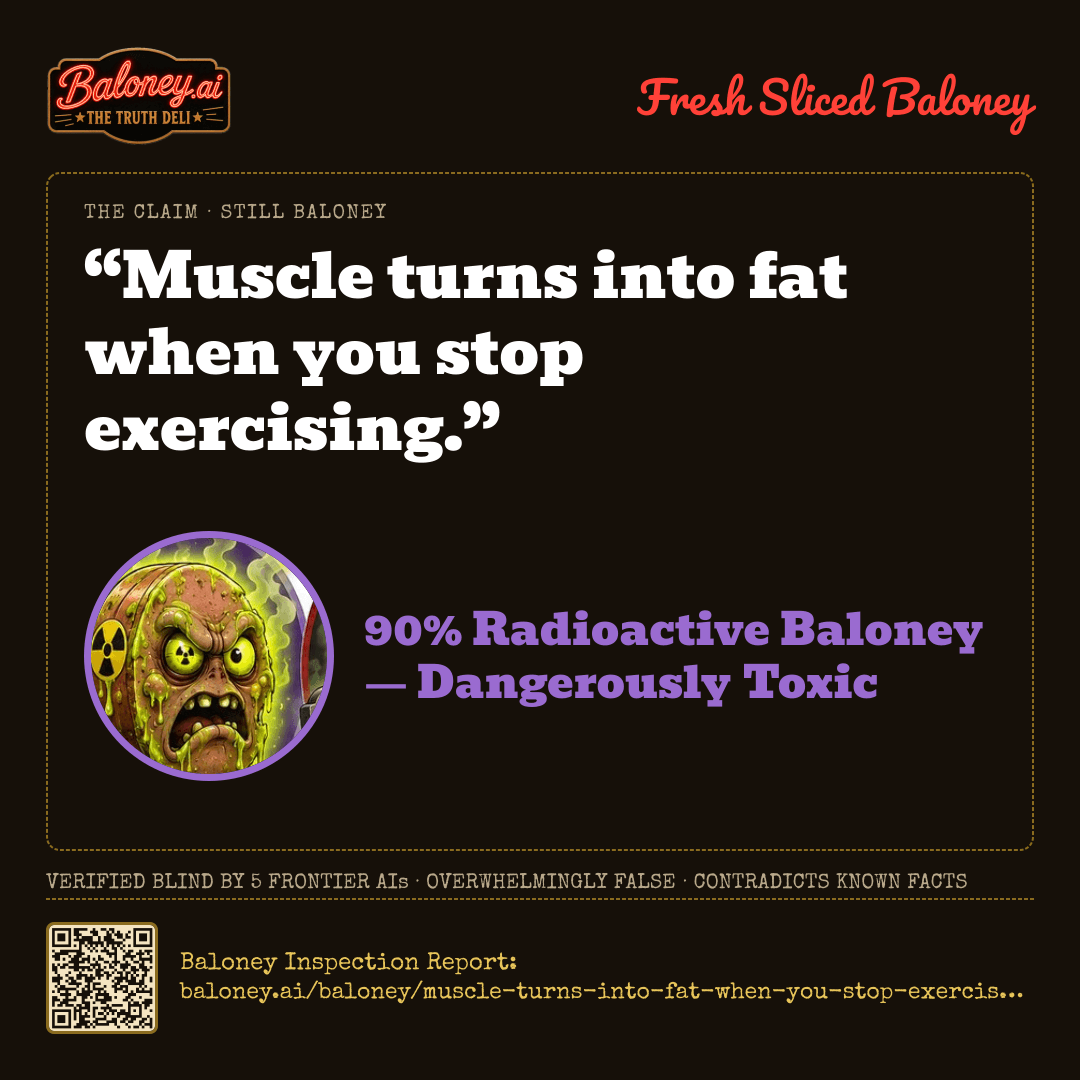
“Muscle turns into fat when you stop exercising.”90% Radioactive Baloney — Dangerously ToxicVerified blind by 5 frontier AIs · Baloney Inspection Report: baloney.ai/baloney/muscle-turns-into-fat-when-you-stop-exercising