Baloney Inspection Report: Claim #1172 · Inspected Oct 31, 2026, 7:48 AM PDT · Scoring model v2
 30%
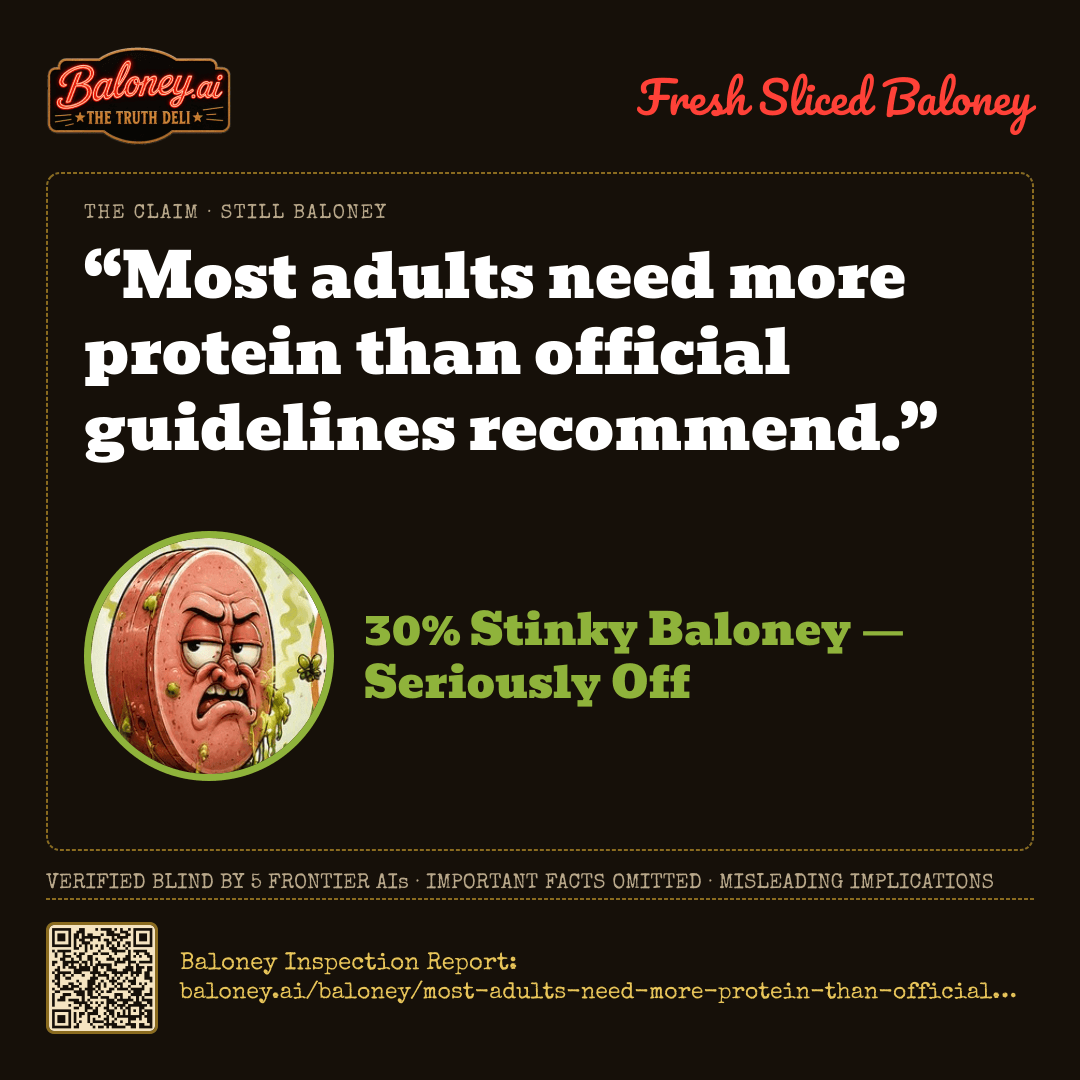
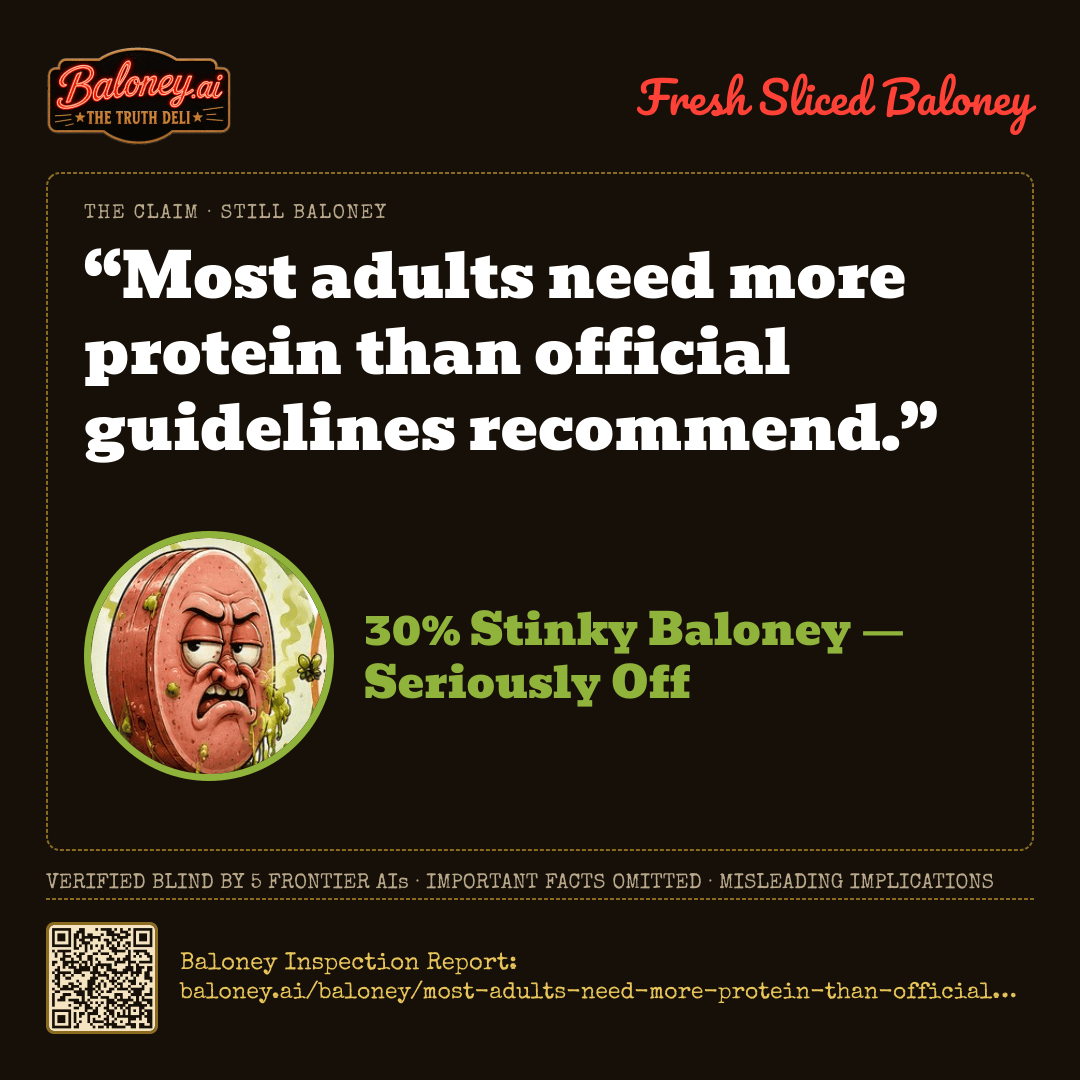
“Most adults need more protein than official guidelines recommend.”
30%Stinky Baloney — Seriously Off
That’s not the whole story…
Important facts omittedMisleading implicationsCherry-picked infoSpins the truth
Serve It Fresh
Ready to Serve18 servings
Serve it the way you want it
The Verdict
 “Most adults need more protein than official guidelines recommend.”30% Stinky Baloney — Seriously OffVerified blind by 5 frontier AIs · Baloney Inspection Report: baloney.ai/baloney/most-adults-need-more-protein-than-official-guidelines
The Baloney Sampler
The official 0.8 g/kg/day figure is not an average need. The National Academies set it roughly two standard deviations above the estimated average requirement of 0.66 g/kg so that it covers 97–98% of healthy adults, and the World Health Organization's joint requirements report arrives at a similar safe intake near 0.83 g/kg/day. USDA's What We Eat in America survey data show typical US adult intake already sits above that level, and the Dietary Guidelines for Americans do not flag protein as an underconsumed nutrient.
The panel found the scientific challenge real but unsettled. Indicator amino acid oxidation studies point to a higher average requirement, but rest on small samples and short feeding periods and have not been adopted by any guideline body. The strongest expert support — the PROT-AGE group for adults over 65, and sports-nutrition position stands for trained athletes — applies to subgroups, not to adults generally. The wording also blurs physiological need with possible benefit, and treats a floor as though it were the whole of official guidance.
Resting on National Academies of Sciences, Engineering, and Medicine · World Health Organization · USDA Agricultural Research Service — What We Eat in America (NHANES) · JAMDA — PROT-AGE Study Group (Bauer et al. 2013)
Original Claim Source https://tsquaredlab.com/blog/how-much-protein-do-you-need-singapore/
Other ways to slice it — phrasings that might have changed the rating
- “Healthy adults over 65 need more protein than the general adult RDA of 0.8 g/kg/day.” The PROT-AGE and ESPEN recommendations of 1.0–1.2 g/kg/day for older adults are the strongest mainstream support in the reports, though one systematic review still concluded 0.83 g/kg/day covers virtually all healthy elderly people.
- “The 0.8 g/kg/day protein RDA is a minimum set to prevent deficiency, not an intake optimised for muscle mass, satiety or healthy ageing.” Every lab accepted this framing, and the primary master noted that the two outlier scores effectively graded this softer statement rather than the claim as written.
- “Indicator amino acid oxidation studies estimate the average adult protein requirement at about 0.9–1.0 g/kg/day, higher than the nitrogen-balance figure underpinning the RDA.” This is the single strongest point for the claim in the reports, but it is a methodological dispute not yet adopted by the National Academies, WHO/FAO or EFSA.
Written from the panel’s reports by Anthropic · claude-opus-5. Nothing here changed the score.
The Order Ticket
14:48:49CLAIM RECEIVED — QUEUED FOR INSPECTION✓
14:50:05claude-opus-5 REPORTED — SCORE 30, CONFIDENCE 72✓
14:49:35gpt-5.5 REPORTED — SCORE 34, CONFIDENCE 84✓
14:49:26gemini-3.1-pro-preview REPORTED — SCORE 4, CONFIDENCE 95✓
14:48:54sonar-pro REPORTED — SCORE 32, CONFIDENCE 90✓
14:50:32grok-4.6 REPORTED — SCORE 14, CONFIDENCE 72✓
14:52:15PRIMARY MASTER CLAUDE — SCORE 28✓
14:50:40BLIND VALIDATION CHATGPT — SCORE 30✓
14:52:39AGREEMENT CONFIRMED — DELTA 2✓
14:52:39SCORING MODEL V2 — MEDIAN OF 5 COUNTED LAB SCORES: 30, 34, 4, 32, 14 → 30.✓
14:52:39SOURCE RULE — LABS CITED 28 SOURCES: 0 DISCARDED FOR HAVING NO URL, 1 DISCARDED AS DEAD LINKS (404/410), 5 COULD NOT BE OPENED BY US AND ARE MARKED UNVERIFIED.✓
14:52:39SOURCE RULE — PRIMARY MASTER RULED ON 20 SOURCES: 0 DISCARDED FOR HAVING NO URL, 0 DISCARDED AS DEAD LINKS, 4 MARKED UNVERIFIED, 16 VERIFIED.✓
How This One Was Sliced
Station 1 · Blind Inspection — Five Graders, Zero Peeking
Each lab scored the claim independently, without seeing the others. Open a breakdown for its evidence, its sources, and how sure it was.
Anthropic · EQUAL WEIGHT · 76.0s
claude-opus-5
30%BALONEY
ROUND-1 BREAKDOWN
Evidence offered for the claim- The adult RDA of 0.8 g protein/kg body weight/day was derived largely from nitrogen-balance studies, a method widely criticized for systematically underestimating requirements (short adaptation periods, unmeasured losses, linear extrapolation to zero balance). The Institute of Medicine's own DRI report acknowledges the limitations of the nitrogen-balance database used.
- Studies using the indicator amino acid oxidation (IAAO) technique (Humayun, Elango, Ball & Pencharz and follow-ups) estimated an average adult requirement of roughly 0.9–1.0 g/kg/d and a safe (97.5th percentile) intake near 1.2 g/kg/d — about 40–50% higher than the current RDA. If the average requirement really is ~0.9–1.0 g/kg, then by definition more than half of adults would need more than 0.8 g/kg.
- Expert consensus groups specifically reject 0.8 g/kg for older adults: the PROT-AGE Study Group (JAMDA, 2013) and the ESPEN expert group recommend 1.0–1.2 g/kg/d for healthy adults over 65, and 1.2–1.5 g/kg/d with acute/chronic illness, to counter anabolic resistance and sarcopenia. Adults 65+ are a large and growing share of the adult population.
- The RDA is explicitly a minimum to prevent deficiency/negative nitrogen balance, not an intake optimized for muscle mass retention, bone health, satiety, weight management or healthy aging. Reviews (e.g., Phillips, Chevalier & Leidy; Harvard's Nutrition Source and Harvard Health) argue intakes meaningfully above 0.8 g/kg are better for these outcomes, particularly during weight loss, resistance training, and aging.
- Protein needs rise with energy restriction, high physical activity, pregnancy/lactation, illness and recovery — conditions common enough that a single sedentary-adult minimum understates real-world needs for a substantial share of people.
Evidence against the claim- The RDA is not an average need; it is set at roughly two standard deviations above the Estimated Average Requirement (0.66 g/kg) so that it already covers about 97–98% of healthy adults. Taken at face value against the official standard, 'most adults need more than the RDA' is the opposite of what the standard is constructed to mean.
- National intake data (USDA What We Eat in America / NHANES) show average U.S. adult protein intake is already well above the RDA — roughly 90+ g/day for men and 65–70 g/day for women, or about 1.1–1.3 g/kg — so protein inadequacy is rare in the general U.S. adult population, and most adults are not falling short of guidelines.
- 'Official guidelines' are broader than the RDA: the Acceptable Macronutrient Distribution Range allows 10–35% of calories from protein, and the Dietary Guidelines for Americans do not cap intake at 0.8 g/kg. Under those guidelines, higher intakes are already permitted, so the claim misrepresents the guidance it criticizes.
- The IAAO-based higher estimates have not been accepted by the National Academies, WHO/FAO, EFSA or other DRI-setting bodies. The method is based on small samples, short feeding periods, and validation against a surrogate endpoint; the question is under active review rather than settled.
- Evidence that higher protein improves hard clinical endpoints in generally healthy, non-elderly, non-athletic adults is limited; most benefits documented are for specific subgroups (older adults, people in caloric deficit, resistance trainers) rather than 'most adults.'
- The claim is frequently promoted by protein-product marketing and fitness media, which blurs the distinction between 'requirement to avoid deficiency' and 'intake that might be optimal.'
How sure this lab was72/100 — the lab’s own confidence in the score above, not a second reading of the claim.
SourcesNational Academies of Sciences, Engineering, and Medicine (Institute of Medicine) — DRI report setting the 0.8 g/kg RDA and 10–35% AMDRgov · 97 · USDA / HHS, Dietary Guidelines for Americans 2020–2025gov · 95 · USDA Agricultural Research Service — What We Eat in America (NHANES) nutrient intake tablesgov · 95 · Bauer et al., PROT-AGE Study Group position paper, JAMDA 2013 (via PubMed/NLM)journal · 88 · Humayun, Elango, Ball & Pencharz, 'Reevaluation of the protein requirement in young men with the indicator amino acid oxidation technique,' American Journal of Clinical Nutrition 2007journal · 85 · Harvard T.H. Chan School of Public Health — The Nutrition Sourceedu · 88
OpenAI · EQUAL WEIGHT · 46.2s
gpt-5.5
34%BALONEY
ROUND-1 BREAKDOWN
Evidence offered for the claim- Some expert groups argue the adult RDA (0.8 g/kg/day) is a minimum adequacy target, not an optimal target for muscle preservation, satiety, or athletic adaptation.
- Older adults are the strongest mainstream case for more than the RDA: the PROT-AGE Study Group recommends about 1.0-1.2 g/kg/day for healthy older adults, and higher intakes in some illness/exercise contexts, above the standard adult RDA.
- Athletes and people doing substantial resistance/endurance training often have recommended intakes above the RDA; a major sports-nutrition position statement gives roughly 1.2-2.0 g/kg/day depending on training demands.
- A systematic review/meta-analysis in resistance-training adults found protein supplementation improved strength and fat-free mass gains, with benefits plateauing around roughly 1.6 g/kg/day—well above the RDA—supporting 'more than RDA' for that subgroup.
Evidence against the claim- The claim says 'most adults need' more, which is stronger than the evidence supports. The National Academies RDA of 0.8 g/kg/day is explicitly intended to meet the requirement of nearly all healthy adults, not just the average adult.
- WHO/FAO/UNU guidance is broadly consistent with the U.S. RDA, giving an adult safe/recommended intake near 0.83 g/kg/day; multiple official bodies have not concluded that most healthy adults require more.
- U.S. dietary guidance does not identify protein as a general underconsumed nutrient of public-health concern; the bigger population-level concerns are diet quality and sources of protein foods, not widespread protein inadequacy.
- Population intake analyses show U.S. adults typically consume protein above the RDA on average, so 'most adults need more than official guidelines' is not supported for the general adult population. Some subgroups—older adults, athletes, people dieting, illness/recovery—may need or benefit from more, but that does not establish 'most adults.'
- The claim also blurs 'need' with 'may benefit from.' Higher protein can help with muscle gain, satiety, or aging-related goals, but those are not the same as a physiological requirement for most healthy sedentary adults.
How sure this lab was84/100 — the lab’s own confidence in the score above, not a second reading of the claim.
SourcesNational Academies / NCBI Bookshelfgov · 95 · World Health Organizationgov · 94 · U.S. Department of Agriculture and U.S. Department of Health and Human Servicesgov · 93 · Journal of the American Medical Directors Association / PROT-AGE Study Groupjournal · 86 · Academy of Nutrition and Dietetics, Dietitians of Canada, and American College of Sports Medicinejournal · 86 · British Journal of Sports Medicinejournal · 88 · American Journal of Clinical Nutritionjournal · 80
Google · EQUAL WEIGHT · 37.0s
gemini-3.1-pro-preview
4%BALONEY
ROUND-1 BREAKDOWN
Evidence offered for the claim- The official Recommended Dietary Allowance (RDA) of 0.8 grams of protein per kilogram of body weight per day was established using nitrogen balance studies to determine the minimum amount necessary to prevent deficiency, rather than the optimal amount needed to promote overall health and longevity.
- Major expert consensus groups, including the PROT-AGE Study Group and the European Society for Clinical Nutrition and Metabolism (ESPEN), explicitly recommend that older adults (over age 65) consume 1.0 to 1.2 g/kg/day to prevent age-related muscle loss (sarcopenia).
- The International Society of Sports Nutrition (ISSN) and the American College of Sports Medicine (ACSM) strongly recommend that physically active adults consume between 1.4 and 2.0 g/kg/day to support muscle repair, physical adaptation, and recovery.
- Recent studies utilizing the more precise Indicator Amino Acid Oxidation (IAAO) technique suggest that the true physiological protein requirement for optimal health in average healthy adults is closer to 1.0 to 1.2 g/kg/day, which is significantly higher than the official 0.8 g/kg/day guideline.
Evidence against the claim- The RDA of 0.8 g/kg/day remains the official U.S. government standard established by the Food and Nutrition Board of the National Academies to meet the basic nutritional requirements for the vast majority (97.5%) of the healthy adult population.
- For highly sedentary younger or middle-aged adults without specific athletic, metabolic, or body-composition goals, consuming 0.8 g/kg/day is technically sufficient to prevent clinical protein deficiency.
- Broad recommendations for the general population to significantly increase protein intake could pose risks for individuals with undiagnosed or pre-existing chronic kidney disease due to increased renal filtration burden.
- While the official 'recommended' baseline is 0.8 g/kg/day, dietary surveys show that the average adult in developed nations already naturally consumes roughly 1.0 to 1.2 g/kg/day, meaning many adults do not need to change their actual dietary habits.
How sure this lab was95/100 — the lab’s own confidence in the score above, not a second reading of the claim.
SourcesNational Institutes of Health / JAMDAjournal · 95 · National Institutes of Health / JISSNjournal · 95 · Harvard T.H. Chan School of Public Healthedu · 95
Perplexity · EQUAL WEIGHT · 4.9s
sonar-pro
32%BALONEY
ROUND-1 BREAKDOWN
Evidence offered for the claim- Some expert groups recommend more than the general-adult RDA for healthy older adults: ESPEN recommends about 1.0–1.2 g/kg/day, compared with the general RDA of 0.8 g/kg/day.[2]
- A systematic review and meta-analysis of approximately 13,285 older adults found higher sarcopenia risk among people consuming less than 0.8 g/kg/day than among those consuming 0.8–1.2 g/kg/day.[2]
- Observational evidence summarized in a scientific review suggests that intake near 0.8 g/kg/day may be suboptimal for maintaining muscle mass across adult life, although this does not establish that most adults require more.[1]
Evidence against the claim- The official U.S. Dietary Reference Intake for adults is 0.8 g protein/kg body weight/day, established as the recommended intake for healthy adults.[3][6]
- A systematic review concluded that 0.83 g/kg/day represents the minimum protein need of virtually all healthy elderly people, providing evidence against a blanket claim that most adults require more than the official guideline.[9]
- The evidence favoring higher intake is concentrated in older adults, people with illness, and muscle-preservation outcomes; it does not demonstrate that most adults of all ages need more than the general-adult RDA.[1][2]
- The cited review notes that studies have not unequivocally shown a higher protein requirement in older adults when the outcome is whole-body protein balance, indicating that the proposed higher targets remain debated.[1]
How sure this lab was90/100 — the lab’s own confidence in the score above, not a second reading of the claim.
SourcesCambridge University Press, Nutrition Research Reviewsjournal · 88 · Cambridge University Press, Proceedings of the Nutrition Societyjournal · 86 · National Academies of Sciences, Engineering, and Medicinegov · 98 · National Academies of Sciences, Engineering, and Medicinegov · 98 · Nutrients / PubMed Centraljournal · 91 · Food & Nutrition Researchjournal · 84
xAI · EQUAL WEIGHT · 102.7s
grok-4.6
14%BALONEY
ROUND-1 BREAKDOWN
Evidence offered for the claim- Protein metabolism researchers argue the 0.8 g/kg RDA (based mainly on nitrogen-balance studies) is a deficiency-prevention minimum, not an optimal intake for muscle maintenance; many recommend 1.2–1.6 g/kg for adults, especially with aging or activity.
- RCTs and meta-analyses link higher protein to better muscle protein synthesis, reduced sarcopenia risk in older adults, greater satiety, and improved body composition during weight loss.
- The International Society of Sports Nutrition position stand recommends 1.4–2.0 g/kg for people who exercise, a substantial share of adults.
- Expert groups such as PROT-AGE recommend 1.0–1.2 g/kg or higher for adults 65+, a large and growing segment of the adult population.
Evidence against the claim- U.S. National Academies DRIs still set the adult RDA at 0.8 g/kg/day as sufficient to meet the needs of 97–98% of healthy people; WHO and EFSA use similar values and have not raised them.
- Dietary Guidelines for Americans and NHANES data show most U.S. adults already consume protein above the RDA, so they are not falling short of official recommendations.
- Guideline bodies treat the RDA as covering physiological 'need' (preventing deficiency and negative nitrogen balance); extra intake for possibly optimal muscle or body-composition outcomes has not changed official RDAs.
- For healthy sedentary younger adults, clinically meaningful benefits from routinely exceeding 0.8 g/kg remain limited and insufficient for agencies to revise the general-population recommendation.
- The claim’s wording ('need' + 'most adults') blurs requirement versus possible benefit and does not distinguish subgroups (athletes, elderly, calorie-restricted) from the general adult population.
How sure this lab was72/100 — the lab’s own confidence in the score above, not a second reading of the claim.
SourcesHarvard T.H. Chan School of Public Healthedu · 88 · Journal of the International Society of Sports Nutritionjournal · 86 · National Academies of Sciences, Engineering, and Medicineother · 95 · U.S. Department of Agriculture / HHSgov · 94 · Applied Physiology, Nutrition, and Metabolismjournal · 90
Station 2 · The Masters
Primary Master · drawn at random
claude-opus-5
28% BALONEY
The claim is directionally interesting but overstated as written, which puts it in the lower 'Stinky Baloney' band rather than the true band. Three considerations drove the number. First, the arithmetic of the standard itself: the 0.8 g/kg/day RDA is not an average requirement but is set roughly two standard deviations above the Estimated Average Requirement (0.66 g/kg) precisely so that it covers 97-98% of healthy adults. A claim that 'most adults need more' than this is the direct opposite of what the official figure is constructed to mean, and no DRI-setting body (National Academies, WHO/FAO, EFSA) has concluded otherwise. Second, the genuine scientific challenge is real but unresolved: IAAO-based studies estimate an average requirement near 0.9-1.0 g/kg and a safe intake near 1.2 g/kg, which, if correct, would indeed mean most adults need more than 0.8 g/kg. That is the single strongest point for the claim and it is why this does not score higher. But those estimates rest on small samples, short feeding periods and a surrogate endpoint, and have not been adopted by any guideline body. Third, the expert-group evidence that evaluators leaned on most heavily (PROT-AGE/ESPEN at 1.0-1.2 g/kg for 65+, ISSN/ACSM at 1.4-2.0 g/kg for trained athletes) is subgroup evidence. Older adults and seriously training adults are large and growing populations, but they are not 'most adults', and at least one systematic review cited concluded 0.83 g/kg covers the minimum need of virtually all healthy elderly people. The claim also blurs 'need' (a physiological requirement) with 'may benefit from' (satiety, body composition, muscle gain), and it misrepresents 'official guidelines', which include an AMDR of 10-35% of calories and do not cap intake at 0.8 g/kg. Finally, context the claim omits: average adult intake in developed nations is already around 1.0-1.3 g/kg, so framing this as a widespread shortfall misleads even if the RDA were raised. I weighted the two outlier scores (4 and 14) down because they effectively graded the claim as 'the RDA is a floor, not an optimum' — true, but that is not what the sentence says — and I did not push above 35 because the IAAO literature and mainstream geriatric guidance mean this is a live scientific dispute, not a fabrication.
All five evaluators agreed on the underlying facts: the RDA is 0.8 g/kg/day, it was derived from nitrogen-balance studies as a deficiency-prevention floor, and mainstream expert groups recommend more for older adults (1.0-1.2 g/kg) and for athletes (1.4-2.0 g/kg). All five also acknowledged that typical adult intake already exceeds the RDA. They disagreed sharply on how to grade the wording. One evaluator scored it 4, treating the IAAO evidence and the subgroup recommendations as effectively validating the claim; another scored 14. Three clustered at 30-34, holding that 'most adults' is a materially stronger assertion than subgroup evidence supports and that the RDA is by design set to cover 97.5% of adults. The split is entirely about the quantifier 'most', not about the science.
Blind Validation Master · never saw the Primary’s work
gpt-5.5
30% BALONEY
The claim is misleading as written. The official adult RDA of about 0.8 g/kg/day is intended to meet the protein requirement of nearly all healthy adults, and major official bodies such as the National Academies, WHO/FAO, and EFSA have not concluded that most adults require more. Population data also suggest many adults in developed countries already consume above the RDA, so widespread protein inadequacy is not the main public-health issue. There is real evidence that some groups often benefit from or may need higher intakes: older adults, athletes or regular exercisers, people dieting, pregnant/lactating people, and people recovering from illness. Some methods such as IAAO also suggest higher physiological requirements than nitrogen-balance-derived RDAs, but this remains debated and has not displaced official standards. The statement blurs “need” with “may benefit from” and generalizes subgroup recommendations to “most adults.” A more accurate claim would be that many adults, especially older or active adults, may benefit from protein intakes above the RDA. As written, it omits important context and overstates the evidence.
AGREEMENT TEST PASSED — MASTERS SCORED 28% AND 30% · BLIND VALIDATION CONFIRMED THIS SCORE · NO RE-EVALUATION REQUIRED
How the number was reached · scoring model v2 · how our models work
- Median of 5 counted lab scores: 30, 34, 4, 32, 14 → 30.
The Evidence
Evidence offered for the claim
- RDA is a minimum, not an optimum The 0.8 g/kg/day adult RDA was derived from nitrogen-balance studies and is designed to prevent deficiency and negative nitrogen balance, not to optimise muscle maintenance, satiety, bone health or weight-loss body composition. Nitrogen balance itself is criticised for short adaptation periods, unmeasured losses and linear extrapolation to zero balance.
- IAAO studies estimate a higher requirement Indicator amino acid oxidation work (Humayun, Elango, Ball & Pencharz and follow-ups) estimates an average adult requirement near 0.9-1.0 g/kg/day and a 97.5th-percentile safe intake near 1.2 g/kg/day, 40-50% above the RDA. If that average requirement is correct, more than half of adults would by definition need more than 0.8 g/kg. These estimates remain under review and have not been adopted by the National Academies, WHO/FAO or EFSA.
- Expert groups advise more for adults over 65 DEBUNKED — PROT-AGE and ESPEN recommend 1.0-1.2 g/kg/day for healthy older adults and more during illness. The panel did not accept this as establishing the claim: adults 65+ are a subgroup rather than 'most adults', and one systematic review cited concluded 0.83 g/kg/day represents the minimum need of virtually all healthy elderly people, while a critical narrative review notes a higher requirement in older adults has not been unequivocally shown for whole-body protein balance.
- Sports-nutrition bodies advise 1.4-2.0 g/kg DEBUNKED — ISSN and ACSM/Academy of Nutrition and Dietetics recommend roughly 1.2-2.0 g/kg/day for people training seriously, and a meta-analysis found resistance-training benefits plateauing near 1.6 g/kg/day. The panel judged this inapplicable to the claim as written: it describes the needs of people in substantial resistance or endurance training, not the general adult population.
Evidence against the claim
- The RDA already covers 97.5% of adults The RDA is not an average need. It is set roughly two standard deviations above the Estimated Average Requirement of 0.66 g/kg so that it meets the requirement of 97-98% of healthy adults. 'Most adults need more than the RDA' is the inverse of what the figure is constructed to mean.
- International bodies converge on the same number WHO/FAO/UNU give a safe adult intake near 0.83 g/kg/day, and EFSA uses similar values. No DRI-setting body has concluded that most healthy adults require more, and none has revised its general-population figure upward.
- Typical intakes already exceed the guideline USDA What We Eat in America/NHANES data show average US adult intake around 90+ g/day for men and 65-70 g/day for women, roughly 1.1-1.3 g/kg. Protein inadequacy is rare in the general adult population of developed nations, and US dietary guidance does not list protein as an underconsumed nutrient of public-health concern.
- Official guidance is broader than the RDA The Acceptable Macronutrient Distribution Range permits 10-35% of calories from protein and the Dietary Guidelines for Americans do not cap intake at 0.8 g/kg. Higher intakes are already accommodated within official guidance, so the claim misstates what the guidelines actually say.
- 'Need' is conflated with 'may benefit' Benefits documented for higher protein — satiety, lean-mass retention during energy restriction, training adaptation — are improvements in specific outcomes for specific groups, not physiological requirements. Evidence of benefit on hard clinical endpoints in healthy, non-elderly, non-athletic adults remains limited.
Sources · Reliability · Why Accepted or Discounted
| Source | Type | Reliability | Ruling |
|---|
| Harvard T.H. Chan School of Public Health — The Nutrition Source | edu | 88 | ACCEPTED — Credible academic summary cited by three evaluators; used here as secondary synthesis of the 'RDA is a floor' argument, not as primary evidence. |
| Journal of the International Society of Sports Nutrition | journal | 86 | ACCEPTED — Legitimate position stand, but its 1.4-2.0 g/kg figure applies to exercising individuals and does not speak to the general adult population. |
| National Academies of Sciences, Engineering, and Medicine (DRI report) | other | 95 | ACCEPTED — The primary document establishing the 0.8 g/kg RDA, the 0.66 g/kg EAR and the 10-35% AMDR; decisive on what the official guideline actually asserts. |
| U.S. Department of Agriculture / HHS, Dietary Guidelines for Americans 2020-2025 | gov | 94 | ACCEPTED — Authoritative statement of current US guidance, including that protein is not flagged as an underconsumed nutrient. |
| Applied Physiology, Nutrition, and Metabolismunverified | journal | 90 | ACCEPTED — Peer-reviewed contribution to the requirement debate; supports the 'suboptimal for muscle' argument without establishing a population-wide requirement. |
| JAMDA — PROT-AGE Study Group (Bauer et al. 2013) | journal | 90 | ACCEPTED — Cited by three evaluators and the central expert-consensus document for older adults; accepted for what it says about 65+, not extrapolated to all adults. |
| JISSN position stand (PubMed record) | journal | 95 | ACCEPTED — Same position stand indexed on PubMed; relevant to athletes specifically. |
| National Academies / NCBI Bookshelf — DRI protein chapter | gov | 95 | ACCEPTED — Primary text confirming the RDA is intended to meet the needs of nearly all healthy adults. |
| World Health Organization (WHO/FAO/UNU protein and amino acid requirements) | gov | 94 | ACCEPTED — International corroboration of a safe intake near 0.83 g/kg/day, independent of the US process. |
| USDA / HHS, Dietary Guidelines for Americans 2020-2025 (alternate posting) | gov | 93 | ACCEPTED — Same official document at a second URL; accepted on the same basis. |
| Academy of Nutrition and Dietetics / Dietitians of Canada / ACSM joint position | journal | 86 | ACCEPTED — Authoritative on athlete requirements; explicitly scoped to active populations rather than adults generally. |
| British Journal of Sports Medicine (protein supplementation meta-analysis)unverified | journal | 88 | ACCEPTED — Strong meta-analytic evidence for a ~1.6 g/kg plateau in resistance-training adults; a benefit finding in a subgroup, not a population requirement. |
| American Journal of Clinical Nutrition (protein requirement review)unverified | journal | 80 | ACCEPTED — Peer-reviewed supplement article on requirement methodology; lower weight as a supplement-issue review. |
| Nutrition Research Reviews (Cambridge) — critical narrative review, protein in older adults | journal | 88 | ACCEPTED — Valuable precisely because it cuts both ways, noting that a higher requirement in older adults is not unequivocally demonstrated for whole-body protein balance. |
| Proceedings of the Nutrition Society (Cambridge) — protein transition in older adults | journal | 86 | ACCEPTED — Peer-reviewed source for the ESPEN 1.0-1.2 g/kg recommendation and associated sarcopenia-risk meta-analysis. |
| National Academies of Sciences, Engineering, and Medicine (DRI reference text) | gov | 98 | ACCEPTED — Authoritative confirmation of the current 0.8 g/kg/day DRI for adults. |
| National Academies of Sciences, Engineering, and Medicine (DRI reference text) | gov | 98 | ACCEPTED — Second National Academies reference corroborating the official adult intake figure. |
| Nutrients (PubMed Central) | journal | 91 | ACCEPTED — Peer-reviewed open-access review supporting the muscle-maintenance arguments for intakes above the RDA. |
| Food & Nutrition Researchunverified | journal | 84 | ACCEPTED — Systematic review concluding 0.83 g/kg/day is the minimum need of virtually all healthy elderly; directly relevant counterweight to the subgroup argument. |
| USDA Agricultural Research Service — What We Eat in America (NHANES) | gov | 95 | ACCEPTED — Primary national intake data establishing that typical US adult protein intake already exceeds the RDA. |
Every link was opened when this claim was inspected. A dead link was discarded before publication; “unverified” means the site refused our automated check and the link is the one the panel cited. A source without a URL was never kept.
Serve It Fresh
Ready to Serve18 servings
Serve it the way you want it
The Verdict
“Most adults need more protein than official guidelines recommend.”30% Stinky Baloney — Seriously OffVerified blind by 5 frontier AIs · Baloney Inspection Report: baloney.ai/baloney/most-adults-need-more-protein-than-official-guidelines