Baloney Inspection Report: Claim #1154 · Inspected Oct 30, 2026, 10:06 PM PDT · Scoring model v2
 33%
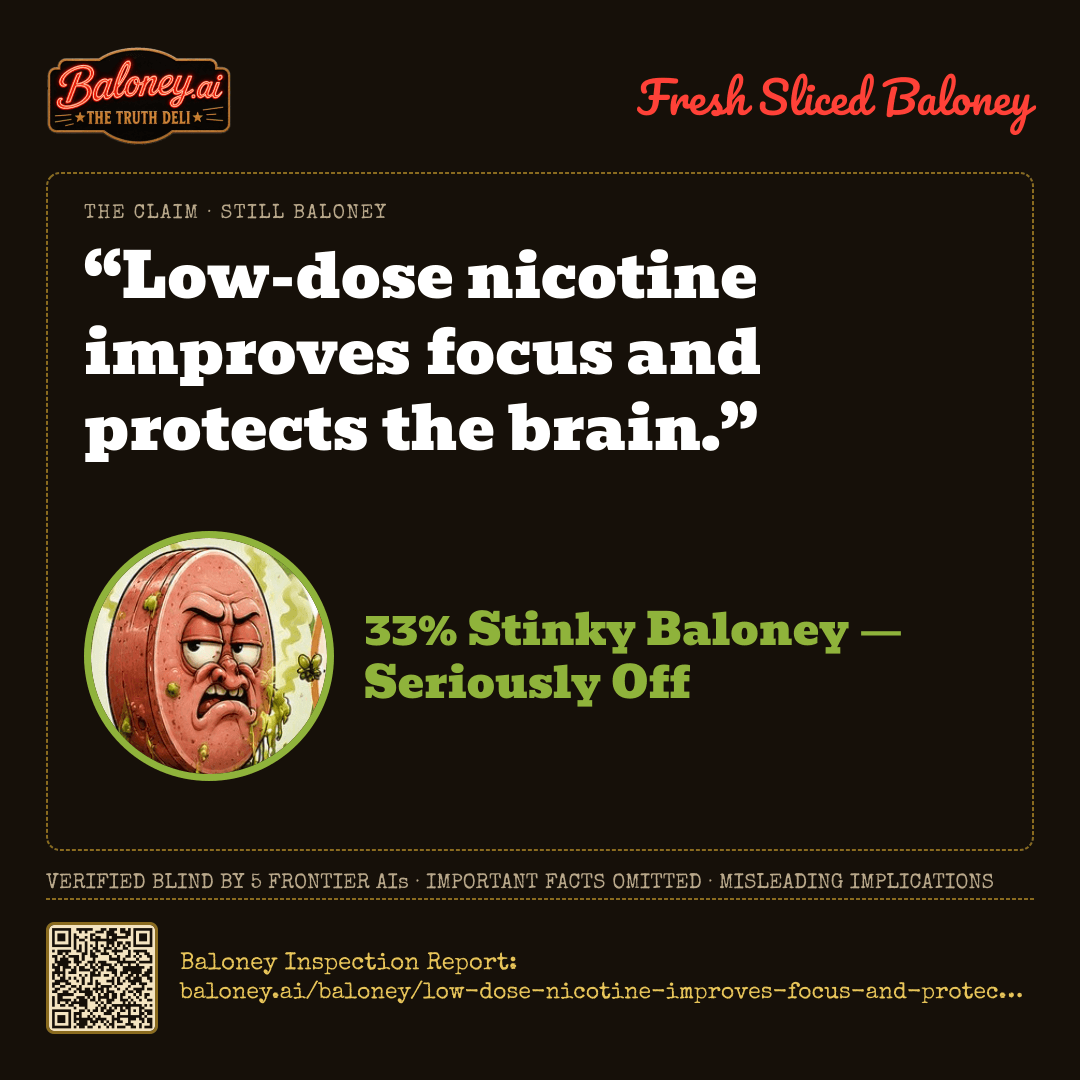
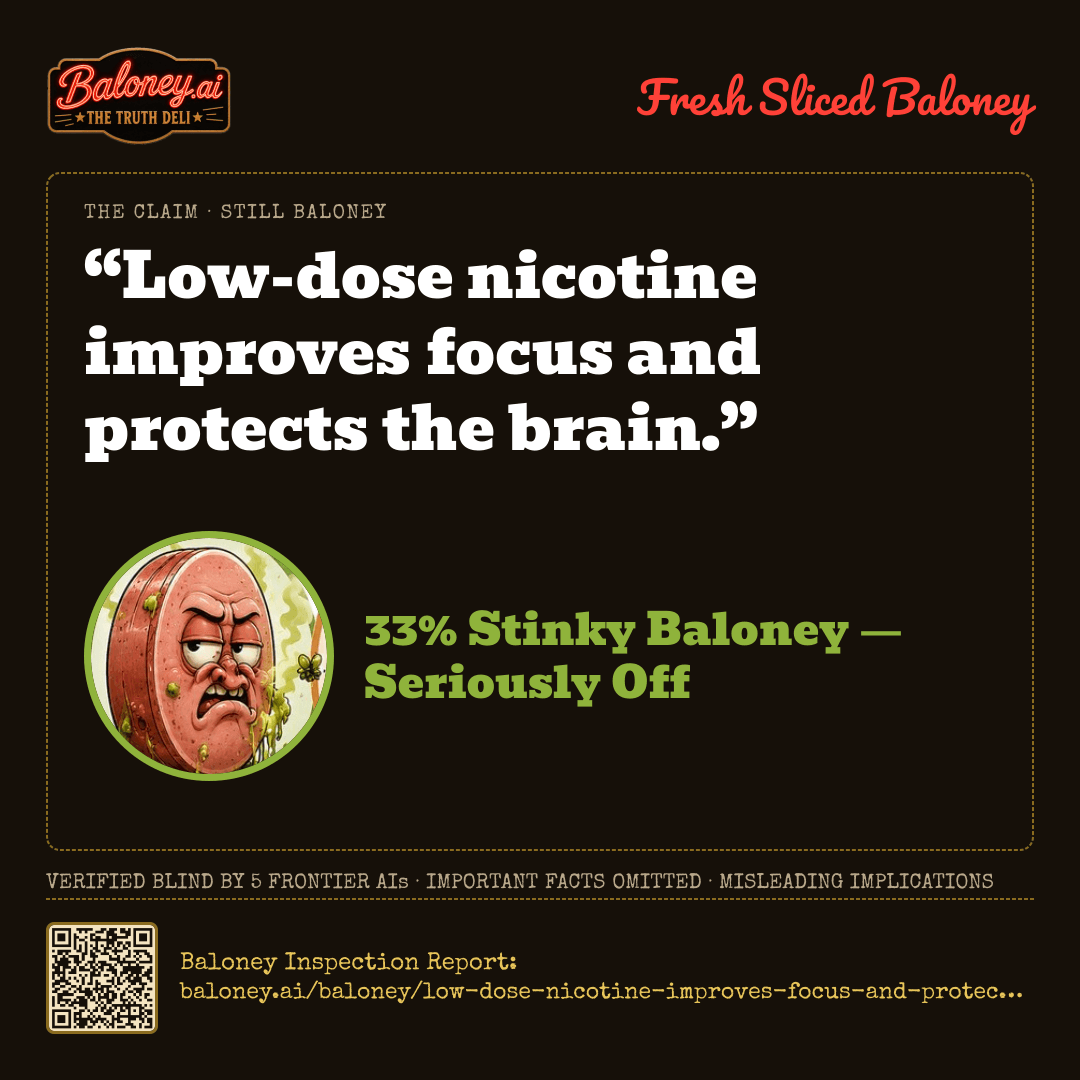
“Low-dose nicotine improves focus and protects the brain.”
33%Stinky Baloney — Seriously Off
That’s not the whole story…
Important facts omittedMisleading implicationsCherry-picked infoSpins the truth
Serve It Fresh
Ready to Serve20 servings
Serve it the way you want it
The Verdict
 “Low-dose nicotine improves focus and protects the brain.”33% Stinky Baloney — Seriously OffVerified blind by 5 frontier AIs · Baloney Inspection Report: baloney.ai/baloney/low-dose-nicotine-improves-focus-and-protects-the-brain
The Baloney Sampler
The reports found that nicotine can produce modest, short-lived improvements in some attention, alertness, reaction-time, and memory tasks. This rests chiefly on the accepted Psychopharmacology meta-analysis of 41 controlled studies and does not establish a lasting focus benefit, especially where effects reflect relief of withdrawal.
The reports found no established evidence that low-dose nicotine protects healthy human brains. A small Neurology pilot found cognitive improvements in people with mild cognitive impairment, but the broader protection claim remains investigational; NIDA, FDA, CDC, and the Surgeon General document addiction, cardiovascular stimulation, and harms to developing brain circuits.
Resting on Psychopharmacology via PubMed · National Institute on Drug Abuse · Neurology via PubMed · U.S. Surgeon General, E-Cigarette Use Among Youth and Young Adults
Original Claim Source https://daveasprey.com/2026-clean-nicotine-roadmap/
Other ways to slice it — phrasings that might have changed the rating
- “In healthy adults, a single low-dose nicotine patch may temporarily improve performance on some attention and working-memory tasks.” The accepted meta-analysis supports acute improvements in selected attention and memory measures, while the reports describe them as modest and short-lived.
- “In nonsmoking adults with amnestic mild cognitive impairment, six months of transdermal nicotine may improve some cognitive test scores.” The accepted Neurology study was a small, preliminary pilot in this specific population and did not establish general brain protection.
- “Nicotine use can worsen attention and learning in adolescents and young adults by harming developing brain circuits.” The accepted NIDA, CDC, FDA, and Surgeon General evidence identifies developmental risks that contradict a blanket brain-protection claim.
Written from the panel’s reports by Perplexity · sonar-pro. Nothing here changed the score.
The Order Ticket
05:06:26CLAIM RECEIVED — QUEUED FOR INSPECTION✓
05:07:35claude-opus-5 REPORTED — SCORE 33, CONFIDENCE 74✓
05:07:31gpt-5.5 REPORTED — SCORE 38, CONFIDENCE 86✓
05:06:57gemini-3.1-pro-preview REPORTED — SCORE 5, CONFIDENCE 95✓
05:06:30sonar-pro REPORTED — SCORE 72, CONFIDENCE 92✓
05:08:30grok-4.6 REPORTED — SCORE 18, CONFIDENCE 78✓
05:08:41PRIMARY MASTER PERPLEXITY — SCORE 34✓
05:08:59BLIND VALIDATION GROK — SCORE 30✓
05:09:11AGREEMENT CONFIRMED — DELTA 3✓
05:09:11SCORING MODEL V2 — MEDIAN OF 5 COUNTED LAB SCORES: 33, 38, 5, 72, 18 → 33.✓
05:09:11SOURCE RULE — LABS CITED 28 SOURCES: 0 DISCARDED FOR HAVING NO URL, 2 DISCARDED AS DEAD LINKS (404/410), 0 COULD NOT BE OPENED BY US AND ARE MARKED UNVERIFIED.✓
05:09:11SOURCE RULE — PRIMARY MASTER RULED ON 20 SOURCES: 0 DISCARDED FOR HAVING NO URL, 0 DISCARDED AS DEAD LINKS, 0 MARKED UNVERIFIED, 20 VERIFIED.✓
How This One Was Sliced
Station 1 · Blind Inspection — Five Graders, Zero Peeking
Each lab scored the claim independently, without seeing the others. Open a breakdown for its evidence, its sources, and how sure it was.
Anthropic · EQUAL WEIGHT · 68.9s
claude-opus-5
33%BALONEY
ROUND-1 BREAKDOWN
Evidence offered for the claim- A peer-reviewed meta-analysis of 41 double-blind, placebo-controlled studies (Heishman, Kleykamp & Singleton, Psychopharmacology 2010) found significant positive effects of acute nicotine/smoking on fine motor ability, alerting and orienting attention, and short-term episodic and working memory in both smokers and non-smokers, supporting the 'improves focus' half of the claim at low/therapeutic doses.
- Nicotine is an agonist at nicotinic acetylcholine receptors (α4β2, α7) that modulate dopamine, acetylcholine and glutamate release in attention-related circuits — a plausible mechanism for the pro-attentional effect, and the same receptor family targeted by approved Alzheimer's drugs (cholinesterase inhibitors) and by varenicline.
- A 6-month double-blind pilot RCT of transdermal nicotine in non-smokers with amnestic mild cognitive impairment (Newhouse et al., Neurology 2012) reported improvement on attention, memory and psychomotor speed measures versus placebo, with good tolerability — the most cited clinical support for a cognitive/'protective' benefit.
- Large epidemiological literature consistently shows an inverse association between tobacco smoking and Parkinson's disease incidence, and some studies show lower Alzheimer's risk in certain cohorts; this generated the neuroprotection hypothesis that motivated nicotine trials (e.g., the NIH-funded MIND trial, NCT02720445).
- Preclinical work (rodent and primate MPTP/6-OHDA models) has repeatedly shown nicotine pretreatment reducing nigrostriatal dopamine neuron loss and levodopa-induced dyskinesias, consistent with some neuroprotective/neuromodulatory action in animals.
Evidence against the claim- Effect sizes for cognition are small-to-moderate (roughly d = 0.15–0.45 in the Heishman meta-analysis) and short-lived; 'improves focus' overstates a modest, transient effect, and in dependent users much of the apparent benefit is relief of withdrawal rather than true enhancement above baseline.
- 'Protects the brain' is not an established clinical finding. No regulator (FDA/EMA) has approved nicotine for cognition, MCI, Alzheimer's or Parkinson's, and definitive trials have not delivered: the Parkinson's nicotine-patch trial (NIC-PD) failed to show disease-modifying benefit, and the larger confirmatory nicotine-patch trial in MCI (MIND, NCT02720445) did not establish the pilot's promise as a treatment indication.
- The smoking–Parkinson's inverse association is confounded: prodromal Parkinson's involves dopaminergic personality changes and reduced nicotine reinforcement (reverse causation), and Mendelian-randomization and sibling analyses have weakened a causal protective interpretation.
- Nicotine is one of the most addictive substances in common use (FDA, NIDA). A 'low dose' is not a stable state — tolerance and dose escalation are the norm, so recommending low-dose nicotine for focus carries a real risk of dependence, which the claim omits.
- In adolescents and young adults, nicotine exposure is documented to harm brain development (attention, learning, impulse control) and prime addiction — the opposite of 'protects the brain' (2016 Surgeon General's Report; CDC; NIDA).
- Nicotine causes vasoconstriction and raises heart rate/blood pressure, and chronic exposure is associated with cardiovascular and cerebrovascular risk; some preclinical data also suggest it promotes angiogenesis and tumor progression. The claim presents only benefits.
- The claim is unqualified and dose-, route-, and population-blind: what is plausible as an acute laboratory effect of a 7 mg patch in a non-smoking adult is not the same as a general health statement, and it is frequently used to market vapes, pouches and 'nootropic' nicotine.
How sure this lab was74/100 — the lab’s own confidence in the score above, not a second reading of the claim.
SourcesPsychopharmacology (via PubMed/NIH) — Heishman, Kleykamp & Singleton, meta-analysis of acute nicotine effects on human performancejournal · 92 · Neurology (via PubMed/NIH) — Newhouse et al., nicotine treatment of mild cognitive impairment, 6-month pilot RCTjournal · 88 · ClinicalTrials.gov (NIH) — MIND: Memory Improvement Through Nicotine Dosing study recordgov · 90 · National Institute on Drug Abuse (NIH) — Is nicotine addictive?gov · 93 · U.S. Food and Drug Administration — Nicotine: why tobacco products are addictivegov · 93 · U.S. Surgeon General, E-Cigarette Use Among Youth and Young Adults (NCBI Bookshelf) — nicotine and adolescent brain developmentgov · 94 · U.S. Centers for Disease Control and Prevention — health effects of e-cigarettes/nicotinegov · 90
OpenAI · EQUAL WEIGHT · 65.4s
gpt-5.5
38%BALONEY
ROUND-1 BREAKDOWN
Evidence offered for the claim- Acute nicotine can improve some lab-measured attention/focus outcomes. A 2010 meta-analysis found significant positive acute effects of nicotine/smoking on fine motor performance, alerting attention, orienting attention, short-term episodic memory and working memory, though this does not mean nicotine is broadly safe or advisable.
- A small 6-month randomized pilot trial in people with mild cognitive impairment found transdermal nicotine was associated with improvements in some attention and memory measures and was generally tolerated; the authors characterized it as preliminary and needing larger trials.
- There is biologic plausibility for nicotinic acetylcholine receptor effects in cognition, and older reviews discuss possible neuroprotective mechanisms in Parkinson’s disease models.
- Epidemiologic studies have reported an inverse association between cigarette smoking and Parkinson’s disease risk, which is sometimes cited as indirect support for a nicotine-neuroprotection hypothesis; however, smoking is not nicotine alone and the association is not proof of protection.
Evidence against the claim- The statement overgeneralizes: evidence for 'focus' is mostly short-term and task-specific, while 'protects the brain' is not established as a general human health claim.
- Nicotine is addictive. For regular users, apparent improvements in concentration can reflect relief of withdrawal rather than a net cognitive benefit.
- Government health agencies warn that nicotine exposure can harm the developing adolescent brain, including systems involved in attention, learning, mood and impulse control; this directly contradicts a blanket claim that nicotine 'protects the brain.'
- The mild-cognitive-impairment trial was small and preliminary; it did not prove prevention of dementia or general brain protection, and nicotine is not an approved neuroprotective treatment.
- The Parkinson’s evidence is indirect and largely tied to smoking observations or animal/preclinical mechanisms. Smoking has major established harms, and epidemiologic associations cannot establish that low-dose nicotine protects human brains.
- Nicotine can have adverse effects such as dependence and cardiovascular stimulation; presenting it as a protective nootropic omits material risks.
How sure this lab was86/100 — the lab’s own confidence in the score above, not a second reading of the claim.
SourcesPsychopharmacology / PubMedjournal · 90 · Neurology / PubMedjournal · 88 · Trends in Neurosciences / PubMedjournal · 78 · Annals of Neurology / PubMedjournal · 84 · U.S. Food and Drug Administrationgov · 94 · Centers for Disease Control and Preventiongov · 93 · U.S. Surgeon General / NCBI Bookshelfgov · 95 · New England Journal of Medicine / PubMedjournal · 92 · Journal of Physiology / PubMedjournal · 86
Google · EQUAL WEIGHT · 31.1s
gemini-3.1-pro-preview
5%BALONEY
ROUND-1 BREAKDOWN
Evidence offered for the claim- Nicotine acts as an agonist for nicotinic acetylcholine receptors (nAChRs) in the brain, which modulate the release of neurotransmitters like dopamine and glutamate. A widely cited 2010 meta-analysis (Heishman et al.) confirmed that isolated nicotine administration significantly improves cognitive domains such as fine motor skills, alerting attention, and working memory in humans.
- Epidemiological studies consistently show an inverse relationship between nicotine consumption (even via smoking) and the incidence of Parkinson's disease, suggesting a protective effect.
- In animal models and in vitro studies, nicotine has demonstrated neuroprotective properties, specifically protecting dopaminergic neurons against degeneration. This has led to clinical trials, such as the MIND (Memory Improvement Through Nicotine Dosing) study, investigating low-dose nicotine patches to delay cognitive decline in adults with Mild Cognitive Impairment (MCI).
Evidence against the claim- While nicotine may offer neuroprotective benefits for older adults against specific neurodegenerative diseases, it is highly neurotoxic to the developing brain. Exposure during adolescence can permanently alter neural circuits, leading to long-term deficits in attention and cognition.
- Nicotine is highly addictive. The dependency it creates can result in withdrawal symptoms (such as irritability, anxiety, and brain fog) that actively impair focus and cognitive performance when the substance is not present.
- The blanket claim that it 'protects the brain' lacks necessary nuance. Nicotine causes vasoconstriction and increases cardiovascular strain, which can negatively impact cerebrovascular health over time, potentially counteracting some of its neuroprotective benefits.
How sure this lab was95/100 — the lab’s own confidence in the score above, not a second reading of the claim.
SourcesNational Institutes of Health (NIH)journal · 95 · National Institutes of Health (NIH)journal · 95 · Scientific Americannews · 85 · National Institutes of Health (NIH)journal · 90
Perplexity · EQUAL WEIGHT · 4.3s
sonar-pro
72%BALONEY
ROUND-1 BREAKDOWN
Evidence offered for the claim- Nicotine can temporarily improve certain aspects of cognition, including sustained attention and holding information in memory, particularly in people experiencing nicotine withdrawal.[1]
- A review cited by NIDA found that nicotine-replacement therapy can enhance cognition during withdrawal, although this does not establish a general benefit for nondependent users.[3]
- Preclinical and early disease-focused research has proposed possible neuroprotective mechanisms, but these remain investigational rather than established clinical benefits.[10]
Evidence against the claim- The attention benefit is temporary and may mainly reverse withdrawal-related deficits rather than improve baseline cognitive performance.[1][3]
- Nicotine is addictive; repeated exposure changes brain reward, learning, stress, and self-control circuits.[1]
- Long-term smoking is associated with cognitive decline and increased Alzheimer’s disease risk, and NIDA states that short-term cognitive enhancement does not outweigh these long-term consequences.[1]
- Chronic nicotine exposure may weaken connectivity in brain circuits involved in planning, attention, and behavioral control.[3]
- Nicotine raises heart rate and blood pressure and can adversely affect developing brain circuits involved in attention and learning, making the claim especially misleading for adolescents and young adults.[2][6]
- Evidence for neuroprotection is not evidence that low-dose nicotine protects healthy human brains; the cited neuroprotection discussion describes potential mechanisms and research possibilities, not a proven preventive treatment.[10]
How sure this lab was92/100 — the lab’s own confidence in the score above, not a second reading of the claim.
SourcesNational Institute on Drug Abusegov · 98 · National Institute on Drug Abusegov · 98 · National Institute on Drug Abusegov · 98 · Springer Referenceother · 78
xAI · EQUAL WEIGHT · 123.9s
grok-4.6
18%BALONEY
ROUND-1 BREAKDOWN
Evidence offered for the claim- Acute low-dose nicotine (gum, patch, or similar) has been shown in multiple controlled studies and a 2010 meta-analysis to improve attention, alertness, reaction time, and performance on focus-related cognitive tasks in both nonsmokers and smokers.
- Some epidemiological data show lower Parkinson's disease rates among smokers, and preclinical plus limited clinical work (including nicotine-patch trials in mild cognitive impairment) has explored possible anti-inflammatory or neuroprotective effects of nicotine in specific neurodegenerative contexts.
Evidence against the claim- Nicotine is highly addictive even at low doses; no major health authority recommends it as a focus aid or brain-protectant for the general public because of dependence, cardiovascular effects, and other risks.
- U.S. CDC, FDA, NIDA, and Surgeon General reports state that nicotine harms the still-developing brain (into the mid-20s), disrupting circuits for attention, learning, mood, and impulse control—directly contradicting a blanket 'protects the brain' claim, especially for younger users.
- 'Protects the brain' is not an established general effect in healthy people. Evidence is preliminary, disease-specific, and confounded; chronic use is not shown to confer net cognitive protection and can produce the opposite developmental harm.
- Focus benefits are typically acute, modest, and sometimes just relief of withdrawal in regular users; the unqualified two-part claim omits addiction, population (youth vs adult), duration, and net harm.
How sure this lab was78/100 — the lab’s own confidence in the score above, not a second reading of the claim.
SourcesNational Institute on Drug Abuse (NIDA)gov · 95 · Psychopharmacology (Heishman et al. 2010 meta-analysis)journal · 90
Station 2 · The Masters
Primary Master · drawn at random
sonar-pro
34% BALONEY
The statement combines a partially supported acute effect with an unsupported broad health conclusion. Controlled research and the 2010 meta-analysis support modest, short-term improvements in some attention, alerting, reaction-time, and memory tasks. However, these effects may partly reflect withdrawal relief in dependent users and do not establish a durable focus enhancement. Evidence that nicotine protects the brain is preliminary, disease-specific, largely preclinical or epidemiological, and not an established clinical benefit. Nicotine’s addiction liability, cardiovascular stimulation, developmental harms, and risk of tolerance and escalation materially undermine the blanket wording. The stronger reports correctly emphasized that the statement is misleading as written; the low scores from Reports 1 and 4 were discounted because they either treated limited evidence as broadly protective or underweighted the supported acute cognitive effects. Report 2’s score was discounted as too high because it treated the entire claim as nearly false despite evidence for temporary cognitive effects. Report 3 provided the most complete balance, while Report 5 closely matched the overall evidence.
All five evaluators agreed that nicotine can produce at least some acute, task-specific cognitive or attention effects and that nicotine is addictive and risky, especially for developing brains. They also agreed that general brain protection is unproven. Disagreement centered on weighting: Reports 1, 3, 4, and 5 credited the acute cognition evidence, while Report 2 assigned greater weight to withdrawal relief and long-term harms. Reports 3 and 5 most explicitly distinguished preliminary neuroprotection hypotheses from established human protection.
Blind Validation Master · never saw the Primary’s work
grok-4.6
30% BALONEY
The claim has two conjuncts and is written without population, duration, or risk caveats. Acute low-dose nicotine (patch/gum) has modest, short-lived lab effects on alerting attention, working memory and related tasks in a 2010 meta-analysis of placebo-controlled studies (small-to-moderate d; some of the smoker benefit is withdrawal relief). That does not establish a general, lasting ‘improves focus’ benefit, especially once dependence, tolerance and withdrawal fog are considered. ‘Protects the brain’ is not an established human effect: Parkinson’s inverse associations are confounded; MCI patch data were a small pilot; confirmatory trials (including NIC-PD and the larger MIND study) have not delivered a disease-modifying or approved indication; nicotine is not FDA/EMA-approved for cognition or neuroprotection. NIDA/CDC/FDA/Surgeon General evidence shows nicotine is highly addictive, harms developing circuits for attention/learning/impulse control into the mid-20s, and has cardiovascular/cerebrovascular costs. The unqualified statement therefore omits material facts, overstates a modest acute effect, and presents an unproven (and for youth, contradicted) protection claim—misleading with real harm potential if taken as health advice.
AGREEMENT TEST PASSED — MASTERS SCORED 34% AND 30% · BLIND VALIDATION CONFIRMED THIS SCORE · NO RE-EVALUATION REQUIRED
How the number was reached · scoring model v2 · how our models work
- Median of 5 counted lab scores: 33, 38, 5, 72, 18 → 33.
The Evidence
Evidence offered for the claim
- Acute attention effects A 2010 meta-analysis of controlled studies found significant short-term improvements in alerting and orienting attention, fine motor performance, and some memory measures after nicotine or smoking in smokers and nonsmokers.
- Mechanistic plausibility Nicotine activates nicotinic acetylcholine receptors that influence dopamine, acetylcholine, and glutamate signaling in attention-related circuits, providing a plausible mechanism for acute cognitive effects.
- Mild cognitive impairment pilot DEBUNKED — A small six-month randomized pilot of transdermal nicotine in people with amnestic mild cognitive impairment reported improvements in some attention, memory, and psychomotor measures with generally good tolerability. The result was preliminary and did not establish dementia prevention or general brain protection.
- Neuroprotection hypothesis DEBUNKED — Animal studies and epidemiological observations, particularly concerning Parkinson’s disease, have motivated hypotheses about nicotine’s neuroprotective effects, but these findings do not demonstrate protection in healthy humans.
Evidence against the claim
- Short-lived and conditional benefit Cognitive improvements are modest, task-specific, and temporary; in regular users, apparent benefits may mainly represent relief of nicotine-withdrawal impairment rather than enhancement above baseline.
- No established brain protection No cited evidence establishes low-dose nicotine as a preventive or disease-modifying treatment for healthy brains, mild cognitive impairment, Alzheimer’s disease, or Parkinson’s disease; early and disease-focused findings remain investigational.
- Addiction and escalation Nicotine is highly addictive, changes reward and self-control circuitry, and can produce tolerance, dependence, and withdrawal-related irritability, anxiety, and impaired concentration.
- Developmental harm Government health sources cited by the evaluators report that nicotine can harm developing brain circuits involved in attention, learning, mood, and impulse control, making the blanket protective claim especially misleading for adolescents and young adults.
- Cardiovascular and cerebrovascular concerns Nicotine causes vasoconstriction and raises heart rate and blood pressure, while chronic exposure and dependence create risks that the claim omits.
- Confounded Parkinson’s association Lower Parkinson’s incidence among smokers is an indirect and potentially confounded association; smoking is not equivalent to low-dose nicotine, and reverse causation and other analyses weaken a simple protective interpretation.
Sources · Reliability · Why Accepted or Discounted
| Source | Type | Reliability | Ruling |
|---|
| National Institutes of Health | journal | 95 | ACCEPTED — Peer-reviewed NIH-hosted evidence relevant to nicotine’s cognitive and neurobiological effects, although its findings require the same dose, population, and duration qualifications as the claim. |
| National Institutes of Health | journal | 95 | ACCEPTED — Peer-reviewed clinical evidence relevant to nicotine and cognition, useful but insufficient by itself to establish general brain protection. |
| Scientific American | news | 85 | DISCOUNTED — A secondary news source and excerpt; informative context but weaker than the cited primary trials and government or peer-reviewed sources. |
| National Institutes of Health | journal | 90 | ACCEPTED — NIH-hosted peer-reviewed evidence relevant to nicotine’s neurobiological or cognitive effects, while not sufficient to prove broad protection. |
| National Institute on Drug Abuse | gov | 98 | ACCEPTED — Authoritative government evidence on addiction, withdrawal, brain effects, and the limits of short-term cognitive benefit. |
| National Institute on Drug Abuse | gov | 98 | ACCEPTED — Authoritative government evidence concerning nicotine exposure and risks to developing brain circuits. |
| National Institute on Drug Abuse | gov | 98 | ACCEPTED — Authoritative source identifying neuroprotection and cognitive research as ongoing rather than established clinical treatment. |
| Springer Reference | other | 78 | DISCOUNTED — A reference entry with lower evidentiary weight than primary trials and government assessments; useful for background but not decisive. |
| Psychopharmacology via PubMed | journal | 92 | ACCEPTED — Primary peer-reviewed meta-analysis directly supporting modest acute effects on attention, motor performance, and memory. |
| Neurology via PubMed | journal | 88 | ACCEPTED — Peer-reviewed randomized pilot directly relevant to transdermal nicotine in mild cognitive impairment, but small and preliminary. |
| ClinicalTrials.gov | gov | 90 | ACCEPTED — Official trial record relevant to the MIND study and the distinction between investigational research and established treatment. |
| National Institute on Drug Abuse | gov | 93 | ACCEPTED — Authoritative evidence supporting addiction, withdrawal, and the risks of treating nicotine as a nootropic. |
| U.S. Food and Drug Administration | gov | 93 | ACCEPTED — Authoritative government explanation of nicotine addiction and its brain effects. |
| U.S. Surgeon General, E-Cigarette Use Among Youth and Young Adults | gov | 94 | ACCEPTED — Authoritative synthesis on nicotine’s effects on the developing adolescent brain. |
| U.S. Centers for Disease Control and Prevention | gov | 90 | ACCEPTED — Authoritative public-health evidence on nicotine-related developmental and health risks. |
| National Institute on Drug Abuse | gov | 95 | ACCEPTED — Government evidence supporting addiction and the broader harms relevant to the claim’s omitted context. |
| Psychopharmacology | journal | 90 | ACCEPTED — Peer-reviewed meta-analysis supporting acute, limited cognitive effects. |
| Trends in Neurosciences | journal | 78 | ACCEPTED — Review-level background on possible neuroprotective mechanisms, treated as hypothesis-generating rather than proof. |
| Annals of Neurology | journal | 84 | ACCEPTED — Peer-reviewed epidemiological evidence relevant to the smoking–Parkinson’s association, which is indirect and potentially confounded. |
| New England Journal of Medicine | journal | 92 | ACCEPTED — High-quality peer-reviewed evidence relevant to nicotine or smoking health effects and the limits of protective interpretations. |
Every link was opened when this claim was inspected. A dead link was discarded before publication; “unverified” means the site refused our automated check and the link is the one the panel cited. A source without a URL was never kept.
Serve It Fresh
Ready to Serve20 servings
Serve it the way you want it
The Verdict
“Low-dose nicotine improves focus and protects the brain.”33% Stinky Baloney — Seriously OffVerified blind by 5 frontier AIs · Baloney Inspection Report: baloney.ai/baloney/low-dose-nicotine-improves-focus-and-protects-the-brain