Baloney Inspection Report: Claim #1191 · Inspected Oct 31, 2026, 8:57 AM PDT · Scoring model v2
 58%
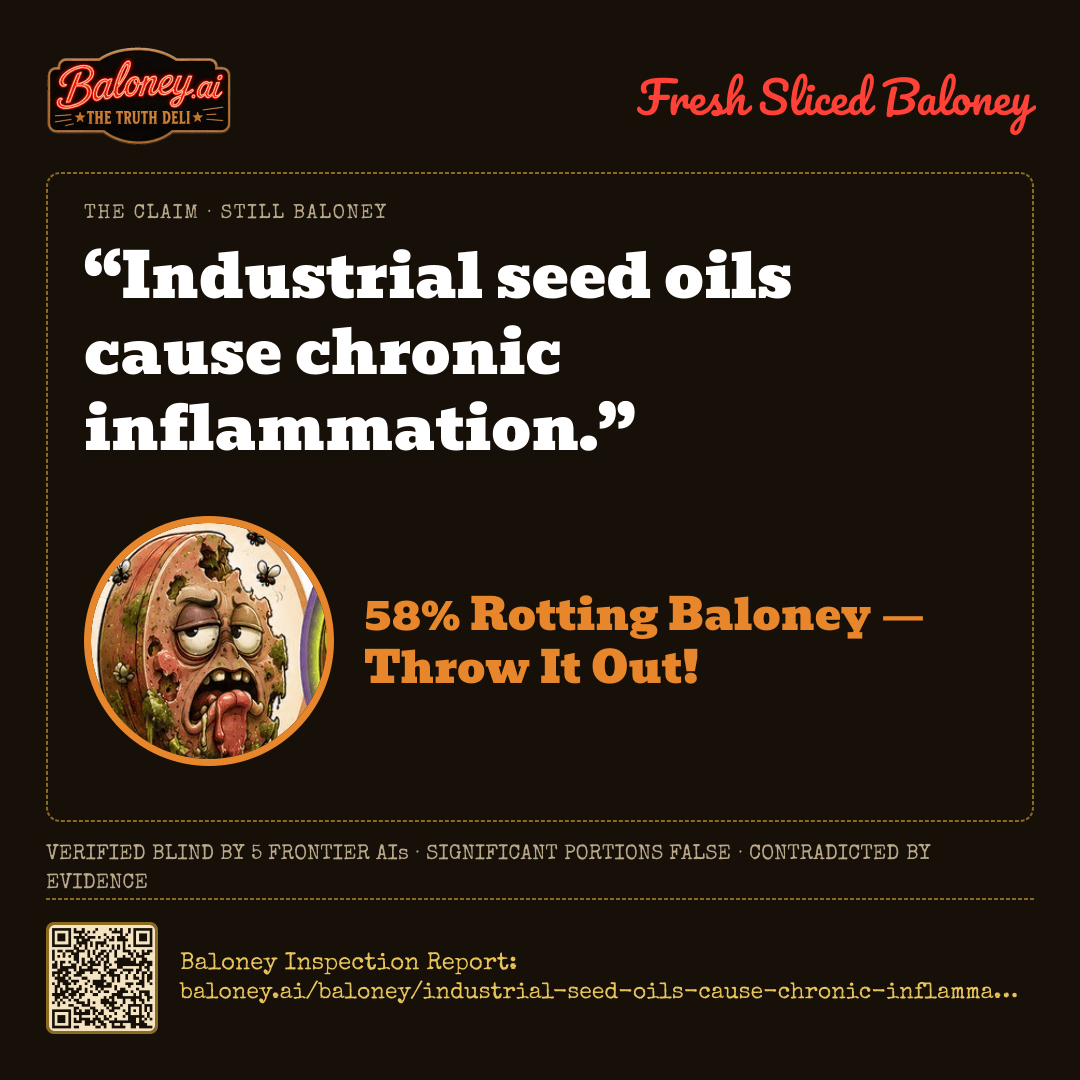
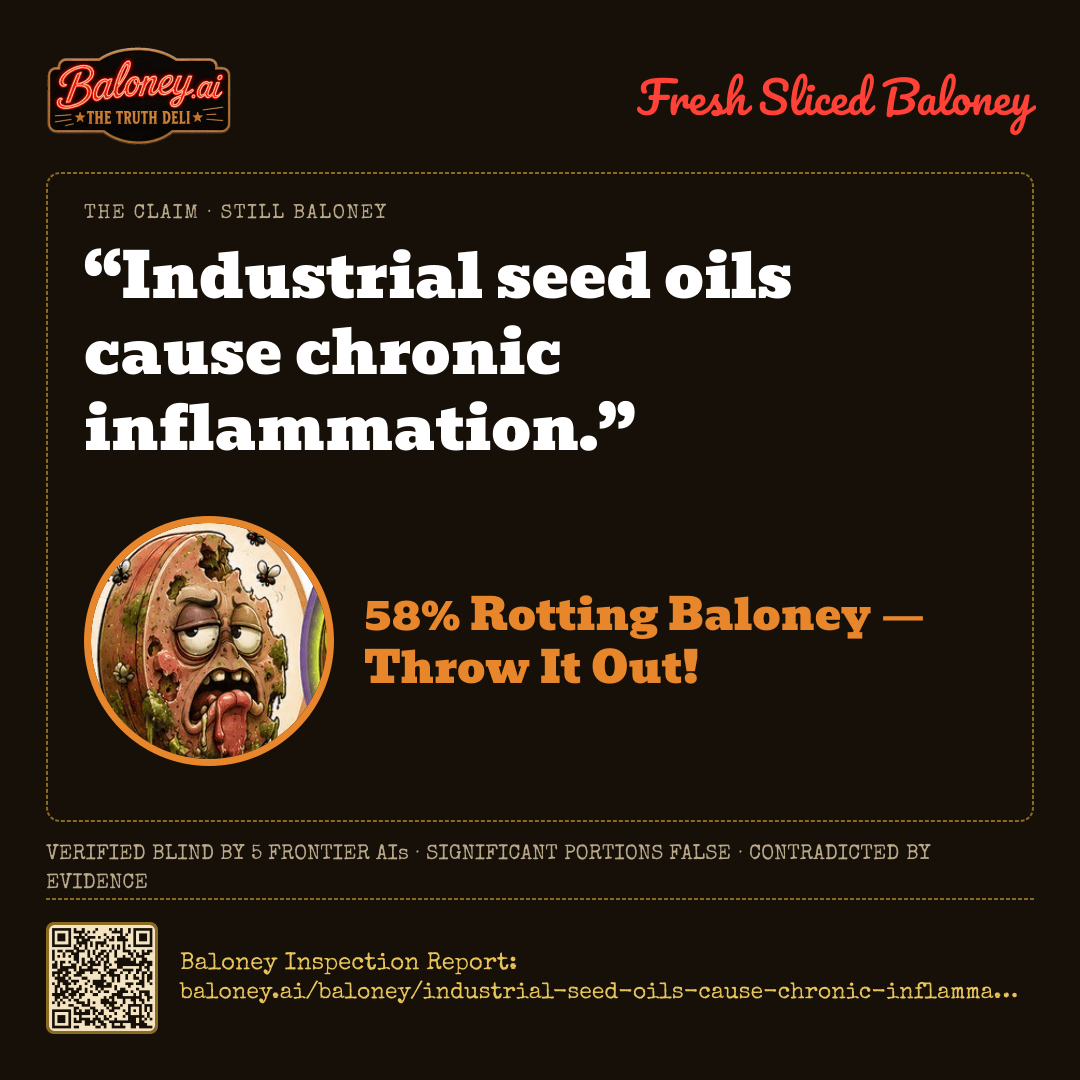
“Industrial seed oils cause chronic inflammation.”
58%Rotting Baloney — Throw It Out!
Most of this claim has spoiled.
Significant portions falseContradicted by evidenceUnsupported assertionsDeceptive narrative
Serve It Fresh
Ready to Serve13 servings
Serve it the way you want it
The Verdict
 “Industrial seed oils cause chronic inflammation.”58% Rotting Baloney — Throw It Out!Verified blind by 5 frontier AIs · Baloney Inspection Report: baloney.ai/baloney/industrial-seed-oils-cause-chronic-inflammation
The Baloney Sampler
Inspectors found the claim too broad: normal consumption of industrial seed oils has not been shown to cause chronic inflammation. The strongest human evidence, cited through NIH/PubMed, found that raising linoleic acid intake did not raise inflammatory markers such as CRP, IL-6 or TNF-alpha; the proposed conversion to arachidonic acid is limited and tightly regulated.
The American Heart Association says omega-6 polyunsaturated fats are not pro-inflammatory at recommended intakes and can lower cardiovascular risk when replacing saturated fat; Cochrane did not find cardiovascular harm from omega-6 interventions. Harvard T.H. Chan likewise recommends liquid vegetable oils over saturated fats. Real concerns are narrower: repeatedly heated/degraded oils and ultra-processed fried foods, not fresh seed oils as a class.
Resting on National Institutes of Health PubMed · American Heart Association / Circulation · Cochrane Database of Systematic Reviews · Harvard T.H. Chan School of Public Health
Original Claim Source https://www.thealternativedaily.com/heart-healthy-seed-oils-chronic-inflammation/
Other ways to slice it — phrasings that might have changed the rating
- “Repeatedly heated or reused industrial seed oils in deep-frying generate oxidation products that promote inflammatory pathways.” The reports found legitimate mechanistic concern about aldehydes, oxidized linoleic-acid products, and degraded oils, distinct from ordinary fresh oil consumption.
- “High-omega-6, low-omega-3 diets promote inflammatory signaling more than diets with a better omega-6 to omega-3 balance.” The reports noted animal, cell-culture, and hypothesis literature on the omega-6:omega-3 ratio, while distinguishing it from proof that seed oils generally cause chronic inflammation in humans.
- “Normal consumption of fresh linoleic-acid-rich seed oils does not increase systemic inflammatory markers in healthy adults.” Human randomized-trial reviews cited by the reports generally found no rise in CRP, IL-6, TNF-alpha, or comparable markers when linoleic acid intake was increased.
Written from the panel’s reports by OpenAI · gpt-5.5. Nothing here changed the score.
The Order Ticket
15:57:26CLAIM RECEIVED — QUEUED FOR INSPECTION✓
15:58:33claude-opus-5 REPORTED — SCORE 53, CONFIDENCE 83✓
15:58:04gpt-5.5 REPORTED — SCORE 58, CONFIDENCE 86✓
15:57:49gemini-3.1-pro-preview REPORTED — SCORE 99, CONFIDENCE 95✓
15:57:31sonar-pro REPORTED — SCORE 78, CONFIDENCE 94✓
15:59:23grok-4.6 REPORTED — SCORE 42, CONFIDENCE 78✓
16:00:28PRIMARY MASTER CHATGPT — SCORE 76✓
15:59:25BLIND VALIDATION PERPLEXITY — SCORE 52✓
16:01:03AGREEMENT MODERATE DISAGREEMENT — DELTA 18✓
16:01:03SCORING MODEL V2 — MEDIAN OF 5 COUNTED LAB SCORES: 53, 58, 99, 78, 42 → 58.✓
16:01:03SOURCE RULE — LABS CITED 31 SOURCES: 0 DISCARDED FOR HAVING NO URL, 3 DISCARDED AS DEAD LINKS (404/410), 13 COULD NOT BE OPENED BY US AND ARE MARKED UNVERIFIED.✓
16:01:03SOURCE RULE — PRIMARY MASTER RULED ON 20 SOURCES: 0 DISCARDED FOR HAVING NO URL, 0 DISCARDED AS DEAD LINKS, 9 MARKED UNVERIFIED, 11 VERIFIED.✓
How This One Was Sliced
Station 1 · Blind Inspection — Five Graders, Zero Peeking
Each lab scored the claim independently, without seeing the others. Open a breakdown for its evidence, its sources, and how sure it was.
Anthropic · EQUAL WEIGHT · 66.8s
claude-opus-5
53%BALONEY
ROUND-1 BREAKDOWN
Evidence offered for the claim- Mechanistic plausibility: linoleic acid (the dominant fatty acid in soybean, corn, sunflower, cottonseed and safflower oils) is a precursor to arachidonic acid, which is the substrate for pro-inflammatory eicosanoids (prostaglandins, thromboxanes, leukotrienes) via the COX and LOX pathways. This biochemical pathway is real and is the backbone of the seed-oil hypothesis.
- US intake of linoleic acid and of soybean oil rose several-fold during the 20th century, paralleling rises in obesity, type 2 diabetes and inflammatory disease — an ecological correlation frequently cited by proponents (Blasbalg et al., Am J Clin Nutr 2011).
- High-omega-6/low-omega-3 diets shift tissue fatty-acid composition and, in some rodent models, promote adiposity, hepatic steatosis and inflammatory signaling; the 'omega-6:omega-3 ratio' hypothesis (Simopoulos) has a substantial literature.
- Repeatedly heated or industrially processed polyunsaturated oils generate lipid oxidation products (4-hydroxynonenal, acrolein, oxidized linoleic acid metabolites such as 9- and 13-HODE) that are demonstrably cytotoxic and pro-inflammatory in laboratory models — a legitimate concern distinct from the fatty acid itself.
- Recovered-data analyses of two old randomized trials that replaced saturated fat with linoleic-acid-rich oils — the Sydney Diet Heart Study (BMJ 2013) and the Minnesota Coronary Experiment (BMJ 2016) — found higher, not lower, mortality in the seed-oil groups, showing that benefit from high linoleic acid intake is not universally demonstrated.
- Linoleic acid is incorporated into LDL particles and increases their susceptibility to oxidation in vitro; oxidized LDL is a recognized driver of vascular inflammation.
Evidence against the claim- The direct human test of the claim is largely negative: a systematic review of randomized controlled trials in healthy adults (Johnson & Fritsche, 2012) found that increasing dietary linoleic acid — even to several times habitual intake — produced essentially no change in circulating inflammatory markers (CRP, IL-6, TNF-α, fibrinogen, adhesion molecules). Later RCT meta-analyses reached the same conclusion.
- Conversion of linoleic acid to arachidonic acid in humans is tightly regulated and very inefficient (on the order of 0.2–1%); increasing dietary linoleic acid does not meaningfully raise tissue arachidonic acid levels in controlled feeding studies, undercutting the central mechanism.
- Pooled biomarker data from 30 prospective cohorts (Marklund et al., Circulation 2019, >68,000 participants) found that higher blood/tissue linoleic acid was associated with LOWER risk of cardiovascular events and total mortality — the opposite direction from a strong pro-inflammatory effect.
- Observational data generally show higher linoleic acid biomarkers associated with lower CRP and lower incidence of type 2 diabetes, not higher.
- A Cochrane systematic review of omega-6 fat interventions (Hooper et al., 2018) found no evidence of harm for cardiovascular events or mortality (low-to-moderate certainty), and some reduction in myocardial infarction.
- The American Heart Association's science advisory concluded that omega-6 PUFA intake of 5–10% of energy reduces CHD risk relative to lower intakes and that reducing omega-6 intake would be more likely to increase than decrease risk.
- Major health bodies (AHA, WHO, Harvard T.H. Chan School of Public Health, Dietary Guidelines for Americans) continue to recommend replacing saturated fat with polyunsaturated vegetable oils; none recognize 'seed oils cause chronic inflammation' as established.
- The word 'cause' is the key failure: establishing causation requires controlled human trials, and the controlled human trials that measured inflammatory markers did not find the effect. Confounding is severe in observational data because seed oils are concentrated in ultra-processed and fried foods, which carry independent risks (excess calories, refined starch, sodium, acrylamide).
- The Sydney and Minnesota re-analyses cited by proponents used oils high in trans fats (Minnesota) or safflower oil plus trans-fat-containing margarine (Sydney), had high attrition and post-hoc recovered data, and are not considered adequate evidence that modern seed oils are inflammatory.
How sure this lab was83/100 — the lab’s own confidence in the score above, not a second reading of the claim.
SourcesJournal of the Academy of Nutrition and Dietetics (via PubMed/NIH)journal · 90 · Circulation (American Heart Association) — Marklund et al., 2019 pooled cohort analysisjournal · 92 · Circulation (AHA Science Advisory) — Harris et al., Omega-6 Fatty Acids and Risk for Cardiovascular Diseasejournal · 88 · Cochrane Database of Systematic Reviews — Omega-6 fats for primary and secondary prevention of cardiovascular diseasejournal · 95 · BMJ — Ramsden et al., Sydney Diet Heart Study recovered datajournal · 85 · BMJ — Ramsden et al., Minnesota Coronary Experiment recovered datajournal · 85 · Harvard T.H. Chan School of Public Health — The Nutrition Source, Types of Fatedu · 88 · Harvard T.H. Chan School of Public Health — Ask the Expert: Concerns about canola oiledu · 85
OpenAI · EQUAL WEIGHT · 37.5s
gpt-5.5
58%BALONEY
ROUND-1 BREAKDOWN
Evidence offered for the claim- Seed oils such as soybean, corn, sunflower and safflower oils are often high in linoleic acid, an omega-6 fatty acid; linoleic acid can be converted to arachidonic acid, a precursor for some inflammatory eicosanoids. This makes the claim biologically plausible in a limited mechanistic sense, but it does not by itself show that normal seed-oil intake causes chronic inflammation in humans.
- Some older narrative reviews argue that a high omega-6/omega-3 ratio in modern diets may promote inflammatory pathways and chronic disease risk. This supports a narrower concern about dietary balance, not the broad claim that industrial seed oils themselves reliably cause chronic inflammation.
- Highly heated or repeatedly reused cooking oils can form oxidation products, so inflammatory/oxidative-stress concerns may apply to some deep-frying or degraded-oil contexts. That is different from ordinary consumption of fresh vegetable oils.
Evidence against the claim- Randomized controlled trial evidence does not support the core claim: a systematic review of human RCTs found that increasing dietary linoleic acid generally did not increase inflammatory markers in healthy adults.
- A 2018 scientific review concluded that the idea that omega-6 linoleic acid is inherently pro-inflammatory is not supported by human evidence; conversion of linoleic acid to arachidonic acid is limited and does not translate into consistent increases in inflammatory biomarkers.
- The American Heart Association concluded that omega-6 polyunsaturated fats are not pro-inflammatory at recommended intakes and that replacing saturated fat with polyunsaturated vegetable oils lowers cardiovascular risk.
- The claim is overbroad because 'industrial seed oils' covers many oils, doses, processing histories and dietary substitutions. Evidence differs greatly between fresh unsaturated oils replacing saturated fat versus excess calories, ultra-processed foods, or repeatedly heated frying oils.
- AP Fact Check reported that experts find no good evidence that seed oils are toxic or uniquely inflammation-causing in normal dietary use.
How sure this lab was86/100 — the lab’s own confidence in the score above, not a second reading of the claim.
SourcesJournal of the Academy of Nutrition and Dietetics / PubMedjournal · 92 · Prostaglandins, Leukotrienes and Essential Fatty Acids / PubMedjournal · 88 · American Heart Association, Circulationjournal · 90 · NIH Office of Dietary Supplementsgov · 95 · Biomedicine & Pharmacotherapy / PubMedjournal · 65 · AP Newsfactcheck · 85
Google · EQUAL WEIGHT · 23.1s
gemini-3.1-pro-preview
99%BALONEY
ROUND-1 BREAKDOWN
Evidence offered for the claim- Industrial seed oils (such as soybean, corn, sunflower, and safflower oils) are rich in omega-6 polyunsaturated fatty acids, particularly linoleic acid.
- In human biochemistry, linoleic acid can be converted into arachidonic acid, which is a precursor to pro-inflammatory eicosanoids (such as certain prostaglandins and leukotrienes).
- Repeated heating of seed oils to high temperatures (e.g., in commercial deep-frying) degrades them, creating oxidation products, trans fats, and aldehydes that can cause oxidative stress and promote inflammation.
- Historically, some animal models and in-vitro studies hypothesized that a high ratio of dietary omega-6 to omega-3 fatty acids might contribute to a systemic pro-inflammatory state.
Evidence against the claim- High-quality human clinical trials consistently demonstrate that consuming dietary linoleic acid does not increase systemic markers of chronic inflammation, such as C-reactive protein (CRP), interleukin-6 (IL-6), or tumor necrosis factor-alpha (TNF-alpha).
- The human body tightly regulates the conversion of linoleic acid to arachidonic acid. Consequently, consuming more omega-6 fatty acids from seed oils does not significantly raise tissue levels of arachidonic acid.
- Systematic reviews and meta-analyses show that higher intake of omega-6 fatty acids is associated with improved lipid profiles (such as lowered LDL cholesterol) and a reduced risk of cardiovascular disease, rather than an increased risk.
- Major health and nutritional organizations, including the American Heart Association and the Harvard T.H. Chan School of Public Health, formally recommend the consumption of liquid plant/seed oils in place of saturated fats to protect against chronic disease.
How sure this lab was95/100 — the lab’s own confidence in the score above, not a second reading of the claim.
SourcesNational Institutes of Health (PubMed)journal · 95 · American Heart Associationjournal · 95 · Cleveland Clinicnews · 90
Perplexity · EQUAL WEIGHT · 4.9s
sonar-pro
78%BALONEY
ROUND-1 BREAKDOWN
Evidence offered for the claim- Some mechanistic arguments suggest that omega-6 linoleic acid can be converted into arachidonic-acid-derived signaling molecules involved in inflammation; this provides a biological rationale for concern, but it does not establish that eating seed oils causes chronic systemic inflammation in humans.[1][5]
- Observational and mechanistic concerns may apply differently to heavily processed foods commonly containing seed oils, where overall dietary pattern, excess calories, refined carbohydrates, and food processing can confound associations. The evidence does not isolate seed oils as the cause.[5][9]
Evidence against the claim- A review of human clinical studies found that none of 15 studies reported a significant positive association between dietary linoleic acid and circulating inflammatory markers; higher intake was more often associated with lower inflammation.[1]
- A review of dietary-fatty-acid evidence concluded that most available data disprove the idea that high linoleic-acid intake causes systemic inflammation, while acknowledging that human evidence does not support the proposed assumption.[5]
- FactCheck.org reported that adult evidence does not indicate harm from seed oils and may show benefits when they replace saturated fat; it also reported that linoleic acid does not produce excess inflammation.[9]
- The British Heart Foundation states that conclusive evidence is lacking that seed oils increase inflammation and that current evidence does not show they cause long-term inflammation.[6]
- The claim conflates biological pathways with demonstrated health effects: inflammatory signaling molecules are not equivalent to chronic disease-causing inflammation, and controlled human studies generally do not show increased CRP, TNF-alpha, or IL-6 from higher linoleic-acid intake.[1][4][7]
How sure this lab was94/100 — the lab’s own confidence in the score above, not a second reading of the claim.
SourcesNational Institutes of Health, PubMed Centraljournal · 96 · National Institutes of Health, PubMed Centraljournal · 96 · FactCheck.orgfactcheck · 93 · British Heart Foundationother · 90 · FoodFacts.orgother · 72 · EatingWellnews · 78
xAI · EQUAL WEIGHT · 116.9s
grok-4.6
42%BALONEY
ROUND-1 BREAKDOWN
Evidence offered for the claim- Linoleic acid (the dominant fat in most industrial seed oils) can be elongated to arachidonic acid, a substrate for pro-inflammatory eicosanoids.
- Some animal and cell-culture studies report higher inflammatory markers on high-omega-6 diets.
- A 2018 hypothesis paper argues that oxidized linoleic-acid metabolites (OXLAMs) generated during industrial refining and cooking promote chronic inflammation and atherosclerosis.
- High-heat solvent extraction and deodorization can create lipid oxidation products that have been linked to inflammatory pathways in mechanistic work.
Evidence against the claim- A 2012 systematic review of human RCTs found no increase in CRP, cytokines or other inflammatory markers when linoleic acid intake was raised.
- Human conversion of linoleic acid to arachidonic acid is tightly regulated and inefficient; raising dietary linoleic acid does not meaningfully raise circulating arachidonic acid or inflammatory mediators.
- Replacing saturated fat with omega-6-rich seed oils lowers cardiovascular events in RCTs and meta-analyses, a result inconsistent with the oils causing harmful chronic inflammation.
- The American Heart Association 2009 advisory and Harvard T.H. Chan Nutrition Source both state that typical intakes of omega-6 PUFAs from vegetable oils do not promote inflammation.
- Major dietary guidelines continue to recommend vegetable oils as part of a healthy eating pattern.
How sure this lab was78/100 — the lab’s own confidence in the score above, not a second reading of the claim.
SourcesJournal of the Academy of Nutrition and Dietetics (via NIH PubMed)journal · 90 · Harvard T.H. Chan School of Public Healthedu · 93 · American Heart Association / Circulationjournal · 94 · BMJ Open Heartjournal · 72 · Prostaglandins, Leukotrienes and Essential Fatty Acids (via NIH PubMed)journal · 88
Station 2 · The Masters
Primary Master · drawn at random
gpt-5.5
76% BALONEY
The statement is scored as a broad causal claim about normal consumption of industrial seed oils, and that claim is not supported by the human evidence the panel cited. I gave the greatest weight to controlled human trials, systematic reviews, and major evidence reviews that measured inflammatory markers such as CRP, IL-6 and TNF-alpha; those reports consistently found no increase when linoleic acid intake was raised. I gave moderate weight to prospective biomarker and cardiovascular-outcome evidence, because it is not a direct inflammation test but points in the opposite direction from a strong pro-inflammatory effect. I gave low weight to mechanistic, animal, cell-culture, ecological and hypothesis evidence: the linoleic-acid-to-arachidonic-acid pathway is real, and degraded or repeatedly heated oils can generate oxidation products, but those points do not establish chronic systemic inflammation from ordinary seed-oil intake in humans. I also treated the old Sydney and Minnesota trial reanalyses as limited because they addressed mortality rather than inflammation and had serious contextual issues noted by the evaluators, including trans-fat-containing interventions and recovered-data limitations. The result is high baloney but not a perfect 99: there are legitimate narrower concerns about repeatedly heated or oxidized oils and about ultra-processed fried foods, but the statement as written overgeneralizes those concerns into a causal claim that human trials do not support.
All five evaluators agreed on the core evidence pattern: seed-oil critics have plausible mechanisms involving linoleic acid, arachidonic acid and oxidation products, but human clinical evidence does not show that ordinary linoleic-acid-rich seed oils cause chronic systemic inflammation. They disagreed mainly on scoring severity: two reports treated the claim as extremely or overwhelmingly false, while three gave mid-range scores because of mechanistic plausibility, degraded-oil caveats, and the overbreadth of the wording.
Blind Validation Master · never saw the Primary’s work
sonar-pro
52% BALONEY
The statement is substantially misleading as written. The reports agree that linoleic acid’s conversion into arachidonic-acid-derived signaling molecules, and the formation of oxidation products during repeated high-heat oil use, provide plausible mechanisms for inflammation in specific contexts. However, controlled human evidence generally finds that increasing dietary linoleic acid does not raise CRP, IL-6, TNF-alpha, or comparable systemic inflammatory markers, while replacing saturated fat with polyunsaturated vegetable oils often improves cardiovascular-risk markers. The claim also conflates fresh seed oils with repeatedly heated oils and with ultra-processed foods that contain them, making it too broad to support causation. Some historical trial reanalyses raise questions about particular oils and substitutions, but they do not establish that modern industrial seed oils generally cause chronic inflammation. Under the stated scale, this is Rotting Baloney: significant portions are contradicted by the strongest human evidence, though the narrower concern about degraded oils and specific dietary contexts is not baseless.
AI EVALUATORS SHOWED MODERATE DISAGREEMENT — MASTERS SCORED 76% AND 52% · REVIEW THE EVIDENCE CAREFULLY
How the number was reached · scoring model v2 · how our models work
- Median of 5 counted lab scores: 53, 58, 99, 78, 42 → 58.
The Evidence
Evidence offered for the claim
- Linoleic acid pathway DEBUNKED — Seed oils such as soybean, corn, sunflower, safflower and cottonseed oils are often rich in linoleic acid, which can be converted into arachidonic acid, a precursor for some inflammatory eicosanoids. The panel treated that mechanism as real but not decisive: the reports repeatedly noted that human conversion is tightly regulated and inefficient, and controlled studies do not show the predicted rise in chronic inflammatory markers.
- Oxidized or reheated oils Repeated high-heat cooking, reuse, refining or degradation of polyunsaturated oils can generate oxidation products such as aldehydes, oxidized linoleic-acid metabolites, 4-hydroxynonenal and acrolein, which have pro-inflammatory or cytotoxic effects in laboratory models. This supports a narrower caution about degraded frying oils, not the broad claim that ordinary seed oils cause chronic inflammation.
- Animal and cell models DEBUNKED — Some rodent, cell-culture and high-omega-6/low-omega-3-ratio literature reports inflammatory signaling or adverse metabolic effects. The panel gave this low weight for the claim as written because the direct human tests cited by the evaluators did not reproduce a chronic systemic inflammation signal.
- Ecological trends DEBUNKED — One report noted that U.S. linoleic-acid and soybean-oil intake rose during the 20th century alongside obesity, diabetes and inflammatory disease. The panel treated this as weak support only: ecological parallels cannot isolate seed oils from total calories, ultra-processed foods, refined starches, sodium, frying practices and other major confounders.
- Old trial reanalyses DEBUNKED — Recovered-data analyses of the Sydney Diet Heart Study and Minnesota Coronary Experiment have been cited as evidence that high-linoleic interventions were not uniformly beneficial. The panel did not treat them as proof of seed-oil-driven inflammation because they measured mortality rather than chronic inflammatory markers and had limitations noted in the reports, including trans-fat-containing interventions, attrition and post-hoc recovered data.
Evidence against the claim
- Human trials The strongest evidence cited was a systematic review of human randomized trials reporting no increase in circulating inflammatory markers such as CRP, IL-6, TNF-alpha, fibrinogen or adhesion molecules when dietary linoleic acid was increased.
- Regulated conversion Multiple reports noted that linoleic acid conversion to arachidonic acid in humans is limited and tightly regulated, undermining the simple claim that eating more omega-6 seed oils automatically produces more inflammatory mediators.
- Opposite health signal The reports cited cardiovascular and biomarker evidence indicating that replacing saturated fat with polyunsaturated vegetable oils lowers LDL cholesterol and is associated with lower cardiovascular risk, not the pattern expected from a strong chronic inflammatory exposure.
- Major health guidance The American Heart Association, Harvard T.H. Chan School of Public Health and other health bodies cited by the evaluators continue to recommend liquid vegetable oils in place of saturated fats and do not treat typical omega-6 intake as pro-inflammatory.
- Overbroad wording The claim lumps together fresh oils, refined oils, repeatedly heated frying oils, ultra-processed foods and overall dietary patterns. The evidence differs sharply across those contexts, and the direct human evidence does not support a blanket causal statement.
Sources · Reliability · Why Accepted or Discounted
| Source | Type | Reliability | Ruling |
|---|
| Journal of the Academy of Nutrition and Dietetics via NIH PubMed | journal | 90 | ACCEPTED — Accepted as a PubMed-indexed source cited for human dietary-fat evidence, but given less weight than the repeated and more specific RCT-review citations. |
| Harvard T.H. Chan School of Public Health | edu | 90 | ACCEPTED — Accepted as a reputable educational synthesis of mainstream dietary-fat evidence and guidance. |
| American Heart Association / Circulationunverified | journal | 93 | ACCEPTED — Accepted as a major professional science advisory relevant to omega-6 intake, inflammation concerns and cardiovascular-risk substitution. |
| BMJ Open Heartunverified | journal | 72 | ACCEPTED — Accepted only as evidence that an oxidized-linoleic-acid hypothesis exists; it was not weighted as direct proof of chronic inflammation in humans. |
| Prostaglandins, Leukotrienes and Essential Fatty Acids via NIH PubMed | journal | 88 | ACCEPTED — Accepted as a relevant review addressing whether linoleic acid is pro-inflammatory in humans. |
| National Institutes of Health PubMed | journal | 94 | ACCEPTED — Accepted as a key human clinical-study review cited by multiple evaluators for inflammatory-marker outcomes. |
| Cleveland Clinic | news | 90 | ACCEPTED — Accepted as a reputable medical explainer, but used only as secondary context rather than primary evidence. |
| NIH Office of Dietary Supplementsunverified | gov | 95 | ACCEPTED — Accepted for background on omega fatty acids and dietary context from a government health source. |
| Biomedicine & Pharmacotherapy via PubMed | journal | 65 | DISCOUNTED — Discounted as support for the broad causal claim because it is an older narrative source about the omega-6:omega-3 ratio rather than direct controlled evidence that seed oils cause chronic inflammation. |
| AP Newsunverified | factcheck | 85 | ACCEPTED — Accepted as a reputable fact-checking summary of expert consensus, but secondary to systematic reviews and clinical trials. |
| Journal of the Academy of Nutrition and Dietetics via PubMed/NIH | journal | 90 | ACCEPTED — Accepted as a PubMed-indexed journal source cited for the human RCT evidence on linoleic acid and inflammatory markers. |
| Circulation / American Heart Associationunverified | journal | 92 | ACCEPTED — Accepted as a large pooled biomarker cohort analysis relevant to whether higher linoleic-acid status tracks with worse chronic-disease risk. |
| Circulation / American Heart Associationunverified | journal | 88 | ACCEPTED — Accepted as a professional advisory on omega-6 fatty acids and cardiovascular disease, with relevance to the claim's public-health implications. |
| Cochrane Database of Systematic Reviewsunverified | journal | 95 | ACCEPTED — Accepted as a high-quality systematic review source on omega-6 fat interventions and cardiovascular outcomes. |
| BMJunverified | journal | 85 | ACCEPTED — Accepted as evidence about the Sydney Diet Heart Study reanalysis, but weighted lightly for this claim because it is not a direct inflammation study and has limitations described by the evaluators. |
| BMJunverified | journal | 85 | ACCEPTED — Accepted as evidence about the Minnesota Coronary Experiment reanalysis, but not treated as strong proof that modern seed oils cause chronic inflammation. |
| Harvard T.H. Chan School of Public Health | edu | 85 | ACCEPTED — Accepted as a reputable educational discussion of canola oil concerns, used as secondary context. |
| National Institutes of Health, PubMed Central | journal | 96 | ACCEPTED — Accepted as an accessible peer-reviewed source directly addressing linoleic acid intake and inflammatory markers. |
| National Institutes of Health, PubMed Central | journal | 96 | ACCEPTED — Accepted as an accessible peer-reviewed review relevant to dietary fatty acids and systemic inflammation. |
| FactCheck.org | factcheck | 93 | ACCEPTED — Accepted as a reputable fact-checking source summarizing expert views, but secondary to clinical trials and reviews. |
Every link was opened when this claim was inspected. A dead link was discarded before publication; “unverified” means the site refused our automated check and the link is the one the panel cited. A source without a URL was never kept.
Serve It Fresh
Ready to Serve13 servings
Serve it the way you want it
The Verdict
“Industrial seed oils cause chronic inflammation.”58% Rotting Baloney — Throw It Out!Verified blind by 5 frontier AIs · Baloney Inspection Report: baloney.ai/baloney/industrial-seed-oils-cause-chronic-inflammation