“Human activity has only a small, localized effect on climate change.”99% Zombie Baloney — Refuses To DieVerified blind by 5 frontier AIs · Baloney Inspection Report: baloney.ai/baloney/human-activity-has-only-a-small-localized-effect-on-climate
The Rating Card
The correction — what is actually true
The Baloney Sampler
The claim relies on a debunked talking point that human impact is limited to localized effects like the urban heat island effect. While urbanization and land-use changes do alter regional temperatures, human activity is unequivocally the dominant driver of planetary-scale climate change. The Intergovernmental Panel on Climate Change (IPCC) and NASA confirm that human-produced greenhouse gases mix globally, driving planet-wide warming, rising sea levels, shrinking ice sheets, and ocean acidification.
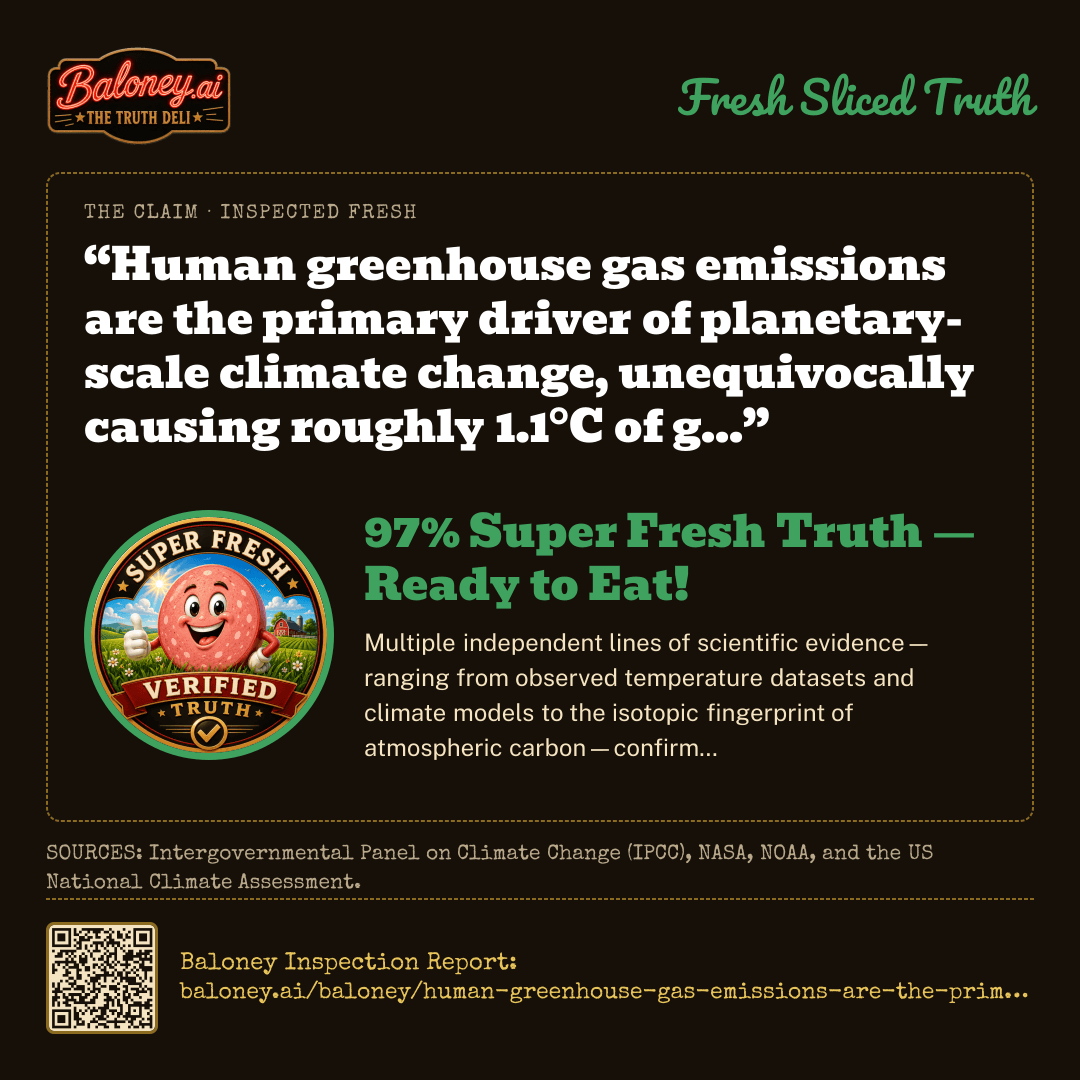
Rather than being small or localized, human emissions account for essentially all observed global warming—approximately 1.1°C—since the pre-industrial period. Datasets from NOAA and peer-reviewed studies show that natural factors alone would have caused a slight global cooling over the past 50 years. Distinctive physical fingerprints, such as changing carbon isotopes and simultaneous tropospheric warming with stratospheric cooling, definitively trace current global climate change to fossil fuels.
Other ways to slice it — phrasings that might have changed the rating
“Urbanization and land-use changes create localized climate impacts, such as the urban heat island effect, which locally raises temperatures.” The lab reports acknowledge that human activities like city building do create urban heat islands, representing a genuine but geographically limited human effect on climate.
“Human activities, primarily through greenhouse gas emissions, are the principal cause of global climate change since the pre-industrial period.” The IPCC, NASA, and NOAA unequivocally identify human greenhouse gas emissions from fossil fuels as the dominant driver of the observed 1.1°C planetary temperature increase.
“Certain human emissions, such as sulfate aerosols, have historically produced strongly regional climate fingerprints.” The reports note that while greenhouse gases mix globally, some human forcing agents like aerosols have distinct, geographically concentrated impacts, such as mid-20th-century Northern Hemisphere cooling.
Written from the panel’s reports by Google · gemini-3.1-pro-preview. Nothing here changed the score.
05:01:04SCORING MODEL V2 — MEDIAN OF 5 COUNTED LAB SCORES: 96, 96, 99, 85, 91 → 96. ZOMBIE RULE: THE PRIMARY MASTER FLAGS A LONG DEBUNK HISTORY, THE BLIND MASTER SCORES 99, THE COUNTED MEDIAN IS 96 — PUBLISHED AS 99.✓
05:01:04SOURCE RULE — LABS CITED 33 SOURCES: 0 DISCARDED FOR HAVING NO URL, 0 DISCARDED AS DEAD LINKS (404/410), 8 COULD NOT BE OPENED BY US AND ARE MARKED UNVERIFIED.✓
05:01:04SOURCE RULE — PRIMARY MASTER RULED ON 20 SOURCES: 0 DISCARDED FOR HAVING NO URL, 0 DISCARDED AS DEAD LINKS, 5 MARKED UNVERIFIED, 15 VERIFIED.✓
How This One Was Sliced
Station 1 · Blind Inspection — Five Graders, Zero Peeking
Each lab scored the claim independently, without seeing the others. Open a breakdown for its evidence, its sources, and how sure it was.
Anthropic · EQUAL WEIGHT · 40.7s
claude-opus-5
96%BALONEY
ROUND-1 BREAKDOWN
Evidence offered for the claim
Some human climate effects genuinely ARE localized: the urban heat island effect raises temperatures within and immediately around cities by several degrees, and land-use changes (deforestation, irrigation, agriculture) alter regional temperature and rainfall patterns without directly driving global mean warming.
Sulfate and other aerosol emissions have strongly regional fingerprints — e.g., mid-20th-century aerosol cooling over the Northern Hemisphere and monsoon disruption over South Asia — so part of humanity's climate footprint is indeed geographically concentrated.
Attribution confidence is lower at local and sub-regional scales than at the global scale; IPCC assigns lower confidence to human-caused changes in some regional variables (certain drought, hail, and tornado metrics) than to global temperature.
Natural factors (solar cycles, volcanic eruptions, ENSO, AMO/PDO) do measurably modulate climate on year-to-decade timescales, so not every observed change is anthropogenic.
The absolute magnitude of warming so far — roughly 1.1–1.3°C of global mean temperature rise — can be rhetorically described as 'small' in degrees, even though its consequences are not.
Evidence against the claim
The IPCC Sixth Assessment Report (2021) states it is 'unequivocal that human influence has warmed the atmosphere, ocean and land,' and that the likely human contribution to 1850–1900 to 2010–2019 warming is 0.8–1.3°C against an observed warming of about 1.07°C — i.e., essentially 100% of observed global warming, not a small fraction.
The effect is global, not localized: warming is observed across every continent and ocean basin, in sea surface temperatures, ocean heat content down to 2,000 m, global sea level (~21–24 cm since 1880), Arctic sea-ice loss, worldwide glacier retreat, and Greenland/Antarctic ice-sheet mass loss measured by GRACE satellites.
Atmospheric CO2 has risen from ~280 ppm pre-industrial to over 420 ppm, the highest in at least 800,000 years of ice-core record and likely millions of years; isotopic signatures (declining 13C/12C and 14C) and falling atmospheric O2 identify fossil-fuel combustion as the source. CO2 mixes globally within a year or two, so its radiative forcing is planet-wide by definition.
Satellite measurements confirm the predicted physical fingerprint: reduced outgoing longwave radiation at greenhouse-gas absorption wavelengths and increased downward longwave radiation at the surface — direct observational evidence of a global, not local, energy imbalance.
Model-based detection and attribution studies show natural forcings (solar + volcanic) alone cannot reproduce observed warming and would have produced slight cooling since 1950; only runs including anthropogenic forcing match observations.
Stratospheric cooling alongside tropospheric warming is a distinctive greenhouse-gas fingerprint that rules out increased solar output as the cause — solar forcing would warm both layers.
Multiple independent scientific academies (US National Academy of Sciences, UK Royal Society, and the national academies of ~80 countries) and >97% of publishing climate scientists endorse human-caused global warming as the dominant driver.
The US Fifth National Climate Assessment (2023), produced by 13 federal agencies, concludes human activities are 'unequivocally' the cause of observed warming and documents impacts in every US region, with global consequences.
How sure this lab was
97/100 — the lab’s own confidence in the score above, not a second reading of the claim.
Some human activities do have localized or regional climate effects. Urbanization creates urban heat islands through pavement, buildings, reduced vegetation, and waste heat; EPA describes these as city-scale temperature increases. This supports a narrow kernel of truth: human activity can affect local climates.
Human land-use change and aerosol pollution can have geographically uneven effects, including regional cooling or warming and changes in clouds or rainfall. IPCC assesses that some human forcing agents, especially aerosols and land-surface changes, have stronger regional patterns than well-mixed greenhouse gases.
Local measurement issues such as urban heat contamination can affect individual temperature stations if not corrected. That is a legitimate local human effect, but major climate datasets account for it and it does not explain ocean warming, Arctic warming, glacier loss, or global temperature trends.
Evidence against the claim
The claim says human activity has only a small, localized effect. That is directly contradicted by IPCC AR6, which states it is unequivocal that human influence has warmed the atmosphere, ocean, and land, and estimates human-caused warming at about 1.07°C for 2010-2019 relative to 1850-1900, while natural drivers contributed little over that period.
Greenhouse gases from human activity are long-lived and globally well mixed, so their effect is not merely local. NOAA measurements show atmospheric CO2 has risen to modern record levels above 420 ppm, largely from fossil-fuel combustion and land-use change, producing a global radiative forcing.
Observed climate change is global and multi-system: warming is seen over land and oceans, ocean heat content has increased, glaciers and ice sheets are losing mass, sea level is rising, and many extremes have changed. These patterns cannot be explained by localized urban or land-use effects.
Peer-reviewed attribution research, including Gillett et al. in Nature Climate Change, finds that the human contribution accounts for essentially all observed global warming since the preindustrial period, with natural factors much smaller.
Scientific agencies such as NASA and NOAA state that human activities, especially greenhouse-gas emissions, are the dominant cause of recent global warming. The existence of some local human climate effects does not make the overall effect small or localized.
How sure this lab was
97/100 — the lab’s own confidence in the score above, not a second reading of the claim.
Proponents of the claim often point to the 'Urban Heat Island' effect, arguing that some observed warming is a localized phenomenon resulting from urban development and land-use changes rather than global atmospheric changes.
Skeptics frequently highlight natural climate drivers, such as solar irradiance cycles, volcanic eruptions, and orbital variations, pointing out that extreme historical climate changes occurred without human input, which they use to suggest human activity's current role is small by comparison.
Prior to the Industrial Revolution, human effects on the environment were largely restricted to small, localized impacts caused by regional deforestation and agriculture.
Evidence against the claim
The Intergovernmental Panel on Climate Change (IPCC) Sixth Assessment Report states unequivocally that human activities, principally through emissions of greenhouse gases, have undeniably caused global warming, with global surface temperatures reaching 1.1°C above 1850-1900 levels.
Greenhouse gases emitted by human activity (such as carbon dioxide and methane) do not remain localized; they mix throughout the Earth's atmosphere, driving planetary-scale warming, global sea-level rise, and ocean acidification.
Isotopic analysis of carbon in the atmosphere (the Suess effect) definitively proves that the unprecedented surge in CO2 levels over the last century is derived from burning fossil fuels, not from natural sources.
Data from NASA and NOAA demonstrate that natural factors alone (like solar and volcanic activity) would have caused a slight global cooling over the past 50 years; the observed rapid global warming can only be mathematically reproduced in climate models by including human-caused greenhouse gas emissions.
How sure this lab was
100/100 — the lab’s own confidence in the score above, not a second reading of the claim.
Human activity can have relatively small or localized effects in some specific cases, such as particular emissions sources, land-use changes, or local urban heat-island effects. However, the authoritative sources reviewed do not support the broader claim that human activity's climate effect is only small and localized.
Natural variability still influences climate in particular regions and over shorter timescales, so not every weather event or local climate fluctuation is primarily human-caused.[1]
Evidence against the claim
The IPCC concludes that human influence has unequivocally warmed the atmosphere, ocean, and land, with widespread and rapid changes across the atmosphere, ocean, cryosphere, and biosphere.[2]
The IPCC reports that human activities have unequivocally caused global warming, with global surface temperature in 2011–2020 reaching about 1.1°C above the 1850–1900 average.[3]
NASA states that human activity is the principal cause of current global warming and that the extra energy from human-produced greenhouse gases has warmed the atmosphere, ocean, and land.[1]
The IPCC identifies human influence as the principal driver of many observed changes across the climate system, not merely a small or localized influence.[4]
NASA notes that climate models cannot reproduce the observed long-term warming trend without including the increase in human-caused greenhouse gases.[5]
How sure this lab was
99/100 — the lab’s own confidence in the score above, not a second reading of the claim.
Urban heat islands and some land-use changes (cities, irrigation, deforestation) produce real but geographically limited temperature and hydrological effects.
Aerosols and certain short-lived pollutants can have stronger regional than global signatures compared with well-mixed CO2.
Evidence against the claim
IPCC AR6 states it is unequivocal that human influence has warmed the atmosphere, ocean and land; well-mixed greenhouse gases from fossil fuels and industry are the dominant cause of observed warming since the mid-20th century.
Warming, ocean heat uptake, global mean sea-level rise, glacier and ice-sheet mass loss, and Arctic sea-ice decline are planetary-scale, not localized, and cannot be explained by natural forcings (solar, volcanic, internal variability) alone.
Carbon isotopes, the vertical fingerprint (tropospheric warming with stratospheric cooling), and energy-budget/attribution studies independently identify fossil-carbon emissions as the primary driver.
NASA, NOAA, EPA, and national academies worldwide describe current climate change as global and predominantly human-caused; the ‘small/localized only’ framing is a long-standing denial talking point contradicted by the instrumental, satellite, ocean, and paleoclimate records.
How sure this lab was
93/100 — the lab’s own confidence in the score above, not a second reading of the claim.
All five evaluators found the claim to be overwhelmingly false, noting that it relies on a long-debunked talking point framing global warming as merely a localized 'Urban Heat Island' effect. While the evaluators acknowledge a kernel of truth—human activities do create some localized climate alterations—they unanimously cite extensive evidence from the IPCC, NASA, and NOAA demonstrating that human-emitted greenhouse gases are globally mixed and the undeniable, dominant driver of planetary-scale climate change.
The evaluators were in complete agreement. They uniformly highlighted the distinction between genuine localized effects (like urbanization or land-use changes) and the overriding, planetary-scale effects of well-mixed greenhouse gases, identifying the claim's 'localized only' framing as heavily contradicted by multiple lines of physical evidence.
ZOMBIE FLAG: TRUE — DEBUNK HISTORY ON RECORD
Blind Validation Master · never saw the Primary’s work
gpt-5.5
99% BALONEY
The statement is overwhelmingly contradicted by the evidence presented. All five reports agree that while some human climate effects are localized or regional—such as urban heat islands, land-use changes, and aerosol effects—the claim as written says human activity has only a small, localized effect on climate change. That is false. The cited IPCC, NASA, NOAA, EPA, national assessment, and peer-reviewed attribution evidence indicates that human activities, especially greenhouse-gas emissions from fossil fuels and land-use change, have caused roughly all of the observed global warming since the preindustrial period, about 1.1°C so far. Greenhouse gases are long-lived and globally mixed, producing planetary-scale radiative forcing, not merely local effects. Observed changes include global land and ocean warming, ocean heat uptake, sea-level rise, glacier and ice-sheet loss, Arctic sea-ice decline, and atmospheric/oceanic fingerprints that natural drivers alone cannot explain. Carbon isotopes and atmospheric measurements link the CO2 rise to fossil fuels, and climate models reproduce the observed warming only when human forcings are included. The narrow truth that some human effects are local does not rescue the broader claim, which is a repeatedly debunked denial framing.
AGREEMENT TEST PASSED — BOTH MASTERS SCORED 99% · BLIND VALIDATION CONFIRMED THIS SCORE · NO RE-EVALUATION REQUIRED
Median of 5 counted lab scores: 96, 96, 99, 85, 91 → 96.
Zombie rule: the Primary Master flags a long debunk history, the Blind Master scores 99, the counted median is 96 — published as 99.
The Evidence
Evidence offered for the claim
Urban Heat IslandsDEBUNKED — Urbanization creates localized temperature increases through pavement, buildings, and waste heat. However, major global climate datasets correct for this contamination, and local urban heating cannot explain global ocean warming, global glacier loss, or Arctic sea-ice decline.
Aerosols and land-use changesDEBUNKED — Deforestation, irrigation, and sulfate aerosol emissions have geographically concentrated effects that alter regional temperature and rainfall patterns. However, these regional signatures are vastly outweighed by the dominant, planetary-scale warming caused by globally mixed greenhouse gases.
Natural historical driversDEBUNKED — Extreme historical climate changes occurred without human input due to solar irradiance cycles and volcanic eruptions. However, models show natural factors alone would have caused slight global cooling since 1950; observed rapid warming requires human greenhouse gas emissions.
Evidence against the claim
Unequivocal global warming The IPCC Sixth Assessment Report concludes that human influence has unequivocally warmed the atmosphere, ocean, and land, driving roughly 1.1°C of global mean temperature increase since the 1850-1900 period.
Globally well-mixed gases Greenhouse gases emitted by human activity, such as carbon dioxide and methane, do not remain localized. They mix throughout the global atmosphere within a year or two, creating a planet-wide radiative forcing effect.
Isotopic fingerprints The Suess effect (declining 13C/12C and 14C carbon isotopes) and falling atmospheric oxygen definitively prove that the unprecedented surge in atmospheric CO2 to over 420 ppm is derived from burning fossil fuels, not natural sources.
Vertical atmospheric signature Observations show the troposphere warming while the stratosphere cools. This is a distinctive physical fingerprint of greenhouse-gas warming; if solar output were responsible, both layers would warm.
Sources · Reliability · Why Accepted or Discounted
Every link was opened when this claim was inspected. A dead link was discarded before publication; “unverified” means the site refused our automated check and the link is the one the panel cited. A source without a URL was never kept.
“Human activity has only a small, localized effect on climate change.”99% Zombie Baloney — Refuses To DieVerified blind by 5 frontier AIs · Baloney Inspection Report: baloney.ai/baloney/human-activity-has-only-a-small-localized-effect-on-climate
Support The Truth Deli
Buy The Truth Deli Merch
“Democracy Makes America Great”
Veritate Libertas — Latin for “Through Truth, Liberty.”
Democracy is what makes America great. But without truth — honest, real, scientifically validated truth — democracy fails. The baloney slicer is on: feeding fresh sliced truth to protect what makes America great. Democracy.