Baloney Inspection Report: Claim #1034 · Inspected Sep 30, 2026, 2:42 PM PDT · Scoring model v2 · Earlier report, model v1
 95%
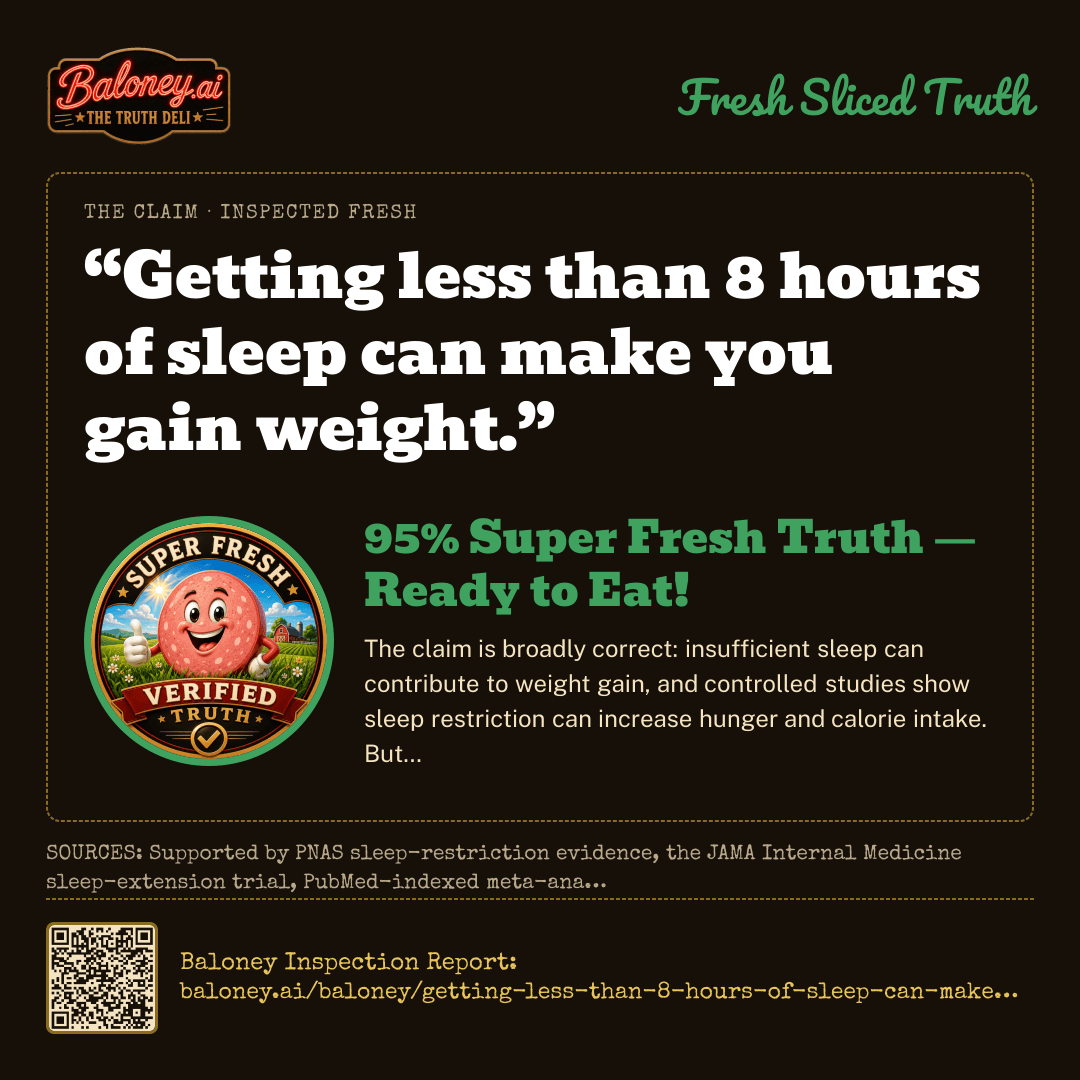
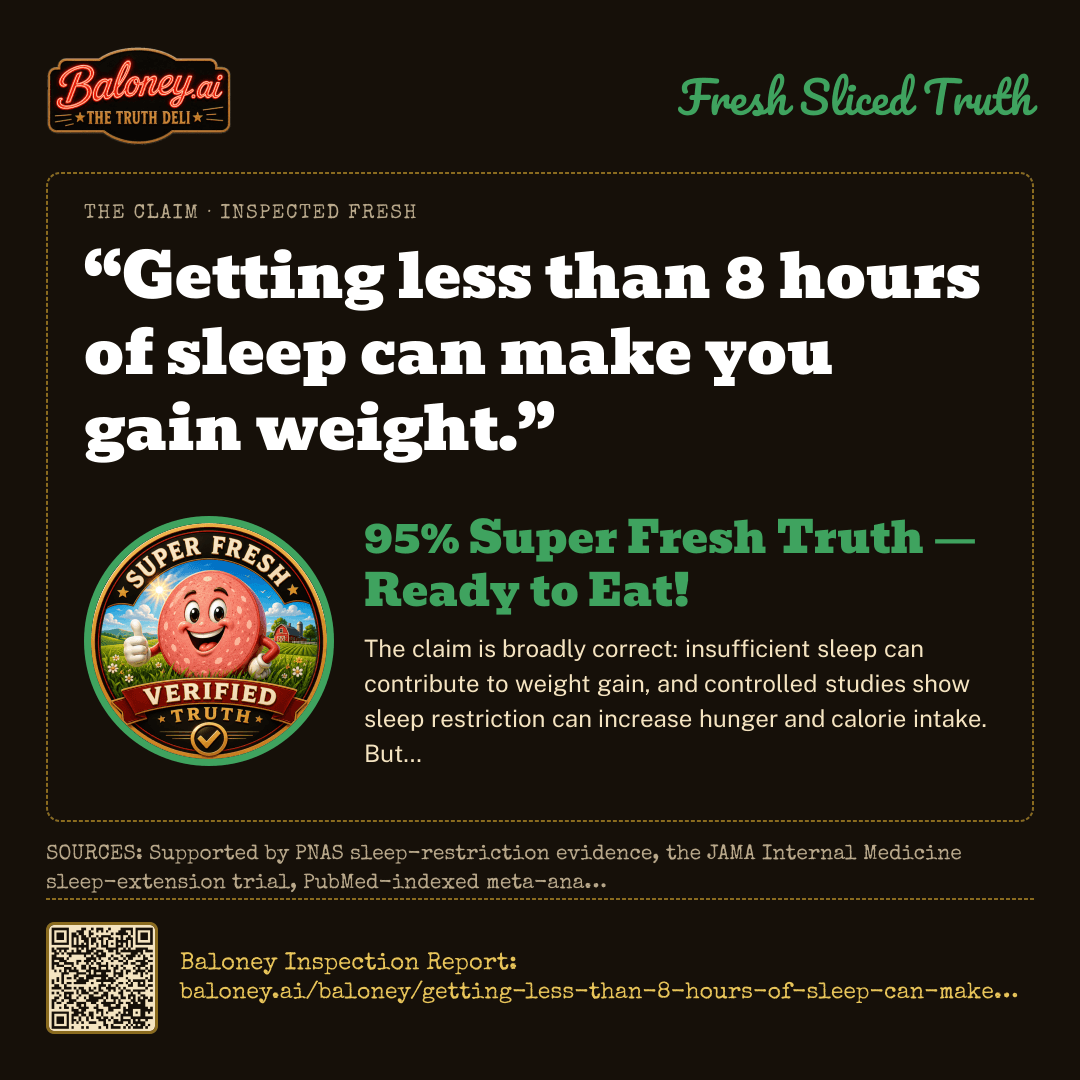
“Getting less than 8 hours of sleep can make you gain weight.”
95%Super Fresh Truth — Ready to Eat!
THE CLAIM CHECKS OUT.
Independently verifiedPhysically repeatable evidenceConfirmed across rival labsSafe to serve
Serve It Fresh
Ready to Serve18 servings
Serve it the way you want it
The Verdict
 “Getting less than 8 hours of sleep can make you gain weight.”95% Super Fresh Truth — Ready to Eat!Verified blind by 5 frontier AIs · Baloney Inspection Report: baloney.ai/baloney/getting-less-than-8-hours-of-sleep-can-make-you-gain-weight
The Baloney Sampler
The reports found the claim is substantially true: insufficient sleep can contribute to weight gain. Controlled work in Proceedings of the National Academy of Sciences found curtailed sleep raised calorie intake enough to cause short-term weight gain, while JAMA Internal Medicine found sleep extension in habitually short-sleeping overweight adults reduced energy intake and weight relative to controls.
The evidence is not a hard eight-hour rule. CDC and American Academy of Sleep Medicine/Sleep Research Society guidance put the adult recommendation at 7 or more hours, and the strongest effects are usually below 6–7 hours. Observational studies consistently link short sleep with higher BMI and obesity risk, but confounding, reverse causation, individual sleep need, diet, and activity still matter.
Resting on Proceedings of the National Academy of Sciences · JAMA Internal Medicine · Centers for Disease Control and Prevention · American Academy of Sleep Medicine / Sleep Research Society
Original Claim Source https://www.health.harvard.edu/healthbeat/how-sleep-loss-threatens-your-health
Other ways to slice it — phrasings that might have changed the rating
- “Adults who regularly sleep fewer than 7 hours are at increased risk of weight gain and obesity.” The reports say adult guidance generally uses 7 or more hours, and the strongest weight-related findings are concentrated below about 6–7 hours.
- “Sleeping 7 to 7.9 hours a night makes adults gain weight.” The reports repeatedly note that 7–8 hours is generally adequate for many adults and that there is no good evidence that trimming from 8 to 7 hours causes weight gain.
- “One night of less than 8 hours of sleep can make a person gain weight.” The reports describe concern mainly with chronic insufficient sleep and multi-night laboratory restriction, not a single modest shortfall below 8 hours.
Written from the panel’s reports by OpenAI · gpt-5.5. Nothing here changed the score.
The Order Ticket
21:42:20CLAIM RECEIVED — QUEUED FOR INSPECTION✓
21:42:20claude-opus-5 REPORT CARRIED OVER FROM THE EARLIER RUN — SCORE 5, CONFIDENCE 82✓
21:42:20gpt-5.5 REPORT CARRIED OVER FROM THE EARLIER RUN — SCORE 4, CONFIDENCE 85✓
21:42:20gemini-3.1-pro-preview REPORT CARRIED OVER FROM THE EARLIER RUN — SCORE 4, CONFIDENCE 95✓
21:42:31sonar-pro REPORTED — SCORE 4, CONFIDENCE 94✓
21:42:20grok-4.6 REPORT CARRIED OVER FROM THE EARLIER RUN — SCORE 5, CONFIDENCE 82✓
21:45:07PRIMARY MASTER CHATGPT — SCORE 4✓
21:44:32BLIND VALIDATION CLAUDE — SCORE 5✓
21:43:32AGREEMENT CONFIRMED — DELTA 1✓
21:43:32SCORING MODEL V2 — MEDIAN OF 5 COUNTED LAB SCORES: 5, 4, 4, 4, 5 → 4. FRESH RULE: THE PRIMARY MASTER SCORES 4 AND THE BLIND MASTER 5 — BOTH SUPER FRESH TRUTH — AND THE COUNTED MEDIAN IS 4, ON THE TRUE SIDE. PUBLISHED AS 5, THE MORE CAUTIOUS OF THE TWO MASTERS.✓
21:43:32SOURCE RULE — LABS CITED 33 SOURCES: 0 DISCARDED FOR HAVING NO URL, 5 DISCARDED AS DEAD LINKS (404/410), 7 COULD NOT BE OPENED BY US AND ARE MARKED UNVERIFIED.✓
21:43:32SOURCE RULE — PRIMARY MASTER RULED ON 20 SOURCES: 0 DISCARDED FOR HAVING NO URL, 0 DISCARDED AS DEAD LINKS, 3 MARKED UNVERIFIED, 17 VERIFIED.✓
How This One Was Sliced
Station 1 · Blind Inspection — Five Graders, Zero Peeking
Each lab scored the claim independently, without seeing the others. Open a breakdown for its evidence, its sources, and how sure it was.
Anthropic · EQUAL WEIGHT · 46.1s
claude-opus-5
95%TRUTH
ROUND-1 BREAKDOWN
Evidence offered for the claim- Randomized/controlled laboratory studies show that restricting sleep increases energy intake: Markwald et al. (PNAS, 2013) found that 5 nights of ~5h sleep increased daily energy intake enough to produce measurable weight gain (~0.8 kg) despite higher energy expenditure.
- A randomized clinical trial (Tasali et al., JAMA Internal Medicine, 2022) in overweight adults who habitually slept <6.5h found that a sleep-extension intervention reduced energy intake by roughly 270 kcal/day and lowered body weight relative to controls — direct causal evidence that more sleep reduces intake.
- Short sleep alters appetite hormones: reduced leptin (satiety) and increased ghrelin (hunger) after sleep restriction, plus increased hedonic drive for high-calorie foods, have been documented in controlled crossover studies (e.g., Spiegel and colleagues; Nedeltcheva and colleagues).
- Large meta-analyses of prospective and cross-sectional studies (e.g., Cappuccio et al., Sleep, 2008; Patel & Hu, Obesity, 2008) find short sleep duration is consistently associated with higher BMI and increased odds of obesity in both children and adults.
- Public-health bodies treat insufficient sleep as a recognized obesity risk factor: NIH/NHLBI, CDC, and Harvard's Obesity Prevention Source all list short sleep among contributors to weight gain.
- Mechanisms beyond appetite are plausible and documented: more waking hours for eating, fatigue-related reductions in physical activity, circadian misalignment, and impaired insulin sensitivity after sleep restriction.
- The claim uses the hedged verb 'can,' which only requires that insufficient sleep be capable of contributing to weight gain — a proposition supported by both trial and epidemiological data.
Evidence against the claim- The specific 8-hour threshold is not where the evidence sits. Consensus guidance (American Academy of Sleep Medicine/Sleep Research Society; CDC) is that adults need 7 or more hours, so 7–8 hours is generally adequate; most weight-gain findings come from studies of <6 or <7 hours of sleep.
- Individual sleep need varies; a person who feels rested on 7 hours is not sleep-deprived, and there is no good evidence that trimming from 8 to 7 hours causes weight gain.
- Much of the supporting data is observational and vulnerable to reverse causation and confounding: obesity causes sleep apnea and fragmented sleep, and shift work, depression, socioeconomic stress, and screen use are tied to both short sleep and weight gain.
- Association studies often show a U- or J-shaped curve, with long sleep (>9h) also linked to higher BMI, which complicates a simple 'less sleep = weight gain' reading.
- Effect sizes in trials are modest and mostly short-term; long-term randomized data showing durable weight change from modest sleep reduction are limited, and sleep restriction also increases energy expenditure, partially offsetting extra intake.
- Some sleep-extension trials in normal sleepers have found little or no change in weight, suggesting the benefit is concentrated in people who are genuinely sleep-restricted.
How sure this lab was82/100 — the lab’s own confidence in the score above, not a second reading of the claim.
SourcesProceedings of the National Academy of Sciences (Markwald et al., 2013)journal · 93 · JAMA Internal Medicine (Tasali et al., 2022, sleep extension and energy intake)journal · 94 · Sleep / PubMed (Cappuccio et al., 2008 meta-analysis)journal · 88 · National Heart, Lung, and Blood Institute (NIH)gov · 92 · U.S. Centers for Disease Control and Preventiongov · 90 · American Academy of Sleep Medicine / Sleep Research Society consensus (7+ hours for adults)journal · 90 · National Sleep Foundationother · 72
OpenAI · EQUAL WEIGHT · 37.1s
gpt-5.5
96%TRUTH
ROUND-1 BREAKDOWN
Evidence offered for the claim- The overall claim is supported in the sense of 'can': sleep restriction/short sleep is a recognized risk factor for weight gain and obesity, plausibly through increased appetite, altered hunger hormones, more time/opportunity to eat, and higher caloric intake.
- A large meta-analysis in Sleep found short sleep duration was associated with significantly higher odds of obesity in both children and adults, though the evidence was observational.
- A systematic review in Obesity concluded that short sleep duration is associated with future weight gain and obesity risk, especially in younger people, while noting causality was not fully proven.
- Controlled experimental evidence supports a causal pathway: in a PNAS laboratory study, insufficient sleep increased energy expenditure slightly but increased food intake more, leading to weight gain during the short intervention.
- A randomized trial in JAMA Internal Medicine found that extending sleep in adults with overweight who habitually slept less than 6.5 hours reduced objectively measured energy intake, consistent with inadequate sleep promoting positive energy balance.
Evidence against the claim- The phrase 'less than 8 hours' is overbroad. U.S. CDC guidance says most adults need at least 7 hours, and National Sleep Foundation recommendations commonly list 7-9 hours for adults; therefore 7-7.9 hours is not necessarily inadequate for many adults.
- Most long-term human evidence linking short sleep to weight gain is observational, so confounding factors such as stress, shift work, depression, socioeconomic status, diet, illness, and activity level may explain part of the association.
- Short sleep does not deterministically make everyone gain weight. Weight change still depends on energy balance, diet, activity, age, health status, medications, and individual sleep need.
- The strongest concern is usually chronic insufficient sleep, often under 6-7 hours, not a single night or a modest shortfall below 8 hours.
How sure this lab was85/100 — the lab’s own confidence in the score above, not a second reading of the claim.
SourcesSleep / Oxford Academic via PubMedjournal · 92 · Obesity / The Obesity Society via PubMedjournal · 90 · Proceedings of the National Academy of Sciencesjournal · 92 · JAMA Internal Medicinejournal · 94 · Sleep Health / National Sleep Foundation consensus recommendationsjournal · 88
Google · EQUAL WEIGHT · 23.0s
gemini-3.1-pro-preview
96%TRUTH
ROUND-1 BREAKDOWN
Evidence offered for the claim- Extensive epidemiological and clinical research shows a strong correlation between short sleep duration and an increased risk of weight gain, obesity, and higher Body Mass Index (BMI).
- Sleep deprivation disrupts metabolic hormones. Specifically, it lowers leptin (the hormone that signals satiety/fullness) and elevates ghrelin (the hormone that stimulates hunger), leading to increased appetite.
- Lack of sleep affects the brain's reward centers, increasing cravings for high-calorie, carbohydrate-dense foods and leading to a higher likelihood of late-night snacking.
- Fatigue resulting from poor sleep can decrease an individual's non-exercise activity thermogenesis (NEAT) and voluntary exercise, reducing overall daily caloric expenditure.
- Inadequate sleep is linked to decreased insulin sensitivity, which can further impact how the body stores fat and processes glucose.
Evidence against the claim- The strict threshold of '8 hours' is a colloquial generalization. The CDC and the American Academy of Sleep Medicine recommend adults get 7 or more hours of sleep. Therefore, getting between 7 and 8 hours of sleep is sufficient for most adults and does not intrinsically cause weight gain.
- Sleep deprivation alone cannot spontaneously create body mass; weight gain ultimately requires a caloric surplus (consuming more calories than expended). Poor sleep simply heavily influences the behavioral and hormonal drivers of that surplus.
- Sleep needs are highly individualized. Certain genetic phenotypes allow a small percentage of the population to thrive on less than 7 hours of sleep without adverse metabolic or cognitive effects.
How sure this lab was95/100 — the lab’s own confidence in the score above, not a second reading of the claim.
SourcesPLoS Medicine (via PubMed Central)journal · 95 · Mayo Clinicother · 92 · Harvard T.H. Chan School of Public Healthedu · 95
Perplexity · EQUAL WEIGHT · 10.9s
sonar-pro
96%TRUTH
ROUND-1 BREAKDOWN
Evidence offered for the claim- Observational evidence generally links short sleep with higher body weight. A systematic review found that short sleep duration was independently associated with weight gain, particularly among younger adults. [https://pmc.ncbi.nlm.nih.gov/articles/PMC2723045/][https://www.cdc.gov/mmwr/volumes/65/wr/mm6506a1.htm]
- A prospective study found that, compared with people sleeping 7–8 hours, those sleeping fewer than 5 hours gained about 0.66 kg more among men and 0.43 kg more among women. [https://academic.oup.com/aje/article/178/11/1600/83147]
- Randomized sleep-restriction studies provide evidence consistent with a causal effect: one 21-day inpatient crossover trial found approximately 0.5 kg greater net weight gain and increased abdominal fat after sleep restriction, driven by higher energy intake without increased energy expenditure. [https://pmc.ncbi.nlm.nih.gov/articles/PMC9187217/]
- A meta-analysis of randomized trials found that sleep restriction increased hunger and energy intake by about 253 kcal per day and produced approximately 0.34 kg of weight gain. [https://pubmed.ncbi.nlm.nih.gov/30870662/]
- A randomized study found that restricting sleep increased caloric intake by approximately 559 kcal per day without changing activity-related energy expenditure. [https://pubmed.ncbi.nlm.nih.gov/23392199/]
- CDC guidance identifies sleeping fewer than 7 hours—not merely fewer than 8—as associated with increased obesity risk. [https://www.cdc.gov/cdi/indicator-definitions/sleep.html]
Evidence against the claim- The statement uses a broad threshold: sleeping 7 hours is technically less than 8, but 7–8 hours is commonly the reference range associated with the lowest obesity risk. Therefore, the evidence does not show that every person sleeping 7 hours will gain weight. [https://www.cdc.gov/nchs/data/hestat/sleep04-06/sleep04-06.htm][https://link.springer.com/article/10.1007/s11325-019-01824-4]
- The strongest observational associations are often concentrated at substantially shorter durations, such as fewer than 5–6 hours, rather than at exactly 7 hours. Observational studies also cannot fully establish causation because obesity, illness, stress, socioeconomic factors, and lifestyle can affect both sleep and weight. [https://academic.oup.com/aje/article/178/11/1600/83147][https://pmc.ncbi.nlm.nih.gov/articles/PMC2723045/]
- Experimental evidence is not uniformly conclusive for body weight. A systematic review of randomized studies found increased food intake with sleep restriction but inconsistent effects on overall energy balance and no statistically significant overall weight effect in its pooled analysis. [https://pmc.ncbi.nlm.nih.gov/articles/PMC4532553/]
- The claim does not specify duration, age, baseline weight, diet, physical activity, or sleep quality. Short-term laboratory restriction to roughly 4–6 hours cannot be directly generalized to everyone who sleeps 7 hours or occasionally sleeps less than 8.
How sure this lab was94/100 — the lab’s own confidence in the score above, not a second reading of the claim.
SourcesNational Library of Medicine; systematic reviewjournal · 94 · Centers for Disease Control and Preventiongov · 98 · American Journal of Epidemiologyjournal · 96 · National Library of Medicine; randomized controlled trialjournal · 96 · PubMed; systematic review and meta-analysis of randomized trialsjournal · 97 · PubMed; randomized clinical studyjournal · 96 · Centers for Disease Control and Preventiongov · 98 · Centers for Disease Control and Preventiongov · 97 · Sleep and Breathing; systematic review and meta-analysisjournal · 91 · National Library of Medicine; systematic review and meta-analysisjournal · 94
xAI · EQUAL WEIGHT · 123.5s
grok-4.6
95%TRUTH
ROUND-1 BREAKDOWN
Evidence offered for the claim- Laboratory sleep-restriction studies (typically 4–5 hours vs ~8–10 hours) consistently raise ghrelin, lower leptin, increase hunger/appetite, and raise caloric intake, especially of energy-dense foods.
- Prospective cohorts and meta-analyses link habitual short sleep with higher BMI, greater subsequent weight gain, and elevated obesity risk in adults and children.
- CDC and NIH/NHLBI report that adults sleeping fewer than 7 hours have higher obesity rates; experimental work supports a causal contribution of insufficient sleep to energy imbalance and metabolic changes (e.g., reduced insulin sensitivity).
Evidence against the claim- Adult guidelines are 7 or more hours, not a hard 8-hour cutoff; many people sleeping ~7 hours maintain stable weight, so 'less than 8' is not uniformly insufficient.
- The link is not deterministic: diet, activity, genetics, and reverse causation (obesity/sleep apnea impairing sleep) dominate; short-term lab overeating does not always produce large, sustained real-world weight gain.
- Observational associations can be confounded, and long-term randomized evidence of clinically large weight-gain effects from modest shortfalls below 8 hours is limited.
How sure this lab was82/100 — the lab’s own confidence in the score above, not a second reading of the claim.
SourcesNIH/NHLBIgov · 94 · Annals of Internal Medicinejournal · 93 · Sleepjournal · 90
Station 2 · The Masters
Primary Master · drawn at random
gpt-5.5
96% TRUTH
I weighted controlled sleep-restriction and sleep-extension trials most heavily because they directly test causal pathways: several cited randomized or laboratory studies found that curtailed sleep increases hunger, caloric intake, or short-term weight gain, and that extending sleep in habitually short-sleeping adults can reduce energy intake. I gave substantial but lesser weight to cohort studies and meta-analyses because they consistently associate short sleep with higher BMI, future weight gain, and obesity risk, while remaining vulnerable to confounding and reverse causation. I also accepted CDC, NIH/NHLBI, AASM/SRS, and National Sleep Foundation guidance for the key threshold caveat: adult recommendations are generally 7 or more hours, not a strict 8-hour minimum. The statement is therefore substantially true because 'can' only claims a possible causal contribution, but it is imprecise because sleeping 7 to 7.9 hours is not necessarily inadequate and does not automatically cause weight gain.
All five evaluators agreed that short or insufficient sleep can contribute to weight gain through higher appetite, higher calorie intake, metabolic effects, and behavioral changes. They also agreed that the 8-hour cutoff is too broad: the strongest evidence concerns chronic short sleep, often below 6–7 hours, while many adults do well with about 7 hours. The only meaningful disagreement was scoring severity: two evaluators gave 5 and three gave 4, reflecting slightly different weighting of the wording caveat rather than a substantive dispute about the science.
SUPER FRESH — VERIFIED AGAINST SUPPORTED BY PNAS SLEEP-RESTRICTION EVIDENCE, THE JAMA INTERNAL MEDICINE SLEEP-EXTENSION TRIAL, PUBMED-INDEXED META-ANALYSES AND SYSTEMATIC REVIEWS, AND CDC/AASM/NATIONAL SLEEP FOUNDATION ADULT SLEEP-DURATION GUIDANCE.
Blind Validation Master · never saw the Primary’s work
claude-opus-5
95% TRUTH
All five peer reports converge tightly (scores 4-5, high confidence), and the underlying evidence is strong. The claim is hedged with 'can,' which only requires that insufficient sleep be capable of contributing to weight gain. That is supported by controlled experimental work (Markwald et al. PNAS 2013; inpatient crossover trials showing ~0.5 kg net gain and increased abdominal fat; a meta-analysis of randomized trials showing ~253 kcal/day increased intake and ~0.34 kg weight gain), by a randomized sleep-extension trial (Tasali et al., JAMA Internal Medicine 2022) showing reduced energy intake and weight with more sleep, by consistent hormonal mechanisms (lower leptin, higher ghrelin, increased reward-driven eating, reduced insulin sensitivity, lower activity), and by large meta-analyses and prospective cohorts linking short sleep with higher BMI and obesity risk. Major public-health bodies (CDC, NIH/NHLBI, Harvard) list insufficient sleep as an obesity risk factor. The only real caveat, noted by every reviewer, is the '8 hours' threshold: official guidance is 7+ hours for adults, and the strongest effects appear below 6-7 hours, so someone sleeping 7.5 hours is not necessarily at risk. Additional minor caveats: much long-term evidence is observational and subject to confounding/reverse causation (obesity causes sleep apnea), effect sizes are modest, some pooled analyses found no significant overall weight effect, and sleep need varies individually. These are wording/precision issues rather than falsity, so the claim sits at the upper end of the 'Super Fresh Truth' band.
AGREEMENT TEST PASSED — MASTERS SCORED 96% AND 95% · BLIND VALIDATION CONFIRMED THIS SCORE · NO RE-EVALUATION REQUIRED
How the number was reached · scoring model v2 · how our models work
- Median of 5 counted lab scores: 5, 4, 4, 4, 5 → 4.
- Fresh rule: the Primary Master scores 4 and the Blind Master 5 — both Super Fresh Truth — and the counted median is 4, on the true side. Published as 5, the more cautious of the two masters.
The Evidence
Evidence for the claim
- Controlled trials support causality Laboratory sleep-restriction studies, including PNAS and other randomized or crossover trials, found that restricting sleep to roughly 4–6 hours can increase energy intake enough to produce short-term weight gain or positive energy balance.
- Sleep extension reduces intake A JAMA Internal Medicine randomized clinical trial in overweight adults who habitually slept less than 6.5 hours found that extending sleep reduced objectively measured energy intake by about 270 kcal/day and lowered body weight relative to controls.
- Appetite mechanisms are plausible Controlled studies cited by the panel report higher hunger, altered leptin and ghrelin, greater reward response to high-calorie foods, and more opportunity for late-night eating after sleep restriction.
- Observational evidence is consistent Prospective cohorts, systematic reviews, and meta-analyses cited by the evaluators generally link short sleep with higher BMI, greater future weight gain, and increased odds of obesity in adults and children.
- Public-health sources list sleep as a risk factor NIH/NHLBI, CDC, Harvard, and other health sources describe insufficient sleep as one contributor to obesity risk, alongside diet, activity, and metabolic factors.
Evidence offered against the claim
- The 8-hour cutoff is too broad Adult guidance from CDC, AASM/SRS, and National Sleep Foundation sources generally says adults need at least 7 hours or 7–9 hours; 7 to 7.9 hours is less than 8 but is adequate for many people.
- Not deterministic Weight gain still depends on energy balance, diet, physical activity, age, medications, health status, genetics, and individual sleep need; short sleep increases risk rather than guaranteeing weight gain.
- Observational studies have confounding Obesity, sleep apnea, stress, depression, shift work, socioeconomic factors, illness, screen use, and lifestyle can affect both sleep duration and body weight.
- Strongest evidence concerns shorter sleep The most concerning studies usually involve chronic sleep restriction below about 6–7 hours, not an occasional short night or a modest reduction from 8 to 7 hours.
- Long-term effect size is uncertain Short-term trials show increased intake and modest weight effects, but long-term randomized evidence for clinically large, durable weight gain from modest sleep shortfalls remains limited.
Sources · Reliability · Why Accepted or Discounted
| Source | Type | Reliability | Ruling |
|---|
| Proceedings of the National Academy of Sciencesunverified | journal | 93 | ACCEPTED — Peer-reviewed controlled laboratory evidence directly relevant to sleep restriction, energy intake, expenditure, and short-term weight change. |
| JAMA Internal Medicineunverified | journal | 94 | ACCEPTED — Peer-reviewed randomized clinical trial directly testing sleep extension and energy intake in habitually short-sleeping adults. |
| PubMed search for Cappuccio meta-analysis | journal | 70 | DISCOUNTED — The URL is a search query rather than a specific source record; the same meta-analysis finding is supported by a direct PubMed citation elsewhere in the reports. |
| National Heart, Lung, and Blood Institute | gov | 94 | ACCEPTED — Government health guidance useful for summarizing recognized effects of sleep deprivation and insufficient sleep. |
| Centers for Disease Control and Prevention | gov | 90 | ACCEPTED — Government sleep-health source supporting general adult sleep guidance and public-health framing. |
| American Academy of Sleep Medicine / Sleep Research Society | journal | 90 | ACCEPTED — Consensus recommendation directly relevant to the key threshold issue: adults are generally advised to get 7 or more hours, not necessarily 8. |
| Sleep Foundation | other | 72 | ACCEPTED — Accepted as a lower-weight explanatory health source; not treated as primary evidence. |
| Annals of Internal Medicine via PubMed | journal | 93 | ACCEPTED — Peer-reviewed experimental evidence cited for sleep curtailment effects on appetite-regulating hormones and hunger. |
| Sleep via PubMed Central | journal | 90 | ACCEPTED — Peer-reviewed source relevant to short sleep duration and obesity or weight-related associations. |
| National Library of Medicine / systematic review | journal | 94 | ACCEPTED — Systematic review addressing whether short sleep is associated with weight gain and obesity risk. |
| Centers for Disease Control and Prevention | gov | 98 | ACCEPTED — Government surveillance report useful for population-level sleep-duration and obesity context. |
| American Journal of Epidemiologyunverified | journal | 96 | ACCEPTED — Peer-reviewed prospective evidence comparing sleep-duration categories and subsequent weight gain. |
| National Library of Medicine / randomized controlled trial | journal | 96 | ACCEPTED — Peer-reviewed randomized inpatient evidence relevant to sleep restriction, energy balance, and abdominal fat or weight outcomes. |
| PubMed / systematic review and meta-analysis of randomized trials | journal | 97 | ACCEPTED — High-value meta-analysis of randomized trials, directly relevant to caloric intake, hunger, and weight effects under sleep restriction. |
| PubMed / randomized clinical study | journal | 96 | ACCEPTED — Peer-reviewed randomized evidence cited for increased caloric intake during restricted sleep. |
| Centers for Disease Control and Prevention | gov | 98 | ACCEPTED — Government indicator definition supporting the threshold distinction around fewer than 7 hours. |
| Centers for Disease Control and Prevention / National Center for Health Statistics | gov | 97 | ACCEPTED — Government data source relevant to sleep-duration categories and population context. |
| Sleep and Breathing | journal | 91 | ACCEPTED — Peer-reviewed systematic review/meta-analysis relevant to sleep-duration patterns and obesity risk, including non-linear associations. |
| National Library of Medicine / systematic review and meta-analysis | journal | 94 | ACCEPTED — Accepted because it provides an important caution: randomized studies show increased intake but not always a statistically significant pooled weight effect. |
| PLoS Medicine via PubMed Central | journal | 95 | ACCEPTED — Peer-reviewed evidence cited for associations among sleep duration, leptin, ghrelin, appetite, and BMI. |
Every link was opened when this claim was inspected. A dead link was discarded before publication; “unverified” means the site refused our automated check and the link is the one the panel cited. A source without a URL was never kept.
Serve It Fresh
Ready to Serve18 servings
Serve it the way you want it
The Verdict
“Getting less than 8 hours of sleep can make you gain weight.”95% Super Fresh Truth — Ready to Eat!Verified blind by 5 frontier AIs · Baloney Inspection Report: baloney.ai/baloney/getting-less-than-8-hours-of-sleep-can-make-you-gain-weight