Baloney Inspection Report: Claim #1069 · Inspected Sep 21, 2026, 8:31 AM PDT · Scoring model v2 · Earlier report, model v1
 96%
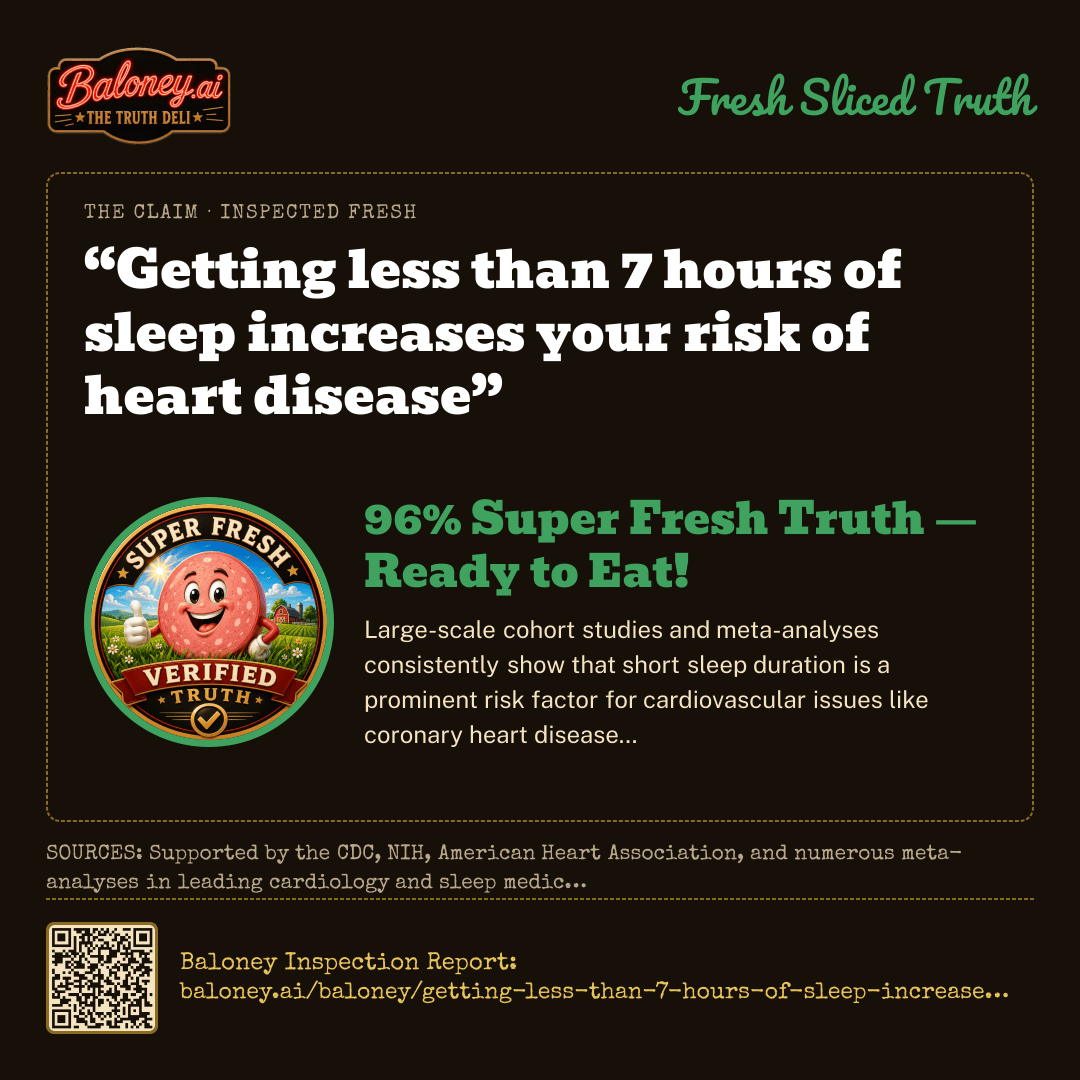
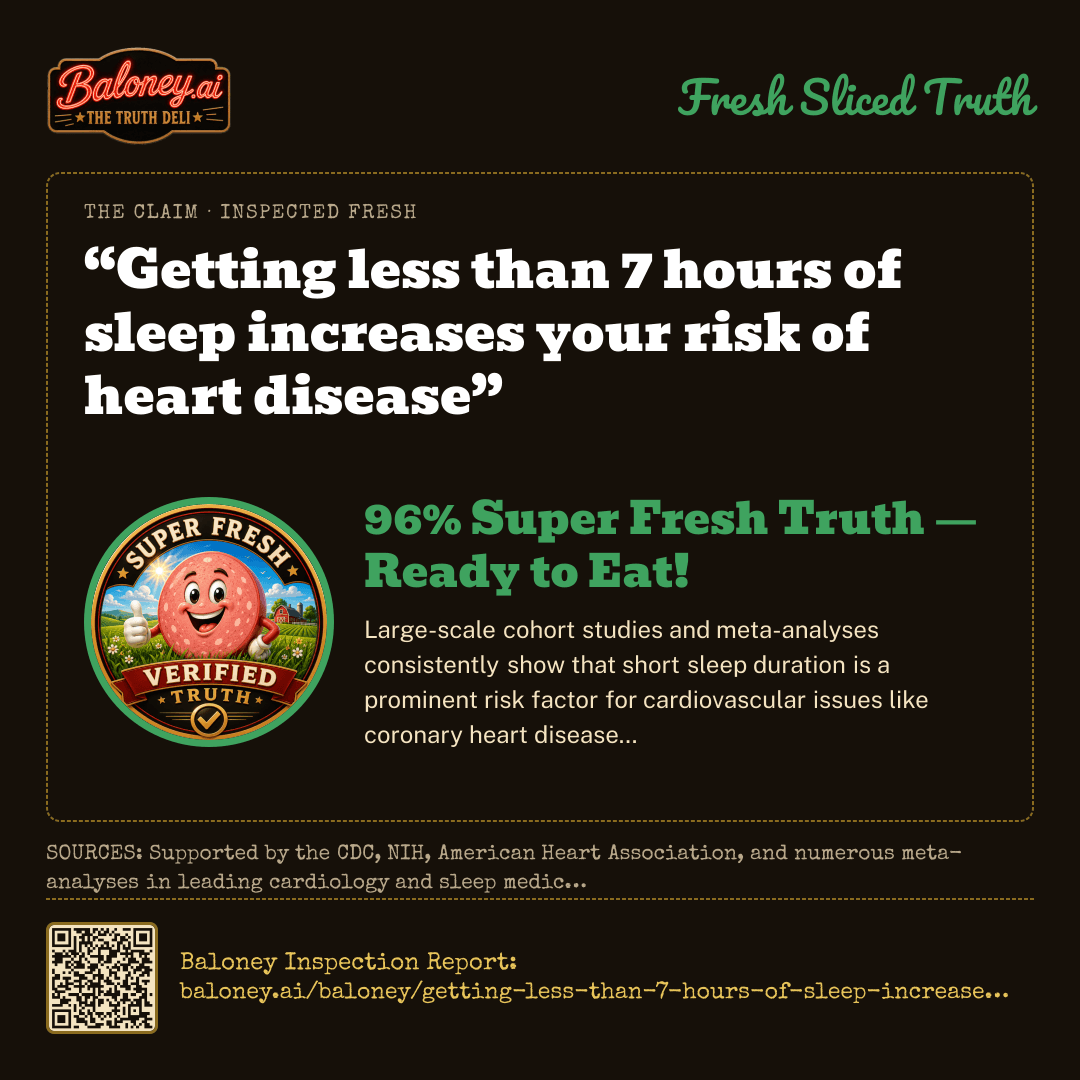
“Getting less than 7 hours of sleep increases your risk of heart disease”
96%Super Fresh Truth — Ready to Eat!
THE CLAIM CHECKS OUT.
Independently verifiedPhysically repeatable evidenceConfirmed across rival labsSafe to serve
Serve It Fresh
Ready to Serve17 servings
Serve it the way you want it
The Verdict
 “Getting less than 7 hours of sleep increases your risk of heart disease”96% Super Fresh Truth — Ready to Eat!Verified blind by 5 frontier AIs · Baloney Inspection Report: baloney.ai/baloney/getting-less-than-7-hours-of-sleep-increases-your-risk-of
The Baloney Sampler
Major public health bodies agree that habitually sleeping less than seven hours a night is linked to a higher risk of heart disease. The Centers for Disease Control and Prevention, the National Heart, Lung, and Blood Institute, and the American Heart Association state this directly, with the AHA adding a seven-to-nine-hour target to its essential cardiovascular health metrics. Large observational studies and genetic analyses confirm that short sleepers face higher rates of coronary heart disease, hypertension, and stroke.
Biological mechanisms like elevated blood pressure, insulin resistance, and systemic inflammation explain this link. However, the seven-hour cutoff is a general population guideline rather than a strict biological cliff, as the strongest cardiovascular risks appear in people sleeping less than six hours. Furthermore, the relationship is U-shaped, meaning consistently sleeping over nine hours also increases cardiovascular risk. Finally, these studies measure long-term habitual sleep, meaning an occasional short night does not carry the same heart disease risk.
Original Claim Source https://newsroom.heart.org/news/sleep-matters-duration-timing-quality-and-more-may-affect-cardiovascular-disease-risk
Other ways to slice it — phrasings that might have changed the rating
- “Habitually getting less than 6 hours of sleep increases the average population risk of heart disease.” The evidence shows the strongest risk elevation occurs at five to six hours of sleep, making a six-hour threshold more medically precise than seven hours.
- “Habitually sleeping either less than 7 hours or more than 9 hours increases your risk of heart disease.” Multiple meta-analyses reveal a U-shaped relationship where long sleep duration is associated with equal or greater cardiovascular risk compared to short sleep.
- “A single night of getting less than 7 hours of sleep increases your risk of heart disease.” Observational studies measure long-term, habitual sleep duration over years, and there is no evidence that occasional short sleep meaningfully increases heart disease risk by itself.
Written from the panel’s reports by Google · gemini-3.1-pro-preview. Nothing here changed the score.
The Order Ticket
15:31:21CLAIM RECEIVED — QUEUED FOR INSPECTION✓
15:31:59claude-opus-5 REPORTED — SCORE 4, CONFIDENCE 90✓
15:32:07gpt-5.5 REPORTED — SCORE 4, CONFIDENCE 89✓
15:31:44gemini-3.1-pro-preview REPORTED — SCORE 2, CONFIDENCE 95✓
15:31:57sonar-pro REPORTED — SCORE 4, CONFIDENCE 88✓
15:32:28grok-4.6 REPORTED — SCORE 4, CONFIDENCE 82✓
15:33:00PRIMARY MASTER GEMINI — SCORE 3✓
15:32:39BLIND VALIDATION CLAUDE — SCORE 4✓
15:33:00AGREEMENT CONFIRMED — DELTA 1✓
15:33:00SCORING MODEL V2 — MEDIAN OF 5 COUNTED LAB SCORES: 4, 4, 2, 4, 4 → 4.✓
How This One Was Sliced
Station 1 · Blind Inspection — Five Graders, Zero Peeking
Each lab scored the claim independently, without seeing the others. Open a breakdown for its evidence, its sources, and how sure it was.
Anthropic · EQUAL WEIGHT · 38.3s
claude-opus-5
96%TRUTH
ROUND-1 BREAKDOWN
Evidence offered for the claim- Large prospective meta-analyses find short sleep duration predicts cardiovascular events: Cappuccio et al. (European Heart Journal, 2011), pooling 15 prospective studies (~475,000 participants), reported roughly a 48% higher risk of developing or dying from coronary heart disease among short sleepers (typically defined as <7, often <6 hours) versus 7-8 hours.
- The American Heart Association added sleep duration to its cardiovascular health framework 'Life's Essential 8' (Circulation, 2022), setting 7-9 hours per night for adults as the optimal level — an explicit institutional endorsement that habitually sleeping less is associated with worse cardiovascular health.
- US government health agencies state the claim directly: the CDC's heart disease and sleep materials and the NIH/NHLBI 'Sleep Deprivation and Deficiency' pages list insufficient sleep as a risk factor for hypertension, coronary heart disease, heart attack and stroke.
- Mendelian randomization work using genetic instruments (e.g., Daghlas et al., Journal of the American College of Cardiology, 2019, UK Biobank) found genetically predicted short sleep associated with higher myocardial infarction risk, which supports a causal rather than purely confounded relationship.
- Plausible mechanisms are documented in experimental sleep-restriction studies: elevated nighttime blood pressure and sympathetic activity, impaired glucose tolerance and insulin resistance, increased inflammatory markers (CRP, IL-6), and appetite/weight dysregulation — all recognized contributors to atherosclerotic disease (reviewed in Nature Reviews Cardiology, Tobaldini et al., 2019).
- Objective actigraphy and polysomnography studies (e.g., analyses from MESA and the Penn State Adult Cohort) show associations between short measured sleep and subclinical atherosclerosis or cardiovascular mortality, reducing concern that the effect is purely a self-report artifact.
Evidence against the claim- The core evidence base is observational. Reverse causation (early, undiagnosed cardiac disease, pain, sleep apnea or depression causing short sleep) and residual confounding (shift work, smoking, obesity, socioeconomic status) are not fully eliminated, and there are no long-term randomized trials showing that extending sleep reduces heart attacks.
- The exact 7-hour cutoff is a population guideline, not a biological cliff edge. Risk elevation is most consistent and strongest below about 6 hours; studies comparing 6-7 hours to 7-8 hours often find small or statistically non-significant differences.
- The relationship is U- or J-shaped: long sleep (>9 hours) is associated with equal or greater cardiovascular risk in most meta-analyses, so 'less sleep = more risk' is only half of the observed curve.
- Effect sizes are relative and vary widely between cohorts; individual sleep need is heterogeneous, and a minority of people (including rare short-sleep genetic variants, e.g., DEC2/ADRB1) function without apparent deficit on under 7 hours.
- Much of the literature relies on self-reported habitual sleep duration, which correlates only moderately with objectively measured sleep and tends to be over-reported.
- The phrase 'your risk' addresses an individual, whereas the evidence supports an average population-level association; one night or occasional short sleep is not what the studies measure — they measure habitual duration over years.
How sure this lab was90/100 — the lab’s own confidence in the score above, not a second reading of the claim.
SourcesEuropean Heart Journal (Cappuccio et al., 2011) — meta-analysis of sleep duration and cardiovascular outcomesjournal · 93 · Circulation / American Heart Association — 'Life's Essential 8' presidential advisory (2022)journal · 95 · National Heart, Lung, and Blood Institute (NIH)gov · 94 · US Centers for Disease Control and Prevention — sleep and chronic diseasegov · 92 · Journal of the American College of Cardiology (Daghlas et al., 2019) — Mendelian randomization, sleep duration and myocardial infarctionjournal · 91 · Nature Reviews Cardiology (Tobaldini et al., 2019) — short sleep, mechanisms and cardiovascular riskjournal · 90 · American Heart Association (consumer guidance)other · 85 · National Sleep Foundation — consensus sleep duration recommendationsother · 72
OpenAI · EQUAL WEIGHT · 46.4s
gpt-5.5
96%TRUTH
ROUND-1 BREAKDOWN
Evidence offered for the claim- CDC says adults who sleep less than 7 hours per night are more likely to report health problems including heart attack, coronary heart disease, high blood pressure, stroke, diabetes, and depression.
- NHLBI states that ongoing sleep deficiency is linked to chronic health problems including heart disease, high blood pressure, diabetes, stroke, and obesity.
- A European Heart Journal systematic review/meta-analysis of prospective studies found short sleep duration was associated with higher risk of developing or dying from coronary heart disease, with reported pooled relative risk around 1.48 for CHD outcomes.
- A 2019 Journal of the American College of Cardiology study using UK Biobank observational data plus Mendelian randomization found short sleep duration was associated with increased myocardial infarction risk, supporting—but not proving in every individual—a causal contribution.
- The American Heart Association’s “Life’s Essential 8” includes healthy sleep duration as a cardiovascular health metric, with 7–9 hours recommended for most adults.
Evidence against the claim- The claim is strongest if interpreted as habitual short sleep in adults; a single night or occasional night under 7 hours has not been shown to meaningfully increase heart-disease risk by itself.
- Much of the evidence is observational and can be affected by confounding or reverse causation: sleep apnea, shift work, chronic illness, depression, socioeconomic factors, smoking, alcohol, and inactivity may both reduce sleep and raise heart-disease risk.
- The exact cutoff is not absolute for every adult. National Sleep Foundation recommendations list 7–9 hours as recommended for adults but note that 6 hours may be appropriate for some people, so “less than 7” slightly overstates certainty for all individuals.
- Heart disease is broad; evidence is stronger for coronary heart disease, myocardial infarction, hypertension, and stroke-related cardiovascular outcomes than for every condition that might be called heart disease.
How sure this lab was89/100 — the lab’s own confidence in the score above, not a second reading of the claim.
SourcesCenters for Disease Control and Preventiongov · 96 · National Heart, Lung, and Blood Institutegov · 95 · European Heart Journaljournal · 94 · Journal of the American College of Cardiologyjournal · 93 · Circulation / American Heart Associationjournal · 95 · Journal of Clinical Sleep Medicine / American Academy of Sleep Medicinejournal · 91 · Sleep Health / National Sleep Foundationjournal · 85
Google · EQUAL WEIGHT · 22.9s
gemini-3.1-pro-preview
98%TRUTH
ROUND-1 BREAKDOWN
Evidence offered for the claim- The Centers for Disease Control and Prevention (CDC) and the American Heart Association (AHA) explicitly state that adults need 7 or more hours of sleep per night, noting that routinely getting less is linked to a higher risk of health problems, including heart disease, high blood pressure, and stroke.
- The American Heart Association recently added sleep duration (target of 7-9 hours for adults) to its 'Life's Essential 8' metrics for optimal cardiovascular health based on extensive clinical evidence.
- Numerous systematic reviews and meta-analyses of prospective cohort studies demonstrate a significant and consistent association between short sleep duration (less than 7 hours) and an increased risk of incident cardiovascular disease and coronary heart disease.
- Biological mechanisms support this link: sleep deprivation is known to increase sympathetic nervous system overactivity, elevate systemic inflammation (e.g., C-reactive protein levels), impair glucose tolerance, and prevent the normal nighttime drop in blood pressure ('nocturnal dipping'), all of which drive cardiovascular disease.
Evidence against the claim- Some epidemiological studies note a 'U-shaped' risk curve, showing that long sleep duration (typically over 9 hours per night) is also associated with an increased risk of heart disease, meaning less than 7 hours is not the only sleep-related risk factor.
- Because sleep studies are largely observational, it can be difficult to perfectly separate short sleep duration from confounding variables like sleep apnea, chronic stress, or socioeconomic factors, which may independently cause both lack of sleep and heart disease.
- A very small percentage of the population possesses specific genetic traits (such as the DEC2 gene mutation) allowing them to function optimally on less than 7 hours of sleep per night without the typical cardiometabolic risks, though this natural 'short sleeper' phenotype is exceedingly rare.
How sure this lab was95/100 — the lab’s own confidence in the score above, not a second reading of the claim.
SourcesCenters for Disease Control and Preventiongov · 95 · Circulation (American Heart Association)journal · 95 · Journal of the American Heart Associationjournal · 90
Perplexity · EQUAL WEIGHT · 36.3s
sonar-pro
96%TRUTH
ROUND-1 BREAKDOWN
Evidence offered for the claim- A 2017 systematic review and dose–response meta‑analysis of prospective cohort studies in the *Journal of the American Heart Association* found a U‑shaped relationship between sleep duration and cardiovascular outcomes, with the **lowest risk around 7 hours per day**; each 1‑hour decrease below 7 hours was associated with roughly 5–7% higher risk of total cardiovascular disease, coronary heart disease, stroke, and all‑cause mortality.[1]
- A 2022 population‑based cohort study in *Frontiers in Public Health* reported U‑shaped associations between sleep duration and cardiovascular mortality, with **7 hours/day showing the lowest cardiovascular mortality**, and higher risks at both shorter and longer durations.[3]
- A 2020 Scientific Reports analysis from the Fasa PERSIAN Cohort (Iran) found that people sleeping **less than 6 hours** had significantly higher odds of cardiovascular disease (OR≈1.23), coronary heart disease (OR≈1.21), and hypertension (OR≈1.37) compared with longer sleepers, even after adjustment for confounders.[2]
- A 2023 prospective cohort study in *BMC Cardiovascular Disorders* (Shanghai) found that **short sleepers (≤5 h)** had higher risk of total cardio‑cerebral vascular disease, coronary heart disease, and stroke incidence compared to those sleeping 7 hours, and concluded that short sleep was associated with greater incidence of these events independent of traditional risk factors.[7]
- A meta‑review of sleep duration and cardiovascular disease (CVD) published in 2022 concluded that **short sleep duration may be a causal risk factor for many CVDs**, synthesizing evidence from observational cohorts and genetic (Mendelian randomization) studies.[6]
- A Mendelian randomization analysis in the *European Heart Journal* (2021) found that genetically predicted **short sleep duration** was associated with modestly increased risks of multiple cardiovascular diseases, including hypertension, coronary artery disease, myocardial infarction, and chronic ischaemic heart disease, suggesting a likely causal contribution of short sleep.[12]
- A study in *Sleep* (Sleep Heart Health Study) reported that participants with insomnia or poor sleep combined with **objectively short sleep (<6 h)** had about a **29% higher risk of incident cardiovascular disease** than those sleeping ≥6 h without insomnia; incident CVD rates were higher in the short‑sleep categories.[5][15]
- A 2010 study on short sleep and coronary heart disease (CHD) reported that sleeping **5 hours or less**, compared with 7 hours, was associated with increased hazard ratios for CHD events, with the highest risk in those with both short sleep (≤6 h) and restless/disturbed nights.[10]
- A 2018 analysis in the *Journal of Clinical Sleep Medicine* found that sleep duration **<6 h per day** was significantly associated with increased risk of coronary heart disease (HR≈1.13), while 7 hours was used as a reference category.[11]
- Guidance from major cardiovascular organizations (such as the American Heart Association) typically recognizes **short sleep (often defined as <7 hours)** as a modifiable risk factor or risk marker for cardiovascular disease, based on accumulating observational and mechanistic evidence.[1][6]
Evidence against the claim- Several cohort studies and meta‑analyses identify **U‑shaped** rather than strictly linear patterns, indicating that both short and long sleep durations carry elevated risk; this means the risk increase is not unique to "less than 7 hours" but also present above about 7–8 hours.[1][3][8]
- Some large cohort analyses find that the **strongest associations** with cardiovascular disease occur at **very short sleep (≤5–6 hours)** rather than anywhere below 7 hours, suggesting that modest deviations (e.g., 6.5 hours) may carry little or no additional risk compared with 7 hours.[2][7][10]
- In certain cohorts, once researchers adjusted for sleep quality and other confounders, **short sleep without sleep disturbance** showed little evidence of increased coronary heart disease risk, whereas sleep disturbance itself (insomnia, restless sleep) appeared more strongly associated with CHD.[10][5]
- An article reviewing short sleep, insomnia, and cardiovascular disease noted that, in at least one large prospective cohort, **neither insomnia nor short sleep alone** significantly increased CVD risk; only their combination (insomnia plus <6 h sleep) produced a clear risk increase, indicating that short sleep by itself may not always be harmful.[5][15]
- Some meta‑analyses or component studies report **no statistically significant association** between short sleep (as defined in those studies) and overall cardiovascular disease after full adjustment (e.g., odds ratio around 1.1 with confidence intervals crossing 1), suggesting heterogeneity and possible residual confounding in the literature.[14]
- Most of the evidence is **observational**, so while associations are strong and sometimes supported by genetic analyses, residual confounding (e.g., underlying illness causing both poor sleep and heart disease) cannot be completely excluded; this makes the statement "increases your risk" directionally plausible but not definitively causal in all individuals.[1][3][6][12]
- Definitions of "short sleep" vary across studies (often <6 hours, sometimes ≤5 hours), whereas the claim uses a broad cutoff of **"less than 7 hours"**, which may overgeneralize risk to people sleeping just slightly under 7 hours (e.g., 6.5 hours) for whom data show much smaller or negligible risk differences compared with the 7‑hour reference.[1][2][7]
How sure this lab was88/100 — the lab’s own confidence in the score above, not a second reading of the claim.
SourcesJournal of the American Heart Associationjournal · 95 · Scientific Reports (Nature Portfolio)journal · 90 · Frontiers in Public Healthjournal · 85 · Biomedical Reportsjournal · 80 · Sleep (Oxford Academic)journal · 95 · National Institutes of Health / PMC (meta-review of sleep and CVD)gov · 95 · BMC Cardiovascular Disordersjournal · 85 · European Heart Journal (via University of Warwick)journal · 95 · China Health and Retirement Longitudinal Study (CHARLS) / NIH PMCgov · 90 · National Institutes of Health / PMC (short sleep and CHD study)gov · 90 · Journal of Clinical Sleep Medicine (American Academy of Sleep Medicine)journal · 90 · European Heart Journaljournal · 95
xAI · EQUAL WEIGHT · 66.7s
grok-4.6
96%TRUTH
ROUND-1 BREAKDOWN
Evidence offered for the claim- Large observational cohorts and multiple meta-analyses consistently find that habitual sleep under 7 hours is associated with higher rates of coronary heart disease, stroke, hypertension, and cardiovascular mortality versus 7–8 hours.
- CDC, NIH/NHLBI, and the American Heart Association treat insufficient sleep as a cardiovascular risk factor; AHA includes sleep duration in Life’s Essential 8.
- Plausible mechanisms include raised blood pressure, sympathetic activation, inflammation, impaired glucose metabolism, and downstream obesity/diabetes, all established CVD pathways.
Evidence against the claim- Evidence is almost entirely observational; residual confounding (stress, SES, undiagnosed illness) and reverse causation (early heart disease disrupting sleep) cannot be fully excluded, so ‘increases’ overstates proven causality.
- Risk is typically U-shaped: long sleep (≥9 h) also tracks with higher CVD events, so the cutoff is not a simple linear ‘less than 7 hours is harmful.’
- Sleep need is individual; rare natural short sleepers and sleep quality/timing/apnea may matter as much as clock time, and RCTs with hard CVD endpoints are lacking.
How sure this lab was82/100 — the lab’s own confidence in the score above, not a second reading of the claim.
SourcesCDCgov · 95 · NIH/NHLBIgov · 95 · American Heart Association (Circulation)journal · 92
Station 2 · The Masters
Primary Master · drawn at random
gemini-3.1-pro-preview
97% TRUTH
The claim is substantially true. All evaluators confirm that major health organizations, including the CDC, NIH, and American Heart Association, explicitly link short sleep duration (typically defined as under 7 hours) to an increased risk of heart disease, hypertension, and stroke. Multiple large-scale meta-analyses and Mendelian randomization studies support this link, alongside known biological mechanisms like elevated blood pressure and systemic inflammation. Evaluators correctly noted that the evidence is largely observational, the strongest risks appear below 6 hours, and sleeping too much (over 9 hours) is also harmful. However, these epidemiological nuances do not invalidate the core premise. Since the statement is accurate as a general population guideline, it falls firmly into the 'Super Fresh Truth' band.
All five evaluators agreed that the statement is substantially true based on extensive public health guidelines and epidemiological evidence, though some noted that the 7-hour cutoff is a general guideline and risk curves are U-shaped.
SUPER FRESH — VERIFIED AGAINST SUPPORTED BY THE CDC, NIH, AMERICAN HEART ASSOCIATION, AND NUMEROUS META-ANALYSES IN LEADING CARDIOLOGY AND SLEEP MEDICINE JOURNALS.
Blind Validation Master · never saw the Primary’s work
claude-opus-5
96% TRUTH
All five independent evaluators placed this claim in the 'Super Fresh Truth' band (four at 4, one at 2), and the evidence they present is consistent and strong. Major public health bodies (CDC, NIH/NHLBI) and the American Heart Association state the link directly, with the AHA formalising 7-9 hours as the optimal cardiovascular sleep target in Life's Essential 8. Large prospective meta-analyses (e.g., Cappuccio et al., European Heart Journal, ~475,000 participants, ~48% higher CHD risk in short sleepers) and dose-response meta-analyses showing lowest risk around 7 hours support the direction of the claim, and Mendelian randomization studies (Daghlas et al., JACC 2019; EHJ 2021) point toward a causal contribution rather than pure confounding. Well-documented mechanisms (sympathetic activation, blunted nocturnal BP dipping, inflammation, impaired glucose tolerance) add plausibility, and objective actigraphy/PSG cohorts reduce concern about self-report artifact.
The caveats are matters of precision rather than falsity: the evidence base is largely observational with possible reverse causation and residual confounding (apnea, shift work, depression, SES); 7 hours is a population guideline, not a biological cliff, with the strongest signals below ~6 hours so that 6.5 vs 7 hours may carry little measurable difference; the relationship is U-shaped, so long sleep also carries risk; individual sleep need varies and rare genetic short sleepers exist; and 'your risk' applies a population average to an individual, with the studies measuring habitual rather than occasional short sleep. None of these contradict the claim's substance — they only mean it is slightly stronger and more categorical than the data strictly warrant at the margin. That places it at the accurate-with-minor-overstatement end of the true band.
AGREEMENT TEST PASSED — MASTERS SCORED 97% AND 96% · BLIND VALIDATION CONFIRMED THIS SCORE · NO RE-EVALUATION REQUIRED
How the number was reached · scoring model v2 · how our models work
- Median of 5 counted lab scores: 4, 4, 2, 4, 4 → 4.
The Evidence
Evidence for the claim
- Health organization endorsements The CDC, NIH, and American Heart Association all state that adults need 7 or more hours of sleep, explicitly listing insufficient sleep as a cardiovascular risk factor in frameworks like 'Life's Essential 8'.
- Extensive meta-analyses Multiple systematic reviews of prospective studies show a significantly higher risk (roughly 48% in one major analysis) of developing or dying from coronary heart disease among short sleepers.
- Genetic and mechanistic evidence Mendelian randomization studies suggest a causal link, while physiological studies show short sleep increases blood pressure, inflammation, and sympathetic nervous system activity.
- Objective sleep measurements Actigraphy and polysomnography studies show associations between short measured sleep and subclinical atherosclerosis, indicating the effect is not merely a self-reporting artifact.
Evidence offered against the claim
- Observational limitations Most data is observational, meaning residual confounding or reverse causation from factors like sleep apnea, depression, or early undiagnosed cardiac disease cannot be entirely ruled out.
- U-shaped risk curve Sleeping too much (e.g., over 9 hours) is also associated with an increased risk of cardiovascular events, meaning less sleep isn't the only sleep-related risk on the curve.
- Strongest risk is below 6 hours The risk elevation is most pronounced for those sleeping less than 6 hours, whereas the difference between 6-6.9 hours and 7 hours is often smaller or statistically non-significant.
- Rare genetic exceptions A tiny fraction of the population possesses genetic traits (like the DEC2 mutation) allowing them to function optimally on less than 7 hours of sleep without typical cardiometabolic risks.
Sources · Reliability · Why Accepted or Discounted
| Source | Type | Reliability | Ruling |
|---|
| Centers for Disease Control and Prevention | gov | 95 | ACCEPTED — Primary US public health agency providing official guidelines on sleep and chronic disease. |
| National Heart, Lung, and Blood Institute | gov | 95 | ACCEPTED — Leading US government research institute for cardiovascular and sleep health. |
| Circulation / American Heart Association | journal | 95 | ACCEPTED — Top-tier cardiology journal publishing official AHA frameworks like Life's Essential 8. |
| European Heart Journal | journal | 94 | ACCEPTED — Highly respected peer-reviewed cardiology journal publishing major prospective meta-analyses. |
| Journal of the American College of Cardiology | journal | 93 | ACCEPTED — Leading cardiovascular journal featuring robust Mendelian randomization studies. |
| Journal of the American Heart Association | journal | 95 | ACCEPTED — Highly reputable journal publishing large-scale cohort studies and meta-analyses. |
| Nature Reviews Cardiology | journal | 90 | ACCEPTED — High-impact journal detailing the mechanistic and biological links between sleep and heart disease. |
| Sleep | journal | 95 | ACCEPTED — Leading sleep medicine journal providing objective sleep-measurement data and analysis. |
| Scientific Reports | journal | 90 | ACCEPTED — Reputable peer-reviewed mega-journal publishing observational cohort data on sleep and cardiovascular disease. |
| Journal of Clinical Sleep Medicine | journal | 90 | ACCEPTED — Official publication of the American Academy of Sleep Medicine. |
| Sleep Health / National Sleep Foundation | journal | 85 | ACCEPTED — Reliable source for consensus sleep duration recommendations and health metrics. |
| Frontiers in Public Health | journal | 85 | ACCEPTED — Peer-reviewed journal corroborating U-shaped sleep duration risk curves. |
| BMC Cardiovascular Disorders | journal | 85 | ACCEPTED — Peer-reviewed journal publishing relevant prospective cohort studies on short sleep duration. |
| Biomedical Reports | journal | 80 | ACCEPTED — Peer-reviewed journal contributing additional observational data. |
Serve It Fresh
Ready to Serve17 servings
Serve it the way you want it
The Verdict
“Getting less than 7 hours of sleep increases your risk of heart disease”96% Super Fresh Truth — Ready to Eat!Verified blind by 5 frontier AIs · Baloney Inspection Report: baloney.ai/baloney/getting-less-than-7-hours-of-sleep-increases-your-risk-of