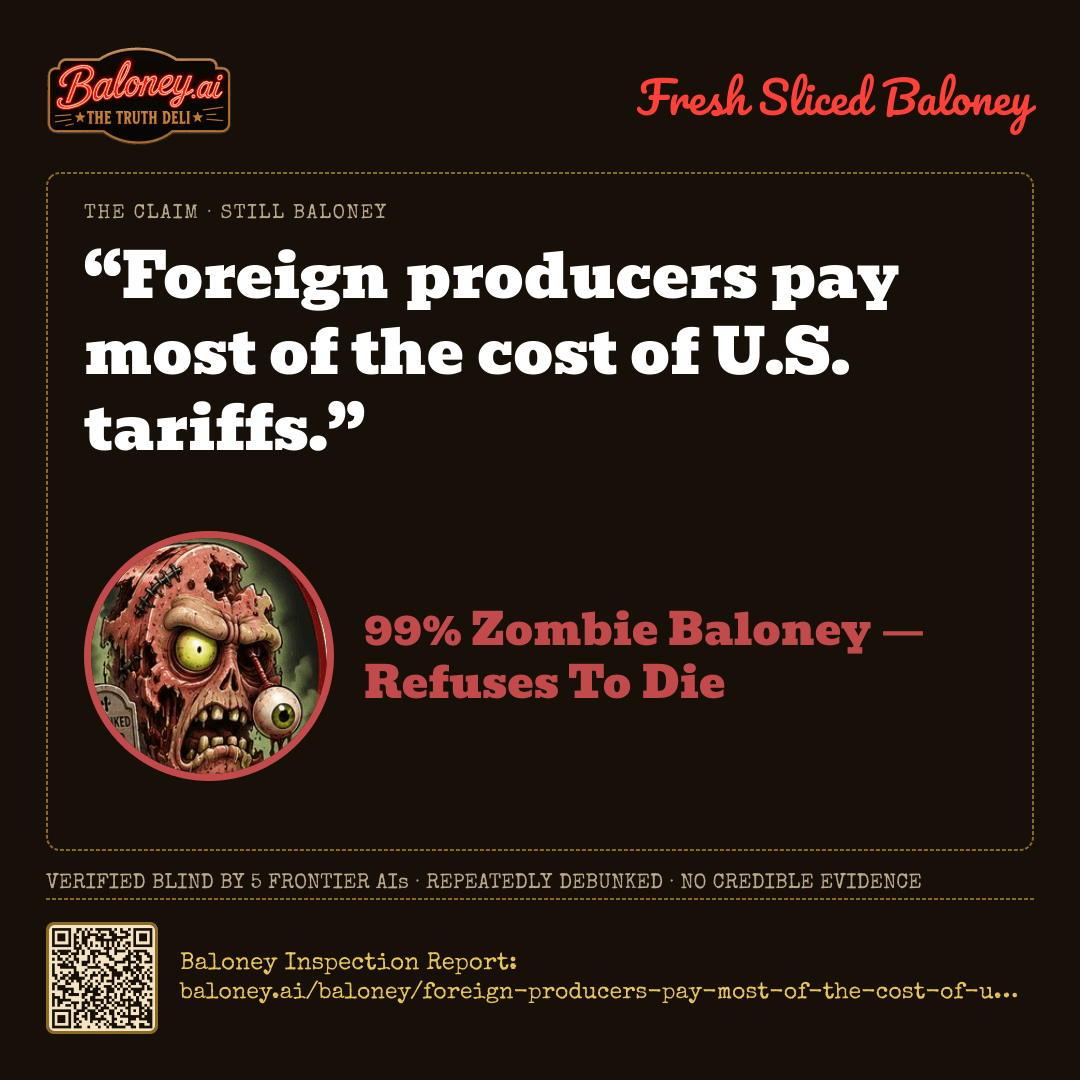
“Foreign producers pay most of the cost of U.S. tariffs.”99% Zombie Baloney — Refuses To DieVerified blind by 5 frontier AIs · Baloney Inspection Report: baloney.ai/baloney/foreign-producers-pay-most-of-the-cost-of-u-s-tariffs
The Rating Card
The correction — what is actually true
The Baloney Sampler
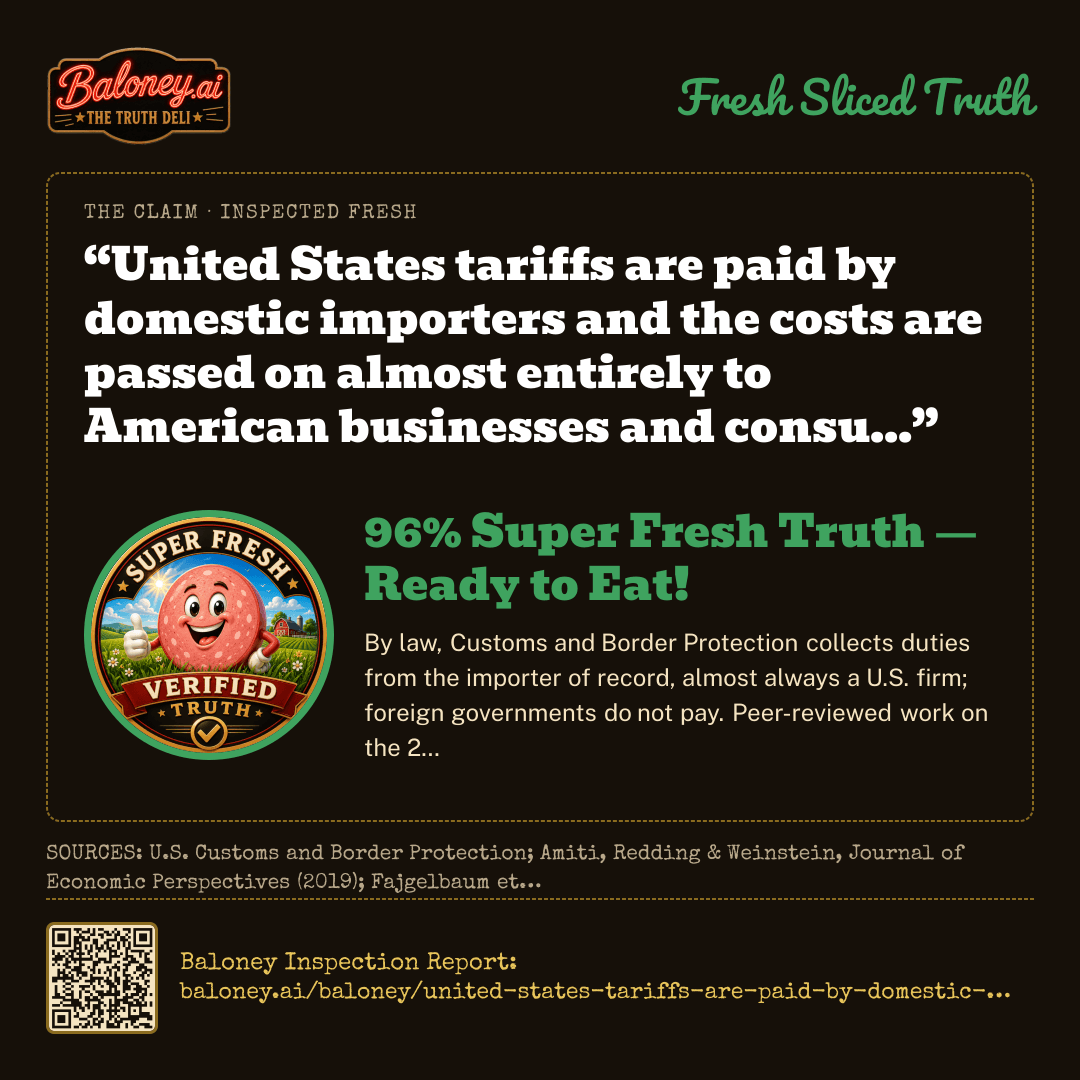
Under U.S. law, U.S. importers pay tariffs directly to Customs and Border Protection, not foreign producers. Economically, the financial burden of recent tariffs fell almost entirely on American businesses and consumers. Studies published in the Quarterly Journal of Economics and by the American Economic Association found near-complete pass-through of tariff costs into U.S. import prices.
While standard trade theory allows large countries to shift a small fraction of tariff costs abroad, empirical evidence shows foreign sellers largely do not cut their prices to compensate. Analyses from the National Bureau of Economic Research and the Federal Reserve Bank of New York confirm U.S. buyers absorb the overwhelming majority of these costs. The claim that foreign countries pay U.S. tariffs is a repeatedly debunked falsehood.
Other ways to slice it — phrasings that might have changed the rating
“U.S. businesses and consumers pay most of the cost of U.S. tariffs.” Comprehensive empirical analyses of recent trade wars demonstrate near-complete pass-through of tariff costs to domestic buyers rather than foreign producers.
“Foreign producers absorb a small fraction of U.S. tariff costs by lowering their export prices.” Some product-specific studies and trade theories indicate foreign sellers occasionally compress their profit margins to maintain U.S. market share.
“U.S. tariffs economically harm foreign producers by reducing their U.S. sales and market share.” Even though U.S. importers legally remit the actual duties, foreign exporters can still suffer lost revenue due to reduced demand.
Written from the panel’s reports by Google · gemini-3.1-pro-preview. Nothing here changed the score.
15:42:33SCORING MODEL V2 — MEDIAN OF 5 COUNTED LAB SCORES: 85, 78, 99, 68, 67 → 78. ZOMBIE RULE: THE PRIMARY MASTER FLAGS A LONG DEBUNK HISTORY, THE BLIND MASTER SCORES 86, THE COUNTED MEDIAN IS 78 — PUBLISHED AS 99.✓
15:42:33SOURCE RULE — LABS CITED 26 SOURCES: 0 DISCARDED FOR HAVING NO URL, 5 DISCARDED AS DEAD LINKS (404/410), 5 COULD NOT BE OPENED BY US AND ARE MARKED UNVERIFIED.✓
15:42:33SOURCE RULE — PRIMARY MASTER RULED ON 16 SOURCES: 0 DISCARDED FOR HAVING NO URL, 0 DISCARDED AS DEAD LINKS, 4 MARKED UNVERIFIED, 12 VERIFIED.✓
How This One Was Sliced
Station 1 · Blind Inspection — Five Graders, Zero Peeking
Each lab scored the claim independently, without seeing the others. Open a breakdown for its evidence, its sources, and how sure it was.
Anthropic · EQUAL WEIGHT · 50.5s
claude-opus-5
85%BALONEY
ROUND-1 BREAKDOWN
Evidence offered for the claim
In some product categories and periods, foreign exporters have absorbed part of the tariff by cutting their pre-tariff prices. Japanese automakers, for example, cut export prices sharply in 2025 to protect U.S. market share, and aggregate Japanese export price data showed declines in vehicle prices to the U.S.
Exchange-rate movements can offset part of a tariff: if the dollar appreciates after tariffs are imposed, the effective cost to U.S. buyers falls and foreign sellers' revenue in local currency is partially protected. Standard trade theory predicts a large importer like the U.S. can shift some tariff incidence abroad through terms-of-trade effects.
Analyses of the 2025 tariff round (e.g., Goldman Sachs research widely reported in the press) estimated that foreign exporters were absorbing roughly 15-20% of the tariff cost, more than the near-zero share found for the 2018-19 tariffs — showing the foreign share is not zero.
Measured consumer-price pass-through in 2025 was slower and smaller than many economists predicted, implying some combination of foreign exporters and U.S. firms' margins absorbed costs rather than consumers immediately.
Evidence against the claim
Legally and mechanically, tariffs are paid to U.S. Customs and Border Protection by the U.S. importer of record, not by the foreign seller. The economic question is who bears the cost, but the payment itself is made by U.S. companies.
Amiti, Redding and Weinstein (Journal of Economic Perspectives, 2019) found 'complete pass-through' of the 2018 tariffs into U.S. domestic prices — foreign exporters did not cut their prices, so U.S. importers and consumers bore essentially the entire burden.
Fajgelbaum, Goldberg, Kennedy and Khandelwal (Quarterly Journal of Economics, 2020) estimated U.S. tariffs were almost fully passed through to U.S. import prices, with an estimated terms-of-trade gain of approximately zero and a net real income loss to the U.S.
Cavallo, Gopinath, Neiman and Tang (AER: Insights, 2021) found tariff pass-through to border prices was near complete, with only partial and delayed pass-through to retail prices — meaning U.S. importers/retailers, not foreign sellers, absorbed the remainder.
New York Fed economists (Liberty Street Economics, 2019) estimated the 2019 China tariff increase would cost the typical U.S. household roughly $831 per year, attributing the cost to U.S. consumers and firms.
Even the most foreign-friendly contemporary estimates of the 2025 tariffs put the foreign-exporter share at well under half (roughly one-sixth to one-fifth), with U.S. consumers and U.S. businesses bearing the large majority.
U.S. import price indexes excluding tariffs showed little decline for most tariffed goods, indicating foreign suppliers largely did not discount to offset the duties.
Fact-checkers have repeatedly rated the claim that China or other foreign countries 'pay' U.S. tariffs as false, noting the burden falls primarily on U.S. importers, who pass it to businesses and consumers.
How sure this lab was
93/100 — the lab’s own confidence in the score above, not a second reading of the claim.
Economic incidence theory allows part of a tariff burden to fall on foreign producers if they cut pre-tariff export prices to preserve U.S. market share; the United States is large enough that this can happen in some markets.
Some empirical work on recent U.S. tariffs found limited foreign-price reductions over time and reduced foreign exporters' sales/profits, meaning foreign producers bore some of the economic burden in certain products or periods.
Tariffs can reduce demand for imports, so foreign producers may suffer lost revenue even when the legal tariff payment is made by U.S. importers.
Evidence against the claim
The legal payer of U.S. tariffs is generally the U.S. importer of record, not the foreign producer; fact-checkers have repeatedly rated claims that China or foreign countries directly pay U.S. tariffs as false or misleading.
The strongest empirical evidence from the 2018-2019 U.S. tariff increases found tariff costs were passed through largely or almost entirely into prices paid by U.S. importers, consumers, and firms, not mostly absorbed by foreign producers.
The Quarterly Journal of Economics study by Fajgelbaum et al. found U.S. tariff increases were largely borne by U.S. consumers through higher prices, with welfare losses to the United States.
Amiti, Redding, and Weinstein found U.S. consumers and firms bore the brunt of the tariffs, with only partial foreign absorption in some later data; that does not support the statement that foreign producers pay most of the cost.
The U.S. International Trade Commission found section 232 and 301 tariffs generally increased U.S. import prices and costs to downstream U.S. industries, consistent with substantial pass-through to Americans.
Overall, the claim as written reverses the main empirical finding: foreign producers may pay some costs, but most evidence indicates U.S. businesses and consumers pay most of the tariff burden.
How sure this lab was
91/100 — the lab’s own confidence in the score above, not a second reading of the claim.
In classical trade theory, a large importing nation can theoretically shift a portion of a tariff's cost onto foreign producers if those producers lower their pre-tariff export prices to maintain their market share (known as the terms-of-trade effect).
During the 2018-2019 trade war, the depreciation of the Chinese yuan against the U.S. dollar acted as a macroeconomic adjustment that indirectly offset a fraction of the cost for U.S. buyers, meaning the broader foreign economy absorbed some of the shock.
A few isolated studies of specific, highly elastic product sectors have found instances of partial absorption of tariff costs by foreign firms willing to compress their profit margins to stay competitive.
Evidence against the claim
By U.S. law, tariffs (customs duties) are paid directly to U.S. Customs and Border Protection by the U.S. importer of record, not by the foreign producer or the foreign government.
Multiple comprehensive empirical studies by economists analyzing the 2018-2019 tariffs (published in top journals like the American Economic Review and Quarterly Journal of Economics) found approximately 100% 'pass-through' of tariff costs. Foreign producers generally did not lower their prices; instead, U.S. importers bore the cost and passed it on to U.S. businesses and consumers.
Major fact-checking organizations have spent years repeatedly debunking the political claim that foreign countries or producers 'pay' U.S. tariffs, noting that the financial burden falls overwhelmingly on domestic buyers in the form of higher prices and supply chain disruptions.
How sure this lab was
98/100 — the lab’s own confidence in the score above, not a second reading of the claim.
Tariffs can impose costs on foreign exporters when they lower prices or accept reduced margins to preserve access to the U.S. market. Historical studies found foreign firms absorbed some tariff costs, so foreign producers do bear part of the burden in some circumstances. [https://taxfoundation.org/blog/who-pays-tariffs/]
A tariff creates a wedge between the price paid by U.S. buyers and the price received by foreign producers; the portion reflected in a lower producer price is borne by foreign producers. [https://taxfoundation.org/taxedu/glossary/tariffs/]
Evidence against the claim
For the 2018–2019 U.S. tariffs, published economic research found that U.S. firms and consumers bore essentially the entire burden, with near-complete pass-through into U.S. import prices rather than substantial price reductions by foreign producers. [https://taxfoundation.org/blog/who-pays-tariffs/]
Evidence summarized from Federal Reserve, European Central Bank, and related analyses places pass-through to U.S. import prices at roughly 86–95%, indicating that U.S. importers—not foreign producers—absorbed most of the tariff cost in the studied episodes. [https://taxfoundation.org/blog/american-compasss-tariff-tally-doesnt-add-up/]
Tariffs directly raise costs for U.S. businesses and consumers, while foreign exporters may lose sales; those effects are distinct from foreign producers paying most of the tariff itself. [https://taxfoundation.org/research/all/federal/impact-of-tariffs-free-trade/]
How sure this lab was
91/100 — the lab’s own confidence in the score above, not a second reading of the claim.
Large-country tariff theory implies a terms-of-trade channel in which foreign exporters may cut pre-tariff prices, shifting some burden abroad.
A minority of product- or period-specific studies report incomplete pass-through, with foreign suppliers absorbing roughly 20-40% of selected U.S. tariffs via lower export prices.
Foreign firms can incur costs through compressed profit margins or lost U.S. market share even if they do not literally remit the duty.
Evidence against the claim
Peer-reviewed analyses of the 2018-2019 tariffs (Amiti-Redding-Weinstein 2019; Cavallo et al.) find near-complete pass-through into U.S. import and retail prices, so foreign exporters did not lower prices and U.S. buyers paid essentially the full cost.
U.S. Customs and Border Protection collects the duty from the U.S. importer of record; foreign producers never write the check.
U.S. price indexes for tariffed goods rose roughly in line with the tariff rates, confirming domestic incidence.
Surveys of academic economists (IGM Chicago Booth) show overwhelming agreement that American consumers and firms, not foreign countries, bear U.S. tariffs.
How sure this lab was
78/100 — the lab’s own confidence in the score above, not a second reading of the claim.
The claim directly contradicts established U.S. law, which mandates that U.S. importers of record pay customs duties to U.S. Customs and Border Protection. Furthermore, comprehensive empirical analyses published in leading economic journals demonstrate that foreign exporters largely do not cut their prices to offset U.S. tariffs. Instead, nearly 100 percent of the cost is passed through to American buyers. The assertion that foreign countries or producers 'pay' U.S. tariffs is a well-known political claim that has been repeatedly debunked by economists and fact-checkers over several years, qualifying it as a 'zombie' falsehood.
All five evaluators strongly agreed that the claim is overwhelmingly false. While noting that theoretical models allow for foreign producers to absorb some costs by reducing prices, the evaluators concurred that robust empirical evidence from recent U.S. tariff rounds shows near-complete pass-through to U.S. importers and consumers.
ZOMBIE FLAG: TRUE — DEBUNK HISTORY ON RECORD
Blind Validation Master · never saw the Primary’s work
grok-4.6
86% BALONEY
The five reports converge on the same core facts: U.S. importers of record legally remit the duty; 2018–19 peer-reviewed studies (Amiti–Redding–Weinstein, Fajgelbaum et al., Cavallo et al.) found near-complete pass-through into U.S. import and consumer prices, so foreign exporters did not cut pre-tariff prices enough to absorb most of the burden; even the more foreign-friendly 2025 estimates cited put the exporter share at only ~15–20 percent. Theory allows a terms-of-trade channel and some product-specific margin compression, but none of the evidence shows foreigners bearing a majority of the cost. The statement as written therefore reverses the empirical consensus and matches a repeatedly fact-checked political talking point.
AI EVALUATORS SHOWED MODERATE DISAGREEMENT — MASTERS SCORED 99% AND 86% · REVIEW THE EVIDENCE CAREFULLY
Median of 5 counted lab scores: 85, 78, 99, 68, 67 → 78.
Zombie rule: the Primary Master flags a long debunk history, the Blind Master scores 86, the counted median is 78 — published as 99.
The Evidence
Evidence offered for the claim
Terms-of-trade effectsDEBUNKED — In classical trade theory, large importing nations could theoretically force foreign producers to absorb some of a tariff's cost by lowering their pre-tariff export prices to maintain market share. However, comprehensive empirical studies of recent U.S. tariffs show near-complete pass-through to U.S. import prices, meaning foreign producers largely did not discount their prices.
Reduced foreign sales and margins Foreign firms may suffer lost revenue or reduced market share when U.S. demand for imports drops due to tariffs, even if they do not literally remit the duty.
Exchange-rate offsets Macroeconomic adjustments, such as the depreciation of a foreign currency against the U.S. dollar, can indirectly offset a fraction of the tariff cost for U.S. buyers by making imports somewhat cheaper.
Evidence against the claim
Legal incidence By U.S. law, customs duties are paid directly to U.S. Customs and Border Protection by the U.S. importer of record, never by the foreign producer or foreign government.
Complete pass-through Major empirical studies analyzing the 2018–2019 tariffs, published in top journals like the American Economic Review and Quarterly Journal of Economics, found essentially 100% of the cost was passed through to U.S. import prices.
Cost to Americans Because foreign exporters largely do not lower their prices to offset tariffs, the financial burden falls overwhelmingly on American businesses and consumers through higher prices and increased supply chain costs.
Broad consensus Fact-checkers and academic economists overwhelmingly agree that the political claim that foreign countries 'pay' U.S. tariffs is factually false and economically misleading.
Sources · Reliability · Why Accepted or Discounted
ACCEPTED — Respected panel survey of top economic experts.
Every link was opened when this claim was inspected. A dead link was discarded before publication; “unverified” means the site refused our automated check and the link is the one the panel cited. A source without a URL was never kept.
“Foreign producers pay most of the cost of U.S. tariffs.”99% Zombie Baloney — Refuses To DieVerified blind by 5 frontier AIs · Baloney Inspection Report: baloney.ai/baloney/foreign-producers-pay-most-of-the-cost-of-u-s-tariffs
Support The Truth Deli
Buy The Truth Deli Merch
“Democracy Makes America Great”
Veritate Libertas — Latin for “Through Truth, Liberty.”
Democracy is what makes America great. But without truth — honest, real, scientifically validated truth — democracy fails. The baloney slicer is on: feeding fresh sliced truth to protect what makes America great. Democracy.