Baloney Inspection Report: Claim #1156 · Inspected Oct 30, 2026, 10:06 PM PDT · Scoring model v2
 43%
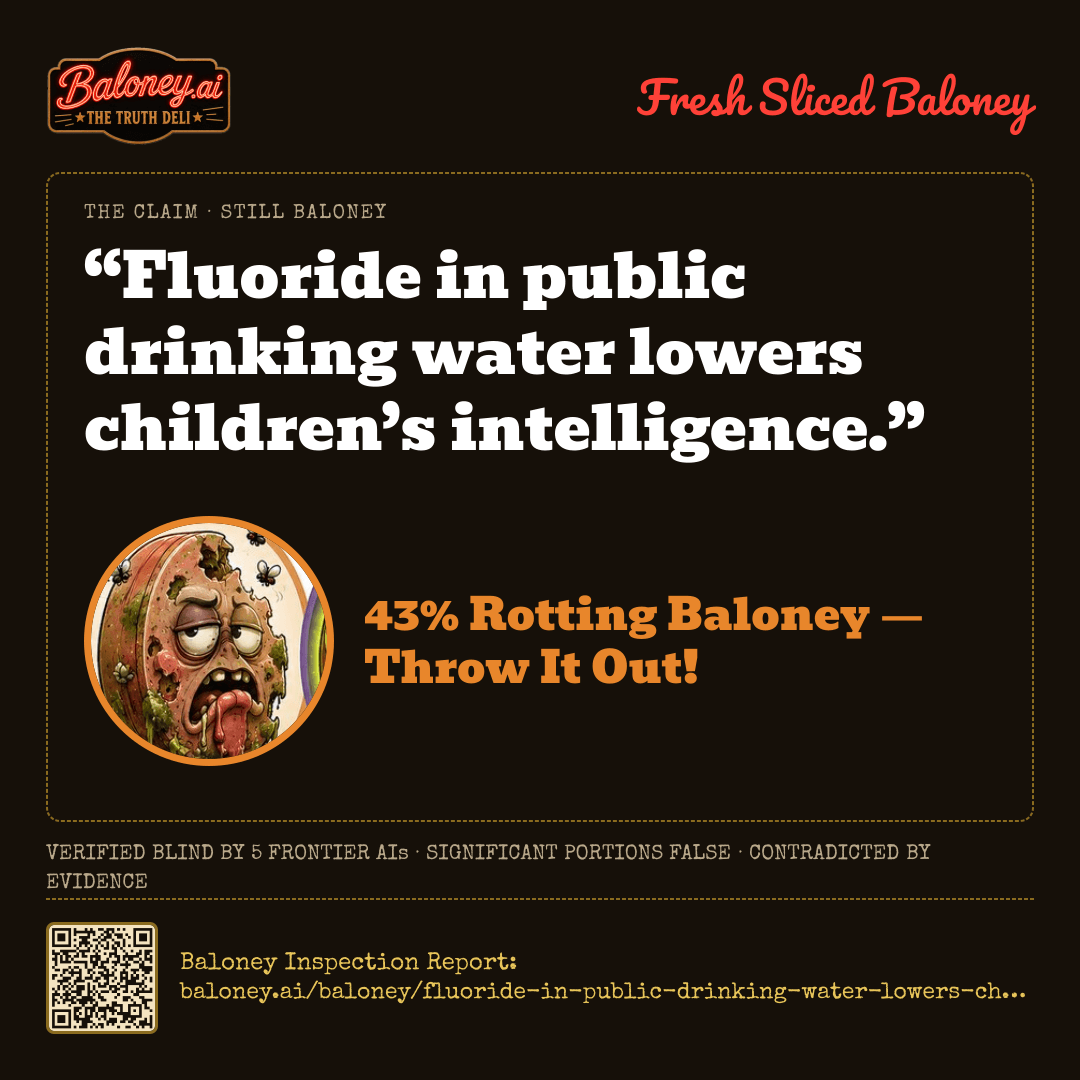
“Fluoride in public drinking water lowers children’s intelligence.”
43%Rotting Baloney — Throw It Out!
Most of this claim has spoiled.
Significant portions falseContradicted by evidenceUnsupported assertionsDeceptive narrative
Serve It Fresh
Ready to Serve13 servings
Serve it the way you want it
The Verdict
 “Fluoride in public drinking water lowers children’s intelligence.”43% Rotting Baloney — Throw It Out!Verified blind by 5 frontier AIs · Baloney Inspection Report: baloney.ai/baloney/fluoride-in-public-drinking-water-lowers-children-s
The Baloney Sampler
The claim takes a high-dose finding and pins it on ordinary tap water. The U.S. National Toxicology Program's 2024 monograph concluded, with moderate confidence, that fluoride above about 1.5 mg/L is linked to lower IQ in children — and said plainly that the evidence is insufficient to judge the 0.7 mg/L level used in U.S. community water fluoridation. Most of the underlying studies come from high-fluoride regions where arsenic, lead, iodine deficiency and poverty muddy the picture.
Where fluoridation has actually been studied, the signal disappears. The American Journal of Public Health's Dunedin New Zealand birth cohort, followed to age 38, found no IQ difference; a Journal of Political Economy register study using natural fluoride variation below 1.5 mg/L found no cognitive, educational or income penalty. Australia's NHMRC found no reliable IQ effect at its fluoridation levels. Prenatal cohort studies in Mexico and Canada do report associations, so the concern is not invented — but it is observational and contested.
Resting on National Toxicology Program, NIH · American Journal of Public Health (via PubMed) · Journal of Political Economy · Australian National Health and Medical Research Council
Original Claim Source https://comptroller.texas.gov/about/media-center/news/20260929-texas-comptroller-don-huffines-launches-review-of-fluoridation-costs-and-health-impacts-in-public-drinking-water-1790724897675
Other ways to slice it — phrasings that might have changed the rating
- “Drinking water containing fluoride above 1.5 mg/L is associated with lower IQ in children.” This is precisely what the NTP concluded with moderate confidence, and it was the one point all five labs agreed on.
- “Higher maternal urinary fluoride during pregnancy is associated with lower IQ in offspring, including in communities with standard water fluoridation.” The Mexican ELEMENT and Canadian MIREC prospective cohorts reported such associations at exposures overlapping fluoridation levels, though the findings are observational and heavily debated.
- “Community water fluoridation at 0.7 mg/L has no measurable effect on children's intelligence.” The Dunedin cohort, the Swedish register study below 1.5 mg/L and Australia's NHMRC review found no cognitive effect, while the NTP declined to reach any conclusion at that level.
Written from the panel’s reports by Anthropic · claude-opus-5. Nothing here changed the score.
The Order Ticket
05:06:26CLAIM RECEIVED — QUEUED FOR INSPECTION✓
05:07:44claude-opus-5 REPORTED — SCORE 52, CONFIDENCE 76✓
05:07:08gpt-5.5 REPORTED — SCORE 43, CONFIDENCE 86✓
05:06:58gemini-3.1-pro-preview REPORTED — SCORE 75, CONFIDENCE 90✓
05:06:30sonar-pro REPORTED — SCORE 33, CONFIDENCE 91✓
05:07:44grok-4.6 REPORTED — SCORE 32, CONFIDENCE 72✓
05:09:14PRIMARY MASTER CLAUDE — SCORE 44✓
05:07:47BLIND VALIDATION PERPLEXITY — SCORE 34✓
05:09:49AGREEMENT CONFIRMED — DELTA 9✓
05:09:49SCORING MODEL V2 — MEDIAN OF 5 COUNTED LAB SCORES: 52, 43, 75, 33, 32 → 43.✓
05:09:49SOURCE RULE — LABS CITED 28 SOURCES: 0 DISCARDED FOR HAVING NO URL, 1 DISCARDED AS DEAD LINKS (404/410), 15 COULD NOT BE OPENED BY US AND ARE MARKED UNVERIFIED.✓
05:09:49SOURCE RULE — PRIMARY MASTER RULED ON 20 SOURCES: 0 DISCARDED FOR HAVING NO URL, 0 DISCARDED AS DEAD LINKS, 11 MARKED UNVERIFIED, 9 VERIFIED.✓
How This One Was Sliced
Station 1 · Blind Inspection — Five Graders, Zero Peeking
Each lab scored the claim independently, without seeing the others. Open a breakdown for its evidence, its sources, and how sure it was.
Anthropic · EQUAL WEIGHT · 78.1s
claude-opus-5
52%BALONEY
ROUND-1 BREAKDOWN
Evidence offered for the claim- The U.S. National Toxicology Program's 2024 systematic review concluded, with 'moderate confidence,' that higher fluoride exposure — specifically drinking water containing more than 1.5 mg/L — is consistently associated with lower IQ scores in children. This is a federal-agency finding, not fringe advocacy, and it is the strongest formal support the claim has.
- A 2025 meta-analysis in JAMA Pediatrics (Taylor et al., authored by NTP/NIEHS scientists) pooled 74 epidemiological studies and found an inverse dose-response association between fluoride exposure and children's IQ, with the authors reporting a statistically significant association persisting in some analyses restricted to lower exposures (including urinary-fluoride analyses relevant to <1.5 mg/L).
- Prospective birth-cohort studies in Mexico (Bashash et al. 2017, Environmental Health Perspectives, ELEMENT cohort) and Canada (Green et al. 2019, JAMA Pediatrics, MIREC cohort) reported associations between higher maternal urinary fluoride during pregnancy and lower IQ in offspring — the Canadian cohort is notable because exposure came largely from standard community water fluoridation (~0.7 mg/L).
- In September 2024, a U.S. federal district court (Food & Water Watch v. EPA, Judge Edward Chen, N.D. Cal.) ruled that fluoridation at 0.7 mg/L presents an 'unreasonable risk' of reduced IQ sufficient to require EPA regulatory action under the Toxic Substances Control Act — a legal, risk-precaution standard, not a finding of proven harm.
- Fluoride is a known developmental neurotoxicant at sufficiently high doses, so a biologically plausible mechanism exists; the scientific dispute is about the threshold, not about whether any dose can be harmful.
Evidence against the claim- The NTP explicitly stated that its review was 'not designed to evaluate' and could not determine effects at the 0.7 mg/L level used in U.S. community water fluoridation, and that data at that level are insufficient. The claim as written attributes to ordinary fluoridated public water an effect the source document declines to attribute to it.
- Most of the studies driving the pooled IQ associations come from China, India, Iran, Pakistan and Mexico, where exposure is from naturally high-fluoride groundwater (often several mg/L) and is confounded by arsenic, lead, iodine deficiency, and poverty. The NTP and JAMA Pediatrics authors themselves rated the great majority of these studies 'low quality' / high risk of bias.
- The best prospective evidence from an artificially fluoridated population found no effect: Broadbent et al. (2015, American Journal of Public Health) followed the Dunedin New Zealand birth cohort from childhood to age 38 and found no significant IQ difference between those raised in fluoridated and non-fluoridated areas after adjustment.
- A large Swedish register study using quasi-random variation in natural fluoride levels (Aggeborn & Öhman, Journal of Political Economy 2021) covering hundreds of thousands of individuals found no negative effect of fluoride at levels below ~1.5 mg/L on cognitive ability, educational attainment or income — and found better dental health and slightly improved labor-market outcomes.
- Australia's NHMRC, after systematic review, concluded there is no reliable evidence that water fluoridation at Australian levels (0.6–1.1 mg/L) affects IQ or cognitive development; CDC, the American Academy of Pediatrics, the American Dental Association and the WHO continue to regard fluoridation at recommended levels as safe.
- Several meta-analyses (including the JAMA Pediatrics one) show the association weakens or loses significance when restricted to low-risk-of-bias studies and/or to exposures below 1.5 mg/L, indicating the headline result is driven by high-exposure, lower-quality studies.
- The claim is stated as an unqualified causal fact about 'public drinking water' generally. No health authority in any country has concluded that fluoridation at recommended levels lowers IQ, and no randomized or natural-experiment evidence in an artificially fluoridated population supports it.
How sure this lab was76/100 — the lab’s own confidence in the score above, not a second reading of the claim.
SourcesEnvironmental Health Perspectives (Bashash et al. 2017)journal · 86 · JAMA Pediatrics (Green et al. 2019)journal · 85 · American Journal of Public Health (Broadbent et al. 2015, Dunedin cohort)journal · 88 · Journal of Political Economy (Aggeborn & Öhman 2021)journal · 82 · Cochrane Database of Systematic Reviews (water fluoridation review)journal · 92 · U.S. Centers for Disease Control and Preventiongov · 85 · Australian National Health and Medical Research Councilgov · 88
OpenAI · EQUAL WEIGHT · 42.3s
gpt-5.5
43%BALONEY
ROUND-1 BREAKDOWN
Evidence offered for the claim- The strongest evidence supporting the claim is dose-specific: the U.S. National Toxicology Program concluded in 2024, with moderate confidence, that higher fluoride exposures—especially drinking-water fluoride concentrations above about 1.5 mg/L—are consistently associated with lower IQ in children. This supports concern about high-fluoride water, not necessarily optimally fluoridated water.
- Several observational birth-cohort studies report associations between prenatal fluoride exposure and lower child IQ or cognitive scores, including studies in Mexico and Canada using maternal urinary fluoride or estimated fluoride intake. These studies are relevant because public-water fluoride can contribute to total fluoride exposure.
- The pro-claim evidence is largely observational, so it can show associations but is weaker for proving that fluoride at typical public-water fluoridation levels directly causes lower intelligence.
Evidence against the claim- The claim is phrased too broadly. The NTP report explicitly said its conclusions about lower IQ were based mainly on higher exposures and that the available evidence was insufficient to determine whether the U.S. recommended community-water fluoridation level of 0.7 mg/L affects children’s IQ.
- A prospective New Zealand cohort study found no association between residence in fluoridated areas and IQ in childhood or adulthood after accounting for confounders, including breastfeeding and socioeconomic factors.
- Government and expert reviews that specifically evaluated community water fluoridation at recommended levels have generally found no reliable evidence of lowered IQ at those levels, while continuing to recognize uncertainty and the need to limit higher exposures.
- Bottom line: high fluoride exposure in drinking water may be associated with lower child IQ, but the statement as written implies that public drinking water fluoridated at standard recommended levels lowers intelligence, which is not established and is misleading without dose and exposure context.
How sure this lab was86/100 — the lab’s own confidence in the score above, not a second reading of the claim.
SourcesU.S. National Toxicology Programgov · 95 · Environmental Health Perspectivesjournal · 88 · JAMA Pediatricsjournal · 87 · American Journal of Public Healthjournal · 86 · National Health and Medical Research Councilgov · 90 · U.S. Public Health Service / Federal Registergov · 90
Google · EQUAL WEIGHT · 32.6s
gemini-3.1-pro-preview
75%BALONEY
ROUND-1 BREAKDOWN
Evidence offered for the claim- A 2024 monograph by the National Toxicology Program (NTP) concluded with 'moderate confidence' that high levels of fluoride exposure (at or above 1.5 milligrams per liter) are associated with lower IQ in children.
- A 2019 observational study published in JAMA Pediatrics evaluated maternal fluoride exposure during pregnancy in Canadian cohorts and reported a statistical association with modestly lower IQ scores in boys, though this finding has been heavily debated.
- In certain regions of the world where naturally occurring fluoride levels in groundwater are unusually high (often well above the WHO's 1.5 mg/L guideline), epidemiological studies have documented negative neurodevelopmental outcomes in children.
Evidence against the claim- The NTP monograph explicitly notes that there is 'insufficient evidence' to determine if fluoride at the recommended, optimal levels for public drinking water in the United States (0.7 mg/L) has any negative effect on children's IQ.
- Decades of broad scientific consensus and major public health organizations, including the CDC, the American Academy of Pediatrics (AAP), and the American Dental Association (ADA), maintain that optimally fluoridated water is safe and effective for preventing tooth decay without causing cognitive harm.
- Large-scale prospective studies, such as a prominent 2015 study tracking a cohort of New Zealanders over 38 years, found no significant differences in IQ or neurological development between those raised in areas with community water fluoridation and those without.
How sure this lab was90/100 — the lab’s own confidence in the score above, not a second reading of the claim.
SourcesNational Toxicology Program (NTP)gov · 95 · American Journal of Public Health (via PubMed)journal · 90 · JAMA Pediatricsjournal · 85 · Centers for Disease Control and Prevention (CDC)gov · 95
Perplexity · EQUAL WEIGHT · 4.7s
sonar-pro
33%BALONEY
ROUND-1 BREAKDOWN
Evidence offered for the claim- The National Toxicology Program’s systematic review found that 18 of 19 higher-quality studies reported an inverse association between estimated fluoride exposure and children’s IQ, with moderate confidence for higher exposures such as drinking water above 1.5 mg/L.[1][3]
- A 2024 systematic review and meta-analysis reported inverse associations between fluoride exposure and children’s IQ overall, but found the drinking-water-only association was null below 1.5 mg/L and described the evidence at lower concentrations as limited and uncertain.[5]
- A 2024 review commissioned for a public-health hazard assessment identified reduced IQ as an important endpoint, while acknowledging uncertainty about causality and the exposure level at which effects occur.[4]
Evidence against the claim- The claim is too broad as written: the strongest government review concerns higher estimated fluoride exposure, particularly above 1.5 mg/L, not ordinary community-water fluoridation at the commonly recommended 0.7 mg/L.[1][3][6]
- The NTP review states that more research is needed to determine whether lower fluoride exposures affect IQ; it does not establish that fluoride added to public water at recommended levels lowers children’s intelligence.[1][3]
- The meta-analysis found no statistically significant association when drinking-water exposure was restricted to concentrations below 1.5 mg/L, although the available evidence was limited.[5]
- The evidence is primarily observational and includes exposure-estimation limitations and substantial risk of bias in many studies, so an association does not by itself prove that fluoridated water causes lower intelligence.[4][5]
How sure this lab was91/100 — the lab’s own confidence in the score above, not a second reading of the claim.
SourcesNational Toxicology Program, NIHgov · 97 · PubMed; National Toxicology Program systematic reviewjournal · 96 · PubMed; systematic review of epidemiological and toxicological evidencejournal · 94 · Fluoride Action Bulletin research summary of 2024 meta-analysisother · 78 · American Dental Association Newsnews · 82
xAI · EQUAL WEIGHT · 78.2s
grok-4.6
32%BALONEY
ROUND-1 BREAKDOWN
Evidence offered for the claim- Observational studies and meta-analyses, mostly from high-fluoride endemic areas (often well above 1.5–4 mg/L, far higher than typical U.S. community water fluoridation of ~0.7 mg/L), report inverse associations between fluoride exposure and children’s IQ scores.
- The U.S. National Toxicology Program’s 2024 monograph concluded with moderate confidence that higher fluoride exposures (typically corresponding to drinking-water levels >1.5 mg/L) are associated with lower IQ in children.
- A few studies of prenatal/maternal exposure at concentrations overlapping fluoridated-water ranges (e.g., Green et al. 2019 Canada; Bashash et al. Mexico) reported associations with lower offspring IQ, especially in boys, though these are observational and contested.
Evidence against the claim- NTP found the data insufficient to determine whether the 0.7 mg/L level used in U.S. community water fluoridation affects children’s IQ.
- Prospective cohort evidence from a fluoridated high-income setting (Broadbent et al. 2015 Dunedin, New Zealand) found no association between community water fluoridation and IQ.
- High-fluoride studies frequently involve ecological designs, co-exposures (arsenic, iodine deficiency, poverty, nutrition), and other confounders common in rural endemic-fluorosis regions; they do not isolate the low, controlled doses added to public water supplies.
- CDC, ADA, AAP and other major public-health bodies continue to endorse community water fluoridation at recommended levels as safe and effective for caries prevention; small observational IQ associations have not been shown to be causal at those doses.
How sure this lab was72/100 — the lab’s own confidence in the score above, not a second reading of the claim.
SourcesNational Toxicology Program (NIEHS)gov · 95 · Environmental Health Perspectivesjournal · 90 · JAMA Pediatricsjournal · 92 · American Journal of Public Healthjournal · 88 · Centers for Disease Control and Preventiongov · 95
Station 2 · The Masters
Primary Master · drawn at random
claude-opus-5
44% BALONEY
The claim is scored as written: an unqualified, causal statement that fluoride in public drinking water lowers children's intelligence. All five evaluators agreed on the pivotal fact that decides this — the 2024 National Toxicology Program monograph reached 'moderate confidence' of an inverse association with IQ only at higher exposures, typically water above 1.5 mg/L, and explicitly stated the evidence was insufficient to determine whether the 0.7 mg/L used in U.S. community water fluoridation affects IQ. The claim transfers a high-dose finding onto ordinary fluoridated public water, which is the reading almost every reader will take. That implied reading is not merely unsupported but is contradicted by the best available evidence from artificially fluoridated populations: the Dunedin New Zealand birth cohort followed to age 38 found no IQ difference, the Swedish register study exploiting quasi-random natural variation below ~1.5 mg/L found no cognitive, educational or income penalty, and the 2024/2025 meta-analysis found the drinking-water-only association null below 1.5 mg/L. Against that, the claim is not fabricated: a federal agency does endorse the high-exposure association, prospective maternal-urinary-fluoride cohorts in Mexico and Canada reported associations at exposures overlapping fluoridated ranges, and fluoride is a plausible developmental neurotoxicant at sufficient dose. So there is a real kernel at high exposure, wrapped in a statement whose plain meaning is contradicted. That places it at the boundary of 'important facts omitted, misleading implications' and 'significant portions false' — I landed just inside the latter, close to the panel median of 43, because the claim is phrased as established causation about ordinary public water supplies, a proposition no health authority anywhere has endorsed. I weighted the NTP monograph and the Dunedin and Swedish natural-experiment studies most heavily, since they speak directly to the exposure level the claim implicates. I discounted the 2024 federal court ruling as support, because a TSCA 'unreasonable risk' finding is a precautionary regulatory trigger, not a scientific determination of harm. I discounted an advocacy-aligned research summary where the underlying meta-analysis is available in primary form, and discounted two of the four conflicting citations evaluators gave for the same Dunedin paper, while accepting the study itself.
All five evaluators converged on the substance: the NTP high-exposure finding is real, the NTP explicitly declined to reach a conclusion at 0.7 mg/L, and the Dunedin cohort found no effect in a fluoridated population. Four of five scored the claim between 32 and 52; the outlier at 75 cited essentially the same evidence base and differed on severity rather than on facts, judging the claim more affirmatively false. Evaluators disagreed mainly on how much weight the maternal-urinary-fluoride cohorts (Bashash, Green) deserve at exposures overlapping fluoridated water, and only one raised the Swedish register study and the 2024 federal court ruling.
Blind Validation Master · never saw the Primary’s work
sonar-pro
34% BALONEY
The statement is too broad and misleading as written. The strongest evidence supports an association between higher fluoride exposure—especially drinking water above about 1.5 mg/L—and lower IQ in children, while the NTP says there are insufficient data to determine whether the U.S. community-water level of 0.7 mg/L affects IQ.[1] Observational prenatal-exposure studies and meta-analyses provide some concern at lower overall exposures, but they cannot establish that routinely fluoridated public water causes reduced intelligence, and drinking-water-only analyses below 1.5 mg/L are limited or null.[6][9] A prospective New Zealand study found no IQ difference associated with community water fluoridation after adjustment for confounders.[2] Thus, the claim captures a genuine high-exposure safety concern but wrongly presents it as an established general effect of public drinking water, including standard fluoridation. This places it in the Stinky Baloney range.
AGREEMENT TEST PASSED — MASTERS SCORED 44% AND 34% · BLIND VALIDATION CONFIRMED THIS SCORE · NO RE-EVALUATION REQUIRED
How the number was reached · scoring model v2 · how our models work
- Median of 5 counted lab scores: 52, 43, 75, 33, 32 → 43.
The Evidence
Evidence offered for the claim
- Federal review found an IQ link at high exposure The U.S. National Toxicology Program's 2024 monograph concluded with 'moderate confidence' that higher fluoride exposures — typically drinking water above 1.5 mg/L — are consistently associated with lower IQ in children; 18 of 19 higher-quality studies reported an inverse association.
- Meta-analysis of 74 studies showed dose-response DEBUNKED — Partly refuted. The pooled analysis by NTP/NIEHS authors did report an inverse dose-response association, but the panel noted the drinking-water-only association was null below 1.5 mg/L, and the association weakens or loses significance when restricted to low-risk-of-bias studies — the headline result is driven by high-exposure, lower-quality studies.
- Prenatal cohorts in Mexico and Canada Birth-cohort studies reported associations between higher maternal urinary fluoride in pregnancy and lower offspring IQ, with the Canadian MIREC cohort notable because exposure came largely from standard community fluoridation. These are observational, heavily contested, and the Canadian effect was reported mainly in boys.
- A federal court called fluoridation an unreasonable risk DEBUNKED — Refuted as evidence of harm. In September 2024 a U.S. district court ruled that fluoridation at 0.7 mg/L poses an 'unreasonable risk' requiring EPA action under the Toxic Substances Control Act — but that is a precautionary regulatory threshold, explicitly not a judicial finding that harm has been proven.
- Biological plausibility exists Fluoride is a recognised developmental neurotoxicant at sufficiently high doses, so the scientific dispute concerns the threshold rather than whether any dose can be harmful.
Evidence against the claim
- The NTP ruled out its own finding at fluoridation levels The NTP stated its review was not designed to evaluate, and could not determine, effects at the 0.7 mg/L used in U.S. community water fluoridation, calling the data at that level insufficient. The claim attributes to ordinary fluoridated water an effect the source document declines to attribute to it.
- No effect in a fluoridated population followed to age 38 The Dunedin, New Zealand birth cohort (Broadbent et al. 2015) found no significant IQ difference between people raised in fluoridated and non-fluoridated areas, in childhood or adulthood, after adjusting for confounders including breastfeeding and socioeconomic status.
- Swedish natural experiment found no cognitive penalty A register study using quasi-random variation in natural fluoride levels across hundreds of thousands of individuals found no negative effect below ~1.5 mg/L on cognitive ability, educational attainment or income — and found better dental health and slightly improved labour-market outcomes.
- The driving studies come from confounded high-fluoride regions Most pooled IQ associations derive from China, India, Iran, Pakistan and Mexico, where exposure is from naturally high-fluoride groundwater of several mg/L alongside arsenic, lead, iodine deficiency and poverty. The NTP and the meta-analysis authors themselves rated the great majority of these studies low quality or high risk of bias.
- The association disappears at fluoridation-level doses The 2024 meta-analysis found no statistically significant association when drinking-water exposure was restricted to concentrations below 1.5 mg/L, and described the evidence at lower concentrations as limited and uncertain.
- No health authority endorses the claim Australia's NHMRC concluded after systematic review that there is no reliable evidence fluoridation at 0.6–1.1 mg/L affects IQ or cognitive development; the CDC, American Academy of Pediatrics, American Dental Association and WHO continue to regard fluoridation at recommended levels as safe.
Sources · Reliability · Why Accepted or Discounted
| Source | Type | Reliability | Ruling |
|---|
| National Toxicology Program (NIEHS) | gov | 95 | ACCEPTED — The central document in this dispute, cited by four of five evaluators; it supports the high-exposure association and explicitly disclaims a conclusion at 0.7 mg/L. |
| National Toxicology Program, NIH (monograph) | gov | 97 | ACCEPTED — Primary monograph text underlying the NTP conclusion; highest-grade evidence available on this question. |
| PubMed — NTP systematic review | journal | 96 | ACCEPTED — Peer-reviewed publication of the NTP systematic review, consistent with the monograph. |
| PubMed — systematic review of epidemiological and toxicological evidence | journal | 94 | ACCEPTED — Independent peer-reviewed review identifying IQ as an endpoint while flagging causal and dose uncertainty; cuts both ways and is used accordingly. |
| Environmental Health Perspectives (Bashash et al. 2017)unverified | journal | 86 | ACCEPTED — Prospective ELEMENT cohort, one of the better-designed prenatal exposure studies; observational and contested, weighted as supportive but not decisive. |
| Environmental Health Perspectivesunverified | journal | 90 | ACCEPTED — Peer-reviewed pooled analysis of high-fluoride-area studies; relevant to the high-exposure finding, not to fluoridation levels. |
| JAMA Pediatrics (Green et al. 2019, MIREC cohort)unverified | journal | 88 | ACCEPTED — Cited by four evaluators; the most directly relevant study at fluoridation-level exposure, though its sex-specific findings remain heavily debated. |
| American Journal of Public Health (Broadbent et al. 2015, Dunedin cohort)unverified | journal | 88 | ACCEPTED — The key prospective evidence from an artificially fluoridated population; no IQ difference after adjustment. |
| American Journal of Public Healthunverified | journal | 88 | DISCOUNTED — Offered as a citation for the Dunedin study but gives a different DOI from the two other evaluators citing the same paper; the citation cannot be verified, though the underlying study is accepted via the other references. |
| American Journal of Public Healthunverified | journal | 86 | DISCOUNTED — A third, conflicting DOI given for the same Dunedin cohort paper; discounted as an unverifiable citation, not as a rejection of the study itself. |
| American Journal of Public Health (via PubMed) | journal | 90 | ACCEPTED — PubMed record for the Dunedin cohort study, corroborating the same null finding. |
| Journal of Political Economy (Aggeborn & Öhman 2021)unverified | journal | 82 | ACCEPTED — Large quasi-experimental register study exploiting natural variation in fluoride; the strongest causal-identification evidence at sub-1.5 mg/L exposures, even though it comes from an economics journal. |
| Cochrane Database of Systematic Reviews (water fluoridation)unverified | journal | 92 | ACCEPTED — Standard independent systematic review of water fluoridation; methodologically conservative and not aligned with any advocacy position. |
| U.S. Centers for Disease Control and Prevention | gov | 85 | ACCEPTED — Authoritative statement of current public-health policy; treated as a position statement rather than independent primary evidence. |
| Centers for Disease Control and Prevention | gov | 95 | ACCEPTED — Same agency landing page; accepted on the same basis as above. |
| Australian National Health and Medical Research Councilunverified | gov | 88 | ACCEPTED — Independent national systematic review that specifically assessed IQ at Australian fluoridation levels — directly on point for the claim as written. |
| National Health and Medical Research Council (2017 public statement)unverified | gov | 90 | ACCEPTED — Public statement summarising the same NHMRC evidence review; consistent with the underlying report. |
| U.S. Public Health Service / Federal Register | gov | 90 | ACCEPTED — Establishes the 0.7 mg/L recommended concentration that the claim implicitly concerns; documentary and uncontested. |
| Fluoride Action Bulletin research summaryunverified | other | 78 | DISCOUNTED — An advocacy-aligned secondary summary of a meta-analysis that the panel can read in primary peer-reviewed form; adds no independent evidential value and carries a directional interest. |
| American Dental Association News | news | 82 | DISCOUNTED — Trade-association reporting on the NTP monograph by a body with a declared position on fluoridation; the primary NTP document is cited directly and is preferred. |
Every link was opened when this claim was inspected. A dead link was discarded before publication; “unverified” means the site refused our automated check and the link is the one the panel cited. A source without a URL was never kept.
Serve It Fresh
Ready to Serve13 servings
Serve it the way you want it
The Verdict
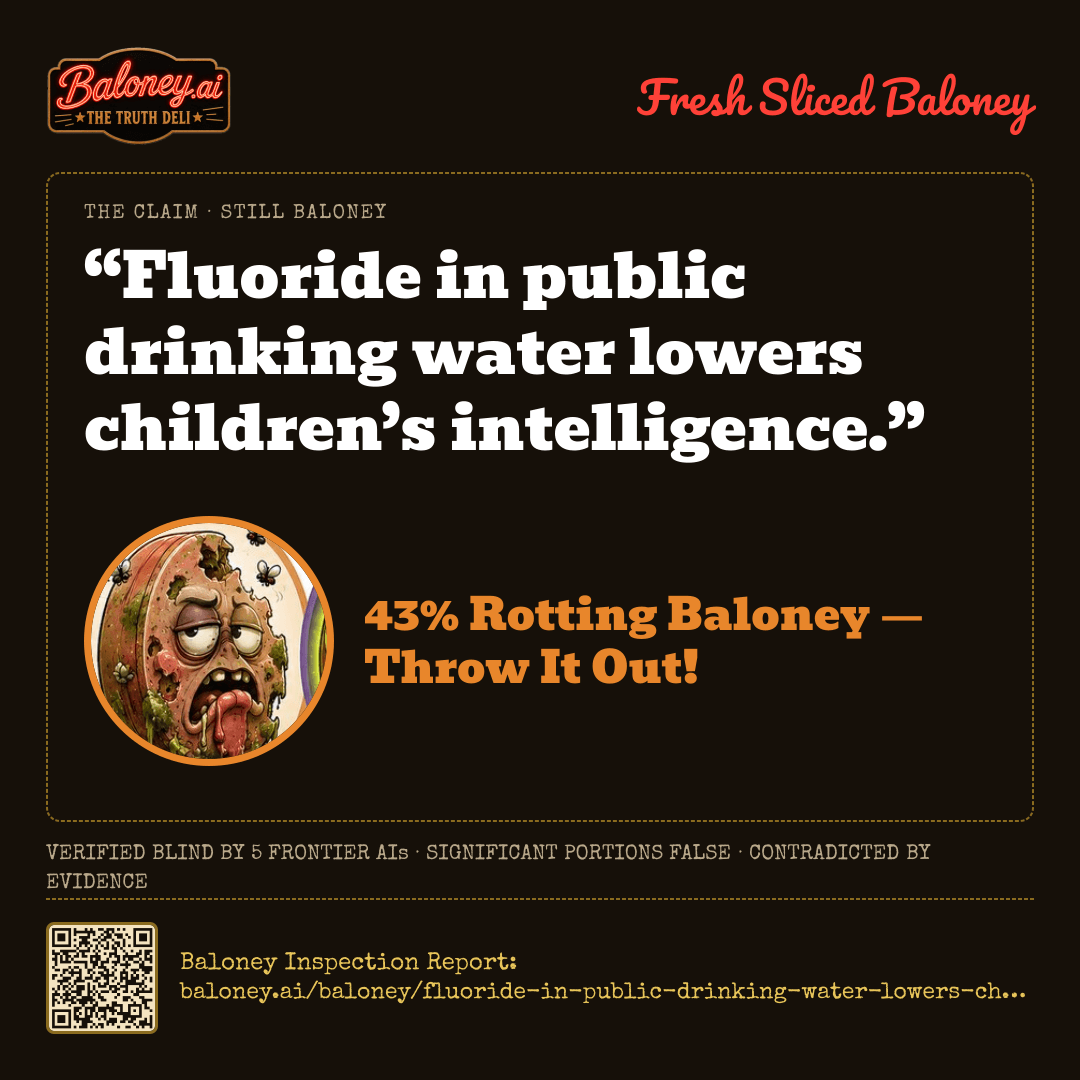
“Fluoride in public drinking water lowers children’s intelligence.”43% Rotting Baloney — Throw It Out!Verified blind by 5 frontier AIs · Baloney Inspection Report: baloney.ai/baloney/fluoride-in-public-drinking-water-lowers-children-s