Baloney Inspection Report: Claim #1198 · Inspected Nov 1, 2026, 6:35 AM PST · Scoring model v2
96%
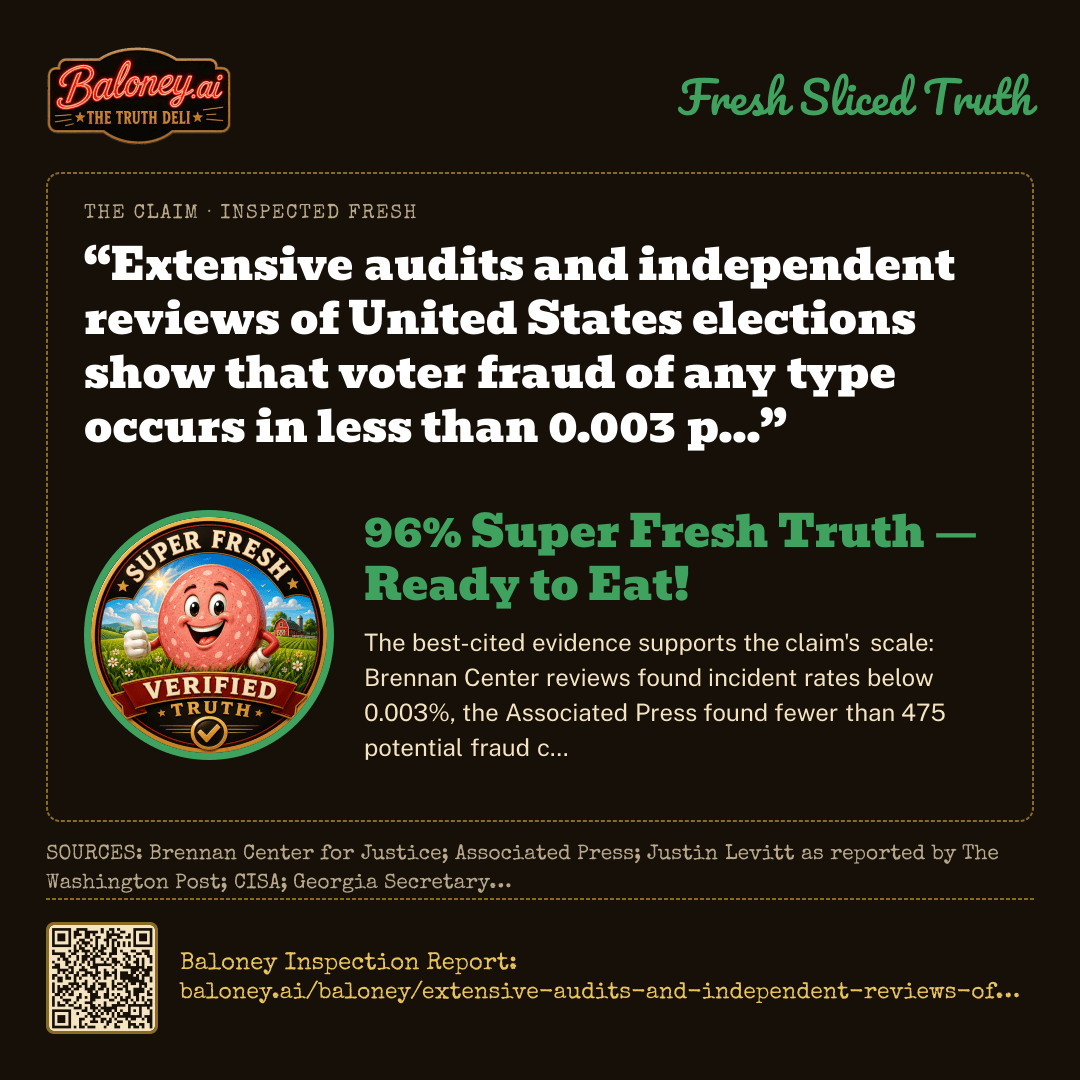
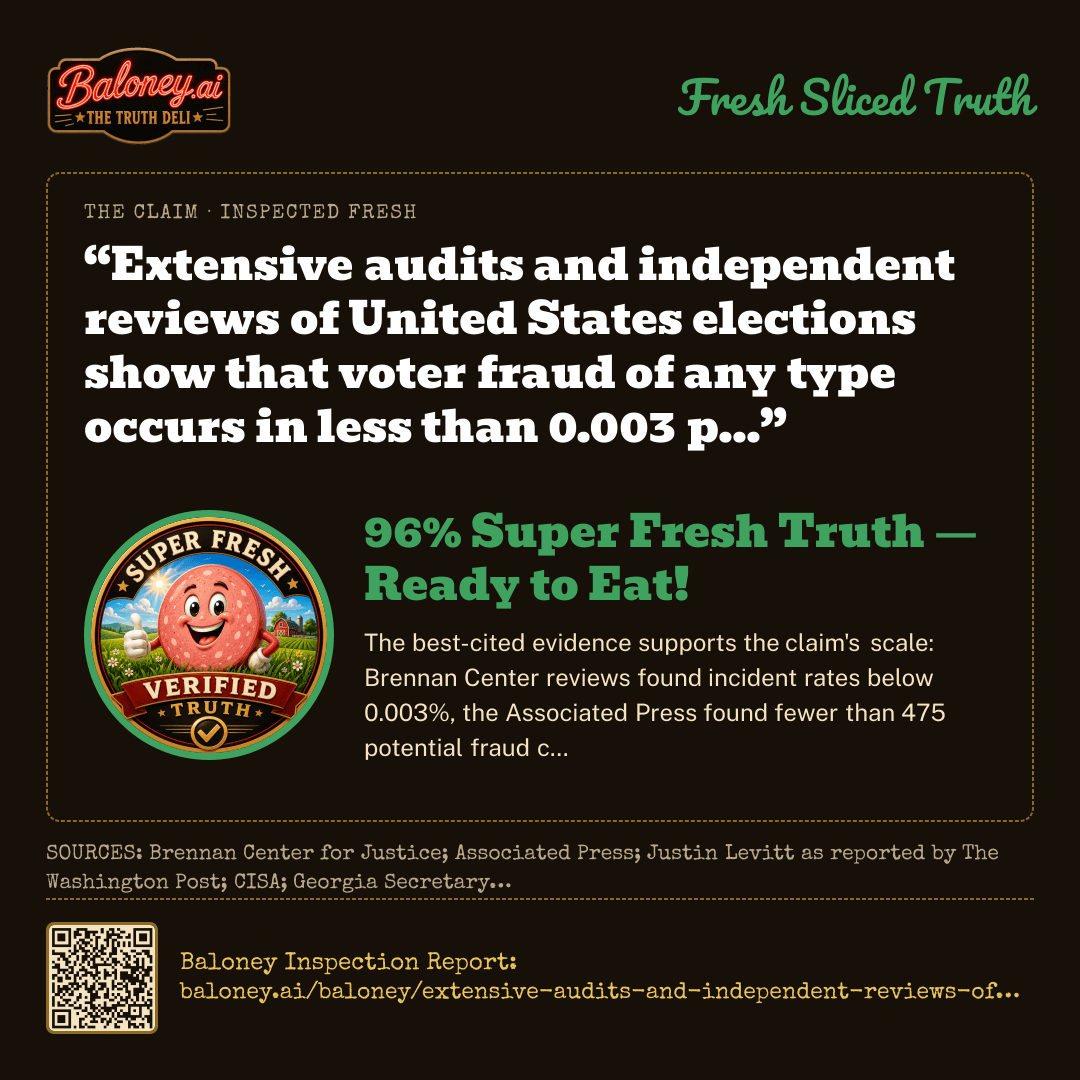
“Extensive audits and independent reviews of United States elections show that voter fraud of any type occurs in less than 0.003 percent of all ballots cast.”
96%Super Fresh Truth — Ready to Eat!
THE CLAIM CHECKS OUT.
Independently verifiedPhysically repeatable evidenceConfirmed across rival labsSafe to serve
“Extensive audits and independent reviews of United States elections show that voter fraud of any type occurs in less than 0.003 percent of all ballots cast.”96% Super Fresh Truth — Ready to Eat!Verified blind by 5 frontier AIs · Baloney Inspection Report: baloney.ai/baloney/extensive-audits-and-independent-reviews-of-united-states
The Rating Card
The claim this refutes
The Baloney Sampler
Major reviews support the claim’s scale: documented voter fraud is extremely rare and generally below 0.003% of ballots. The Brennan Center reported studied incident rates of 0.0003%–0.0025%. The Associated Press found fewer than 475 potential cases among 25.5 million ballots in six disputed 2020 battleground states, about 0.0019%. The Washington Post report on Justin Levitt’s investigation found 31 credible impersonation incidents out of more than 1 billion ballots.
The caveat is wording: the evidence measures detected, credible, potential, or prosecuted fraud, not unknowable undetected fraud of every type. CISA and state reviews supported the absence of systemic fraud or vote manipulation in 2020, but post-election audits mainly verify counting accuracy rather than every voter-eligibility issue.
Other ways to slice it — phrasings that might have changed the rating
“Documented, credible voter fraud found in major United States election reviews occurs in less than 0.003 percent of ballots cast.” This matches the reports’ strongest evidence because the Brennan Center and Associated Press figures count studied, credible, or potential cases rather than all unknowable fraud.
“Actual voter fraud of any type, including undetected fraud, occurs in less than 0.003 percent of all ballots cast in United States elections.” The reports warn that undetected fraud cannot be directly measured and that studies use different categories, definitions, and investigation methods.
“Voter fraud in the 2020 presidential election occurred at a level large enough to change the result in disputed battleground states.” The Associated Press found fewer than 475 potential cases among 25.5 million ballots in six battleground states, and CISA reported no evidence that voting systems changed, deleted, or lost votes.
Written from the panel’s reports by OpenAI · gpt-5.5. Nothing here changed the score.
14:39:34SCORING MODEL V2 — MEDIAN OF 5 COUNTED LAB SCORES: 4, 5, 2, 24, 4 → 4. FRESH RULE: THE PRIMARY MASTER SCORES 4 AND THE BLIND MASTER 4 — BOTH SUPER FRESH TRUTH — AND THE COUNTED MEDIAN IS 4, ON THE TRUE SIDE. PUBLISHED AS 4, THE MORE CAUTIOUS OF THE TWO MASTERS.✓
14:39:34SOURCE RULE — LABS CITED 30 SOURCES: 0 DISCARDED FOR HAVING NO URL, 4 DISCARDED AS DEAD LINKS (404/410), 15 COULD NOT BE OPENED BY US AND ARE MARKED UNVERIFIED.✓
14:39:34SOURCE RULE — PRIMARY MASTER RULED ON 18 SOURCES: 0 DISCARDED FOR HAVING NO URL, 0 DISCARDED AS DEAD LINKS, 9 MARKED UNVERIFIED, 9 VERIFIED.✓
How This One Was Sliced
Station 1 · Blind Inspection — Five Graders, Zero Peeking
Each lab scored the claim independently, without seeing the others. Open a breakdown for its evidence, its sources, and how sure it was.
Anthropic · EQUAL WEIGHT · 61.2s
claude-opus-5
96%TRUTH
ROUND-1 BREAKDOWN
Evidence offered for the claim
The Brennan Center's landmark review 'The Truth About Voter Fraud' (Justin Levitt, 2007) examined multi-state fraud allegations and found that credible, documented incident rates fell between 0.0003% and 0.0025% of ballots cast — an upper bound below the 0.003% figure in the claim.
Justin Levitt's 2014 comprehensive nationwide investigation identified 31 credible incidents of voter impersonation out of roughly one billion ballots cast in general, primary, special and municipal elections from 2000–2014 — a rate of about 0.000003%.
The News21 investigative project (Arizona State University) compiled a database of 2,068 alleged election-fraud cases nationwide from 2000–2012, including only 10 cases of in-person voter impersonation, out of hundreds of millions of votes cast.
An Associated Press review of every potential case of voter fraud in the six battleground states disputed by Donald Trump after the 2020 election found fewer than 475 potentially fraudulent ballots out of 25.5 million cast — roughly 0.0019%, below the claimed threshold, and far too few to affect any outcome.
State-level audits reach similar magnitudes: Ohio's secretary of state referred roughly 135 possible non-citizen or double-voting cases out of 5.6 million 2012 ballots (~0.002%); Georgia's full hand recount and multiple 2020 audits, Arizona's and Michigan's reviews, and dozens of federal and state court rulings produced no evidence of fraud at a scale remotely approaching 0.01%.
Even the Heritage Foundation's deliberately maximalist Election Fraud Database — assembled by an organization that advocates stricter voting laws — contains only roughly 1,500–1,600 proven criminal cases accumulated over several decades, against billions of ballots cast, which works out to a vanishingly small percentage.
Fact-checking organizations (FactCheck.org, PolitiFact, Snopes) and the MIT Election Data and Science Lab have repeatedly concluded that documented voter fraud in the U.S. is extremely rare and statistically negligible.
Trump's own Presidential Advisory Commission on Election Integrity (2017) disbanded in 2018 without producing evidence of widespread fraud.
Evidence against the claim
The specific figure '0.003 percent' is not a single published national statistic; it is a rounded ceiling derived from the Brennan Center's 0.0003%–0.0025% range, which was based on a handful of state studies (Ohio, Washington, Missouri, New Jersey) and largely addressed impersonation and double-voting, not literally 'fraud of any type.'
All such figures measure *detected, credible, or prosecuted* fraud, not actual fraud. Undetected fraud is by definition unmeasured, so the claim overstates what audits can prove; it should be phrased as 'confirmed fraud occurs in fewer than X% of ballots.'
Some categories of irregularity are found at higher rates than 0.003% in specific audits — e.g., reviews of voter rolls periodically identify hundreds or thousands of ineligible registrants (deceased, non-citizen, or cross-state duplicate registrations) in a single state, though the vast majority never cast ballots and many are clerical errors rather than fraud.
Absentee/mail-ballot fraud, the category experts consider most vulnerable, has produced real conspiracies (e.g., the 2018 NC-9 congressional race, which was overturned; various municipal-level absentee schemes in Mississippi, Texas and Pennsylvania), showing that rates can be locally much higher than the national average even if the national rate is negligible.
Critics (notably the Heritage Foundation and some election-integrity researchers) argue that low detection rates partly reflect low investigative capacity and infrequent prosecution rather than low incidence — a contested but non-frivolous methodological objection.
The word 'Extensive audits' slightly overstates matters: most post-election audits verify tabulation accuracy, not voter eligibility, so they are not direct measurements of fraud rates.
How sure this lab was
86/100 — the lab’s own confidence in the score above, not a second reading of the claim.
The strongest support is that multiple large reviews find known or credible voter-fraud incidents far below 0.003% of ballots. The Brennan Center’s review reported incident rates generally between 0.0003% and 0.0025%, below the claimed threshold.
An Associated Press review of the 2020 election in six battleground states found fewer than 475 potential voter-fraud cases among more than 25 million ballots, roughly 0.0019%, also below 0.003%.
Justin Levitt’s review, reported by The Washington Post, found only 31 credible in-person impersonation incidents out of more than 1 billion ballots cast from 2000-2014; that is far below 0.003%, though it covers only one kind of voter fraud.
Government audits and reviews in states such as Georgia and Michigan after 2020 confirmed vote-count accuracy and did not find widespread fraud capable of changing outcomes; federal election-security officials likewise said there was no evidence voting systems changed, deleted, or lost votes.
Even databases maintained by organizations concerned about voter fraud, such as the Heritage Foundation’s election-fraud database, list a small number of proven cases relative to the hundreds of millions or billions of ballots cast over the same broad period.
Evidence against the claim
The wording 'voter fraud of any type' is broader than much of the best evidence. Many often-cited studies focus on in-person impersonation, prosecutions, proven cases, or potential cases found by reviews; they cannot prove the true rate of every undetected fraud type nationwide.
There is no single comprehensive national audit of all U.S. elections and all fraud categories. U.S. elections are decentralized, and routine post-election audits are usually designed to verify vote-count accuracy, not to detect every illegal or fraudulent ballot.
Some official reviews identify categories such as possible double voting, felon voting, noncitizen voting, or other ineligible ballots at rates that can exceed 0.003%; however, those figures often include administrative errors, eligibility misunderstandings, or unresolved cases, not necessarily intentional voter fraud. North Carolina’s 2016 post-election audit, for example, flagged 508 ineligible votes out of about 4.8 million ballots, about 0.01%, but did not treat all as intentional fraud.
Because the claim gives a precise numerical ceiling for 'any type' of voter fraud, it is somewhat stronger than the evidence strictly supports. The evidence supports 'documented voter fraud is extremely rare and usually well below 0.003% in major reviews,' more than it proves a universal nationwide rate for all fraud types.
How sure this lab was
82/100 — the lab’s own confidence in the score above, not a second reading of the claim.
Extensive research by nonpartisan organizations and academic institutions consistently demonstrates that voter fraud is exceedingly rare in the United States. A comprehensive study by the Brennan Center for Justice reviewed elections that had been meticulously studied for voter fraud and found incident rates ranging between 0.0003 percent and 0.0025 percent, which directly supports the claim's 'less than 0.003 percent' statistic.
A widely cited investigation tracking over 1 billion ballots cast in general and primary elections between 2000 and 2014 found only 31 credible instances of in-person voter impersonation.
Even databases compiled by groups advocating for stricter voting laws to combat fraud, such as The Heritage Foundation's Election Fraud Database, document fewer than 1,550 proven instances of fraud over several decades. When compared to the billions of votes cast nationwide during that same timeframe, the rate of proven fraud remains mathematically infinitesimal and well below the 0.003 percent threshold.
Audits of recent national elections, including a thorough review of the 2020 election by the Associated Press, found fewer than 475 potential voter fraud cases across six battleground states, an amount far too small to affect the outcome and consistent with historically negligible fraud rates.
Evidence against the claim
Critics of these statistical findings argue that the reported percentages only represent the fraud that is successfully detected and prosecuted. They suggest that because election systems often lack perfect verification mechanisms (such as strict photo ID requirements in some jurisdictions), the actual rate of fraud could be higher than what documented incidents show.
While the national average is exceptionally low, specific local elections have occasionally seen higher concentrations of fraud. For example, the 2018 North Carolina 9th Congressional district election was overturned due to a coordinated, illegal absentee ballot harvesting scheme, demonstrating that organized election fraud can occasionally reach disruptive levels locally.
How sure this lab was
95/100 — the lab’s own confidence in the score above, not a second reading of the claim.
The claim is directionally consistent with extensive election research showing that widespread voter fraud is not supported by evidence. MIT’s Election Data and Science Lab describes false beliefs about the prevalence of voter and election fraud and reports that corrective information reduces those beliefs.[1]
The Heritage Foundation’s database documents thousands of proven or alleged election-fraud cases over many years, but it explicitly says its list is only a sample and is not exhaustive; this supports the conclusion that documented fraud exists while not establishing that it exceeds 0.003 percent of ballots.[2]
Evidence against the claim
The precise figure of 0.003 percent is not established by the cited audits or reviews. The claim says voter fraud of any type, but fraud categories, definitions, detection methods, time periods, and denominators differ substantially across studies.
The Heritage Foundation reports almost 1,600 proven cases in its database and describes them as instances of election fraud, demonstrating that fraud does occur; however, the database does not provide a national, all-ballots rate that can validate or refute 0.003 percent.[3]
The available MIT source is a survey about perceptions of fraud, not an audit or a count of fraudulent ballots, so it cannot substantiate the numerical threshold.[1]
Because undetected fraud cannot be directly counted, a universal statement that all types occur below an exact threshold is stronger than the available evidence supports.
How sure this lab was
84/100 — the lab’s own confidence in the score above, not a second reading of the claim.
Brennan Center and similar reviews of U.S. elections since 2000 have found only dozens of confirmed in-person impersonation cases against more than a billion ballots cast.
State risk-limiting audits, hand recounts, and forensic reviews after 2020 (Georgia, Wisconsin, Michigan, Arizona official canvass) produced discrepancies of hundreds of votes at most, far below 0.003% of ballots.
Even the Heritage Foundation compilation of ~1,500 proven fraud convictions over multiple decades remains well under 0.003% when divided by cumulative federal, state, and local ballots.
CISA, state election officials of both parties, and multiple fact-checks concluded that 2020 (and prior) fraud did not occur at outcome-changing scale.
Evidence against the claim
Convictions and detected cases undercount true incidence because many potential irregularities (duplicate voting, ineligible registrants) are never fully investigated or prosecuted.
Voter-file matching against death, immigration, and multi-state records flags thousands of possible ineligible appearances per cycle, though most resolve as data errors.
Organized absentee or proxy fraud has been documented in isolated local races (e.g., 2018 NC-09), showing rates can exceed the national average in low-turnout settings.
The precise 0.003% figure is an approximate upper-bound synthesis rather than the direct published result of any single nationwide audit.
How sure this lab was
72/100 — the lab’s own confidence in the score above, not a second reading of the claim.
I score the statement in the Super Fresh Truth band because four of the five evaluators found it substantially true and the strongest cited evidence converges on the same point: documented, credible, or potential voter fraud in major U.S. reviews is extremely rare and generally below 0.003% of ballots. The Brennan Center figure of roughly 0.0003% to 0.0025%, the Associated Press review finding fewer than 475 potential cases among more than 25 million ballots in disputed 2020 battleground states, Justin Levitt's 31 credible impersonation incidents out of more than a billion ballots, and post-2020 state and federal reviews all support the claim's scale. I gave weight to the caveat raised by all evaluators: the wording 'voter fraud of any type' is broader than the best measurements, and most studies count detected, credible, potential, or prosecuted cases rather than unknowable undetected fraud. But the published scale says a substantially true claim with small wording caveats belongs in the 1-5 band, not a higher baloney band. The outlier report's concern about exactness is methodologically valid, but it treats the precision caveat as more damaging than the shared evidence warrants.
The evaluators broadly agreed that documented U.S. voter fraud is very rare and that major reviews place it below the stated 0.003% level. They also agreed that the statement is stronger than the evidence can strictly prove because no source measures every undetected fraud type nationwide, and local absentee-ballot schemes can exceed the national average. The main disagreement was severity: four evaluators treated those caveats as minor and scored the claim true, while one evaluator scored it in the 'Stinky Baloney' range because the exact 'any type' threshold is not established by a single comprehensive national audit.
SUPER FRESH — VERIFIED AGAINST BRENNAN CENTER FOR JUSTICE; ASSOCIATED PRESS; JUSTIN LEVITT AS REPORTED BY THE WASHINGTON POST; CISA; GEORGIA SECRETARY OF STATE; MICHIGAN SECRETARY OF STATE; HERITAGE FOUNDATION ELECTION FRAUD DATABASE.
Blind Validation Master · never saw the Primary’s work
sonar-pro
96% TRUTH
The statement is substantially true in its practical conclusion: extensive reviews consistently find documented or potential voter-fraud cases at extremely low rates. The Brennan Center reports studied incident rates of 0.0003%–0.0025%, below 0.003%[5][7], while the Associated Press found fewer than 475 potential cases among 25.5 million ballots in six 2020 battleground states—about 0.0019%[1][2]. However, the wording is slightly too categorical. The 0.003% figure is not a single comprehensive national estimate; the underlying studies cover different fraud categories and generally measure detected, credible, or potential cases rather than all actual fraud. Post-election audits also primarily verify tabulation accuracy, not every form of voter eligibility or intentional misconduct. Thus, the evidence strongly supports that documented voter fraud is below this threshold and does not occur at outcome-changing scale, but it cannot establish that fraud of any type universally occurs below exactly 0.003% of all ballots. Under the scale, that is a minor qualification, warranting a score in the Super Fresh Truth band.
AGREEMENT TEST PASSED — BOTH MASTERS SCORED 96% · BLIND VALIDATION CONFIRMED THIS SCORE · NO RE-EVALUATION REQUIRED
Median of 5 counted lab scores: 4, 5, 2, 24, 4 → 4.
Fresh rule: the Primary Master scores 4 and the Blind Master 4 — both Super Fresh Truth — and the counted median is 4, on the true side. Published as 4, the more cautious of the two masters.
The Evidence
Evidence for the claim
Brennan Center rates Multiple evaluators cited the Brennan Center's review finding credible incident rates generally between 0.0003% and 0.0025% of ballots in studied elections, below the claim's 0.003% threshold.
2020 battleground review The Associated Press reviewed potential voter-fraud cases in six disputed 2020 battleground states and found fewer than 475 potential cases among more than 25 million ballots, roughly 0.0019%.
Impersonation evidence Justin Levitt's investigation, reported by The Washington Post, found 31 credible in-person impersonation incidents out of more than one billion ballots cast from 2000 to 2014, far below 0.003%, though it covers only one fraud type.
Official audits and reviews CISA and state reviews in Georgia, Michigan, Arizona, Wisconsin and elsewhere found no evidence of fraud or tabulation problems at a scale remotely near outcome-changing levels; discrepancies were small relative to total ballots.
Adversarial database comparison Even the Heritage Foundation's election-fraud database, compiled by an organization focused on election-integrity concerns, lists only around 1,500 to 1,600 proven cases over many years against billions of ballots, supporting the conclusion that proven fraud is rare.
Evidence offered against the claim
Detected, not total The studies count detected, credible, potential or prosecuted fraud; they cannot measure undetected fraud, so the strongest precise phrasing would be 'confirmed' or 'documented' fraud.
Broad wording The phrase 'voter fraud of any type' is broader than much of the best evidence, which often focuses on in-person impersonation, prosecutions, voter-file matches, or post-election reviews rather than every fraud category.
No single national audit U.S. elections are decentralized, and routine post-election audits usually verify tabulation accuracy rather than directly measuring every illegal or fraudulent ballot nationwide.
Local exceptions Organized absentee-ballot fraud has occurred in isolated local races, including the 2018 North Carolina 9th Congressional District race, showing that local rates can be higher even when the national rate is tiny.
Irregularity flags Some audits or voter-file checks flag possible ineligible voting, duplicate voting, deceased registrants or noncitizen registration at higher raw rates, but many flags resolve as clerical errors, misunderstandings, or unproven cases rather than intentional fraud.
Sources · Reliability · Why Accepted or Discounted
ACCEPTED — Directly relevant to the numerical threshold and repeatedly cited by evaluators; accepted with the caveat that it addresses studied and documented incidents, not unknowable undetected fraud.
ACCEPTED — Useful as a conservative, fraud-focused database of proven cases; accepted only as evidence about documented cases, not as an exhaustive national rate.
ACCEPTED — Relevant official statement on 2020 election infrastructure and absence of evidence that voting systems changed, deleted or lost votes; not a direct all-fraud rate but supports the broader finding.
DISCOUNTED — Reliable on election research and perceptions, but the cited material concerns beliefs about fraud rather than an audit or numerical count of fraudulent ballots.
DISCOUNTED — Useful for context about Heritage's advocacy and database framing, but not a direct source establishing a national fraud rate below or above 0.003%.
ACCEPTED — Relevant database of alleged or proven election-fraud cases; accepted with caution because it is not exhaustive and does not itself calculate a national ballots-based rate.
ACCEPTED — Accepted for reporting Justin Levitt's widely cited investigation of in-person voter impersonation; limited because impersonation is only one fraud category.
ACCEPTED — Directly relevant review of potential 2020 voter-fraud cases in disputed battleground states; useful because it examined actual allegations at scale.
ACCEPTED — Accepted as official evidence that Georgia's full hand audit upheld the presidential result and found only small discrepancies, though it is not a nationwide fraud-rate source.
ACCEPTED — Accepted as official evidence that Michigan audits confirmed election accuracy and integrity; relevant to scale but not a comprehensive national fraud measure.
ACCEPTED — Accepted for evaluating specific 2020 fraud claims and finding them not credible; supports the broader pattern of negligible documented fraud.
ACCEPTED — Accepted for the AP's review of potential fraud in six 2020 battleground states, one of the strongest directly quantitative pieces of evidence cited.
ACCEPTED — Accepted as a relevant investigative compilation of alleged election-fraud cases from 2000 to 2012, useful for scale and category comparisons.
ACCEPTED — Accepted for background on election integrity and audit practices; useful context but not a direct numerical fraud-rate source.
Every link was opened when this claim was inspected. A dead link was discarded before publication; “unverified” means the site refused our automated check and the link is the one the panel cited. A source without a URL was never kept.
“Extensive audits and independent reviews of United States elections show that voter fraud of any type occurs in less than 0.003 percent of all ballots cast.”96% Super Fresh Truth — Ready to Eat!Verified blind by 5 frontier AIs · Baloney Inspection Report: baloney.ai/baloney/extensive-audits-and-independent-reviews-of-united-states
Support The Truth Deli
Buy The Truth Deli Merch
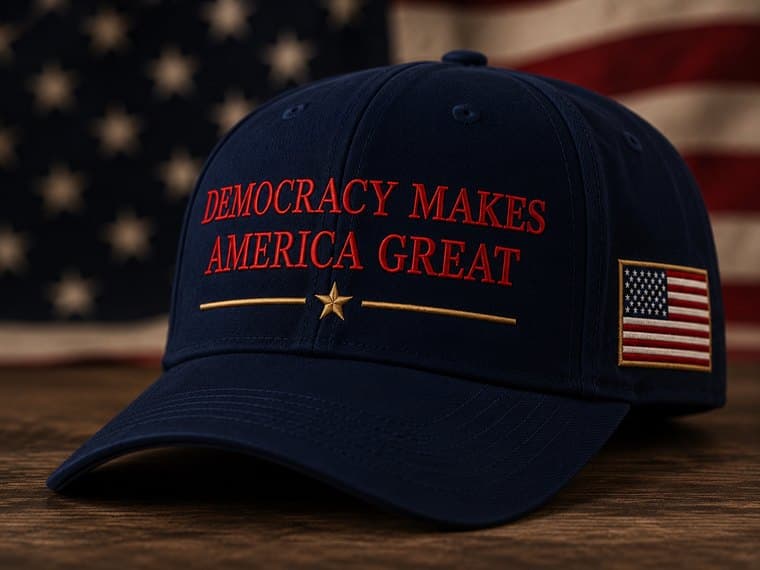
“Democracy Makes America Great”
Veritate Libertas — Latin for “Through Truth, Liberty.”
Democracy is what makes America great. But without truth — honest, real, scientifically validated truth — democracy fails. The baloney slicer is on: feeding fresh sliced truth to protect what makes America great. Democracy.