Baloney Inspection Report: Claim #1163 · Inspected Oct 31, 2026, 7:38 AM PDT · Scoring model v2
 75%
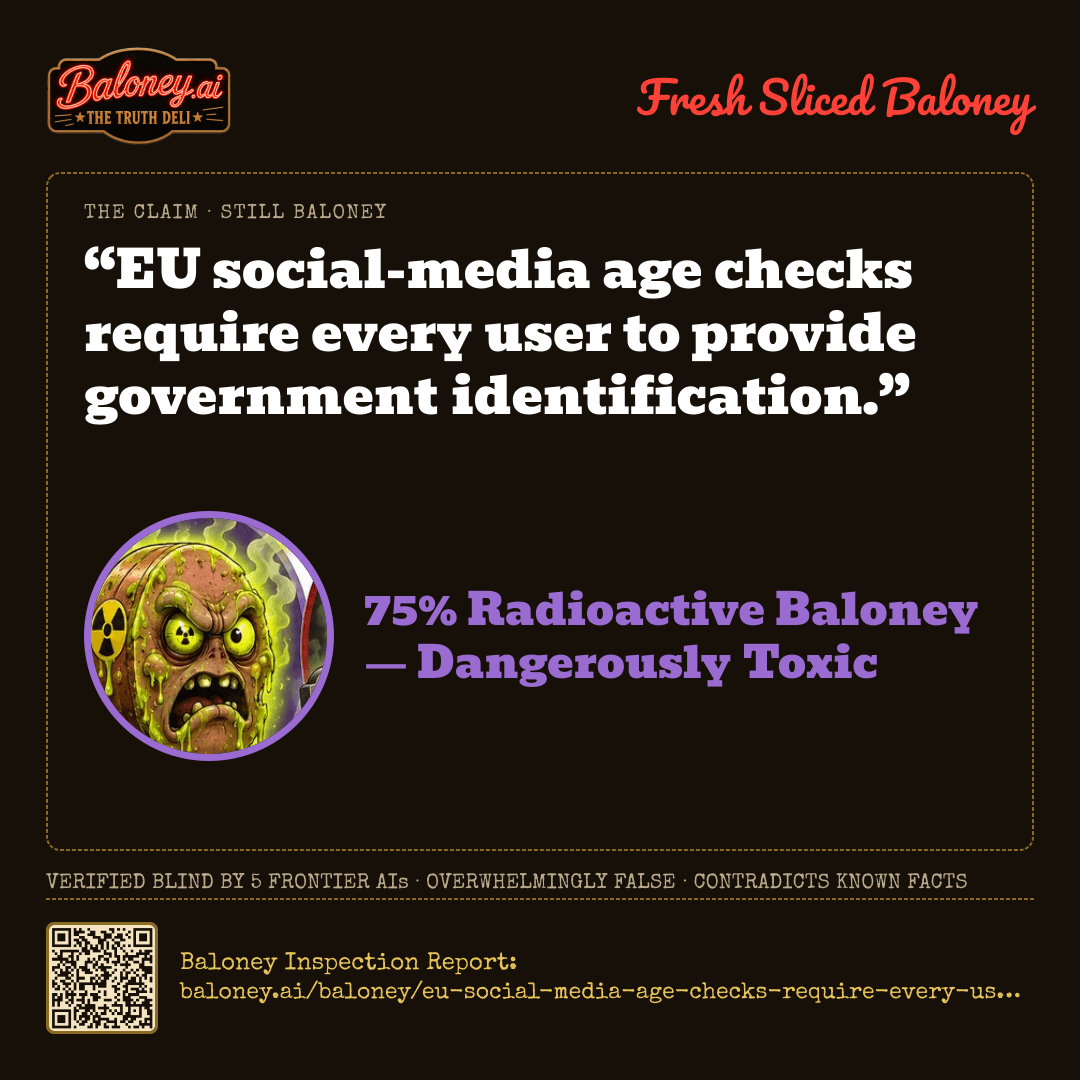
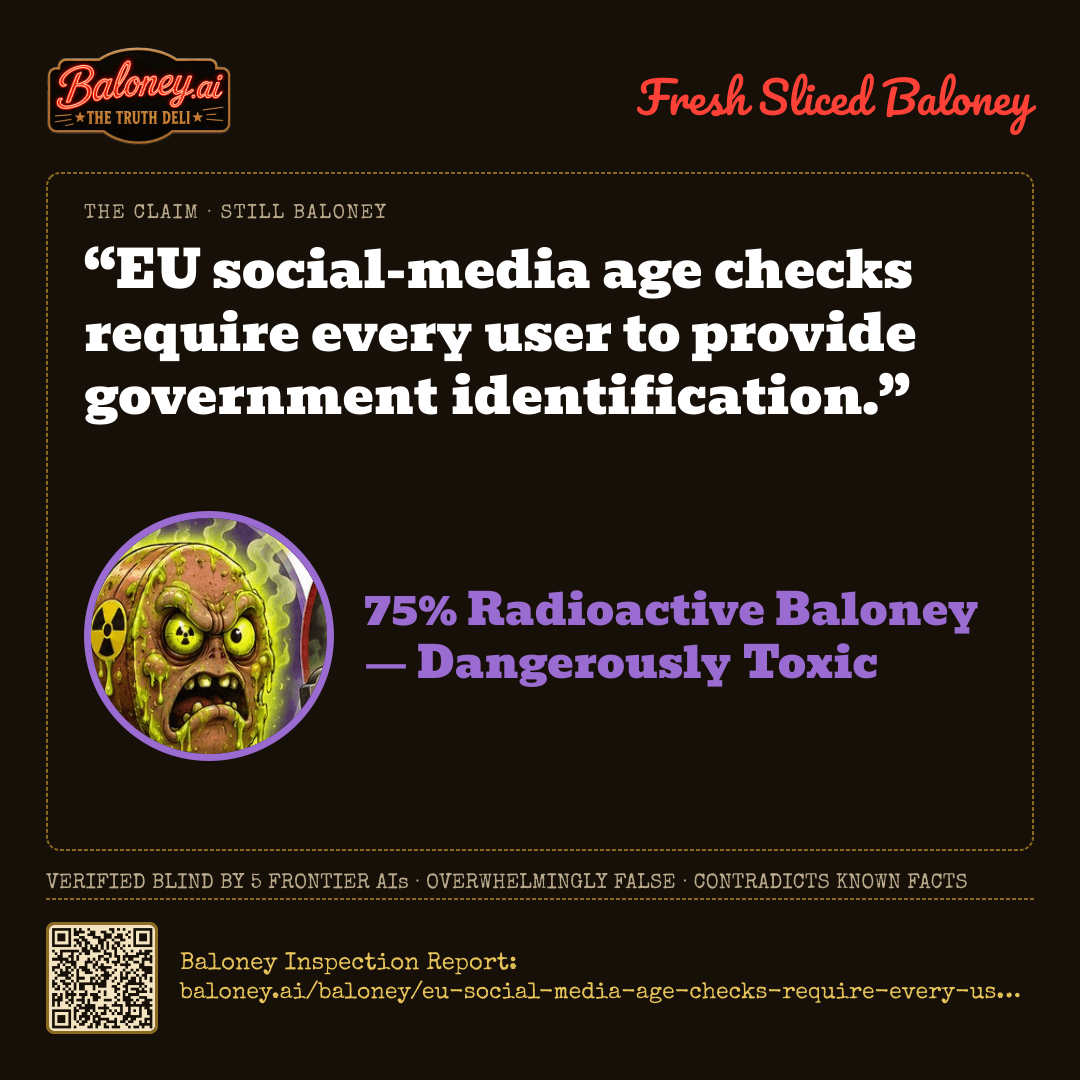
“EU social-media age checks require every user to provide government identification.”
75%Radioactive Baloney — Dangerously Toxic
Dangerously misleading.
Overwhelmingly falseContradicts known factsPromotes false beliefsPotential for harm
Serve It Fresh
Ready to Serve17 servings
Serve it the way you want it
The Verdict
 “EU social-media age checks require every user to provide government identification.”75% Radioactive Baloney — Dangerously ToxicVerified blind by 5 frontier AIs · Baloney Inspection Report: baloney.ai/baloney/eu-social-media-age-checks-require-every-user-to-provide
The Baloney Sampler
The claim is overwhelmingly false: no EU rule requires every social-media user to submit government identification. Lab reports and both masters found the Digital Services Act, published by EUR-Lex, creates an outcome-based duty to protect minors and Article 28(3) expressly does not oblige platforms to process extra personal data to assess age.
Age assurance is method-neutral. The European Commission's privacy-preserving app can attest over-18 status without the platform seeing an identity document, and the EUR-Lex eIDAS 2 Digital Identity Wallet is voluntary for individuals. GDPR data-minimisation on EUR-Lex and CNIL guidance constrain blanket ID collection. Government credentials remain one possible method in some national or high-risk settings.
Resting on EUR-Lex · EUR-Lex · European Commission · CNIL
Original Claim Source https://www.reddit.com/r/privacy/comments/1wiygwy/eus_new_social_media_child_protection_rules_to/
Other ways to slice it — phrasings that might have changed the rating
- “The EU Digital Services Act requires very large social-media platforms to take appropriate measures to protect minors, which can include age assurance.” Reports found a real outcome-based DSA Article 28 duty and Commission guidance on age assurance, but not a rule that every user must provide government identification.
- “Some EU member states have required identity-document or bank-ID checks for pornography sites and other age-restricted services.” Labs cited France and proposals in Denmark, Spain, Greece and Italy as narrower national implementations that fuel the perception of a blanket ID mandate.
- “EU law prohibits social-media platforms from asking users for government identification.” Article 28(3), GDPR data-minimisation and CNIL guidance constrain extra ID collection, but reports also found the law does not forbid ID-based checks and platforms remain free to choose methods.
Written from the panel’s reports by xAI · grok-4.6. Nothing here changed the score.
The Order Ticket
14:38:06CLAIM RECEIVED — QUEUED FOR INSPECTION✓
14:38:54claude-opus-5 REPORTED — SCORE 86, CONFIDENCE 88✓
14:38:55gpt-5.5 REPORTED — SCORE 72, CONFIDENCE 84✓
14:38:32gemini-3.1-pro-preview REPORTED — SCORE 75, CONFIDENCE 95✓
14:38:12sonar-pro REPORTED — SCORE 78, CONFIDENCE 96✓
14:39:45grok-4.6 REPORTED — SCORE 72, CONFIDENCE 78✓
14:41:33PRIMARY MASTER GROK — SCORE 77✓
14:39:50BLIND VALIDATION CHATGPT — SCORE 84✓
14:42:32AGREEMENT CONFIRMED — DELTA 9✓
14:42:32SCORING MODEL V2 — MEDIAN OF 5 COUNTED LAB SCORES: 86, 72, 75, 78, 72 → 75.✓
14:42:32SOURCE RULE — LABS CITED 21 SOURCES: 0 DISCARDED FOR HAVING NO URL, 2 DISCARDED AS DEAD LINKS (404/410), 3 COULD NOT BE OPENED BY US AND ARE MARKED UNVERIFIED.✓
14:42:32SOURCE RULE — PRIMARY MASTER RULED ON 17 SOURCES: 0 DISCARDED FOR HAVING NO URL, 0 DISCARDED AS DEAD LINKS, 3 MARKED UNVERIFIED, 14 VERIFIED.✓
How This One Was Sliced
Station 1 · Blind Inspection — Five Graders, Zero Peeking
Each lab scored the claim independently, without seeing the others. Open a breakdown for its evidence, its sources, and how sure it was.
Anthropic · EQUAL WEIGHT · 48.0s
claude-opus-5
86%BALONEY
ROUND-1 BREAKDOWN
Evidence offered for the claim- The EU's Digital Services Act (Regulation (EU) 2022/2065), Article 28, does require very large online platforms and other providers to put in place appropriate measures to ensure a high level of privacy, safety and security for minors, and the Commission's July 2025 guidelines on the protection of minors recommend age assurance in higher-risk cases — so some form of age checking is genuinely being pushed at EU level, which is the kernel of truth in the claim.
- One permitted method of proving age is indeed presenting a government-issued credential: the EU Digital Identity Wallet framework (Regulation (EU) 2024/1183, amending eIDAS) is built on national electronic identity schemes derived from government ID documents, and the Commission's white-label age-verification app can be provisioned using national eID/passport data.
- Several individual member states (e.g. France for pornography sites, and proposals in Denmark, Spain, Greece and Italy) have pushed harder age-verification mandates, and some national implementations have in practice used ID-document or bank-ID checks, which fuels the perception of a blanket ID requirement.
- Platforms are free to choose their verification method, so a platform could in principle decide to demand ID uploads — the law does not forbid ID-based checks.
Evidence against the claim- There is no EU law requiring every social-media user to submit government identification. The DSA imposes an outcome-based obligation (protect minors, assess risk) and explicitly does not prescribe ID collection; Article 28(3) states that the obligation does not oblige providers to process additional personal data to assess whether a user is a minor.
- The Commission's age-verification blueprint/app is deliberately 'double-blind' and privacy-preserving: it returns a yes/no 'over 18' attestation, so the platform never sees the identity document and the issuer never learns which site the proof was used on — the opposite of 'provide government ID to the platform'.
- Age assurance under the EU approach is method-neutral: acceptable techniques include facial age estimation, device- or OS-level signals, payment-card or mobile-operator signals, parental attestation and zero-knowledge attributes, not only ID documents.
- GDPR data-minimisation (Art. 5(1)(c)) and purpose limitation constrain blanket ID collection; data-protection authorities such as France's CNIL have explicitly criticised ID-document upload as disproportionate and recommended third-party, privacy-preserving verification instead.
- Scope is narrower than 'every user': the Commission's guidelines are non-binding guidance, apply risk-based (strongest for porn, gambling, and high-risk content), and the age-verification app's initial pilots (with a handful of member states) target restricted content rather than all social-media accounts.
- The eIDAS 2 / EU Digital Identity Wallet is to be made available to citizens, but using it is voluntary for individuals; it is not a condition of having a social-media account.
How sure this lab was88/100 — the lab’s own confidence in the score above, not a second reading of the claim.
SourcesEUR-Lex — Regulation (EU) 2022/2065 (Digital Services Act), Art. 28gov · 98 · EUR-Lex — Regulation (EU) 2024/1183 (European Digital Identity Framework / eIDAS 2)gov · 97 · EUR-Lex — GDPR, Art. 5(1)(c) data minimisationgov · 97 · European Commission — Shaping Europe's Digital Future (DSA policy page)gov · 92 · CNIL (French Data Protection Authority)gov · 90 · European Commission — Digital Services Act overviewgov · 92
OpenAI · EQUAL WEIGHT · 48.9s
gpt-5.5
72%BALONEY
ROUND-1 BREAKDOWN
Evidence offered for the claim- EU law does require certain online platforms, including social-media platforms accessible to minors, to take “appropriate and proportionate” measures to protect minors under the Digital Services Act. That creates a real EU legal basis for age-assurance measures in some contexts.
- The European Commission has promoted an age-verification app/prototype connected to the EU Digital Identity Wallet ecosystem. That means some age checks may use official digital-identity credentials to prove age, especially for high-risk or age-restricted online services.
Evidence against the claim- The Digital Services Act does not say every social-media user must provide government identification. Article 28 requires appropriate and proportionate protections for minors, not blanket ID checks for all users.
- EU materials describe age assurance/age verification as risk-based and privacy-preserving, not as a universal government-ID upload mandate. Age assurance can include different methods and should minimize personal-data disclosure.
- The Commission’s age-verification approach is designed to let users prove an age attribute, such as being over 18, without revealing their identity or handing a government ID to a platform.
- The EU Digital Identity Wallet framework states use of the wallet is voluntary; it is not a general requirement that every internet or social-media user identify themselves with government documents.
- The claim conflates “some platforms may need age-assurance measures” with “every user must provide government ID.” As written, that is substantially false.
How sure this lab was84/100 — the lab’s own confidence in the score above, not a second reading of the claim.
SourcesEUR-Lex / European Uniongov · 97 · European Commissiongov · 93 · European Commissiongov · 92 · EUR-Lex / European Uniongov · 96
Google · EQUAL WEIGHT · 25.3s
gemini-3.1-pro-preview
75%BALONEY
ROUND-1 BREAKDOWN
Evidence offered for the claim- The EU Digital Services Act (DSA) requires Very Large Online Platforms (VLOPs) to implement 'appropriate and proportionate measures' to ensure the privacy, safety, and security of minors.
- Because platforms must mitigate risks to minors, they are increasingly required to use age assurance or age verification technologies to distinguish between adults and children.
- Certain EU member states, such as France, have passed national laws requiring social media platforms to verify the ages of users to enforce parental consent for minors under 15, which has fueled speculation about mandatory ID uploads.
Evidence against the claim- Article 28(3) of the EU Digital Services Act explicitly forbids forcing platforms to collect extra identifying data: 'Compliance with the obligations set out in this Article shall not oblige providers of online platforms to process additional personal data in order to assess whether the recipient of the service is a minor.'
- Under the EU's General Data Protection Regulation (GDPR), the principle of 'data minimization' dictates that platforms cannot legally collect sensitive government identification from every user just for standard access, as it would be highly disproportionate.
- EU regulators and national data protection authorities consistently advocate for privacy-preserving age assurance methods, such as third-party age tokens or zero-knowledge proofs, explicitly warning against universal government ID collection due to cybersecurity and privacy risks.
How sure this lab was95/100 — the lab’s own confidence in the score above, not a second reading of the claim.
SourcesEUR-Lex (Official Journal of the European Union)gov · 100 · Reutersnews · 90
Perplexity · EQUAL WEIGHT · 5.1s
sonar-pro
78%BALONEY
ROUND-1 BREAKDOWN
Evidence offered for the claim- The European Commission’s 2025 guidelines recommend age-verification methods for adult-restricted content and where EU or national law sets a minimum age for certain services, potentially including defined categories of social-media services.[1]
- The Commission defines age verification as relying on physical identifiers or verified identification sources, which could include government-issued credentials.[2]
Evidence against the claim- The claim says every user must provide government identification, but the Commission’s guidance is conditional: it applies to adult content and services subject to a legally defined minimum age, not universally to every social-media user.[1][3]
- The guidance distinguishes age verification from age estimation and recommends age estimation in some cases, especially where platforms set a lower-than-18 minimum age based on risk.[1]
- The EU’s proposed age-verification approach is designed to confirm only an age threshold, with selective disclosure and privacy safeguards; it is not equivalent to requiring users to hand government ID directly to every platform.[3][4]
- The Commission states that age verification should be separate from other platform data collection and should not allow providers to store personal data beyond the user’s age group.[3][4]
- The guidelines do not themselves prescribe a universal minimum age for all social-media services; they describe measures platforms should use where EU or national law establishes one.[5]
How sure this lab was96/100 — the lab’s own confidence in the score above, not a second reading of the claim.
SourcesEuropean Commissiongov · 98 · EUR-Lex / European Commissiongov · 98 · European Commissiongov · 98 · Council of the European Uniongov · 97 · EUR-Lex / European Commissiongov · 98
xAI · EQUAL WEIGHT · 98.6s
grok-4.6
72%BALONEY
ROUND-1 BREAKDOWN
Evidence offered for the claim- Some national rules in EU member states for protecting minors on certain online services can involve document-based identity checks.
- The EU Digital Identity Wallet (eIDAS 2.0) is a government-issued credential that platforms could choose to accept for age assurance.
- Robust age verification that must distinguish children from young adults often relies in practice on strong identity proofing, which commonly uses government documents or equivalent.
Evidence against the claim- The Digital Services Act requires very large platforms to assess and mitigate risks to minors but does not mandate that every user submit government identification.
- EU work on age assurance promotes privacy-preserving methods (age estimation, selective disclosure / attribute credentials) that avoid handing full ID documents to platforms.
- No EU-wide rule requires existing adult social-media users to provide a passport, national ID card, or similar document to keep using the services.
- Indiscriminate collection of government IDs from all users would conflict with GDPR data-minimisation and purpose-limitation principles.
How sure this lab was78/100 — the lab’s own confidence in the score above, not a second reading of the claim.
SourcesEuropean Commissiongov · 95 · Wikipediaother · 70
Station 2 · The Masters
Primary Master · drawn at random
grok-4.6
77% BALONEY
The statement as written is overwhelmingly false. All five evaluators agree there is no EU rule that every social-media user must submit government identification. The Digital Services Act creates an outcome-based duty to protect minors and, in Article 28(3), expressly says that duty does not oblige platforms to process extra personal data to assess age. Age assurance is method-neutral and designed to be privacy-preserving; the EU Digital Identity Wallet is voluntary; GDPR data-minimisation further blocks blanket ID collection. I weighted primary legal texts (DSA, eIDAS 2, GDPR) and Commission/CNIL materials far above secondary pages. A real kernel exists—platforms must protect minors, and government credentials are one possible method in some national or high-risk settings—but that cannot salvage a claim that EU age checks require every user to provide government ID. Scores from the five reports clustered in the radioactive band (72–86); 77 sits at the confidence-weighted centre.
All five evaluators agreed the claim is substantially false, that DSA Article 28 is outcome-based rather than an ID mandate, that age assurance is meant to be privacy-preserving and method-neutral, and that wallet use is voluntary. They also agreed some member-state rules and the existence of eID-based options fuel the misconception. They differed only on intensity: recommended scores ran from 72 to 86, mainly over how much weight to give national ID-style schemes and the fact that platforms are not forbidden from choosing document checks.
Blind Validation Master · never saw the Primary’s work
gpt-5.5
84% BALONEY
The claim is overwhelmingly false as written. The reports agree that EU law, especially the Digital Services Act, requires platforms to take appropriate and proportionate steps to protect minors and may lead to age-assurance measures in some higher-risk contexts. Some age-verification systems may use government-backed digital identity credentials, and some member-state rules or platform choices could involve ID-based checks. But the evidence does not support the claim that EU social-media age checks require every user to provide government identification. The DSA is risk-based and outcome-based, not a blanket ID mandate; Article 28 does not require platforms to collect additional personal data to determine whether users are minors. EU guidance promotes privacy-preserving, data-minimizing methods such as age tokens, selective disclosure, age estimation, or wallet-based proof of an age attribute, not handing government ID to social-media platforms. The EU Digital Identity Wallet is voluntary, and GDPR principles would weigh against indiscriminate government-ID collection from all users. The claim conflates limited, conditional age-assurance obligations and possible ID-based options with a universal requirement for every social-media user to submit government identification.
AGREEMENT TEST PASSED — MASTERS SCORED 77% AND 84% · BLIND VALIDATION CONFIRMED THIS SCORE · NO RE-EVALUATION REQUIRED
How the number was reached · scoring model v2 · how our models work
- Median of 5 counted lab scores: 86, 72, 75, 78, 72 → 75.
The Evidence
Evidence offered for the claim
- DSA requires child-safety measures Article 28 of the Digital Services Act requires very large online platforms to put in place appropriate and proportionate measures ensuring a high level of privacy, safety and security for minors, which has driven EU-level age-assurance work.
- Government credentials can prove age The EU Digital Identity Wallet is built on national electronic identity schemes derived from government documents, and the Commission’s age-verification app can be provisioned with national eID or passport data.
- Some member states use ID-style checks France and other countries have adopted or proposed stricter age-verification rules for some services, and some national implementations have used ID-document or bank-ID checks.
- Platforms must collect government ID DEBUNKED — The law does not forbid document checks, but it also does not require them. EU materials treat age assurance as method-neutral, and data-protection authorities have called universal ID upload disproportionate.
Evidence against the claim
- No extra personal data to assess age DSA Article 28(3) states that compliance shall not oblige providers of online platforms to process additional personal data in order to assess whether a user is a minor.
- Age assurance is method-neutral Acceptable techniques include facial age estimation, device or OS signals, payment-card or mobile-operator signals, parental attestation and zero-knowledge attributes, not only identity documents.
- Proof is designed to hide identity The Commission’s age-verification approach is double-blind: it returns a yes/no over-18 attestation, so the platform never sees the identity document and the issuer never learns which site was used.
- GDPR blocks blanket ID collection Data-minimisation and purpose limitation make collecting government identification from every user for ordinary access disproportionate; France’s CNIL has criticised ID-document upload and recommended third-party, privacy-preserving verification.
- Scope is not every social-media user Commission guidelines are non-binding and risk-based, aimed at adult-restricted or legally age-gated services; using the Digital Identity Wallet is voluntary for individuals and is not a condition of having a social-media account.
Sources · Reliability · Why Accepted or Discounted
| Source | Type | Reliability | Ruling |
|---|
| EUR-Lex | gov | 98 | ACCEPTED — Official text of the Digital Services Act, including Article 28. |
| EUR-Lex | gov | 97 | ACCEPTED — Official European Digital Identity / eIDAS 2 regulation. |
| EUR-Lex | gov | 97 | ACCEPTED — Official GDPR text, including data-minimisation. |
| European Commission | gov | 92 | ACCEPTED — Commission policy page on the DSA. |
| CNIL | gov | 90 | ACCEPTED — National data-protection authority guidance against disproportionate ID upload. |
| European Commission | gov | 92 | ACCEPTED — Commission overview of the Digital Services Act. |
| European Commissionunverified | gov | 93 | ACCEPTED — Commission guidelines on protection of minors under the DSA. |
| European Commission | gov | 92 | ACCEPTED — Commission announcement of guidelines and the age-verification app. |
| EUR-Lex | gov | 100 | ACCEPTED — Alternate official URL for the same DSA regulation. |
| Reutersunverified | news | 90 | ACCEPTED — Reputable news explainer used only as background on the DSA’s entry into application. |
| European Commissionunverified | gov | 95 | ACCEPTED — Commission page on the European Digital Identity Wallet. |
| Wikipedia | other | 70 | DISCOUNTED — Secondary encyclopedia page, not a primary legal source; official EUR-Lex and Commission texts already cover the same ground. |
| European Commission | gov | 98 | ACCEPTED — Commission publication of the minors-protection guidelines. |
| EUR-Lex / European Commission | gov | 98 | ACCEPTED — Official Commission communication on the guidelines. |
| European Commission | gov | 98 | ACCEPTED — Commission page on protecting children online. |
| Council of the European Union | gov | 97 | ACCEPTED — Official Council document cited on the age-verification approach. |
| EUR-Lex / European Commission | gov | 98 | ACCEPTED — Official Journal publication related to the Commission guidelines. |
Every link was opened when this claim was inspected. A dead link was discarded before publication; “unverified” means the site refused our automated check and the link is the one the panel cited. A source without a URL was never kept.
Serve It Fresh
Ready to Serve17 servings
Serve it the way you want it
The Verdict
“EU social-media age checks require every user to provide government identification.”75% Radioactive Baloney — Dangerously ToxicVerified blind by 5 frontier AIs · Baloney Inspection Report: baloney.ai/baloney/eu-social-media-age-checks-require-every-user-to-provide