Baloney Inspection Report: Claim #1055 · Inspected Sep 29, 2026, 6:37 PM PDT · Scoring model v2 · Earlier report, model v1
 25%
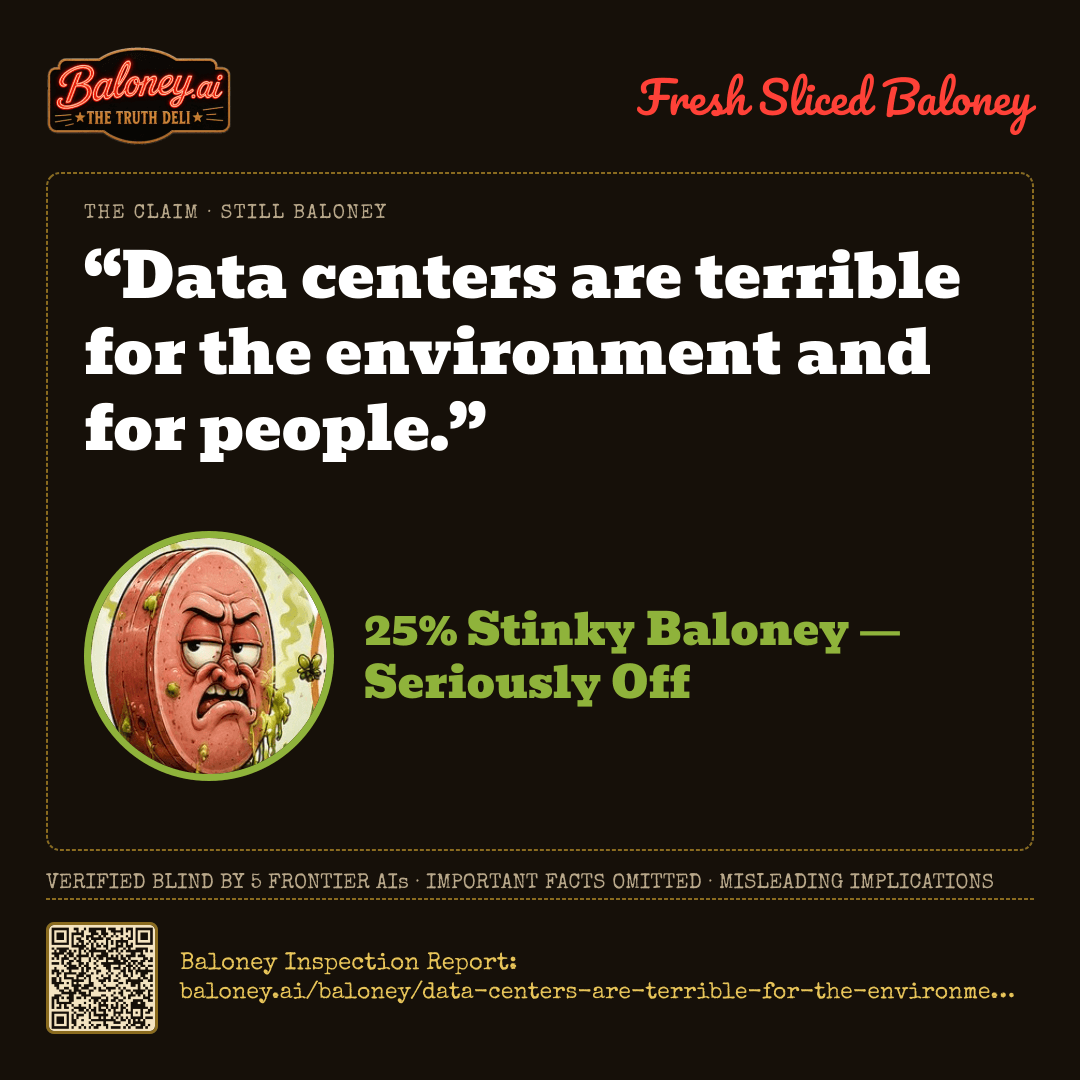
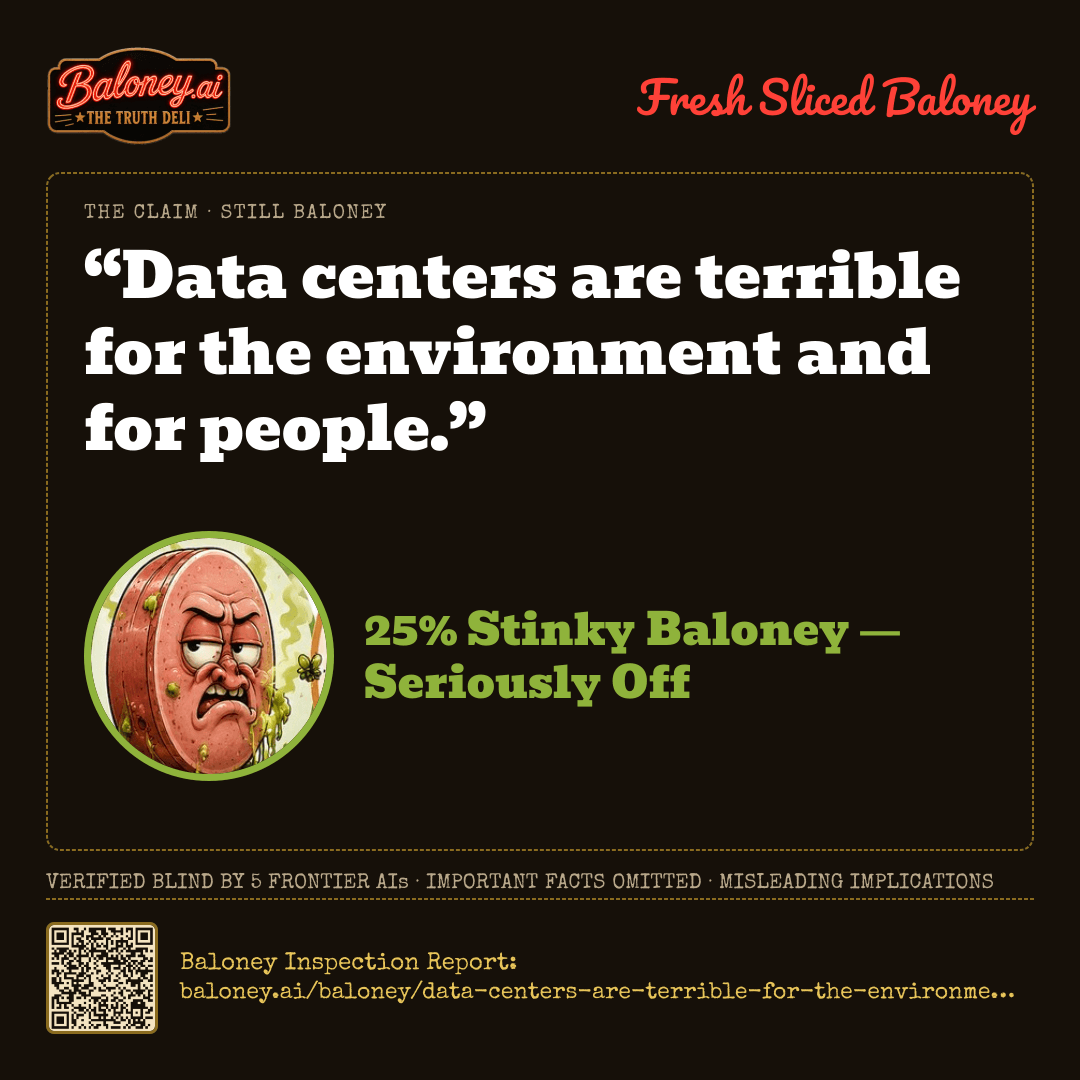
“Data centers are terrible for the environment and for people.”
25%Stinky Baloney — Seriously Off
That’s not the whole story…
Important facts omittedMisleading implicationsCherry-picked infoSpins the truth
Serve It Fresh
Ready to Serve18 servings
Serve it the way you want it
The Verdict
 “Data centers are terrible for the environment and for people.”25% Stinky Baloney — Seriously OffVerified blind by 5 frontier AIs · Baloney Inspection Report: baloney.ai/baloney/data-centers-are-terrible-for-the-environment-and-for-people
The Baloney Sampler
The harms behind this claim are real. The International Energy Agency puts data centres at roughly 1–1.5% of global electricity, about 415 TWh in 2024, with a projected near-doubling by 2030; Lawrence Berkeley National Laboratory and the Department of Energy put U.S. facilities at about 176 TWh in 2023 with large direct and indirect water footprints. Peer-reviewed work in npj Clean Water documents cooling water draw in water-stressed areas, and documented local burdens include diesel backup generators, cooling-fan noise, e-waste and ratepayer cost-shifting.
But "terrible" as a blanket judgement is not what the evidence shows. The IEA figures put the sector at roughly 0.5% of combustion emissions, and the landmark Science study found data-centre compute grew about 550% from 2010–2018 while energy use rose only about 6%. Impacts vary enormously with grid mix, cooling design and siting. On the "for people" half, these facilities underpin hospitals, banking, emergency services and research, and Virginia's JLARC found roughly $1 billion a year in local tax revenue alongside low job creation.
Resting on International Energy Agency · Lawrence Berkeley National Laboratory, U.S. Department of Energy · Science (Masanet et al., 'Recalibrating global data center energy-use estimates') · npj Clean Water (Mytton, 'Data centre water consumption')
Original Claim Source https://www.brookings.edu/articles/local-implications-data-centers-rural-communities-us/
Other ways to slice it — phrasings that might have changed the rating
- “Data centres sited on fossil-heavy grids or in water-stressed regions impose serious environmental and quality-of-life burdens on nearby residents.” The panel found the claim is strongest for poorly sited or poorly powered facilities, where cooling water draw, diesel generators and noise create documented local harm.
- “Data-centre electricity demand is growing fast enough to raise emissions and shift grid costs onto ordinary ratepayers.” The IEA's projected near-doubling to 2030, utilities proposing new gas plants, and Harvard Electricity Law Initiative concerns about cost-shifting are all in the accepted record.
- “Moving computing from on-premise server rooms into hyperscale data centres has reduced energy use per unit of work.” The Science study's 550%-compute-for-6%-energy finding and hyperscale PUE of about 1.1–1.2 versus about 2.0 for legacy rooms speak directly to this narrower question.
Written from the panel’s reports by Anthropic · claude-opus-5. Nothing here changed the score.
The Order Ticket
01:37:29CLAIM RECEIVED — QUEUED FOR INSPECTION✓
01:38:36claude-opus-5 REPORTED — SCORE 32, CONFIDENCE 78✓
01:38:15gpt-5.5 REPORTED — SCORE 26, CONFIDENCE 84✓
01:38:01gemini-3.1-pro-preview REPORTED — SCORE 25, CONFIDENCE 90✓
01:37:38sonar-pro REPORTED — SCORE 24, CONFIDENCE 88✓
01:38:27grok-4.6 REPORTED — SCORE 16, CONFIDENCE 78✓
01:40:07PRIMARY MASTER CLAUDE — SCORE 26✓
01:38:55BLIND VALIDATION GROK — SCORE 25✓
01:40:19AGREEMENT CONFIRMED — DELTA 1✓
01:40:19SCORING MODEL V2 — MEDIAN OF 5 COUNTED LAB SCORES: 32, 26, 25, 24, 16 → 25.✓
01:40:19SOURCE RULE — LABS CITED 31 SOURCES: 0 DISCARDED FOR HAVING NO URL, 0 DISCARDED AS DEAD LINKS (404/410), 7 COULD NOT BE OPENED BY US AND ARE MARKED UNVERIFIED.✓
01:40:19SOURCE RULE — PRIMARY MASTER RULED ON 20 SOURCES: 0 DISCARDED FOR HAVING NO URL, 0 DISCARDED AS DEAD LINKS, 3 MARKED UNVERIFIED, 17 VERIFIED.✓
How This One Was Sliced
Station 1 · Blind Inspection — Five Graders, Zero Peeking
Each lab scored the claim independently, without seeing the others. Open a breakdown for its evidence, its sources, and how sure it was.
Anthropic · EQUAL WEIGHT · 66.6s
claude-opus-5
32%BALONEY
ROUND-1 BREAKDOWN
Evidence offered for the claim- Electricity demand is large and growing fast: the IEA estimates data centres consumed about 415 TWh in 2024 (~1.5% of global electricity) and projects roughly a doubling to ~945 TWh by 2030, with AI the main driver. In the U.S., Lawrence Berkeley National Laboratory/DOE estimate data centres used ~176 TWh in 2023 (~4.4% of U.S. electricity) and could reach 6.7–12% by 2028.
- Fast load growth is being met partly with fossil generation and is delaying coal/gas retirements in some regions; several utilities have proposed new gas plants explicitly to serve data-centre load, and grid emissions per unit of new demand can be high.
- Water use is real and locally significant: evaporative cooling consumes potable water, and studies (e.g., Mytton, npj Clean Water 2021; Li et al., 'Making AI Less Thirsty') document facility-level withdrawals of hundreds of thousands of gallons per day and note siting in water-stressed regions. Google's own reporting shows billions of gallons of water withdrawal annually.
- Hyperscaler emissions have risen despite clean-energy pledges: Google reported 2023 GHG emissions ~48% above its 2019 baseline, and Microsoft reported ~29–30% above its 2020 baseline, largely attributed to data-centre construction and AI infrastructure.
- Local externalities affect residents: diesel backup generators (criteria pollutants), constant low-frequency cooling-fan noise (documented complaints/litigation in Chandler AZ, Northern Virginia, and elsewhere), land conversion, and transmission-line buildout.
- Cost-shifting risk to households: researchers at Harvard's Electricity Law Initiative and multiple state regulators have raised concerns that special utility contracts and rate structures can shift grid-upgrade costs onto ordinary ratepayers; PJM's 2025/26 capacity auction cleared at record prices, with data-centre load growth a cited contributor.
- Job creation per dollar and per megawatt is low: Virginia's JLARC found the industry generates substantial tax revenue but relatively few permanent jobs relative to capital investment and energy footprint.
- Embodied impacts: server manufacturing, rare-earth/critical-mineral demand, and short hardware refresh cycles generate e-waste and upstream mining impacts.
Evidence against the claim- The word 'terrible' overstates the aggregate scale: data centres are still only ~1.5% of global electricity use, smaller than, for example, global road-transport, steel, or cement emissions, and far smaller than agriculture's water footprint (agriculture is ~70% of global freshwater withdrawals).
- Efficiency gains have been dramatic: Masanet et al. (Science, 2020) found global data-centre compute grew ~550% from 2010–2018 while energy use rose only ~6%, because of improvements in server efficiency, virtualisation, and the shift to hyperscale facilities. Average hyperscale PUE is ~1.1–1.2 versus ~2.0 for legacy on-premise rooms.
- Migrating workloads from small enterprise server rooms to cloud data centres typically reduces total energy and carbon per unit of compute; the 'data centre' category absorbing computing is not the same as net new environmental harm.
- Data centres are among the largest corporate purchasers of clean energy in the world; Amazon, Microsoft, Google, and Meta have collectively contracted tens of gigawatts of renewables and are financing new nuclear and geothermal capacity that would not otherwise exist. Several operators match 100% of annual consumption with carbon-free purchases and are pursuing 24/7 hourly matching.
- Cooling water intensity varies enormously by design; air-cooled, closed-loop, and reclaimed/non-potable-water designs exist and are increasingly mandated, and some operators (e.g., Microsoft's zero-water evaporation designs, Meta and Google water-replenishment programmes) are cutting potable water draw.
- 'Terrible for people' ignores benefits: data centres underpin hospitals, banking, emergency services, remote work, education, scientific computing, and weather/climate modelling; digital substitution (telework, videoconferencing, dematerialised media) offsets some emissions.
- Economic benefits are documented: JLARC found Virginia's data-centre industry supports tens of thousands of direct and indirect jobs and generates roughly $1 billion/year in local tax revenue that funds schools and services, and can lower residents' property-tax burden.
- The claim is a universal statement about a heterogeneous category: impacts depend heavily on grid mix, cooling design, siting, and local governance — a Nordic hydro-powered, heat-recovering facility (district-heating reuse in Denmark, Finland, Sweden) is not comparable to a gas-turbine-powered one in a water-stressed region.
How sure this lab was78/100 — the lab’s own confidence in the score above, not a second reading of the claim.
SourcesInternational Energy Agencygov · 93 · International Energy Agencygov · 92 · U.S. Department of Energygov · 90 · Lawrence Berkeley National Laboratory (Energy Technologies Area)gov · 92 · Science (Masanet et al., 'Recalibrating global data center energy-use estimates')journal · 94 · npj Clean Water (Mytton, 'Data centre water consumption')journal · 88 · arXiv (Li et al., 'Making AI Less Thirsty')journal · 70 · Joule (de Vries, 'The growing energy footprint of artificial intelligence')journal · 85 · Google (2024 Environmental Report)other · 62 · Microsoft Environmental Sustainability Reportother · 60 · Virginia Joint Legislative Audit and Review Commission, 'Data Centers in Virginia' (2024)gov · 90 · Monitoring Analytics (PJM Independent Market Monitor)other · 82
OpenAI · EQUAL WEIGHT · 45.8s
gpt-5.5
26%BALONEY
ROUND-1 BREAKDOWN
Evidence offered for the claim- Data centers do have real environmental burdens: the IEA says data centers and data-transmission networks use roughly 1–1.3% of global electricity, and IEA’s Electricity 2024 report says electricity use from data centers, AI and cryptocurrency could roughly double from 2022 to 2026 if trends continue.
- A peer-reviewed Environmental Research Letters study found U.S. data centers have sizable electricity, carbon and water footprints, including indirect water use from electricity generation and direct cooling water use; these impacts can matter more in water-stressed regions.
- When data centers are built on fossil-heavy grids, their 24/7 power demand can increase greenhouse-gas emissions and local air-pollution burdens. They can also impose local costs such as land use, transmission infrastructure, cooling-water demand and backup-generator/noise concerns.
- The claim is strongest for poorly sited or poorly powered data centers: in communities with constrained water supplies, fossil-fuel electricity, weak grid capacity, or nearby residents exposed to construction/noise/diesel backup generators, the harms can be substantial.
Evidence against the claim- The statement is too sweeping. A Science study found global data-center energy use rose only modestly from 2010 to 2018 despite huge increases in workloads, because efficiency improvements were large; data centers were estimated at about 1% of global electricity use, not a dominant share of global energy use.
- Impacts vary greatly by facility, grid mix, cooling design, utilization, and procurement of low-carbon electricity. A renewable-powered, efficient data center in a cool climate has a very different footprint from one on a stressed fossil grid in a water-scarce area.
- Data centers also provide major social and economic benefits: cloud computing, hospitals’ records, scientific research, communications, banking, emergency services, and business productivity. The claim weighs harms but ignores these benefits to people.
- The best-supported conclusion is not that data centers are categorically 'terrible,' but that they are energy- and resource-intensive infrastructure whose impacts can be serious and are growing, especially without clean power, efficient cooling, transparency, and careful siting.
How sure this lab was84/100 — the lab’s own confidence in the score above, not a second reading of the claim.
SourcesInternational Energy Agencyother · 92 · International Energy Agencyother · 92 · Sciencejournal · 95 · Environmental Research Lettersjournal · 93 · Lawrence Berkeley National Laboratory / U.S. Department of Energygov · 92 · International Energy Agencyother · 90
Google · EQUAL WEIGHT · 31.2s
gemini-3.1-pro-preview
25%BALONEY
ROUND-1 BREAKDOWN
Evidence offered for the claim- Data centers are highly resource-intensive, accounting for approximately 1% to 1.5% of global electricity demand. With the rapid expansion of Artificial Intelligence (AI) and cryptocurrency, the International Energy Agency (IEA) projects this energy consumption could double by 2026.
- Cooling data center servers requires massive amounts of fresh water. A single large data center can consume millions of gallons of water per day, often straining local water supplies in drought-prone regions like the American Southwest.
- Local communities frequently oppose new data centers due to immediate negative impacts on people, including strain on local power grids (which can drive up utility rates for residents), massive land use, and severe, constant noise pollution generated by industrial cooling fans.
- The rapid turnover of servers and hardware to keep up with computing demands generates significant amounts of electronic waste (e-waste), which poses environmental and human health risks if not properly recycled.
Evidence against the claim- The claim that they are 'terrible for people' ignores the foundational societal benefits of data centers; they form the backbone of the modern internet, enabling global communication, advanced medical and scientific research, digital banking, and remote work.
- Data centers enable remote work and the virtualization of services, which can actually reduce broader societal greenhouse gas emissions by drastically cutting down on physical commuting and travel.
- The industry has achieved massive efficiency gains. A landmark 2020 study in the journal Science found that while global data center computing workloads increased by 550% between 2010 and 2018, their actual energy use grew by only 6%.
- Major data center operators (such as Google, Microsoft, Amazon, and Meta) are the largest corporate purchasers of renewable energy in the world. The EPA frequently lists tech giants at the very top of their Green Power Partnership list, as they often match 100% of their electricity consumption with renewable energy purchases and invest heavily in carbon-free grid initiatives.
How sure this lab was90/100 — the lab’s own confidence in the score above, not a second reading of the claim.
SourcesInternational Energy Agency (IEA)other · 95 · Massachusetts Institute of Technology (MIT) Climate Portaledu · 95 · Sciencejournal · 98 · U.S. Environmental Protection Agency (EPA)gov · 98
Perplexity · EQUAL WEIGHT · 8.2s
sonar-pro
24%BALONEY
ROUND-1 BREAKDOWN
Evidence offered for the claim- Data centers consume substantial and rapidly increasing amounts of electricity: globally they used about 415 TWh in 2024, or 1.5% of world electricity consumption, and the IEA projects demand could roughly double by 2030. This increases associated greenhouse-gas emissions, especially where electricity comes from fossil fuels.[https://www.iea.org/reports/energy-and-ai/executive-summary]
- U.S. data centers consumed approximately 176 TWh of electricity in 2023. Their electricity-related indirect water footprint was estimated at nearly 800 billion liters, while direct on-site water consumption was estimated at about 66 billion liters.[https://eta-publications.lbl.gov/sites/default/files/2024-12/us_data_center_energy_usage_report_lbnl-2001637_0.pdf]
- The environmental burden is locally concentrated: large facilities can intensify electricity-grid demand, require new generation and transmission, and compete for water in water-stressed regions. The Berkeley Lab report documents substantial energy, greenhouse-gas, and water impacts, although the severity varies by facility design, location, cooling system, and electricity mix.[https://eta-publications.lbl.gov/sites/default/files/2024-12/us_data_center_energy_usage_report_lbnl-2001637_0.pdf]
- The IEA estimates data centers currently cause about 180 million tonnes of indirect CO2 emissions from electricity use, with emissions projected to rise substantially through the decade in its central scenario.[https://www.iea.org/reports/energy-and-ai/ai-and-climate-change]
Evidence against the claim- The claim is overly absolute: data centers currently account for a relatively small share of global emissions—about 0.5% of combustion emissions according to the IEA—even though their electricity demand is growing quickly.[https://www.iea.org/reports/energy-and-ai/ai-and-climate-change]
- Data centers provide the infrastructure for communications, digital public services, commerce, research, banking, and other activities; the environmental assessment therefore depends partly on what services they enable and what activities they replace. The available evidence does not support treating every data center as uniformly harmful to people or the environment.
- The IEA projects data-center electricity use to reach about 3% of global electricity demand by 2030 in its central outlook, meaning the sector is significant but not the dominant source of global energy use or emissions.[https://www.iea.org/reports/energy-and-ai/energy-supply-for-ai]
- Impacts vary materially with efficiency, cooling technology, water source, local climate, grid mix, and use of low-carbon electricity. The Berkeley Lab analysis reports both rising aggregate demand and major efficiency changes, including a shift toward more efficient hyperscale and colocation facilities; this undermines the blanket claim that all facilities are equally damaging.[https://eta-publications.lbl.gov/sites/default/files/2024-12/lbnl-2024-united-states-data-center-energy-usage-report_1.pdf]
How sure this lab was88/100 — the lab’s own confidence in the score above, not a second reading of the claim.
SourcesInternational Energy Agencyother · 96 · International Energy Agencyother · 96 · International Energy Agencyother · 96 · Lawrence Berkeley National Laboratory, U.S. Department of Energygov · 98 · Lawrence Berkeley National Laboratory, U.S. Department of Energygov · 98
xAI · EQUAL WEIGHT · 57.6s
grok-4.6
16%BALONEY
ROUND-1 BREAKDOWN
Evidence offered for the claim- Data centers use a large and growing share of electricity (about 1–1.5% globally, higher in some countries), and growth from AI/cloud is projected to raise demand sharply; when grids are fossil-heavy this increases GHG emissions.
- Many facilities use large volumes of water for cooling, which can stress local supplies in drought-prone or water-scarce areas.
- Construction, land use, heat rejection, grid strain, noise, and e-waste create local environmental and quality-of-life impacts; some communities report higher costs or opposition.
- Rapid hyperscale/AI buildout has outpaced some grids and water systems, producing documented local conflicts and emissions from new generation.
Evidence against the claim- Efficiency gains (servers, cooling, PUE) have historically kept energy-use growth far below growth in compute/data traffic.
- Major operators buy large volumes of renewables/PPAs and are shifting toward carbon-free energy and better cooling; impact depends heavily on location and design, not an inherent property of all data centers.
- Centralized cloud is often more energy-efficient than equivalent on-premises IT; digital services also enable remote work and other substitutions that can cut other emissions.
- Facilities create jobs, tax base, and infrastructure investment; ‘for people’ impacts are mixed rather than uniformly terrible.
- Absolute wording (‘are terrible’) ignores variation, ongoing mitigation, and net benefits of the services they host.
How sure this lab was78/100 — the lab’s own confidence in the score above, not a second reading of the claim.
SourcesInternational Energy Agencyother · 92 · International Energy Agencyother · 92 · Sciencejournal · 95 · U.S. Department of Energygov · 90
Station 2 · The Masters
Primary Master · drawn at random
claude-opus-5
26% BALONEY
All five evaluators independently converged on the same structural finding: the factual raw materials behind this claim are real, but the claim as written is a universal, absolute verdict on a heterogeneous category of infrastructure, and that is where it fails. On the 'for' side the panel is in strong agreement and well sourced: the IEA puts data centres at roughly 1–1.5% of global electricity (about 415 TWh in 2024) with a projected near-doubling by 2030; Berkeley Lab/DOE put U.S. data centres at about 176 TWh in 2023 with large direct and indirect water footprints; documented local harms include evaporative cooling water draw in water-stressed areas, diesel backup generators, low-frequency cooling-fan noise, transmission buildout, e-waste, and ratepayer cost-shifting risk; and two of the largest operators have themselves disclosed emissions rising well above their own baselines because of AI and data-centre construction. That is a serious and growing impact profile, and it is why this claim does not sit above the 40s.
But 'terrible for the environment and for people' is a blanket judgement the evidence does not carry. The sector is ~1.5% of global electricity and, per the IEA figures cited, on the order of 0.5% of combustion emissions — significant but far from a dominant driver. The landmark Science study found global data-centre compute grew ~550% from 2010–2018 while energy use rose only ~6%, and hyperscale PUE of ~1.1–1.2 versus ~2.0 for legacy on-premise server rooms means the migration of computing into data centres has often reduced energy per unit of work rather than added net harm. Impacts vary enormously with grid mix, cooling design, water source and siting: a hydro-powered Nordic facility feeding waste heat into district heating is not the same object as a gas-served facility in a drought-stressed county. And the 'for people' half of the claim is the weakest part — these facilities underpin hospitals, banking, emergency services, education, scientific and weather modelling, and the operators are among the world's largest corporate buyers of clean power, while at the local level the record is genuinely mixed (Virginia's JLARC found roughly $1 billion/year in local tax revenue alongside low job creation per megawatt).
So: important facts omitted, misleading universal implication, but built on a real and verifiable core. That is squarely Stinky Baloney. The five recommendations (16, 24, 25, 26, 32) cluster tightly; I land at 26, close to the median, rejecting the 16 as too harsh on a claim whose factual base is largely sound and the 32 as slightly overweighting the wording problem.
Unusually high agreement. All five evaluators accepted the underlying facts — 1–1.5% of global electricity, rapid AI-driven growth, real cooling-water and local noise/grid/e-waste impacts — and all five faulted the absolute wording, the omission of large efficiency gains (the Science 550%-compute/6%-energy finding was cited by four of five), and the failure to weigh the services and economic benefits the facilities provide. Disagreement was one of degree only: recommendations spanned 16 to 32, with the lowest score treating the claim as broadly defensible directional shorthand and the highest emphasising that 'terrible' is a category judgement contradicted by the enormous variation between facilities. Report 3 supplied the deepest local-harm evidence (ratepayer cost-shifting, noise litigation, hyperscaler emissions disclosures) and still scored highest, because it also documented the strongest counter-evidence. No evaluator regarded the claim as flatly false, and none regarded it as true as written.
Blind Validation Master · never saw the Primary’s work
grok-4.6
25% BALONEY
The claim is an absolute, categorical judgment that the evidence does not support. Data centers have real and growing burdens—roughly 1–1.5% of global electricity (higher and rising fast in the U.S.), substantial water use for cooling, local grid strain, noise, land use, e-waste, and extra emissions when powered by fossil grids—and these can be severe in poorly sited facilities. That is not the same as being uniformly ‘terrible’ for the environment or for people. Global share of energy and emissions remains modest; efficiency gains historically kept energy growth far below compute growth; impacts vary enormously by grid mix, cooling design, and siting; operators purchase large volumes of clean power; and the same facilities underpin communications, hospitals, research, banking, and other services with documented economic and social benefits. The wording omits that heterogeneity, the benefits, and the modest aggregate scale, so it is misleading rather than substantially true.
AGREEMENT TEST PASSED — MASTERS SCORED 26% AND 25% · BLIND VALIDATION CONFIRMED THIS SCORE · NO RE-EVALUATION REQUIRED
How the number was reached · scoring model v2 · how our models work
- Median of 5 counted lab scores: 32, 26, 25, 24, 16 → 25.
The Evidence
Evidence offered for the claim
- Large and fast-rising electricity demand The IEA estimates data centres consumed about 415 TWh in 2024, roughly 1.5% of global electricity, and projects a near-doubling to about 945 TWh by 2030, with AI the main driver. Berkeley Lab/DOE put U.S. data centres at about 176 TWh in 2023, or ~4.4% of U.S. electricity, potentially 6.7–12% by 2028.
- Emissions where grids are fossil-heavy The IEA attributes roughly 180 million tonnes of indirect CO2 to data-centre electricity use. Fast load growth is being met partly with new gas generation and has been cited in proposals to delay coal and gas retirements, so 24/7 demand on a fossil grid raises emissions and local air-pollution burdens.
- Cooling water competes with local supply Berkeley Lab estimated U.S. data centres' direct on-site water consumption at about 66 billion litres and their electricity-related indirect water footprint at nearly 800 billion litres. Peer-reviewed work in npj Clean Water documents facility-level withdrawals in the hundreds of thousands of gallons per day, which matters most in water-stressed regions.
- Operators' own emissions have risen Google reported 2023 greenhouse-gas emissions about 48% above its 2019 baseline and Microsoft reported roughly 29–30% above its 2020 baseline, both attributed substantially to data-centre construction and AI infrastructure — disclosures made against the companies' own interest.
- Real local nuisance and cost impacts Diesel backup generators emit criteria pollutants; constant low-frequency cooling-fan noise has generated documented complaints and litigation; land conversion and new transmission lines add burdens. Researchers and state regulators have raised concerns that special utility contracts can shift grid-upgrade costs onto ordinary ratepayers.
- Energy use is spiralling out of control DEBUNKED — REFUTED by the panel. The landmark 2020 Science study found global data-centre compute grew about 550% between 2010 and 2018 while energy use rose only about 6%, because of server efficiency, virtualisation and the shift to hyperscale. Growth is real and now accelerating with AI, but the sector's history is one of demand being substantially absorbed by efficiency.
- Few jobs for the footprint Virginia's Joint Legislative Audit and Review Commission found the industry generates substantial tax revenue but relatively few permanent jobs relative to capital investment and energy footprint. Short hardware refresh cycles also drive e-waste and upstream mining demand.
Evidence against the claim
- A small share of the global total At roughly 1.5% of global electricity — and on IEA figures around 0.5% of combustion emissions, rising to about 3% of electricity by 2030 in the central outlook — data centres are significant but far from a dominant source of emissions, and their water use is dwarfed by agriculture, which accounts for about 70% of global freshwater withdrawals.
- Efficiency has decoupled compute from energy The 2020 Science study found a 550% rise in compute against a 6% rise in energy use from 2010 to 2018. Average hyperscale PUE is about 1.1–1.2 against roughly 2.0 for legacy on-premise server rooms, so moving workloads into data centres typically cuts energy and carbon per unit of compute.
- Impacts vary enormously by facility Grid mix, cooling design, water source, local climate and governance dominate outcomes. Closed-loop, air-cooled and reclaimed-water designs, zero-water-evaporation cooling and waste-heat reuse into district heating in Denmark, Finland and Sweden mean a Nordic hydro-powered facility is not comparable to a gas-served one in a drought-stressed county.
- Largest corporate buyers of clean power Amazon, Microsoft, Google and Meta have collectively contracted tens of gigawatts of renewables and are financing new nuclear and geothermal capacity; the EPA's Green Power Partnership top-100 list repeatedly places tech operators at the top, with several matching 100% of annual consumption and pursuing 24/7 hourly matching.
- The 'for people' half is mixed, not uniform These facilities underpin hospitals and medical records, banking, emergency services, communications, remote work, education, scientific research and weather and climate modelling, and digital substitution offsets some travel emissions. Locally, JLARC found Virginia's industry supports tens of thousands of direct and indirect jobs and roughly $1 billion a year in local tax revenue funding schools and services.
- 'Terrible' is a category judgement, not a finding The claim is a universal verdict on a heterogeneous class of infrastructure. The best-supported conclusion is that data centres are energy- and resource-intensive facilities whose impacts can be serious and are growing, particularly without clean power, efficient cooling, transparency and careful siting.
Sources · Reliability · Why Accepted or Discounted
| Source | Type | Reliability | Ruling |
|---|
| International Energy Agency | other | 92 | ACCEPTED — Standard reference baseline for data-centre share of global electricity; cited independently by three evaluators. |
| International Energy Agency | other | 92 | ACCEPTED — Authoritative source for the projected doubling of data-centre, AI and crypto electricity use to 2026. |
| International Energy Agency | other | 92 | ACCEPTED — Full report underlying the same demand projections; consistent across two evaluators. |
| International Energy Agency | gov | 93 | ACCEPTED — Most current sector-wide analysis, source of the 415 TWh (2024) and ~945 TWh (2030) figures. |
| International Energy Agency | other | 96 | ACCEPTED — Directly supports the headline consumption and growth figures relied on by the panel. |
| International Energy Agency | other | 96 | ACCEPTED — Source of both the 180 Mt indirect CO2 figure and the ~0.5% of combustion emissions share — it cuts both ways and was used honestly in both directions. |
| International Energy Agency | other | 96 | ACCEPTED — Supports the ~3% of global electricity by 2030 central projection. |
| International Energy Agency | other | 90 | ACCEPTED — Directly relevant precedent on how digital-footprint figures get exaggerated in public claims of this type. |
| Science (Masanet et al., 'Recalibrating global data center energy-use estimates')unverified | journal | 95 | ACCEPTED — Peer-reviewed landmark decoupling study; cited by four of five evaluators and the single most load-bearing counter-evidence. |
| Environmental Research Letters | journal | 93 | ACCEPTED — Peer-reviewed quantification of U.S. data-centre electricity, carbon and direct plus indirect water footprints. |
| Lawrence Berkeley National Laboratory / U.S. Department of Energy | gov | 92 | ACCEPTED — Established national laboratory baseline for U.S. data-centre energy use. |
| Lawrence Berkeley National Laboratory (Energy Technologies Area)unverified | gov | 92 | ACCEPTED — Source of the 176 TWh (2023) U.S. figure and the 6.7–12% by 2028 range. |
| Lawrence Berkeley National Laboratory, U.S. Department of Energy | gov | 98 | ACCEPTED — Primary report behind the direct (66 billion litre) and indirect (~800 billion litre) water footprint estimates. |
| Lawrence Berkeley National Laboratory, U.S. Department of Energy | gov | 98 | ACCEPTED — Same report series; documents both rising aggregate demand and the efficiency shift toward hyperscale and colocation. |
| U.S. Department of Energy | gov | 90 | ACCEPTED — Government technical reference on data-centre and server efficiency. |
| U.S. Department of Energy | gov | 90 | ACCEPTED — Official release summarising the federal assessment of rising data-centre electricity demand. |
| npj Clean Water (Mytton, 'Data centre water consumption') | journal | 88 | ACCEPTED — Peer-reviewed and the best available treatment of facility-level water consumption and siting in water-stressed areas. |
| arXiv (Li et al., 'Making AI Less Thirsty') | journal | 70 | DISCOUNTED — Non-peer-reviewed preprint whose per-query water figures have been widely contested; its conclusions are duplicated by the peer-reviewed npj Clean Water paper, so nothing in the verdict rests on it. |
| Joule (de Vries, 'The growing energy footprint of artificial intelligence')unverified | journal | 85 | ACCEPTED — Peer-reviewed commentary on AI energy growth; treated as directional given its reliance on scenario assumptions. |
| Google (2024 Environmental Report) | other | 62 | ACCEPTED — Self-reported and promotional in framing, but accepted narrowly for the emissions increase it discloses — an admission against the publisher's own interest. |
Every link was opened when this claim was inspected. A dead link was discarded before publication; “unverified” means the site refused our automated check and the link is the one the panel cited. A source without a URL was never kept.
Serve It Fresh
Ready to Serve18 servings
Serve it the way you want it
The Verdict
“Data centers are terrible for the environment and for people.”25% Stinky Baloney — Seriously OffVerified blind by 5 frontier AIs · Baloney Inspection Report: baloney.ai/baloney/data-centers-are-terrible-for-the-environment-and-for-people