Baloney Inspection Report: Claim #1066 · Inspected Sep 29, 2026, 3:37 PM PDT · Scoring model v2 · Earlier report, model v1
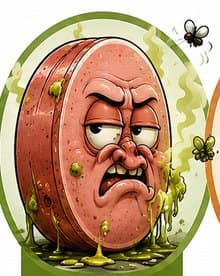 28%
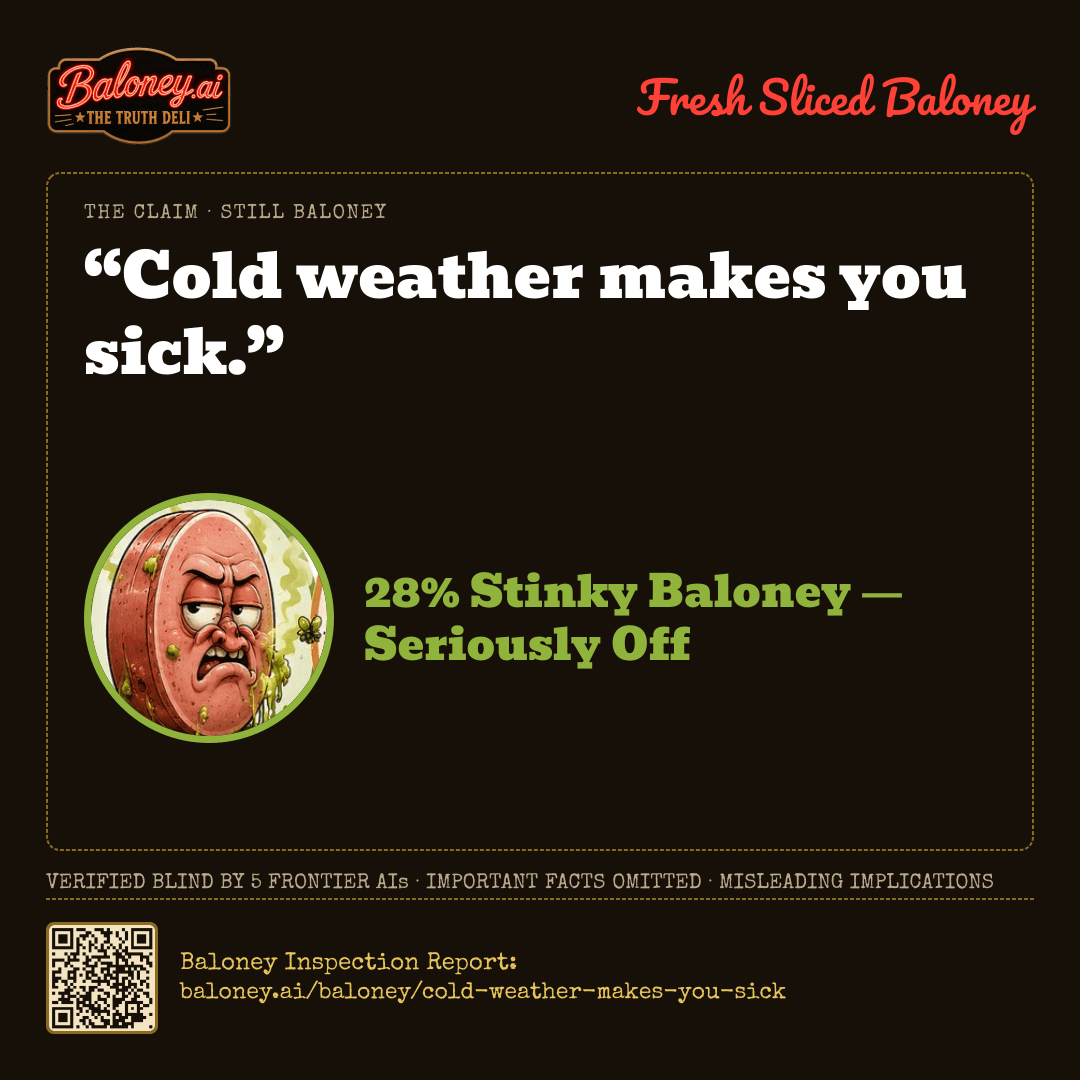
“Cold weather makes you sick.”
28%Stinky Baloney — Seriously Off
That’s not the whole story…
Important facts omittedMisleading implicationsCherry-picked infoSpins the truth
Serve It Fresh
Ready to Serve19 servings
Serve it the way you want it
The Verdict
 “Cold weather makes you sick.”28% Stinky Baloney — Seriously OffVerified blind by 5 frontier AIs · Baloney Inspection Report: baloney.ai/baloney/cold-weather-makes-you-sick
The Baloney Sampler
The Order Ticket
22:37:33CLAIM RECEIVED — QUEUED FOR INSPECTION✓
22:38:31claude-opus-5 REPORTED — SCORE 28, CONFIDENCE 85✓
22:38:03gpt-5.5 REPORTED — SCORE 32, CONFIDENCE 87✓
22:38:00gemini-3.1-pro-preview REPORTED — SCORE 99, CONFIDENCE 98✓
22:37:43sonar-pro REPORTED — SCORE 18, CONFIDENCE 91✓
22:38:36grok-4.6 REPORTED — SCORE 18, CONFIDENCE 82✓
22:39:01PRIMARY MASTER PERPLEXITY — SCORE 18✓
22:38:55BLIND VALIDATION CLAUDE — SCORE 27✓
22:39:08AGREEMENT CONFIRMED — DELTA 10✓
22:39:08SCORING MODEL V2 — MEDIAN OF 5 COUNTED LAB SCORES: 28, 32, 99, 18, 18 → 28.✓
22:39:08SOURCE RULE — LABS CITED 24 SOURCES: 0 DISCARDED FOR HAVING NO URL, 2 DISCARDED AS DEAD LINKS (404/410), 11 COULD NOT BE OPENED BY US AND ARE MARKED UNVERIFIED.✓
22:39:08SOURCE RULE — PRIMARY MASTER RULED ON 20 SOURCES: 0 DISCARDED FOR HAVING NO URL, 0 DISCARDED AS DEAD LINKS, 10 MARKED UNVERIFIED, 10 VERIFIED.✓
How This One Was Sliced
Station 1 · Blind Inspection — Five Graders, Zero Peeking
Each lab scored the claim independently, without seeing the others. Open a breakdown for its evidence, its sources, and how sure it was.
Anthropic · EQUAL WEIGHT · 58.7s
claude-opus-5
28%BALONEY
ROUND-1 BREAKDOWN
Evidence offered for the claim- Cold temperatures directly cause genuine illness and injury independent of any pathogen: hypothermia, frostbite, and chilblains are diagnoses caused purely by cold exposure.
- Cold exposure raises blood pressure, increases blood viscosity and constricts coronary arteries, and is associated with measurable increases in heart attacks and strokes during cold snaps — a direct physiological 'cold makes you sick' pathway.
- Laboratory work shows human rhinovirus replicates more efficiently and the innate antiviral (interferon) response of airway cells is weaker at cooler temperatures (~33°C, typical of a chilled nasal passage) than at core body temperature (37°C), providing a mechanism by which chilling the nose increases susceptibility to infection.
- Research published in the Journal of Allergy and Clinical Immunology (2022) reported that dropping nasal temperature by a few degrees sharply reduced the nose's extracellular-vesicle antiviral defenses, supporting the idea that cold air blunts front-line immunity.
- Guinea pig transmission experiments (Lowen et al., PLoS Pathogens 2007) showed influenza transmits far more efficiently at low temperature and low humidity, one explanation for the winter seasonality of respiratory infections.
- Population data show excess winter mortality and clear winter peaks in influenza, RSV and common colds in temperate countries, so 'cold weather season' and 'getting sick' are strongly correlated in practice.
Evidence against the claim- As literally worded, the claim confuses correlation with cause: colds and flu are caused by viruses. Without exposure to a pathogen, cold weather alone cannot give you a cold, flu or COVID, no matter how long you stay outside underdressed.
- Classic experimental studies in which volunteers were chilled, soaked, or exposed to cold air but not inoculated with virus failed to produce colds; those given virus got sick at similar rates whether chilled or not, which is why NHS, Mayo Clinic, CDC and MedlinePlus all describe 'going out in the cold gives you a cold' as a myth.
- Winter illness peaks are substantially explained by confounders other than temperature itself: more time spent indoors in close contact, poorer ventilation, low absolute humidity favouring virus survival, school terms, and reduced sunlight/vitamin D.
- Some of the coldest inhabited places have low respiratory illness rates in deep winter when people are isolated, while tropical regions have year-round influenza — inconsistent with temperature being the direct cause.
- The cold-nose and cold-foot findings show increased *susceptibility* to an already-present virus, not disease causation; the effect size in humans is modest and some trials (e.g., Eccles's cold-feet studies) are small and contested.
- The statement's unqualified wording ('makes you sick') supports a widespread folk belief that leads people to blame weather rather than contagion — the framing fact-checkers and health agencies specifically warn against.
How sure this lab was85/100 — the lab’s own confidence in the score above, not a second reading of the claim.
SourcesProceedings of the National Academy of Sciences (Foxman et al., 2015)journal · 95 · PLoS Pathogens (Lowen et al., 2007)journal · 93 · UK National Health Servicegov · 93 · Mayo Clinicedu · 90 · MedlinePlus, U.S. National Library of Medicinegov · 92 · U.S. Centers for Disease Control and Preventiongov · 93 · Johns Hopkins Medicineedu · 90
OpenAI · EQUAL WEIGHT · 30.2s
gpt-5.5
32%BALONEY
ROUND-1 BREAKDOWN
Evidence offered for the claim- Cold weather can indirectly raise the risk of respiratory infections: laboratory and epidemiological literature finds that lower temperatures and low humidity can favor respiratory-virus survival/transmission and that people tend to spend more time indoors in close contact during colder seasons.
- Experimental evidence suggests colder nasal-airway temperatures can weaken local antiviral defenses. A Journal of Allergy and Clinical Immunology study found cold exposure impaired extracellular-vesicle-mediated nasal antiviral immunity, and a PNAS study found cooler airway-cell temperatures reduced innate antiviral defenses against rhinovirus.
- Cold weather can directly cause some illnesses or injuries, such as hypothermia and frostbite, so the statement is not wholly false if 'sick' is used broadly rather than specifically to mean colds/flu.
Evidence against the claim- Cold weather by itself does not cause the common cold, flu, COVID-19, or other viral respiratory infections; infectious viruses or other pathogens are required. CDC describes common colds as being caused by viruses, especially rhinoviruses.
- MedlinePlus explicitly states that, contrary to popular belief, cold weather or becoming chilled does not cause a cold, though colds are more common in colder seasons.
- The claim as written omits the key distinction between a risk factor and a cause. Cold conditions may increase susceptibility or transmission under some circumstances, but they do not 'make you sick' in the infectious-disease sense without exposure to a pathogen.
How sure this lab was87/100 — the lab’s own confidence in the score above, not a second reading of the claim.
SourcesCenters for Disease Control and Preventiongov · 96 · MedlinePlus / U.S. National Library of Medicinegov · 94 · Journal of Allergy and Clinical Immunologyjournal · 92 · Proceedings of the National Academy of Sciencesjournal · 91 · Annual Review of Virologyjournal · 90
Google · EQUAL WEIGHT · 27.7s
gemini-3.1-pro-preview
99%BALONEY
ROUND-1 BREAKDOWN
Evidence offered for the claim- Cold weather changes human behavior by driving people indoors, where poorer ventilation and close proximity to others significantly increase the transmission rate of viruses.
- Many respiratory pathogens, such as rhinoviruses (which cause the common cold) and influenza, survive longer and replicate more efficiently in colder, drier air.
- A 2022 study published in The Journal of Allergy and Clinical Immunology demonstrated that inhaling cold air significantly lowers the temperature inside the nasal cavity, which suppresses the local immune response (specifically, the release of virus-fighting extracellular vesicles), making infection more likely if a virus is present.
- Extreme cold can directly cause non-infectious environmental illnesses like hypothermia and frostbite, and cold, dry air can trigger asthma attacks or exacerbate cardiovascular issues.
Evidence against the claim- Infectious diseases like the common cold and the flu are caused by exposure to pathogens (viruses and bacteria), not by low temperatures or weather.
- Without the presence of a specific virus, a person cannot catch a cold or the flu simply by being outside in freezing weather, regardless of whether they have wet hair or lack a coat.
- Medical consensus and major health organizations consistently categorize the direct causal claim that 'being cold gives you a cold' as a persistent myth and old wives' tale.
How sure this lab was98/100 — the lab’s own confidence in the score above, not a second reading of the claim.
SourcesNational Institutes of Health (NIH)gov · 95 · The Journal of Allergy and Clinical Immunologyjournal · 90 · American Heart Associationedu · 90
Perplexity · EQUAL WEIGHT · 10.2s
sonar-pro
18%BALONEY
ROUND-1 BREAKDOWN
Evidence offered for the claim- Cold weather does not create a cold or influenza infection by itself; however, lower temperature and humidity can increase the occurrence and transmission of several respiratory viruses. A peer-reviewed study found that decreases in temperature and absolute humidity were associated with increased human rhinovirus infections, although risk was lower at subfreezing temperatures.[https://pmc.ncbi.nlm.nih.gov/articles/PMC5035958/]
- A review in a scientific journal reports that low temperature and humidity can increase respiratory-virus stability and transmissibility, promote indoor transmission, and reduce some host immune responses.[https://pmc.ncbi.nlm.nih.gov/articles/PMC8988196/]
- A review of environmental and viral-infection research reports that cold temperatures are believed to increase transmission of respiratory viruses including RSV and rhinovirus.[https://pmc.ncbi.nlm.nih.gov/articles/PMC7395586/]
- Cold exposure itself can cause noninfectious health problems, including hypothermia and frostbite, so cold weather can directly make a person ill even without an infection.
Evidence against the claim- The CDC states that common colds are caused by more than 200 respiratory viruses, with rhinoviruses the most frequent cause; this means the infectious cause is a virus, not cold weather itself.[https://www.cdc.gov/common-cold/about/index.html]
- The CDC states that people can get a cold at any time of year, while some respiratory viruses circulate more commonly in winter. This undermines the literal claim that cold weather itself makes people sick.[https://www.cdc.gov/common-cold/about/index.html]
- The relationship is not universal across viruses or temperatures: one peer-reviewed seasonal survey found low temperature associated with several respiratory viruses but found no association with rhinovirus incidence, and the rhinovirus study found lower risk at subfreezing temperatures.[https://pmc.ncbi.nlm.nih.gov/articles/PMC7106483/][https://pmc.ncbi.nlm.nih.gov/articles/PMC5035958/]
- Illness during cold weather can also reflect behavioral and environmental factors, such as increased time indoors and closer contact among people, rather than outdoor cold acting as a direct infectious cause.[https://pmc.ncbi.nlm.nih.gov/articles/PMC8988196/]
How sure this lab was91/100 — the lab’s own confidence in the score above, not a second reading of the claim.
SourcesU.S. Centers for Disease Control and Preventiongov · 98 · Peer-reviewed study indexed by PubMed Centraljournal · 90 · Peer-reviewed review indexed by PubMed Centraljournal · 91 · Peer-reviewed review indexed by PubMed Centraljournal · 88 · Peer-reviewed epidemiological study indexed by PubMed Centraljournal · 87
xAI · EQUAL WEIGHT · 63.4s
grok-4.6
18%BALONEY
ROUND-1 BREAKDOWN
Evidence offered for the claim- Respiratory viruses (influenza, rhinoviruses) survive longer and transmit more readily in cold, dry air typical of winter.
- People spend more time indoors in close contact during cold weather, raising transmission rates.
- A 2022 study found cooler nasal temperatures impair local antiviral immune defenses (extracellular vesicle response), making infection easier after exposure.
- Epidemiology consistently shows peaks of colds and flu in winter months in temperate climates.
Evidence against the claim- Colds, flu, and similar illnesses are caused by viruses (or sometimes bacteria), not by low temperature itself; infection requires exposure to the pathogen.
- People routinely spend time in cold weather without becoming ill, and these infections occur (at lower rates) in warm seasons as well.
- Classic controlled studies found that chilling volunteers did not reliably increase cold incidence in the absence of virus exposure.
- The claim as written treats temperature as a direct cause rather than a contributing environmental factor.
How sure this lab was82/100 — the lab’s own confidence in the score above, not a second reading of the claim.
SourcesMayo Clinicother · 90 · Journal of Allergy and Clinical Immunologyjournal · 88
Station 2 · The Masters
Primary Master · drawn at random
sonar-pro
18% BALONEY
The literal statement is substantially misleading, but not wholly false. Respiratory infections require exposure to pathogens, and cold weather alone does not cause a common cold, influenza, COVID-19, or similar infection. The panel consistently identified this as the decisive issue. Cold conditions can nevertheless increase risk after exposure by promoting indoor crowding, improving some viruses’ stability and transmission, and weakening local nasal antiviral defenses; extreme cold can also directly cause hypothermia, frostbite, chilblains, and cardiovascular stress. Because the statement is broad and omits the essential distinction between direct cause and contributing risk factor, it belongs in Fishy Baloney rather than the true band. I weighted the repeated agreement across the five reports more heavily than any individual score, accepted the peer-reviewed mechanistic and epidemiological evidence as support for a qualified version, and accepted government and medical sources for the direct causal distinction. No cited source was discarded solely because it disagreed with another evaluator; the source rulings below reflect relevance and the limited claims each source supports.
All five evaluators agreed that viruses or other pathogens cause respiratory infections and that cold weather alone cannot produce a cold or flu without exposure. They also agreed that cold conditions can contribute indirectly through indoor contact, cold/dry air, viral stability or transmission, and impaired nasal defenses, and that extreme cold can directly cause noninfectious illness or injury. Disagreement was mainly about severity: Reports 1 and 5 scored 18, Reports 3 and 4 scored 28 and 32, while Report 2 scored 99 by treating the folk wording as an overwhelmingly false myth. The majority view supports a low-to-moderate baloney score because the claim has a real qualified basis but is misleading as written. The alleged cold-temperature effects are context-dependent and do not convert a risk factor into the direct cause of infection.
Blind Validation Master · never saw the Primary’s work
claude-opus-5
27% BALONEY
The statement as written asserts a direct causal link that the evidence only partially supports, which places it in the 'important facts omitted / misleading implication' band rather than either the true band or the debunked-myth extreme.
What is genuinely true (and why this is not a 60+ claim): four of the five reports converge on real mechanisms. Cold, dry air favors survival and transmission of influenza and rhinovirus (Lowen et al. guinea-pig experiments); cooler airway-cell temperatures blunt innate interferon responses (Foxman, PNAS 2015) and reduce nasal extracellular-vesicle antiviral defenses (JACI 2022); cold drives people indoors into poorly ventilated close contact; and temperate-zone epidemiology shows clear winter peaks. Separately, cold exposure directly causes bona fide non-infectious illness and injury — hypothermia, frostbite, chilblains, asthma exacerbation, and elevated heart attack/stroke risk during cold snaps. Under a broad reading of 'sick,' the claim has a legitimate core.
What is wrong (and why it is not a 1-20 claim): the colloquial meaning of this sentence is 'going out in the cold gives you a cold/flu,' and that is a specific belief that CDC, NHS, Mayo Clinic and MedlinePlus explicitly label a myth. Colds and flu require exposure to a pathogen; classic chilling experiments with unexposed volunteers failed to produce colds, and inoculated volunteers got sick at similar rates whether chilled or not. Winter peaks are substantially confounded by indoor crowding, absolute humidity, school terms and sunlight, not temperature per se; rhinovirus associations are inconsistent and risk actually falls at subfreezing temperatures; and tropical regions have year-round influenza. Cold is a modest risk/susceptibility modifier, not a cause — a distinction the unqualified wording erases, and one that leads people to blame weather rather than contagion.
On peer scores: three independent assessments cluster at 18-32 with good confidence, and I weight that consensus. The lone 99 is inconsistent with its own evidence section, which concedes multiple real mechanisms; 'Zombie Baloney' should be reserved for claims with no valid core, and this one has a partially valid core. The 18s undersell how directly the folk framing has been debunked by controlled studies and major health agencies. Settling at 27: a half-truth whose true portion (susceptibility, transmission, cold injury) is real, but whose stated causal framing omits the decisive fact that a pathogen is required.
AGREEMENT TEST PASSED — MASTERS SCORED 18% AND 27% · BLIND VALIDATION CONFIRMED THIS SCORE · NO RE-EVALUATION REQUIRED
How the number was reached · scoring model v2 · how our models work
- Median of 5 counted lab scores: 28, 32, 99, 18, 18 → 28.
The Evidence
Evidence offered for the claim
- Cold conditions can increase respiratory-virus risk Lower temperature and humidity can improve the stability or transmission of some respiratory viruses, while winter behavior increases indoor crowding and close contact. These effects raise risk after a person encounters a pathogen; they do not independently create an infection.
- Cold air can weaken nasal defenses The cited Journal of Allergy and Clinical Immunology and PNAS studies support mechanisms in which cooler nasal or airway temperatures reduce local antiviral defenses, making infection more likely when a virus is present. This supports increased susceptibility, not direct disease causation.
- Extreme cold directly causes illness and injury Hypothermia, frostbite, and chilblains can result directly from cold exposure, and the reports also describe cold-related cardiovascular stress. Thus, “sick” can be true in a broad environmental-health sense, although this does not validate the usual cold-or-flu interpretation.
- Winter illness peaks support the claim DEBUNKED — Winter peaks in influenza, RSV, and common colds are consistent with a role for cold and dry conditions, but the pattern also reflects indoor contact, ventilation, humidity, school terms, and pathogen circulation. Seasonal correlation does not establish that outdoor cold alone causes illness.
Evidence against the claim
- Pathogens cause respiratory infections The common cold is caused by respiratory viruses, especially rhinoviruses, and influenza and similar illnesses likewise require exposure to a pathogen. Being chilled, wet, or outdoors in freezing weather cannot produce an infection in the absence of a virus or other pathogen.
- Colds occur year-round People can get common colds at any time of year, although some respiratory viruses circulate more commonly in winter. This contradicts the literal idea that cold weather itself is necessary or sufficient to make people sick.
- Cold exposure studies do not show direct causation Classic controlled studies in which people were chilled without being inoculated with a virus did not reliably produce colds; the reports describe the relevant effect as susceptibility to an existing infection rather than disease creation.
- The wording confuses risk with cause Cold weather may facilitate transmission or modestly impair defenses under some conditions, but it cannot replace pathogen exposure as the cause of an infectious disease. The unqualified phrase “makes you sick” therefore omits the central qualification.
Sources · Reliability · Why Accepted or Discounted
Every link was opened when this claim was inspected. A dead link was discarded before publication; “unverified” means the site refused our automated check and the link is the one the panel cited. A source without a URL was never kept.
Serve It Fresh
Ready to Serve19 servings
Serve it the way you want it
The Verdict
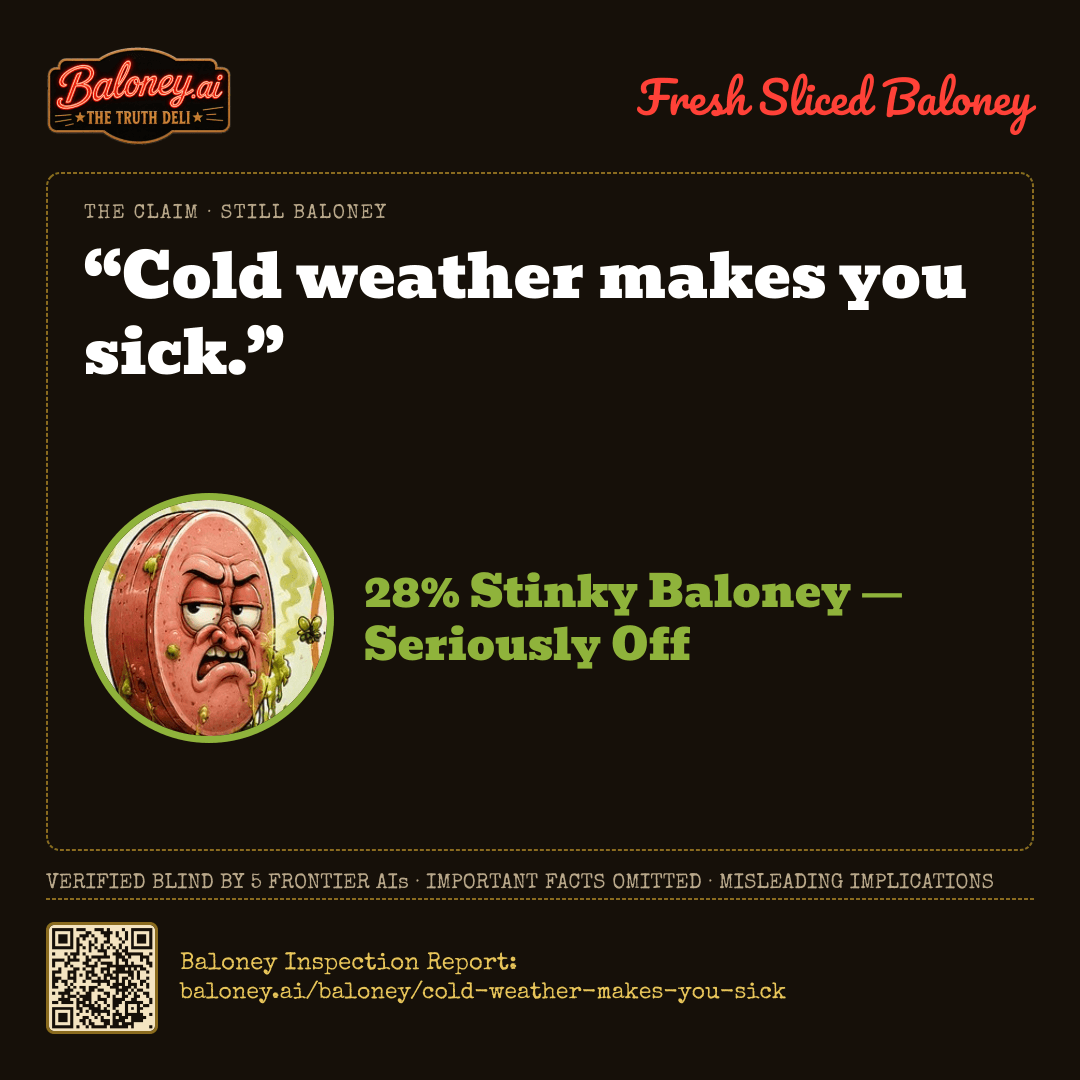
“Cold weather makes you sick.”28% Stinky Baloney — Seriously OffVerified blind by 5 frontier AIs · Baloney Inspection Report: baloney.ai/baloney/cold-weather-makes-you-sick