Baloney Inspection Report: Claim #1150 · Inspected Oct 30, 2026, 9:58 PM PDT · Scoring model v2
 95%
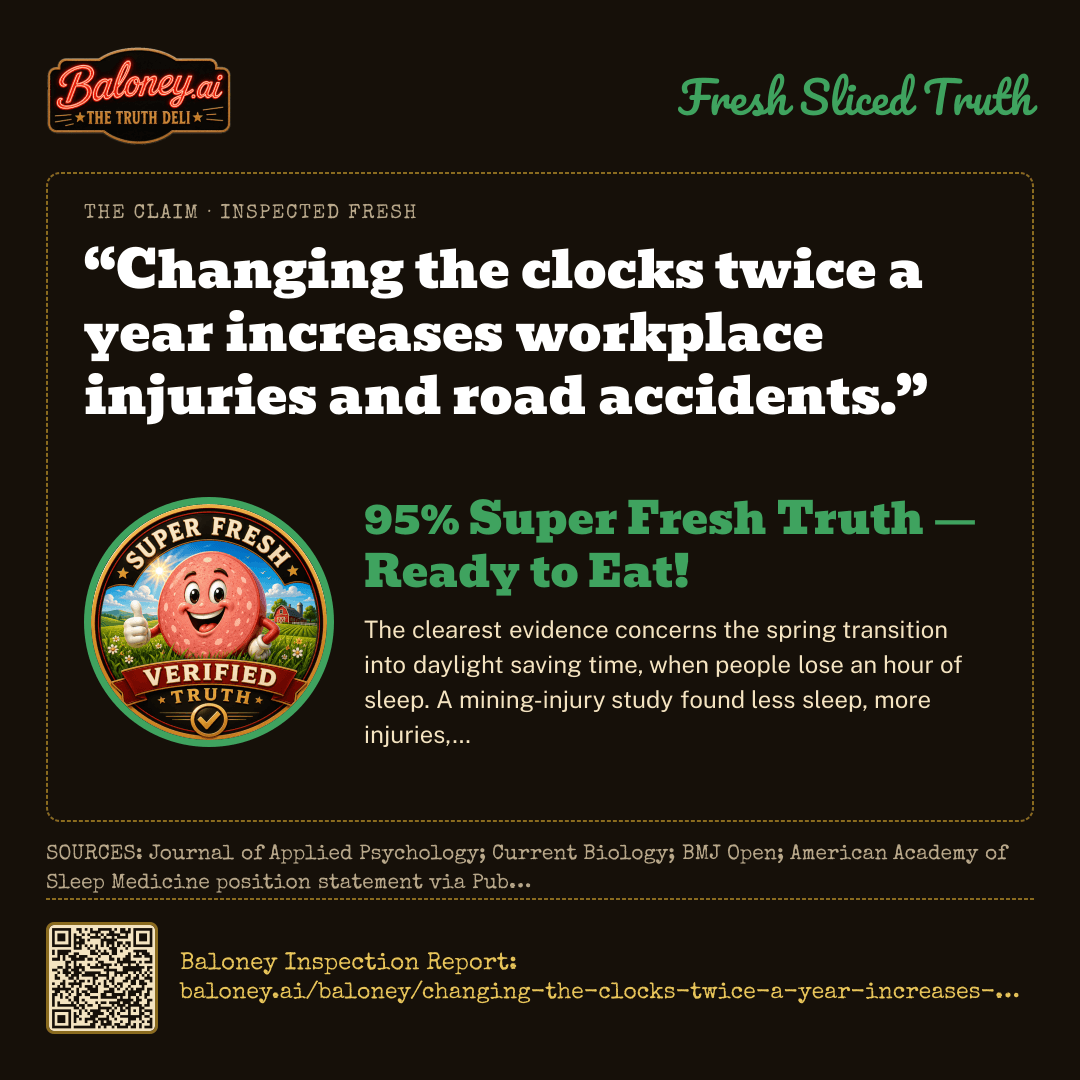
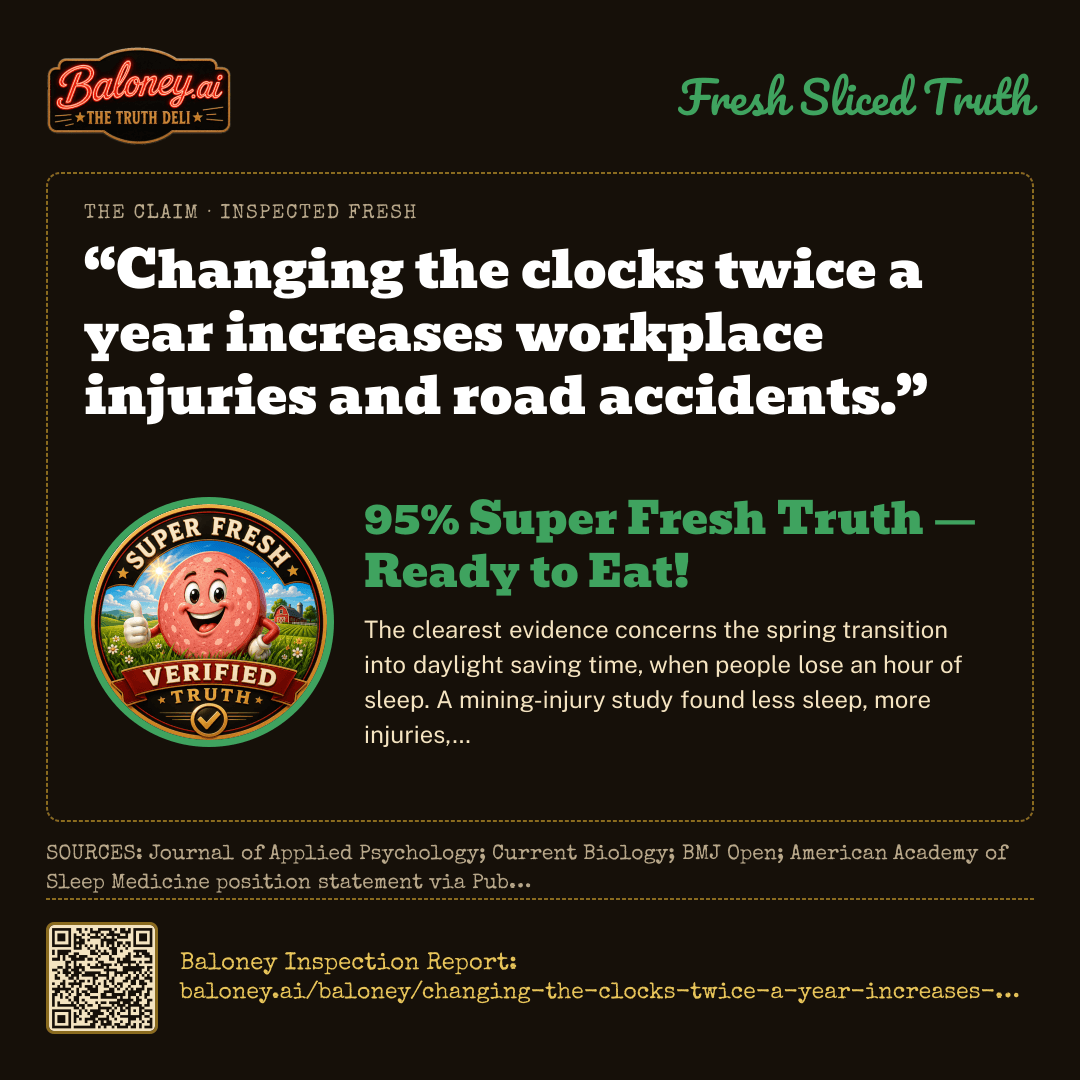
“Changing the clocks twice a year increases workplace injuries and road accidents.”
95%Super Fresh Truth — Ready to Eat!
THE CLAIM CHECKS OUT.
Independently verifiedPhysically repeatable evidenceConfirmed across rival labsSafe to serve
Serve It Fresh
Ready to Serve14 servings
Serve it the way you want it
The Verdict
 “Changing the clocks twice a year increases workplace injuries and road accidents.”95% Super Fresh Truth — Ready to Eat!Verified blind by 5 frontier AIs · Baloney Inspection Report: baloney.ai/baloney/changing-the-clocks-twice-a-year-increases-workplace
The Baloney Sampler
The central finding is real but acute: the rise is clearest after spring forward. Journal of Applied Psychology found US miners slept about 40 minutes less and had more injuries and more lost workdays on the following Monday. Current Biology found a 6% increase in US fatal-crash risk in the week after the spring DST transition, and American Economic Journal: Applied Economics estimated a similar short-term increase in fatal crashes.
The evidence does not show that both yearly changes reliably raise harm. The autumn change often shows no increase, a decrease, or mixed effects. BMJ Open found road-collision studies mixed and often low quality, and the workplace result is strongest in a mining dataset. The claim works best as a short-term spring-transition safety claim, not as a broad statement about every clock change or every workplace.
Resting on Journal of Applied Psychology · Current Biology · American Economic Journal: Applied Economics · BMJ Open
Original Claim Source https://www.reuters.com/business/aerospace-defense/trump-push-end-us-clock-switching-hits-dead-end-2026-10-02/
Other ways to slice it — phrasings that might have changed the rating
- “The spring transition to daylight saving time increases fatal road crashes in the following week.” This narrower claim matches the strongest road evidence cited by the reports, including Current Biology and American Economic Journal: Applied Economics findings of a short-term fatal-crash increase after spring forward.
- “Both the spring and autumn clock changes consistently increase workplace injuries and road accidents.” The reports say the autumn change often shows no increase, a decrease, or mixed timing effects, and the workplace-injury evidence is strongest for spring in a mining dataset.
- “Keeping daylight saving time year-round would reduce total annual traffic fatalities.” Some reports distinguish acute transition harms from the possible safety effects of more evening daylight, noting analyses that estimated fewer pedestrian and vehicle-occupant fatalities under year-round daylight saving time.
Written from the panel’s reports by OpenAI · gpt-5.5. Nothing here changed the score.
The Order Ticket
04:58:34CLAIM RECEIVED — QUEUED FOR INSPECTION✓
04:59:40claude-opus-5 REPORTED — SCORE 4, CONFIDENCE 85✓
04:59:24gpt-5.5 REPORTED — SCORE 5, CONFIDENCE 84✓
04:59:08gemini-3.1-pro-preview REPORTED — SCORE 3, CONFIDENCE 98✓
04:58:40sonar-pro REPORTED — SCORE 24, CONFIDENCE 93✓
05:01:56grok-4.6 REPORTED — SCORE 5, CONFIDENCE 72✓
05:02:41PRIMARY MASTER CHATGPT — SCORE 5✓
05:01:59BLIND VALIDATION PERPLEXITY — SCORE 5✓
05:03:10AGREEMENT CONFIRMED — DELTA 0✓
05:03:10SCORING MODEL V2 — MEDIAN OF 5 COUNTED LAB SCORES: 4, 5, 3, 24, 5 → 5. FRESH RULE: THE PRIMARY MASTER SCORES 5 AND THE BLIND MASTER 5 — BOTH SUPER FRESH TRUTH — AND THE COUNTED MEDIAN IS 5, ON THE TRUE SIDE. PUBLISHED AS 5, THE MORE CAUTIOUS OF THE TWO MASTERS.✓
05:03:10SOURCE RULE — LABS CITED 29 SOURCES: 0 DISCARDED FOR HAVING NO URL, 4 DISCARDED AS DEAD LINKS (404/410), 17 COULD NOT BE OPENED BY US AND ARE MARKED UNVERIFIED.✓
05:03:10SOURCE RULE — PRIMARY MASTER RULED ON 20 SOURCES: 0 DISCARDED FOR HAVING NO URL, 0 DISCARDED AS DEAD LINKS, 13 MARKED UNVERIFIED, 7 VERIFIED.✓
How This One Was Sliced
Station 1 · Blind Inspection — Five Graders, Zero Peeking
Each lab scored the claim independently, without seeing the others. Open a breakdown for its evidence, its sources, and how sure it was.
Anthropic · EQUAL WEIGHT · 65.8s
claude-opus-5
96%TRUTH
ROUND-1 BREAKDOWN
Evidence offered for the claim- Barnes & Wagner (2009, Journal of Applied Psychology) analyzed US Mine Safety and Health Administration data (1983–2006) and found that on the Monday after the spring-forward transition, workers slept ~40 minutes less, injuries rose ~5.7%, and work days lost to injuries rose ~68%; no comparable effect was found after the fall transition.
- Fritz et al. (2020, Current Biology) examined 732,835 US fatal crashes (1996–2017) and found a 6% increase in fatal traffic accident risk in the week following the spring DST transition, with the effect strongest in the morning and in the western (later-sunrise) edges of time zones — a pattern consistent with a circadian/sleep-loss mechanism rather than coincidence.
- Smith (2016, American Economic Journal: Applied Economics) used a regression-discontinuity design on US fatal crash data and estimated roughly a 5–6.5% increase in fatal crash risk for the six days after spring forward, attributing the effect primarily to sleep deprivation rather than ambient light.
- Varughese & Allen (2001, Sleep Medicine) found a significant increase in US fatal traffic accidents on the Monday following the spring shift, and also reported an increase on the Sunday of the autumn shift (attributed to extended late-night activity).
- The American Academy of Sleep Medicine's 2020 position statement, reviewing the literature, concluded that acute transitions into and out of DST are associated with increased motor vehicle crashes and other adverse safety/health outcomes, and advocated abolishing the twice-yearly change in favor of permanent standard time.
- The US Congressional Research Service's overview of DST notes research linking the transitions to sleep disruption and increased accident and injury risk, indicating the association is recognized in policy analysis, not just advocacy literature.
Evidence against the claim- A systematic review in BMJ Open (Carey & Sarma, 2017) of 24 studies concluded the evidence on DST and road traffic collisions is mixed and of generally low quality: some studies found increases after the spring shift, others found no effect or even decreases, and several studies on the autumn shift found reduced collision risk.
- Most of the robust evidence concerns only the spring (lose-an-hour) transition. The claim as written implies both annual changes raise risk, but the autumn transition often shows no increase or a short-term decrease in crashes, so the harm is asymmetric rather than symmetric across the two changes.
- Effect sizes are small in absolute terms and short-lived — typically confined to the first few days to one week after the change — and some of the apparent crash increase in autumn is attributable to earlier evening darkness (a lighting effect) rather than to the act of changing clocks itself.
- The workplace-injury finding rests heavily on a single occupational dataset (US underground mining, an unusually sleep- and shift-sensitive industry); replication across other industries and countries is limited, so generalizing to 'workplace injuries' broadly overstates the evidence base.
- Some national studies (e.g., Finnish data) found no statistically significant change in road traffic accidents around either DST transition, showing the effect is not universally detectable.
- Pre-2000s studies that popularized the claim (e.g., Coren's analyses) used crude time-series methods and have been criticized for failing to control for seasonality, weekday effects and traffic volume.
How sure this lab was85/100 — the lab’s own confidence in the score above, not a second reading of the claim.
SourcesJournal of Applied Psychology (via PubMed/NIH)journal · 92 · Current Biology (Cell Press)journal · 93 · American Economic Journal: Applied Economics (AEA)journal · 90 · BMJ Openjournal · 90 · Sleep Medicine (Elsevier)journal · 82 · Congressional Research Servicegov · 88
OpenAI · EQUAL WEIGHT · 49.6s
gpt-5.5
95%TRUTH
ROUND-1 BREAKDOWN
Evidence offered for the claim- A peer-reviewed Journal of Applied Psychology study using U.S. mine-injury data found that the spring shift to daylight saving time was associated with less sleep and a significant increase in workplace injuries and injury severity on the following Monday; this supports the workplace-injury part of the claim, though mainly for the spring transition and a specific industry.
- A 2020 Current Biology study of U.S. fatal crash data found about a 6% increase in fatal motor-vehicle crashes in the week after the spring daylight-saving transition, supporting the road-accident part of the claim for at least fatal crashes shortly after clocks move forward.
- A New England Journal of Medicine letter found traffic accidents rose after the spring clock change and fell after the autumn change, consistent with the idea that sleep loss at the spring transition can increase road risk.
- The American Academy of Sleep Medicine position statement cites increased motor-vehicle crashes and workplace injuries after the spring daylight-saving transition as part of its rationale for favoring permanent standard time.
- CDC/NIOSH guidance for workers and employers warns that the spring daylight-saving transition can increase fatigue-related safety risk and cites research linking the transition to workplace injuries.
Evidence against the claim- The strongest evidence is concentrated on the spring 'forward' change, when people lose an hour of sleep; the autumn 'back' change often shows smaller, no, or even opposite effects. So the wording 'twice a year' can overstate the evidence if read to mean both clock changes increase injuries and crashes.
- Workplace-injury evidence is not as broad as the claim sounds: a key study used mining-injury records, so it is suggestive but not proof that all workplaces experience the same effect.
- Road-accident findings are not perfectly uniform across countries, methods, and outcome definitions. A Finnish study in Journal of Environmental and Public Health found no significant increase in road traffic accidents after daylight-saving transitions.
- Some road-safety analyses distinguish between the short-term transition effect and the broader effect of more evening daylight; one Accident Analysis & Prevention study estimated that year-round daylight saving time could reduce pedestrian and vehicle-occupant fatalities, which complicates a simple 'DST increases accidents' framing.
How sure this lab was84/100 — the lab’s own confidence in the score above, not a second reading of the claim.
SourcesJournal of Applied Psychology / American Psychological Associationjournal · 90 · Current Biologyjournal · 92 · New England Journal of Medicinejournal · 88 · Journal of Environmental and Public Healthjournal · 78 · Accident Analysis & Preventionjournal · 86
Google · EQUAL WEIGHT · 34.3s
gemini-3.1-pro-preview
97%TRUTH
ROUND-1 BREAKDOWN
Evidence offered for the claim- A 2020 study published in Current Biology analyzed over 732,000 fatal traffic accidents in the U.S. and found a consistent 6% increase in fatal crash risk during the workweek immediately following the spring transition to Daylight Saving Time (DST).
- A widely cited 2009 study in the Journal of Applied Psychology analyzed data from the National Institute for Occupational Safety and Health (NIOSH) and found that workers sleep an average of 40 minutes less on the Monday following the spring clock change. This sleep loss strongly correlated with a spike in both the frequency and severity of workplace injuries on that day.
- While the spring change triggers accidents via sleep deprivation, the autumn 'fall back' transition is associated with an acute spike in evening pedestrian and traffic accidents due to the sudden shift of darkness into the evening rush hour commute.
- The American Academy of Sleep Medicine (AASM) has issued position statements advocating for the elimination of bi-annual clock changes, citing overwhelming evidence that the transitions cause acute disruptions to circadian rhythms, leading to increased risks of motor vehicle crashes, workplace errors, and cardiovascular events.
Evidence against the claim- The autumn clock change (ending DST), which yields an extra hour of sleep, does not cause the same sleep-deprivation-related spike in morning accidents and workplace injuries. Some studies even note a minor decrease in morning accidents immediately following the autumn change.
- Some researchers argue that maintaining DST year-round might reduce the *total* annual number of traffic fatalities by providing more ambient light during evening commutes, suggesting that while the *transitions* cause acute spikes, daylight itself mitigates overall crash rates.
How sure this lab was98/100 — the lab’s own confidence in the score above, not a second reading of the claim.
SourcesNational Institutes of Health (NIH) / PubMedgov · 95 · National Institutes of Health (NIH) / PubMedgov · 95 · National Institutes of Health (NIH) / PubMedgov · 98
Perplexity · EQUAL WEIGHT · 5.6s
sonar-pro
76%TRUTH
ROUND-1 BREAKDOWN
Evidence offered for the claim- A peer-reviewed study of U.S. mining injuries found that the Monday after the spring clock change was associated with 3.6 additional injuries, greater injury severity, 40 minutes less sleep, and about 2,649 additional lost workdays; it found no comparable effect after the autumn change.[1][2]
- A U.S. study of 732,835 fatal motor-vehicle crashes from 1996–2017 found a 6% increase in fatal-crash risk after the spring transition, with the effect concentrated in the following week and no effect after the autumn transition.[3]
- A New Zealand analysis of 12.6 million accident claims reported higher road-accident rates after the spring transition—16% higher on Sunday, 12% higher on Monday, and 6% higher on subsequent weekdays—while finding limited workplace effects.[4]
- The proposed mechanism is plausible: the spring change removes an hour of sleep and creates temporary circadian misalignment, which can impair alertness and reaction time.[1][2][3]
Evidence against the claim- A peer-reviewed U.S. study covering road accidents around transitions from 1981–2006 found that neither the spring nor autumn transition increased road-accident totals.[5]
- A 2019 reappraisal using large U.S. accident datasets found no significant association between the spring transition and fatal or nonfatal accident rates.[6]
- A 2023 Australian study found no effect of either transition, or of long-term daylight-saving observance, on road fatalities, although accident timing shifted with ambient light.[7]
- A 2023 study using all recorded vehicle accidents in Greece found no change in total or minor accidents after entering daylight saving time, a reduction in serious accidents, and only a weak increase in fatal accidents.[8]
- The workplace-injury evidence is narrower than the claim: the strongest positive study examined U.S. mining injuries and found an effect after losing an hour in spring, not a consistent increase after both annual clock changes.[1][2]
How sure this lab was93/100 — the lab’s own confidence in the score above, not a second reading of the claim.
SourcesJournal of Applied Psychologyjournal · 96 · American Psychological Associationother · 90 · Current Biologyjournal · 95 · University of Aucklandedu · 88 · BMC Public Healthjournal · 93 · Sleepjournal · 85 · Economic Inquiryjournal · 93 · Health Economicsjournal · 93
xAI · EQUAL WEIGHT · 202.2s
grok-4.6
95%TRUTH
ROUND-1 BREAKDOWN
Evidence offered for the claim- A 2020 Current Biology analysis of U.S. fatal-crash data found a 6% increase in the workweek after the spring transition, linked to sleep loss and circadian misalignment.
- A 2009 Journal of Applied Psychology study of mining records reported 5.7% more workplace injuries and 67% more lost workdays on the Monday after clocks spring forward.
- The American Academy of Sleep Medicine 2020 position statement lists higher motor-vehicle crash and workplace-injury risk among the reasons to end biannual clock changes.
Evidence against the claim- A 2017 BMJ Open systematic review found the literature on DST and road collisions mixed and of generally low quality, with no consistent overall effect.
- The autumn 'fall-back' change is often associated with fewer (not more) accidents because of the extra hour of sleep, so both yearly changes do not uniformly increase harm.
- Documented spikes are small, last only a few days, and some analyses attribute them to residual confounding (weather, traffic volume, seasonal trends) rather than the clock shift itself.
How sure this lab was72/100 — the lab’s own confidence in the score above, not a second reading of the claim.
SourcesCurrent Biologyjournal · 95 · Journal of Applied Psychologyjournal · 90 · BMJ Openjournal · 92
Station 2 · The Masters
Primary Master · drawn at random
gpt-5.5
95% TRUTH
I scored the statement at the cautious edge of the true band. The strongest, best-replicated evidence supports an acute safety increase after the spring clock change: the Journal of Applied Psychology mining study found less sleep, more workplace injuries, and greater injury severity after spring forward, while Current Biology and other cited road-safety studies found a short-term rise in fatal crashes after the spring daylight-saving transition. The biological mechanism—sleep loss and circadian disruption—is plausible and is also cited by the American Academy of Sleep Medicine and worker-safety guidance. I weighted these peer-reviewed studies heavily. I also gave substantial weight to the caveats: the autumn transition often shows no increase, a decrease, or mixed timing effects; the workplace evidence is narrower than the broad wording suggests; and road-crash findings are not uniform across countries and methods. Those caveats keep the score from being lower, but they do not overturn the central claim that clock changes, especially spring forward, are associated with increased injuries and accidents.
All five evaluators agreed that there is credible evidence of increased road-crash risk after the spring transition and that the key workplace-injury evidence comes from a mining-injury study. They also agreed that the autumn transition is much less clearly harmful and may show no effect or even reduced accidents in some analyses. The main disagreement was scoring: four evaluators treated the wording problem as a caveat within a basically true claim, while one evaluator judged the phrase 'twice a year' and the mixed road literature serious enough to make the statement substantially misleading.
SUPER FRESH — VERIFIED AGAINST JOURNAL OF APPLIED PSYCHOLOGY; CURRENT BIOLOGY; BMJ OPEN; AMERICAN ACADEMY OF SLEEP MEDICINE POSITION STATEMENT VIA PUBMED.
Blind Validation Master · never saw the Primary’s work
sonar-pro
95% TRUTH
The claim is substantially supported, but its wording is broader than the evidence. Multiple reports cite consistent findings that the spring clock change causes short-term increases in fatal road crashes and workplace injuries, plausibly through sleep loss and circadian disruption. However, the strongest evidence concerns only the spring transition, especially the following Monday or week, and is concentrated in fatal crashes and a mining-specific workplace dataset. The autumn change generally shows no increase, a decrease, or mixed results, while systematic reviews find road-accident evidence heterogeneous and sometimes low quality. Thus, changing clocks twice yearly can increase injuries and accidents—primarily after the spring-forward transition—but the statement may imply that both annual changes consistently produce increases, which is not established. Under the scale, this is a substantially true claim with a meaningful but limited wording caveat, warranting a score in the 1–5 band.
AGREEMENT TEST PASSED — BOTH MASTERS SCORED 95% · BLIND VALIDATION CONFIRMED THIS SCORE · NO RE-EVALUATION REQUIRED
How the number was reached · scoring model v2 · how our models work
- Median of 5 counted lab scores: 4, 5, 3, 24, 5 → 5.
- Fresh rule: the Primary Master scores 5 and the Blind Master 5 — both Super Fresh Truth — and the counted median is 5, on the true side. Published as 5, the more cautious of the two masters.
The Evidence
Evidence for the claim
- Spring workplace injuries A Journal of Applied Psychology study using U.S. mine-safety data found that workers slept about 40 minutes less on the Monday after the spring clock change, with more injuries and sharply higher injury severity or lost workdays; no comparable autumn effect was found.
- Fatal crash increase A Current Biology study of more than 700,000 U.S. fatal crashes found about a 6% increase in fatal motor-vehicle crash risk in the workweek after the spring daylight-saving transition.
- Plausible mechanism The cited studies and sleep-medicine statements link the spring effect to sleep loss and circadian misalignment, which can impair alertness, reaction time, and workplace safety.
- Other supporting studies Evaluators cited additional analyses, including Smith's regression-discontinuity work and some earlier traffic studies, reporting short-term increases in fatal crashes after spring forward.
- Autumn crash spike DEBUNKED — One report cited an autumn evening risk from suddenly darker commute hours, but the panel treated this as only partly supportive: several cited studies found no autumn increase, reduced accidents, or effects better explained by ambient light than by the act of changing clocks.
Evidence offered against the claim
- Autumn is different The clearest harm is after losing an hour in spring. The fall-back transition often shows no increase, smaller effects, or even fewer accidents, so 'twice a year' is too broad if it means both clock changes have the same effect.
- Workplace evidence is narrow The strongest workplace-injury evidence comes from U.S. mining, a safety-sensitive industry; evaluators noted limited replication across broader workplaces.
- Road literature is mixed A BMJ Open systematic review and several national or later analyses found mixed, null, or context-dependent road-accident results around daylight-saving transitions.
- Short-lived effect Where found, the risk increase is acute and brief, usually concentrated in the first days or week after the spring transition rather than persisting year-round.
- Light complicates interpretation Some analyses distinguish the transition effect from the effect of more evening daylight; year-round daylight saving has been argued by some studies to reduce certain fatalities.
Sources · Reliability · Why Accepted or Discounted
| Source | Type | Reliability | Ruling |
|---|
| National Institutes of Health / PubMed | gov | 95 | ACCEPTED — PubMed record for the Current Biology fatal-crash study; accepted as a strong peer-reviewed source for the spring-transition road-risk finding. |
| National Institutes of Health / PubMed | gov | 92 | ACCEPTED — PubMed record for the Journal of Applied Psychology workplace-injury study; accepted as the main evidence on spring-transition occupational injury. |
| National Institutes of Health / PubMed | gov | 95 | ACCEPTED — Accepted for the American Academy of Sleep Medicine position statement summarizing health and safety risks of clock changes; useful for context, not primary causal estimation. |
| Journal of Applied Psychologyunverified | journal | 96 | ACCEPTED — Peer-reviewed primary study of mining injuries and sleep loss after the spring transition; heavily weighted but limited in generalizability. |
| American Psychological Association | other | 90 | ACCEPTED — Accepted as a secondary summary of the Journal of Applied Psychology study; not weighted as strongly as the journal article itself. |
| Current Biologyunverified | journal | 95 | ACCEPTED — Peer-reviewed fatal-crash analysis; accepted as strong evidence for a spring-transition increase in fatal crashes. |
| University of Auckland | edu | 88 | ACCEPTED — Accepted as an institutional summary of New Zealand accident-claim findings; secondary and therefore given less weight than peer-reviewed articles. |
| BMC Public Health | journal | 93 | ACCEPTED — Peer-reviewed study reporting no road-accident increase around transitions; accepted as important counterevidence. |
| Sleepunverified | journal | 85 | ACCEPTED — Accepted cautiously because it appears to be an abstract rather than a full article; useful as counterevidence but weighted less than full peer-reviewed studies. |
| Economic Inquiryunverified | journal | 93 | ACCEPTED — Peer-reviewed analysis finding no Australian road-fatality effect; accepted as credible evidence that effects vary by setting and method. |
| Health Economicsunverified | journal | 93 | ACCEPTED — Peer-reviewed Greece vehicle-accident study with mixed findings; accepted as counterevidence to a universal road-accident increase. |
| Current Biologyunverified | journal | 95 | ACCEPTED — Peer-reviewed Current Biology fatal-crash paper; accepted as a key source for the 6% spring-transition fatal-crash increase. |
| American Economic Journal: Applied Economics | journal | 90 | ACCEPTED — Peer-reviewed regression-discontinuity study; accepted as supporting evidence for a short-term fatal-crash increase after spring forward. |
| BMJ Openunverified | journal | 92 | ACCEPTED — Peer-reviewed systematic review; accepted as important evidence that the road-collision literature is mixed and sometimes low quality. |
| Sleep Medicineunverified | journal | 82 | ACCEPTED — Accepted as an earlier peer-reviewed traffic-accident study; weighted modestly because evaluators noted older studies often used cruder methods. |
| Congressional Research Serviceunverified | gov | 88 | ACCEPTED — Accepted as policy background summarizing research on DST, sleep disruption, accidents, and injuries; not treated as primary evidence. |
| Current Biologyunverified | journal | 92 | ACCEPTED — Accepted as another URL for the peer-reviewed Current Biology crash study supporting the spring-transition fatal-crash increase. |
| New England Journal of Medicineunverified | journal | 88 | ACCEPTED — Accepted as supporting older evidence of increased traffic accidents after spring change and reduced accidents after autumn change; weighted less than newer larger analyses. |
| Journal of Environmental and Public Healthunverified | journal | 78 | ACCEPTED — Accepted as peer-reviewed counterevidence reporting no significant Finnish road-traffic accident increase around DST transitions. |
| Accident Analysis & Preventionunverified | journal | 86 | ACCEPTED — Accepted for the distinction between short-term transition harms and possible benefits of more evening daylight; relevant to context but not decisive on the transition claim. |
Every link was opened when this claim was inspected. A dead link was discarded before publication; “unverified” means the site refused our automated check and the link is the one the panel cited. A source without a URL was never kept.
Serve It Fresh
Ready to Serve14 servings
Serve it the way you want it
The Verdict
“Changing the clocks twice a year increases workplace injuries and road accidents.”95% Super Fresh Truth — Ready to Eat!Verified blind by 5 frontier AIs · Baloney Inspection Report: baloney.ai/baloney/changing-the-clocks-twice-a-year-increases-workplace