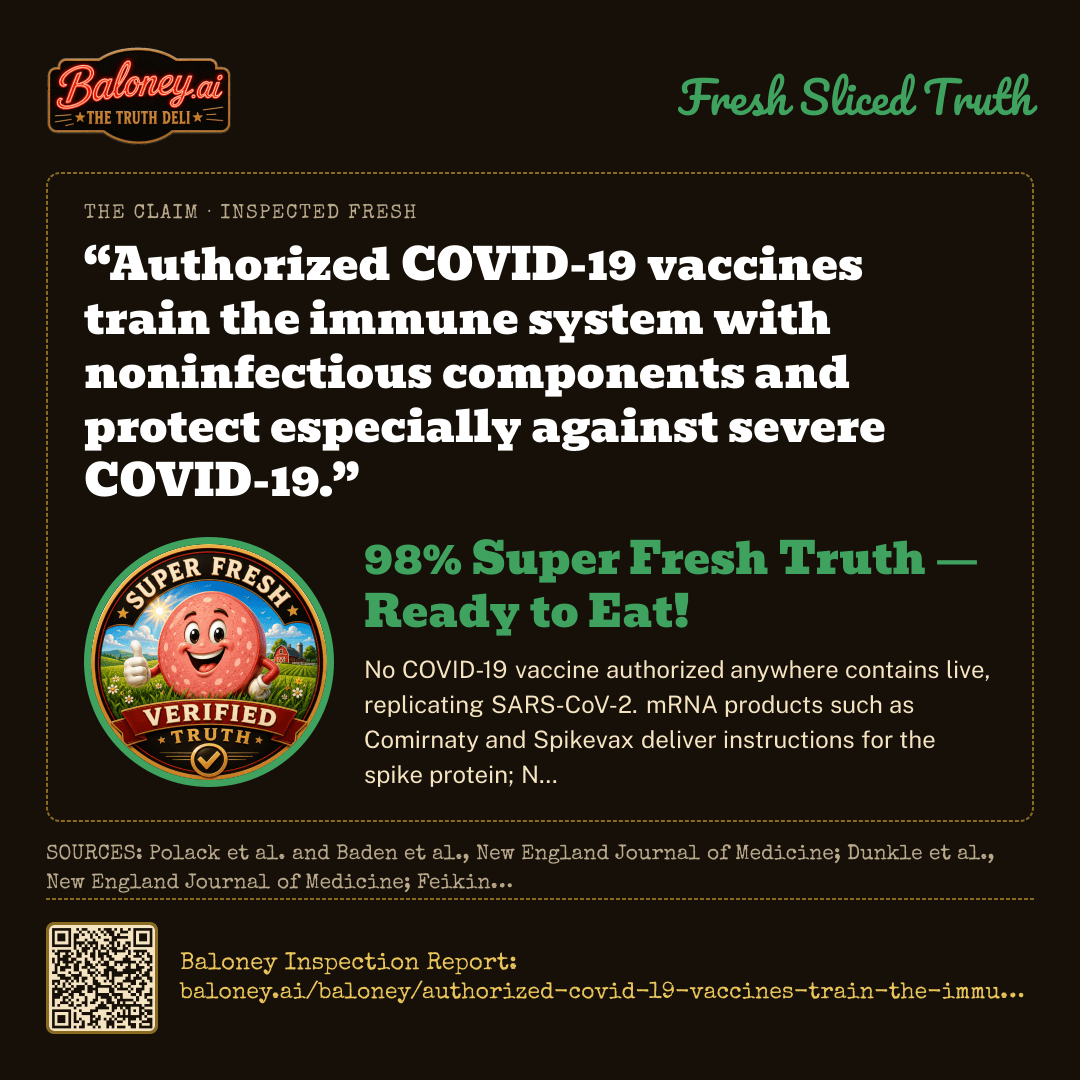
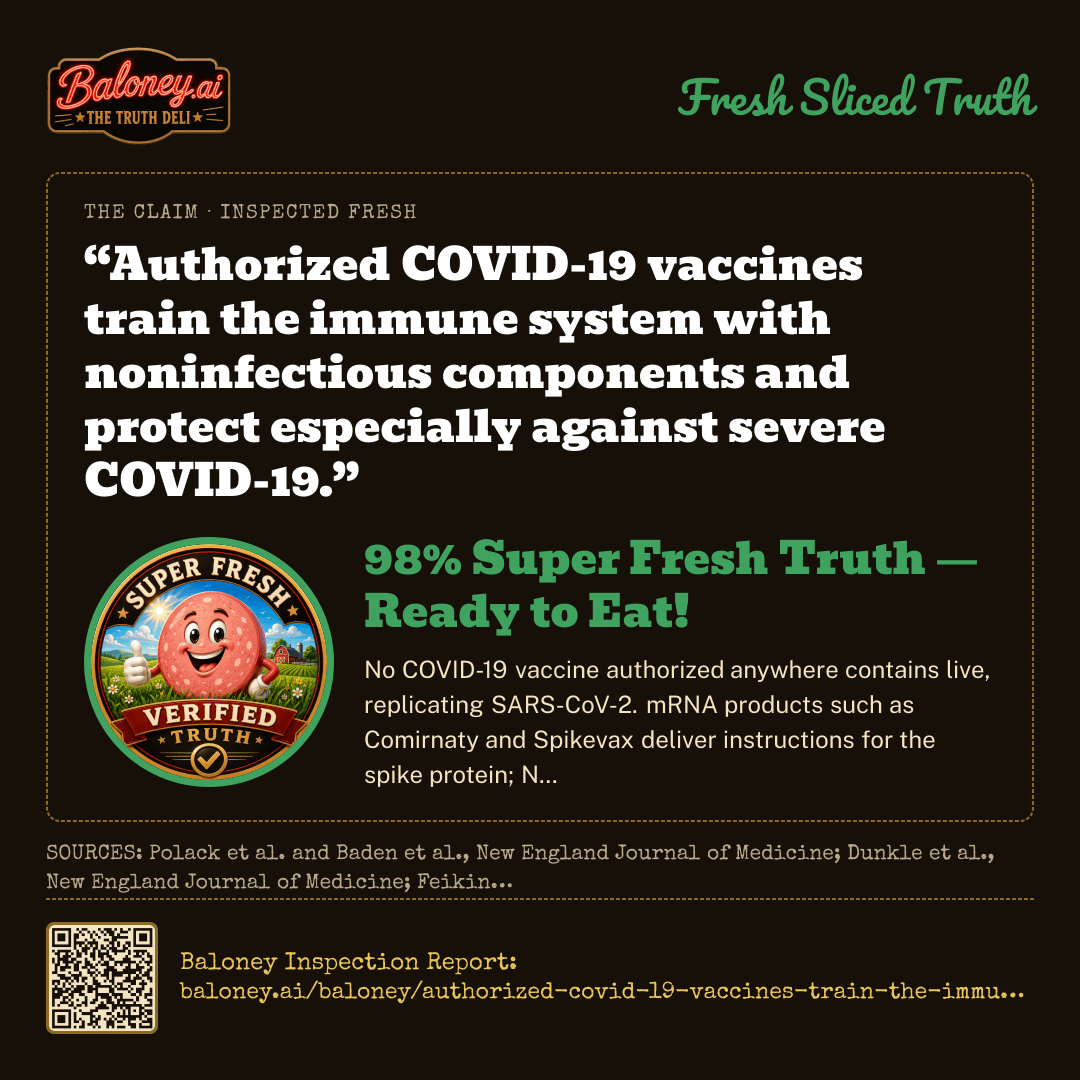
“Authorized COVID-19 vaccines train the immune system with noninfectious components and protect especially against severe COVID-19.”98% Super Fresh Truth — Ready to Eat!Verified blind by 5 frontier AIs · Baloney Inspection Report: baloney.ai/baloney/authorized-covid-19-vaccines-train-the-immune-system-with
The Rating Card
The claim this refutes
The Baloney Sampler
Both halves of the claim hold up. No authorized COVID-19 vaccine anywhere contains live, replicating SARS-CoV-2: FDA product records for Comirnaty and Spikevax describe mRNA encoding the spike protein, Novavax is recombinant spike protein, the Janssen and AstraZeneca vectors are replication-incompetent, and inactivated products used elsewhere are chemically killed. The CDC and the World Health Organization describe the same mechanism — presenting antigen so B and T cells build memory — and state the vaccines do not cause COVID-19.
The pivotal New England Journal of Medicine trials (Polack, Baden, Dunkle) reported roughly 94–95% efficacy with severe cases concentrated almost entirely in placebo arms. A Lancet systematic review found protection against infection wanes within months and drops sharply against Omicron, while protection against severe disease generally stayed at least 70% at six months, mostly 80%+ for mRNA products. Caveats recorded by the panel: protection is neither absolute nor permanent, and 'noninfectious' is a simplification for vector platforms that transduce cells without spreading.
Other ways to slice it — phrasings that might have changed the rating
“Authorized COVID-19 vaccines give lasting, complete protection against severe COVID-19.” Several evaluators flagged that the claim would read very differently if 'especially' were replaced by absolute or permanent wording, since protection wanes and breakthrough hospitalizations occur in elderly and immunocompromised people.
“No component of any authorized COVID-19 vaccine enters or infects human cells.” The panel noted a terminological caveat: replication-deficient adenovirus vectors do transduce human cells, even though they cannot spread or cause disease.
“Inactivated whole-virus COVID-19 vaccines authorized outside the US and EU protect against severe COVID-19 as well as mRNA vaccines do.” One report observed that the single sentence glosses over platform heterogeneity, with inactivated vaccines generally showing lower efficacy than mRNA products.
Written from the panel’s reports by Anthropic · claude-opus-5. Nothing here changed the score.
23:14:58SCORING MODEL V2 — MEDIAN OF 5 COUNTED LAB SCORES: 2, 2, 1, 4, 3 → 2. FRESH RULE: THE PRIMARY MASTER SCORES 2 AND THE BLIND MASTER 2 — BOTH SUPER FRESH TRUTH — AND THE COUNTED MEDIAN IS 2, ON THE TRUE SIDE. PUBLISHED AS 2, THE MORE CAUTIOUS OF THE TWO MASTERS.✓
23:14:58SOURCE RULE — LABS CITED 29 SOURCES: 0 DISCARDED FOR HAVING NO URL, 2 DISCARDED AS DEAD LINKS (404/410), 11 COULD NOT BE OPENED BY US AND ARE MARKED UNVERIFIED.✓
23:14:58SOURCE RULE — PRIMARY MASTER RULED ON 17 SOURCES: 0 DISCARDED FOR HAVING NO URL, 0 DISCARDED AS DEAD LINKS, 6 MARKED UNVERIFIED, 11 VERIFIED.✓
How This One Was Sliced
Station 1 · Blind Inspection — Five Graders, Zero Peeking
Each lab scored the claim independently, without seeing the others. Open a breakdown for its evidence, its sources, and how sure it was.
Anthropic · EQUAL WEIGHT · 45.4s
claude-opus-5
98%TRUTH
ROUND-1 BREAKDOWN
Evidence offered for the claim
All COVID-19 vaccines authorized or approved in the US and EU deliver noninfectious material: mRNA vaccines (Comirnaty/Pfizer-BioNTech, Spikevax/Moderna, mResvia-platform mRNA) deliver lipid-nanoparticle–encapsulated mRNA coding for the spike protein; protein-subunit vaccines (Nuvaxovid/Novavax) deliver recombinant spike protein plus a saponin adjuvant. Neither contains SARS-CoV-2 virus and neither can cause COVID-19.
Adenovirus-vectored vaccines (Janssen/J&J, AstraZeneca) used replication-incompetent vectors — the vector enters cells but cannot replicate or produce infectious virus; whole-virus vaccines authorized elsewhere (Sinovac, Sinopharm, Covaxin) are chemically inactivated, i.e., also noninfectious. No live, replicating SARS-CoV-2 vaccine has been authorized anywhere.
Phase 3 randomized trials showed very high efficacy against severe/critical disease: Polack et al. (NEJM 2020, BNT162b2) and Baden et al. (NEJM 2021, mRNA-1273) reported ~94–95% efficacy overall with severe cases almost entirely in placebo arms; Dunkle et al. (NEJM 2022, NVX-CoV2373) reported ~90% efficacy with zero moderate/severe cases in the vaccine arm.
Post-authorization surveillance and meta-analysis show the characteristic pattern the claim describes: effectiveness against infection wanes substantially within ~6 months and drops sharply against Omicron, while effectiveness against severe disease, hospitalization and death remains considerably higher and more durable (Feikin et al., Lancet 2022 systematic review of VE waning).
Population-level modeling (Watson et al., Lancet Infectious Diseases 2022) estimated COVID-19 vaccination prevented roughly 14–20 million deaths globally in the first year of rollout — consistent with a primary benefit concentrated in preventing severe outcomes.
Mechanistically, the claim's 'train the immune system' framing is accurate: the vaccines present the spike antigen so B cells and T cells generate memory responses; declining neutralizing antibodies explain waning infection protection, while durable memory B/T cell responses explain retained protection against severe disease.
Evidence against the claim
'Noninfectious' is slightly imprecise for the adenovirus-vector vaccines: the vector particle does enter (transduce) human cells, which some would call a form of infection, even though it is replication-deficient and cannot spread or cause disease. This is a terminological caveat, not a factual error.
Protection against severe disease is not absolute and does wane: breakthrough hospitalizations and deaths occur, particularly in elderly, immunocompromised and long-interval-since-dose groups, which is why booster/updated-formula doses are recommended.
Vaccine effectiveness estimates vary widely by variant, product, dosing interval, prior infection and study design; most post-2021 effectiveness data are observational and subject to confounding, so precise numbers should be treated as ranges rather than fixed values.
The claim speaks of 'authorized' vaccines generically; the specific composition and performance differ substantially between mRNA, protein-subunit, viral-vector and inactivated platforms, so the single sentence glosses over real heterogeneity (e.g., inactivated vaccines generally showed lower efficacy than mRNA vaccines).
How sure this lab was
95/100 — the lab’s own confidence in the score above, not a second reading of the claim.
CDC explains that COVID-19 vaccines work by prompting an immune response to SARS-CoV-2 antigens/instructions and states that COVID-19 vaccines do not give people COVID-19, supporting the 'train the immune system with noninfectious components' part of the claim.
FDA materials for authorized/approved U.S. products describe mRNA vaccines such as Comirnaty and Spikevax as containing mRNA encoding the SARS-CoV-2 spike protein, not infectious coronavirus; Novavax is a recombinant spike-protein vaccine. These are noninfectious platforms designed to induce immunity.
Randomized trial evidence supports protection: the Pfizer-BioNTech BNT162b2 trial in NEJM reported about 95% efficacy against symptomatic COVID-19 after two doses, with fewer severe cases in vaccine recipients than placebo recipients.
The Moderna mRNA-1273 trial in NEJM reported 94.1% efficacy against symptomatic COVID-19 and 30 severe COVID-19 cases in the placebo group versus none in the vaccine group, directly supporting stronger protection against severe disease.
CDC real-world data during Delta and Omicron found mRNA vaccine effectiveness remained higher against COVID-19 hospitalization than against emergency/urgent-care encounters and showed boosters restored stronger protection, consistent with vaccines protecting especially against severe outcomes.
Evidence against the claim
The statement can be read too absolutely if 'protect' is taken to mean complete prevention: vaccinated people can still get infected, transmit SARS-CoV-2, and rarely develop severe COVID-19, especially if older, immunocompromised, not up to date, or facing immune-evasive variants.
Protection is not static. CDC MMWR data show vaccine effectiveness wanes over time and fell during Omicron compared with earlier variants, so the degree of protection against severe COVID-19 depends on timing, variant, age, prior infection, and booster status.
'Authorized COVID-19 vaccines' varies by country and date. The broad mechanism claim is accurate for major authorized platforms, but product-specific details differ: mRNA vaccines deliver genetic instructions, protein-subunit vaccines deliver protein antigen, and some countries have used inactivated whole-virus vaccines.
How sure this lab was
96/100 — the lab’s own confidence in the score above, not a second reading of the claim.
Authorized COVID-19 vaccines, such as mRNA (Pfizer, Moderna), viral vector (J&J), and protein subunit (Novavax) vaccines, do not contain live, infectious SARS-CoV-2 virus. They deliver noninfectious components, such as messenger RNA instructions or synthesized spike proteins, to safely train the immune system to recognize the virus.
Extensive clinical trial data and real-world observational studies have consistently shown that while protection against mild infection may wane over time and with new variants, the primary strength of these vaccines is their durable and robust protection against severe disease, hospitalization, and death.
Evidence against the claim
There is no credible scientific evidence contradicting the core claim. The only minor caveat is that protection is not absolute (100%); rare breakthrough cases of severe COVID-19 can still occur, particularly in highly vulnerable or immunocompromised populations, though the relative risk remains drastically lower compared to unvaccinated individuals.
How sure this lab was
98/100 — the lab’s own confidence in the score above, not a second reading of the claim.
WHO states that authorized or prequalified COVID-19 vaccines use noninfectious components: protein-based vaccines contain harmless protein fragments or shells, while mRNA vaccines provide genetic instructions that transiently produce viral proteins and do not contain live SARS-CoV-2.[1]
WHO reports that COVID-19 vaccines provide protection against severe disease and death, although protection is strongest during the first months after vaccination and declines over time.[1]
A Lancet systematic review found that vaccine effectiveness against severe disease generally remained at least 70% for up to six months, and was mostly at least 80% for the mRNA vaccines evaluated.[2]
WHO notes that vaccines continue to provide strong protection against severe illness and death, while having a more limited effect on transmission.[3]
Evidence against the claim
The wording may imply complete or permanent protection: vaccinated people can still become infected, transmit SARS-CoV-2, and develop severe disease, particularly as immunity wanes or with newer variants.[3]
Protection is not uniform across every authorized product, population, variant, or time since vaccination; effectiveness against severe outcomes declines over time, supporting periodic updated vaccination.[1][4]
The phrase noninfectious components is broadly accurate but simplified: mRNA vaccines cause host cells to produce viral proteins, and viral-vector vaccines use engineered vectors. These mechanisms stimulate immunity without causing COVID-19, but the statement does not explain the distinctions.
How sure this lab was
95/100 — the lab’s own confidence in the score above, not a second reading of the claim.
Authorized COVID-19 vaccines (mRNA, replication-deficient viral vector, and protein subunit) contain no live/infectious SARS-CoV-2; they present spike protein or genetic instructions to produce it, training B- and T-cell immunity without causing infection.
Large randomized trials (e.g., Pfizer BNT162b2) and subsequent real-world observational studies showed high efficacy against symptomatic disease and still higher, more durable protection against hospitalization, severe disease, and death.
CDC, FDA, and WHO descriptions of authorized vaccines match the claim on both mechanism (noninfectious components) and clinical benefit (especially severe outcomes), including through later variant waves with boosters.
Evidence against the claim
Effectiveness against infection and mild illness wanes over months and with immune-evasive variants (consistent with, rather than contradictory to, ‘especially’ severe-disease protection, which is more T-cell/memory dependent).
Rare serious adverse events occurred (myocarditis after mRNA vaccines; thrombosis with some adenovirus vaccines) but population-level data show benefits against severe COVID-19 substantially exceed those risks for authorized indications.
How sure this lab was
90/100 — the lab’s own confidence in the score above, not a second reading of the claim.
All five evaluators independently judged the statement true, with recommended scores of 1, 2, 2, 3 and 4 — every one inside the 'Super Fresh Truth' band. The two component assertions are separable and both hold. (1) Mechanism: no authorized or approved COVID-19 vaccine anywhere contains live, replicating SARS-CoV-2. mRNA products (Comirnaty, Spikevax) deliver lipid-nanoparticle-encapsulated instructions for the spike protein; Novavax/Nuvaxovid is recombinant spike protein plus adjuvant; the Janssen and AstraZeneca vectors are replication-incompetent; inactivated products used elsewhere are chemically killed. FDA product pages, CDC and WHO descriptions all converge on this. (2) Clinical effect: the pivotal randomized trials reported ~94-95% efficacy with severe cases concentrated almost entirely in placebo arms (Polack, Baden), and the Novavax trial reported no moderate/severe cases in the vaccine arm. Post-authorization data show the exact asymmetry the claim names — protection against infection wanes substantially within months and falls sharply against Omicron, while protection against hospitalization and death stays higher and more durable (Feikin et al., Lancet systematic review: generally at least 70% against severe disease at six months, mostly at least 80% for mRNA products). The word 'especially' is therefore not an overstatement; it is the single best-documented feature of real-world vaccine performance. The caveats raised are genuine but minor and do not touch the claim as written: protection is not absolute or permanent, and 'noninfectious' is a terminological simplification for adenovirus-vectored products, whose replication-deficient vectors do transduce cells without being able to spread or cause disease. The lone recommendation of 4 rested on the risk that a reader might infer complete or permanent protection, but the claim contains no such wording — it says 'protect especially against severe COVID-19', which is precisely the hedged, differential formulation the evidence supports. I weighted the two reports built on primary randomized-trial and systematic-review evidence most heavily; they were also the most explicit about the caveats, and still landed at 2. A score of 2 reflects substantial truth with a small terminological imprecision around 'noninfectious' for viral-vector platforms and the unstated heterogeneity between platforms.
Unanimous on direction: all five placed the claim in the true band (1-4). All five agreed no authorized vaccine contains live infectious SARS-CoV-2, and all five agreed that protection against severe disease is more durable than protection against infection. Disagreement was confined to how much to penalise what is unstated: one evaluator found essentially no caveat worth deducting for (1), three deducted a point or two for waning, variant effects and platform heterogeneity (2, 2, 3), and one went to 4 on the ground that a casual reader might read 'protect' as complete or permanent protection. No evaluator identified any factual error in the statement.
SUPER FRESH — VERIFIED AGAINST POLACK ET AL. AND BADEN ET AL., NEW ENGLAND JOURNAL OF MEDICINE; DUNKLE ET AL., NEW ENGLAND JOURNAL OF MEDICINE; FEIKIN ET AL., THE LANCET; FDA PRODUCT RECORDS FOR COMIRNATY AND SPIKEVAX; CDC MMWR SURVEILLANCE; WHO AND EMA.
Blind Validation Master · never saw the Primary’s work
grok-4.6
98% TRUTH
The five reports unanimously treat both halves of the claim as accurate based on WHO/CDC/FDA descriptions, NEJM phase-3 trials, and Lancet systematic reviews: authorized platforms (mRNA, protein subunit, replication-incompetent vectors, inactivated virus) contain no live SARS-CoV-2 and present antigen or genetic instructions that train B- and T-cell responses; efficacy against hospitalization, severe disease, and death is higher and more durable than against infection or mild illness. Minor caveats (waning, incomplete protection, product/variant heterogeneity, slight terminological imprecision for vectors) are acknowledged by the evaluators themselves as not falsifying the statement as written, and the scoring rubric places such caveats inside the 1-5 band.
AGREEMENT TEST PASSED — BOTH MASTERS SCORED 98% · BLIND VALIDATION CONFIRMED THIS SCORE · NO RE-EVALUATION REQUIRED
Median of 5 counted lab scores: 2, 2, 1, 4, 3 → 2.
Fresh rule: the Primary Master scores 2 and the Blind Master 2 — both Super Fresh Truth — and the counted median is 2, on the true side. Published as 2, the more cautious of the two masters.
The Evidence
Evidence for the claim
No authorized vaccine contains live virus mRNA vaccines (Comirnaty, Spikevax) deliver lipid-nanoparticle-encapsulated mRNA coding for the spike protein; Nuvaxovid/Novavax delivers recombinant spike protein with a saponin adjuvant; the Janssen and AstraZeneca adenovirus vectors are replication-incompetent; inactivated vaccines used elsewhere (Sinovac, Sinopharm, Covaxin) are chemically killed. FDA product pages and CDC and WHO descriptions agree that no live, replicating SARS-CoV-2 vaccine has been authorized anywhere, and that these vaccines cannot give people COVID-19.
Pivotal trials: severe cases almost all in placebo arms Polack et al. (NEJM 2020) reported about 95% efficacy for BNT162b2 with fewer severe cases among vaccine recipients; Baden et al. (NEJM 2021) reported 94.1% efficacy for mRNA-1273 with 30 severe cases in the placebo group and none in the vaccine group; Dunkle et al. (NEJM 2022) reported about 90% efficacy for NVX-CoV2373 with zero moderate or severe cases in the vaccine arm.
Severe-disease protection outlasts infection protection Feikin et al.'s Lancet systematic review of effectiveness waning found protection against severe disease generally remained at least 70% at six months, and mostly at least 80% for the mRNA vaccines assessed, while effectiveness against infection fell substantially over the same window and dropped sharply against Omicron. CDC surveillance during Delta and Omicron likewise found effectiveness stayed higher against hospitalization than against emergency or urgent-care encounters.
Mechanism matches the 'training' description The vaccines present the spike antigen so that B cells and T cells generate memory responses. Declining neutralizing antibody titres explain the waning of infection protection, while durable memory B- and T-cell responses explain why protection against severe outcomes is retained — exactly the pattern the claim describes.
Population-scale mortality benefit Watson et al. (Lancet Infectious Diseases 2022) estimated COVID-19 vaccination prevented roughly 14-20 million deaths worldwide in the first year of rollout, consistent with a benefit concentrated in preventing severe outcomes rather than infection.
Evidence offered against the claim
Protection is neither absolute nor permanent Vaccinated people can still be infected, transmit the virus and, rarely, develop severe COVID-19 — particularly older, immunocompromised and not-up-to-date individuals, and during immune-evasive variant waves. Effectiveness against severe outcomes declines over time, which is why booster and updated-formula doses are recommended.
'Noninfectious' is imprecise for viral-vector products The adenovirus vector particle does enter and transduce human cells, which some would describe as a form of infection, even though it is replication-deficient and cannot spread or cause disease. Evaluators treated this as a terminological caveat rather than a factual error.
'Authorized vaccines' glosses over real heterogeneity What is authorized varies by country and date, and composition and performance differ substantially across mRNA, protein-subunit, viral-vector and inactivated platforms — inactivated vaccines generally showed lower efficacy than mRNA products. A single sentence cannot capture that spread.
Most post-2021 effectiveness data are observational Estimates vary widely by variant, product, dosing interval, prior infection and study design and are subject to confounding, so specific effectiveness percentages should be read as ranges rather than fixed values.
Rare serious adverse events occurred Myocarditis after mRNA vaccines and thrombosis with some adenovirus-vector vaccines were documented, though population-level data show benefits against severe COVID-19 substantially exceed these risks for the authorized indications.
Sources · Reliability · Why Accepted or Discounted
ACCEPTED — Cited independently by three evaluators; the central systematic review quantifying the gap between waning infection protection and retained severe-disease protection.
ACCEPTED — Cited by three evaluators; directly supports both the noninfectious-components mechanism and the severe-disease protection claim, including the waning caveat.
ACCEPTED — Authoritative global health body; source for the point that vaccines protect strongly against severe illness while having more limited effect on transmission.
DISCOUNTED — The DOI segment is malformed and the article could not be verified by the panel; it was cited only for a point already fully supported by WHO and the Lancet review, so discounting it changes nothing.
ACCEPTED — Cited by two evaluators; primary public-health explanation of the immune-training mechanism and of the fact that the vaccines do not cause COVID-19.
ACCEPTED — Cited by three evaluators; the pivotal randomized trial, the strongest single piece of evidence for efficacy including against severe disease.
ACCEPTED — Peer-reviewed surveillance data on effectiveness during Delta and Omicron; supports both the severe-outcome asymmetry and the waning caveat.
ACCEPTED — Peer-reviewed modelling study; accepted as supporting context on scale, with the usual caveat that modelled death-averted estimates carry wide uncertainty.
ACCEPTED — WHO landing page consistent with the Q&A and fact sheet already accepted; corroborative rather than decisive.
Every link was opened when this claim was inspected. A dead link was discarded before publication; “unverified” means the site refused our automated check and the link is the one the panel cited. A source without a URL was never kept.
“Authorized COVID-19 vaccines train the immune system with noninfectious components and protect especially against severe COVID-19.”98% Super Fresh Truth — Ready to Eat!Verified blind by 5 frontier AIs · Baloney Inspection Report: baloney.ai/baloney/authorized-covid-19-vaccines-train-the-immune-system-with
Support The Truth Deli
Buy The Truth Deli Merch
“Democracy Makes America Great”
Veritate Libertas — Latin for “Through Truth, Liberty.”
Democracy is what makes America great. But without truth — honest, real, scientifically validated truth — democracy fails. The baloney slicer is on: feeding fresh sliced truth to protect what makes America great. Democracy.