Baloney Inspection Report: Claim #1058 · Inspected Sep 29, 2026, 5:51 PM PDT · Scoring model v2 · Earlier report, model v1
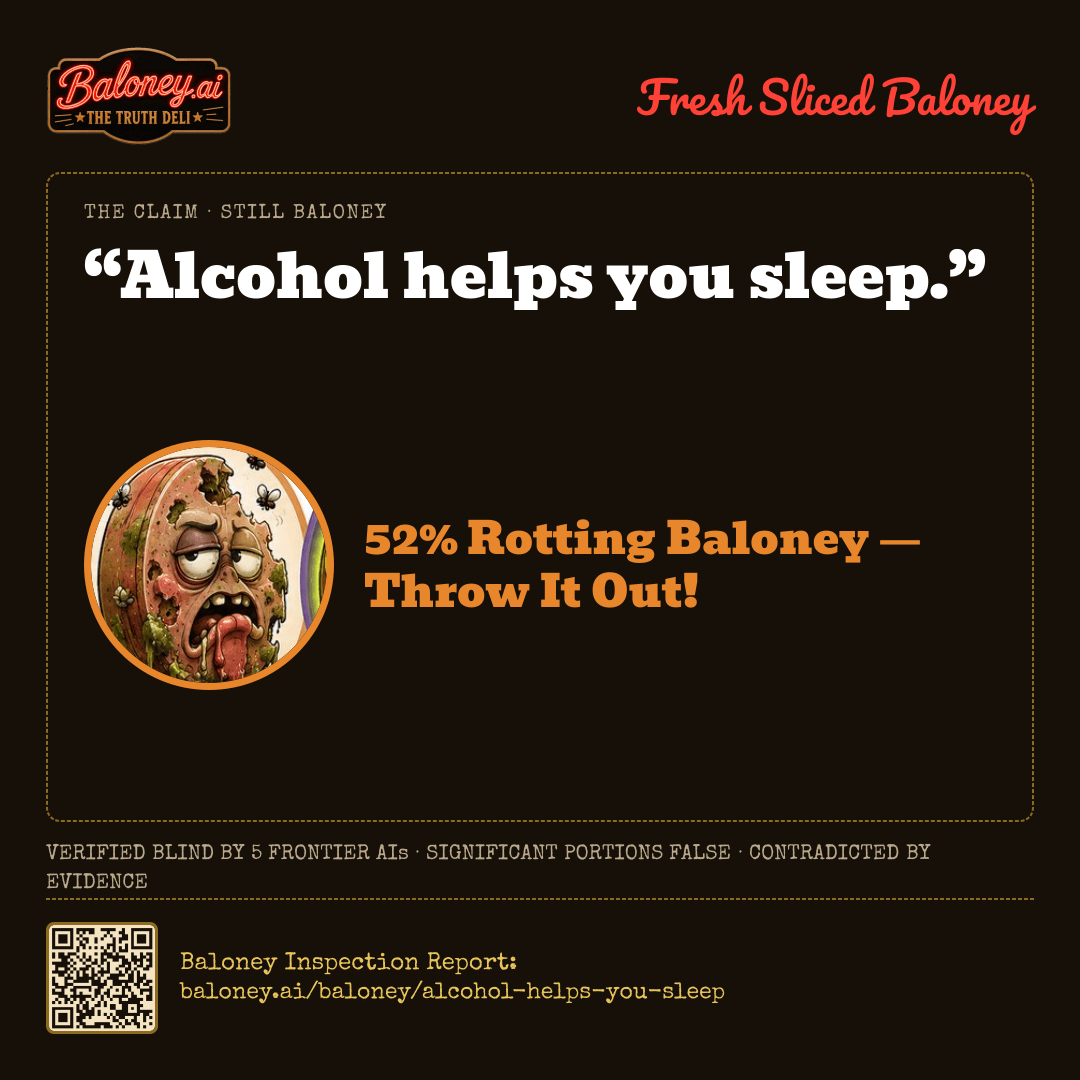
 52%
“Alcohol helps you sleep.”
52%Rotting Baloney — Throw It Out!
Most of this claim has spoiled.
Significant portions falseContradicted by evidenceUnsupported assertionsDeceptive narrative
Serve It Fresh
Ready to Serve13 servings
Serve it the way you want it
The Verdict
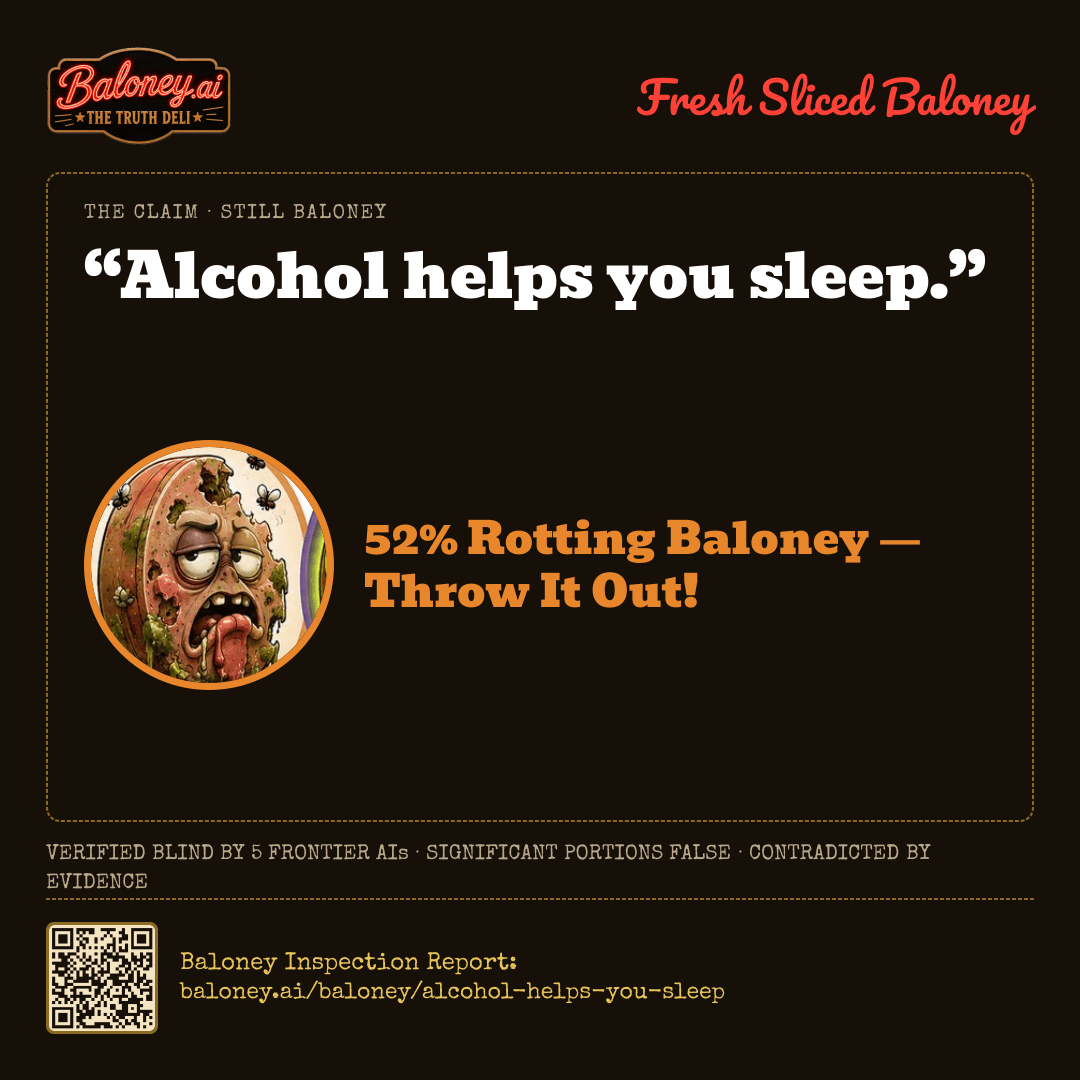
 “Alcohol helps you sleep.”52% Rotting Baloney — Throw It Out!Verified blind by 5 frontier AIs · Baloney Inspection Report: baloney.ai/baloney/alcohol-helps-you-sleep
The Baloney Sampler
The Order Ticket
00:51:50CLAIM RECEIVED — QUEUED FOR INSPECTION✓
00:52:30claude-opus-5 REPORTED — SCORE 42, CONFIDENCE 88✓
00:52:12gpt-5.5 REPORTED — SCORE 52, CONFIDENCE 91✓
00:52:22gemini-3.1-pro-preview REPORTED — SCORE 99, CONFIDENCE 98✓
00:52:01sonar-pro REPORTED — SCORE 68, CONFIDENCE 96✓
00:52:47grok-4.6 REPORTED — SCORE 28, CONFIDENCE 82✓
00:53:03PRIMARY MASTER PERPLEXITY — SCORE 48✓
00:52:54BLIND VALIDATION CHATGPT — SCORE 55✓
00:53:09AGREEMENT CONFIRMED — DELTA 4✓
00:53:09SCORING MODEL V2 — MEDIAN OF 5 COUNTED LAB SCORES: 42, 52, 99, 68, 28 → 52.✓
00:53:09SOURCE RULE — LABS CITED 20 SOURCES: 0 DISCARDED FOR HAVING NO URL, 2 DISCARDED AS DEAD LINKS (404/410), 3 COULD NOT BE OPENED BY US AND ARE MARKED UNVERIFIED.✓
00:53:09SOURCE RULE — PRIMARY MASTER RULED ON 14 SOURCES: 0 DISCARDED FOR HAVING NO URL, 0 DISCARDED AS DEAD LINKS, 3 MARKED UNVERIFIED, 11 VERIFIED.✓
How This One Was Sliced
Station 1 · Blind Inspection — Five Graders, Zero Peeking
Each lab scored the claim independently, without seeing the others. Open a breakdown for its evidence, its sources, and how sure it was.
Anthropic · EQUAL WEIGHT · 40.4s
claude-opus-5
42%BALONEY
ROUND-1 BREAKDOWN
Evidence offered for the claim- Alcohol is a central nervous system depressant: acute doses reliably shorten sleep-onset latency (people fall asleep faster) in both healthy sleepers and people with insomnia, which is the basis of the folk belief.
- In the first half of the night, moderate-to-high doses increase slow-wave (deep) sleep and reduce awakenings, producing a subjectively 'deeper' initial sleep period — documented in polysomnography meta-analyses and reviews of alcohol's effects on normal sleep.
- Survey data consistently show a substantial minority of adults — and a majority of people with insomnia symptoms in some samples — use alcohol as a self-medicated sleep aid, and report short-term subjective benefit.
- Alcohol acts on GABA-A receptors much like older sedative-hypnotic drugs, so the sedative effect is real pharmacology, not placebo.
Evidence against the claim- The effect is front-loaded and reverses: as blood alcohol falls, sleep in the second half of the night becomes fragmented, with more awakenings, lighter stage 1 sleep and 'rebound' arousal — net sleep quality is worse, not better.
- Alcohol suppresses REM sleep in the first part of the night, followed by REM rebound; REM sleep is important for memory consolidation and emotional regulation.
- Tolerance to the sedative (sleep-onset) effect develops within roughly 3–7 nights of repeated use, while the sleep-disrupting effects persist — so it stops 'working' as a sleep aid while continuing to damage sleep, and escalating use risks dependence.
- Alcohol relaxes upper-airway muscles and blunts arousal responses, worsening snoring and obstructive sleep apnea and increasing oxygen desaturation; it is specifically contraindicated for people with apnea.
- Alcohol is a diuretic and disrupts thermoregulation and nocturnal hormone release, contributing to nocturia, night sweats and early-morning awakening.
- Sleep-medicine bodies and national health services (e.g., NHS, sleep foundations, NIAAA-funded reviews) explicitly list 'alcohol as a nightcap' as a myth and recommend avoiding alcohol close to bedtime as standard sleep hygiene.
- Chronic heavy use and alcohol withdrawal produce severe, long-lasting insomnia, and insomnia is a strong predictor of relapse in people recovering from alcohol use disorder.
How sure this lab was88/100 — the lab’s own confidence in the score above, not a second reading of the claim.
SourcesSleep Foundationother · 78 · Ebrahim et al., Alcoholism: Clinical and Experimental Research (via PubMed/NLM)journal · 92 · Colrain, Nicholas & Baker, 'Alcohol and the Sleeping Brain', Handbook of Clinical Neurology (via PubMed Central)journal · 92 · NHS (UK National Health Service)gov · 90 · National Institute on Alcohol Abuse and Alcoholism (NIH)gov · 93 · U.S. Centers for Disease Control and Preventiongov · 88
OpenAI · EQUAL WEIGHT · 22.8s
gpt-5.5
52%BALONEY
ROUND-1 BREAKDOWN
Evidence offered for the claim- Alcohol can have a short-term sedative effect: controlled sleep studies summarized in Alcoholism: Clinical and Experimental Research report that acute alcohol intake can reduce sleep-onset latency, meaning some people may fall asleep faster after drinking.
- NIAAA’s review similarly notes that alcohol consumed near bedtime may help induce sleep initially, especially in non-alcohol-dependent people.
Evidence against the claim- The broader claim is misleading because alcohol tends to worsen sleep quality after the initial sedative period: the same review found disrupted sleep in the second half of the night, more awakenings, and REM-sleep suppression followed by rebound effects.
- NIAAA reports that alcohol before bed can fragment sleep, reduce REM sleep, and aggravate sleep-related breathing problems such as snoring and obstructive sleep apnea.
- MedlinePlus, a U.S. National Library of Medicine resource, advises avoiding alcohol close to bedtime because it can interfere with sleep.
- Alcohol may make someone feel sleepy or fall asleep faster, but the best-supported interpretation of the evidence is that it does not help overall sleep and can make sleep less restorative.
How sure this lab was91/100 — the lab’s own confidence in the score above, not a second reading of the claim.
SourcesAlcoholism: Clinical and Experimental Research / PubMedjournal · 95 · National Institute on Alcohol Abuse and Alcoholismgov · 95 · MedlinePlus, U.S. National Library of Medicinegov · 93
Google · EQUAL WEIGHT · 32.6s
gemini-3.1-pro-preview
99%BALONEY
ROUND-1 BREAKDOWN
Evidence offered for the claim- Alcohol is a central nervous system depressant that acts as a sedative, reducing sleep onset latency (the time it takes to initially fall asleep).
- Moderate consumption of alcohol can temporarily increase slow-wave (deep) sleep during the first half of the sleep cycle.
Evidence against the claim- Alcohol disrupts overall sleep architecture, specifically by suppressing REM (Rapid Eye Movement) sleep, which is critical for memory consolidation and cognitive restoration.
- As the body metabolizes the alcohol, it causes a 'rebound effect' during the second half of the night, leading to fragmented sleep, frequent awakenings, and an inability to return to deep sleep.
- Alcohol acts as a muscle relaxant, which can relax the tissues in the throat and airway, significantly exacerbating breathing issues like snoring and obstructive sleep apnea.
- Alcohol has a diuretic effect, increasing the likelihood of nocturia (waking up to use the bathroom), which further fragments rest.
- Using alcohol regularly to fall asleep leads to rapid tolerance, requiring larger amounts to achieve the same sedative effect. This increases the risk of alcohol dependency and ironically triggers chronic insomnia.
How sure this lab was98/100 — the lab’s own confidence in the score above, not a second reading of the claim.
SourcesNational Institutes of Health (PubMed)gov · 95 · Sleep Foundationother · 90
Perplexity · EQUAL WEIGHT · 12.0s
sonar-pro
68%BALONEY
ROUND-1 BREAKDOWN
Evidence offered for the claim- Alcohol can reduce sleep-onset latency, meaning it may help some people fall asleep faster. A 2013 scientific review reported this effect across tested doses, along with more consolidated sleep in the first half of the night.[https://onlinelibrary.wiley.com/doi/abs/10.1111/acer.12006]
- A 2024 systematic review and meta-analysis found that reductions in sleep-onset latency occurred after relatively high alcohol doses, approximately five standard drinks or more, although this was accompanied by worse subsequent REM-sleep disruption.[https://acuresearchbank.acu.edu.au/item/91wvx/the-effect-of-alcohol-on-subsequent-sleep-in-healthy-adults-a-systematic-review-and-meta-analysis]
- Government and clinical guidance acknowledges that alcohol can make people feel sleepy or fall asleep quickly, which explains why some people perceive it as helpful.[https://www.nhs.uk/live-well/alcohol-advice/tips-on-cutting-down-alcohol/]
Evidence against the claim- Alcohol commonly disrupts the second half of the night, reducing sleep quality even when it initially makes someone drowsy.[https://onlinelibrary.wiley.com/doi/abs/10.1111/acer.12006]
- The 2024 systematic review found that even low doses, up to approximately two standard drinks, disrupted REM sleep; higher doses worsened this disruption. The authors concluded that any shorter time to fall asleep at high doses likely exacerbates later REM-sleep disruption.[https://acuresearchbank.acu.edu.au/item/91wvx/the-effect-of-alcohol-on-subsequent-sleep-in-healthy-adults-a-systematic-review-and-meta-analysis]
- The National Institute on Alcohol Abuse and Alcoholism states that even moderate alcohol doses can reduce REM sleep and that alcohol can aggravate sleep-disordered breathing and other sleep disturbances, compromising sleep quality.[https://www.niaaa.nih.gov/health-professionals-communities/core-resource-on-alcohol/mental-health-issues-alcohol-use-disorder-and-common-co-occurring-conditions]
- The NHS says alcohol may help some people fall asleep quickly but can disrupt sleep patterns and prevent deep sleep, leaving people less rested.[https://www.nhs.uk/live-well/alcohol-advice/tips-on-cutting-down-alcohol/]
- A systematic review and meta-analysis of people with alcohol use disorder found longer sleep-onset latency, lower sleep efficiency, and other abnormalities of sleep architecture, although evidence from alcohol-use-disorder populations should not be generalized directly to every occasional drinker.[https://www.elsevier.es/en-revista-european-journal-psychiatry-431-articulo-sleep-features-in-alcohol-use-S0213616323000447]
How sure this lab was96/100 — the lab’s own confidence in the score above, not a second reading of the claim.
SourcesAustralian Catholic University research repository; study published in Sleep Medicine Reviewsjournal · 94 · Alcoholism: Clinical and Experimental Research; scientific reviewjournal · 93 · National Institute on Alcohol Abuse and Alcoholismgov · 97 · National Health Servicegov · 95 · European Journal of Psychiatry; systematic review and meta-analysisjournal · 89
xAI · EQUAL WEIGHT · 57.0s
grok-4.6
28%BALONEY
ROUND-1 BREAKDOWN
Evidence offered for the claim- Alcohol is a CNS depressant/sedative that can shorten sleep-onset latency, so some people fall asleep faster after drinking.
- People commonly report feeling drowsy or relaxed after alcohol, which they interpret as help initiating sleep.
Evidence against the claim- Alcohol fragments sleep, suppresses REM, and produces more awakenings and lighter sleep in the second half of the night, so overall sleep quality is worse.
- Health agencies treat alcohol before bed as poor sleep hygiene, not a sleep aid.
- Tolerance develops; regular use is linked to worse insomnia and can worsen apnea.
- The net effect is not restorative sleep even if sleep starts sooner.
How sure this lab was82/100 — the lab’s own confidence in the score above, not a second reading of the claim.
SourcesMayo Clinicother · 92 · Sleep Foundationother · 85
Station 2 · The Masters
Primary Master · drawn at random
sonar-pro
48% BALONEY
The statement is partially true only in a narrow, short-term sense: alcohol can produce sedation and reduce the time needed to fall asleep. However, as written, “helps you sleep” reasonably implies better or more restorative sleep. The panel’s evidence indicates that alcohol disrupts sleep later in the night, alters sleep architecture, suppresses or delays REM sleep, and can worsen breathing-related sleep problems. The strongest recent meta-analysis found that reduced sleep-onset latency occurred mainly at high doses of approximately five standard drinks or more, while REM disruption occurred even at low doses of approximately two drinks. I therefore weighted the evidence against the broad claim more heavily than the evidence for its limited sedative effect. The score is in the Rotting Baloney range rather than the highest range because the claim contains a genuine but narrow kernel of truth: alcohol may make some people fall asleep faster.
All five evaluators agreed that alcohol can cause drowsiness and shorten sleep-onset latency, at least under some conditions, and that it commonly worsens sleep quality later in the night. They also agreed on REM-sleep disruption and the risk of fragmented sleep. They disagreed mainly on severity and scoring: recommended scores ranged from 28 to 99. The lower-scoring reports emphasized that the statement is broadly misleading because overall sleep is less restorative; the higher-scoring reports gave more weight to the real short-term sedative effect. Report 1 and the recent systematic review added an important dose distinction: low doses can disrupt REM sleep, while measurable reductions in sleep-onset latency were mainly found at high doses. Evidence from alcohol-use-disorder populations was retained as relevant context but discounted for judging ordinary occasional drinking because it is not directly generalizable.
Blind Validation Master · never saw the Primary’s work
gpt-5.5
55% BALONEY
The reports consistently agree on the key nuance: alcohol can acutely make people drowsy and shorten sleep-onset latency, so there is a real short-term sense in which it can help someone fall asleep faster. However, the same evidence also consistently shows that alcohol worsens overall sleep: it suppresses and disrupts REM sleep, fragments sleep in the second half of the night, increases awakenings, can worsen snoring or obstructive sleep apnea, promotes tolerance with repeated use, and is discouraged by health guidance as a bedtime sleep aid. Therefore, the statement as written is materially misleading because it implies alcohol helps sleep overall, when the best-supported conclusion is that it may help initiate sleep but degrades sleep quality and restoration. It is not completely false, because the sedative effect is real, but the broad claim omits the more important downside.
AGREEMENT TEST PASSED — MASTERS SCORED 48% AND 55% · BLIND VALIDATION CONFIRMED THIS SCORE · NO RE-EVALUATION REQUIRED
How the number was reached · scoring model v2 · how our models work
- Median of 5 counted lab scores: 42, 52, 99, 68, 28 → 52.
The Evidence
Evidence offered for the claim
- Short-term sedation Alcohol is a central-nervous-system depressant and can reduce sleep-onset latency, so some people may fall asleep faster. Older reviews reported this effect across tested doses, while the 2024 meta-analysis found it mainly after high doses of approximately five standard drinks or more.
- Early-night consolidation DEBUNKED — Some controlled studies found more consolidated sleep or increased slow-wave sleep during the first half of the night, which can create a subjective impression of deeper sleep. This limited early-night effect does not establish improved sleep across the whole night.
- Subjective perceived benefit DEBUNKED — People may feel drowsy or relaxed after drinking and may report short-term benefit, which helps explain the nightcap belief. The panel’s evidence indicates that this perception does not reliably correspond to restorative sleep.
Evidence against the claim
- Later-night fragmentation As alcohol is metabolized, sleep commonly becomes more disrupted, with more awakenings and lighter or less continuous sleep in the second half of the night.
- REM-sleep disruption Alcohol delays or suppresses REM sleep. The recent systematic review found REM disruption even at low doses of approximately two standard drinks, with worse disruption at higher doses.
- Reduced restorative quality The overall pattern is a shorter time to initial sleep followed by poorer sleep continuity and altered sleep architecture, so faster sleep onset does not mean better sleep.
- Breathing problems Alcohol can relax upper-airway tissues and aggravate snoring and obstructive sleep apnea, further compromising sleep quality.
- Tolerance and dependence risk Repeated use can produce tolerance to the sedative effect while sleep disruption persists, increasing the risk of escalating use, dependence, and insomnia associated with heavy use or withdrawal.
Sources · Reliability · Why Accepted or Discounted
| Source | Type | Reliability | Ruling |
|---|
| Australian Catholic University research repository; Sleep Medicine Reviews | journal | 94 | ACCEPTED — Recent systematic review and meta-analysis directly distinguishes dose-related sleep-onset effects from REM-sleep disruption in healthy adults. |
| Alcoholism: Clinical and Experimental Researchunverified | journal | 93 | ACCEPTED — Peer-reviewed review directly addresses sleep-onset latency, early-night consolidation, second-half disruption, and REM effects. |
| National Institute on Alcohol Abuse and Alcoholism | gov | 97 | ACCEPTED — Government health source supporting REM reduction, sleep disturbance, and breathing-related risks. |
| National Health Service | gov | 95 | ACCEPTED — Clinical public-health guidance appropriately summarizes the distinction between initial drowsiness and poorer sleep quality. |
| European Journal of Psychiatry | journal | 89 | ACCEPTED — Systematic review supports sleep abnormalities in alcohol-use disorder, but its population is less directly applicable to occasional drinkers. |
| Sleep Foundation | other | 82 | ACCEPTED — Useful synthesis consistent with the peer-reviewed evidence, though secondary rather than primary research. |
| Ebrahim et al., Alcoholism: Clinical and Experimental Research, via PubMed/NLM | journal | 94 | ACCEPTED — Peer-reviewed review directly reports reduced sleep-onset latency, more consolidated first-half sleep, and increased second-half disruption. |
| Colrain, Nicholas & Baker, Alcohol and the Sleeping Brain, via PubMed Central | journal | 92 | ACCEPTED — Scholarly review supports the sedative effect, early architectural changes, REM suppression, and later poor-quality sleep. |
| National Health Service | gov | 90 | ACCEPTED — Public-health sleep guidance supports avoiding alcohol close to bedtime. |
| National Institute on Alcohol Abuse and Alcoholism | gov | 93 | ACCEPTED — Government source cited for alcohol’s physiological effects relevant to sleep and breathing. |
| Centers for Disease Control and Prevention | gov | 88 | DISCOUNTED — The cited report did not identify a specific CDC sleep finding that materially establishes the alcohol claim, so it receives little weight. |
| National Institute on Alcohol Abuse and Alcoholismunverified | gov | 95 | ACCEPTED — Government source supporting initial sleep induction alongside later fragmentation and REM-related disruption. |
| MedlinePlus, U.S. National Library of Medicine | gov | 93 | ACCEPTED — Clinical health guidance advises avoiding alcohol close to bedtime because it can interfere with sleep. |
| Mayo Clinicunverified | other | 92 | ACCEPTED — Secondary clinical guidance consistent with the panel’s conclusion that alcohol may hasten sleep onset but worsens overall sleep. |
Every link was opened when this claim was inspected. A dead link was discarded before publication; “unverified” means the site refused our automated check and the link is the one the panel cited. A source without a URL was never kept.
Serve It Fresh
Ready to Serve13 servings
Serve it the way you want it
The Verdict
“Alcohol helps you sleep.”52% Rotting Baloney — Throw It Out!Verified blind by 5 frontier AIs · Baloney Inspection Report: baloney.ai/baloney/alcohol-helps-you-sleep