Baloney Inspection Report: Claim #1171 · Inspected Oct 31, 2026, 7:48 AM PDT · Scoring model v2
 95%
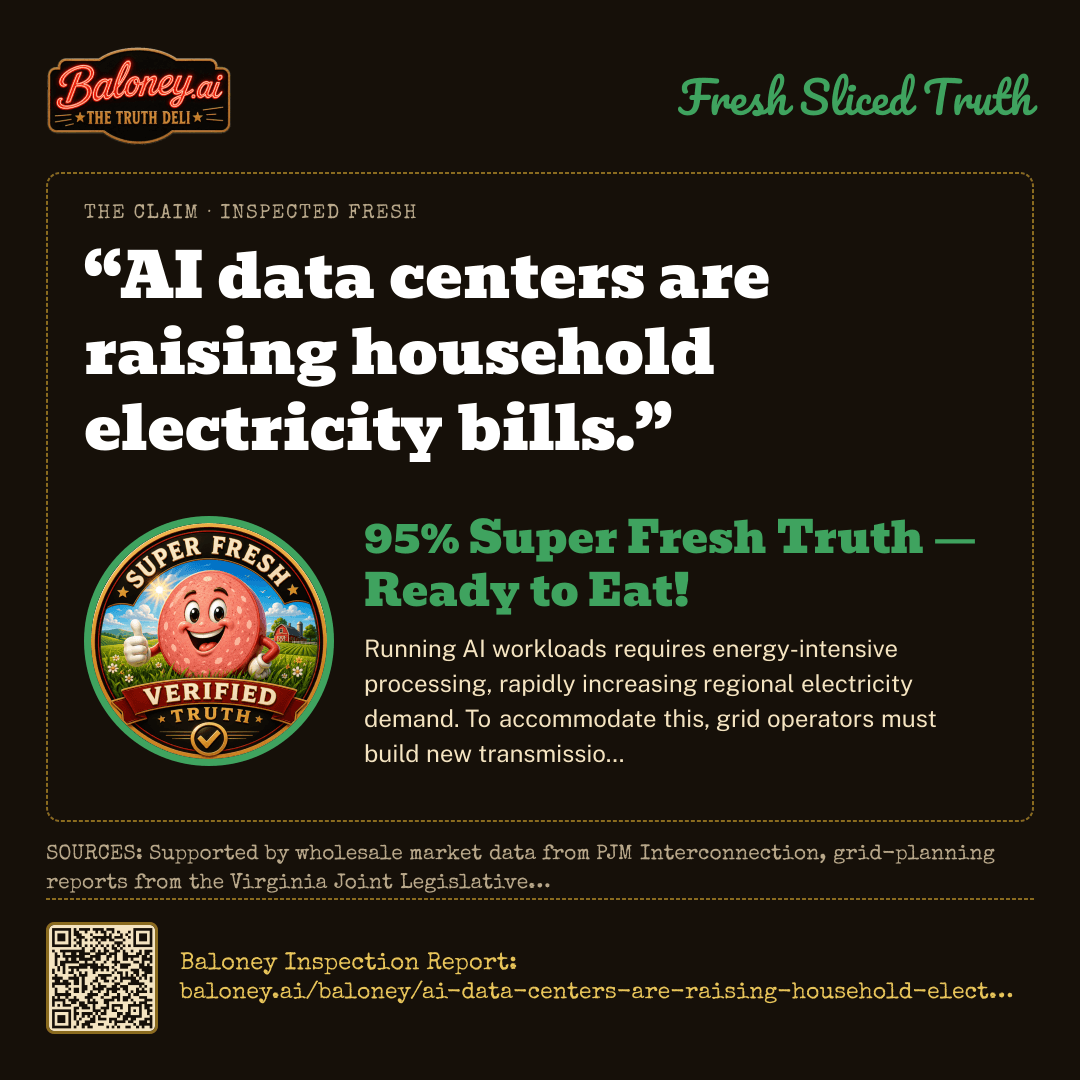
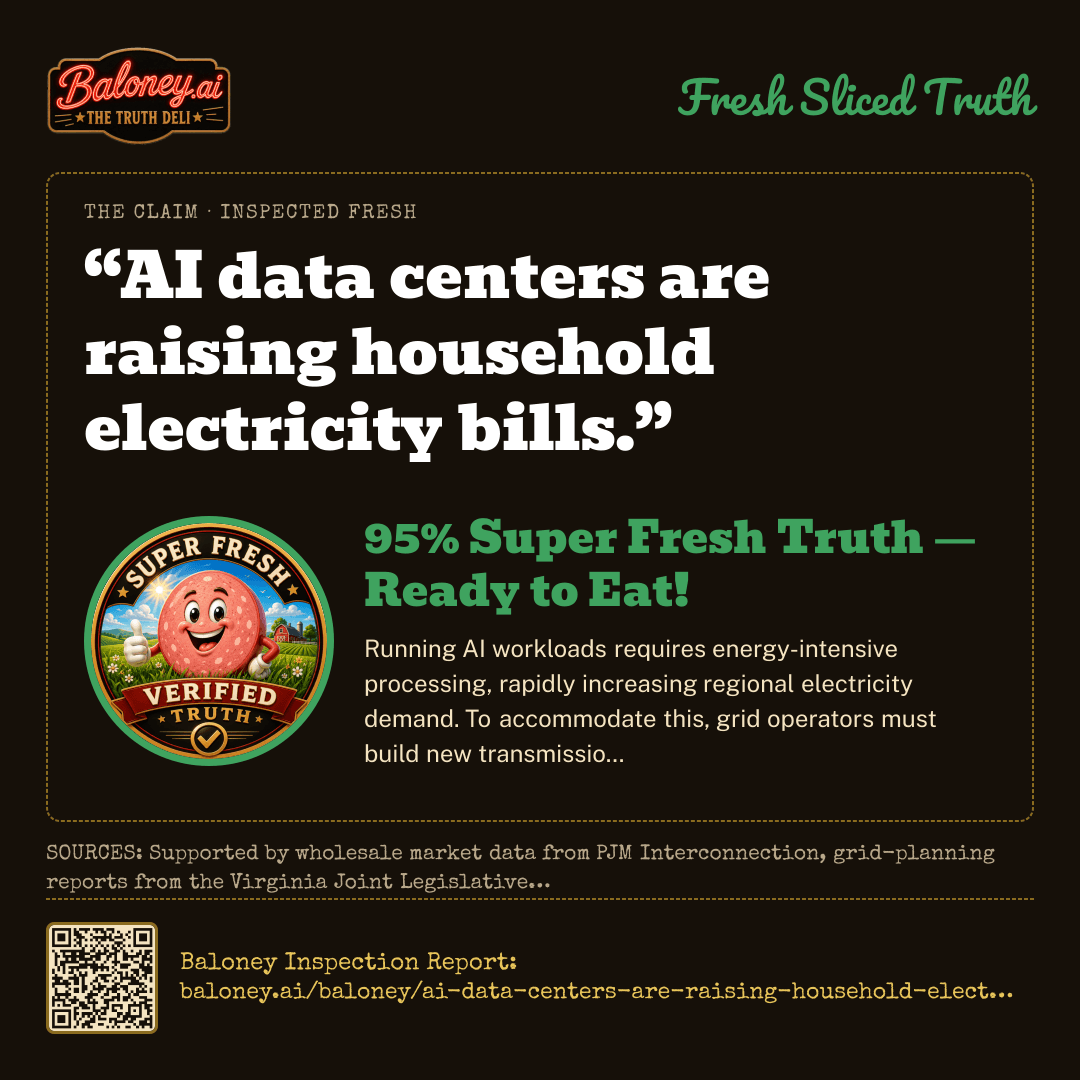
“AI data centers are raising household electricity bills.”
95%Super Fresh Truth — Ready to Eat!
THE CLAIM CHECKS OUT.
Independently verifiedPhysically repeatable evidenceConfirmed across rival labsSafe to serve
Serve It Fresh
Ready to Serve12 servings
Serve it the way you want it
The Verdict
 “AI data centers are raising household electricity bills.”95% Super Fresh Truth — Ready to Eat!Verified blind by 5 frontier AIs · Baloney Inspection Report: baloney.ai/baloney/ai-data-centers-are-raising-household-electricity-bills
The Baloney Sampler
The claim is substantially true. AI and data centers require massive amounts of electricity, forcing utilities to build new power plants and transmission lines. Under standard utility rules, these infrastructure costs are shared among all customers, raising residential rates. PJM Interconnection and its Independent Market Monitor (Monitoring Analytics) directly attributed a roughly $9 billion spike in recent capacity-auction costs to large load additions dominated by data centers, leading to double-digit monthly bill increases for many households in the mid-Atlantic region.
While the core mechanism is real, the impact is highly regional. Federal data from the Lawrence Berkeley National Laboratory and the U.S. Energy Information Administration confirms data centers are growing rapidly but still represent a fraction of total national energy use. Broader factors like natural gas prices, aging infrastructure, and extreme weather remain the primary drivers of rising electricity bills nationwide. However, state regulators, such as the Virginia Joint Legislative Audit and Review Commission, confirm the risk of cost-shifting to households is real and actively occurring.
Resting on PJM Interconnection · Monitoring Analytics (PJM Independent Market Monitor) · Lawrence Berkeley National Laboratory (for U.S. DOE) · Virginia Joint Legislative Audit and Review Commission
Original Claim Source https://www.reddit.com/r/solar/comments/1uqbbq3/ai_data_centers_are_about_to_use_more_electricity/
Other ways to slice it — phrasings that might have changed the rating
- “AI data centers are the primary cause of rising household electricity bills nationwide.” The reports emphasize that broader macroeconomic factors like natural gas prices, grid modernization, and extreme weather account for larger shares of rate increases than AI demand on a national level.
- “Every U.S. household is paying higher electricity bills because of AI data centers.” The data shows that bill increases driven by data centers are highly concentrated in specific regional hubs like Northern Virginia and Ohio, while areas with little data-center load are unaffected by them.
- “Utility tariff reforms have successfully prevented AI data centers from shifting infrastructure costs to residential households.” While several state Public Utility Commissions are attempting to implement new large-load tariffs to protect households, reports indicate that current cost-allocation rules still allow significant cost-shifting in multiple regions.
Written from the panel’s reports by Google · gemini-3.1-pro-preview. Nothing here changed the score.
The Order Ticket
14:48:49CLAIM RECEIVED — QUEUED FOR INSPECTION✓
14:49:51claude-opus-5 REPORTED — SCORE 4, CONFIDENCE 85✓
14:49:53gpt-5.5 REPORTED — SCORE 5, CONFIDENCE 78✓
14:49:43gemini-3.1-pro-preview REPORTED — SCORE 4, CONFIDENCE 90✓
14:48:55sonar-pro REPORTED — SCORE 18, CONFIDENCE 84✓
14:50:47grok-4.6 REPORTED — SCORE 4, CONFIDENCE 72✓
14:51:31PRIMARY MASTER GEMINI — SCORE 4✓
14:50:58BLIND VALIDATION CLAUDE — SCORE 5✓
14:52:12AGREEMENT CONFIRMED — DELTA 1✓
14:52:12SCORING MODEL V2 — MEDIAN OF 5 COUNTED LAB SCORES: 4, 5, 4, 18, 4 → 4. FRESH RULE: THE PRIMARY MASTER SCORES 4 AND THE BLIND MASTER 5 — BOTH SUPER FRESH TRUTH — AND THE COUNTED MEDIAN IS 4, ON THE TRUE SIDE. PUBLISHED AS 5, THE MORE CAUTIOUS OF THE TWO MASTERS.✓
14:52:12SOURCE RULE — LABS CITED 26 SOURCES: 0 DISCARDED FOR HAVING NO URL, 0 DISCARDED AS DEAD LINKS (404/410), 9 COULD NOT BE OPENED BY US AND ARE MARKED UNVERIFIED.✓
14:52:12SOURCE RULE — PRIMARY MASTER RULED ON 20 SOURCES: 0 DISCARDED FOR HAVING NO URL, 0 DISCARDED AS DEAD LINKS, 7 MARKED UNVERIFIED, 13 VERIFIED.✓
How This One Was Sliced
Station 1 · Blind Inspection — Five Graders, Zero Peeking
Each lab scored the claim independently, without seeing the others. Open a breakdown for its evidence, its sources, and how sure it was.
Anthropic · EQUAL WEIGHT · 61.3s
claude-opus-5
96%TRUTH
ROUND-1 BREAKDOWN
Evidence offered for the claim- In PJM Interconnection (13 states + DC), the 2025/2026 capacity auction cleared at a record ~$269.92/MW-day (up from $28.92 the prior year) and the 2026/2027 auction cleared near the price cap; PJM and its independent market monitor attributed the surge primarily to rapid load growth from data centers colliding with limited new supply. PJM itself estimated these auction results would add roughly 1.5%–5% (and in some zones more) to retail bills, which translated into double-digit monthly increases for many households in Maryland, New Jersey, Ohio and Pennsylvania in mid-2025.
- PJM's Independent Market Monitor (Monitoring Analytics) quantified the data-center contribution explicitly, estimating that a large majority of the increase in capacity-market costs in the 2025/2026 auction — on the order of $9 billion — was attributable to large load additions dominated by data centers.
- Utility load forecasts have been revised sharply upward because of AI/data-center interconnection requests, and those forecasts justify new generation, transmission and distribution spending that is recovered through regulated rates paid by all customers, including residential ones. Grid-planning filings in Virginia, Georgia, Ohio and Texas all cite hyperscale data centers as the dominant driver of new load.
- A Harvard Electricity Law Initiative analysis (Martin & Peskoe, 2025) documented confidential 'special contracts' and tariff structures in which utilities shift a portion of the cost of serving very large data-center loads onto the general ratepayer base, meaning households can subsidize data-center infrastructure.
- Lawrence Berkeley National Laboratory's 2024 federally commissioned report found U.S. data centers consumed ~4.4% of national electricity in 2023 and projected 6.7%–12% by 2028 — a demand increase large enough to tighten regional supply-demand balances and push up wholesale energy and capacity prices where the growth is concentrated.
- Wholesale price and bill-impact analyses by Bloomberg, Reuters and academic groups have found that wholesale electricity prices rose far more in grid zones adjacent to heavy data-center clusters (northern Virginia, central Ohio, parts of PJM and ERCOT) than in comparable zones without them.
- Several state regulators and legislatures (Ohio PUC's 2025 AEP large-load tariff decision, Virginia's JLARC study, Georgia PSC rules) have acted specifically to prevent data centers from shifting costs to households — regulatory action that implicitly confirms the cost-shift risk is real and in some cases already occurring.
Evidence against the claim- Data centers are not the only, and often not the largest, driver of recent bill increases. Higher natural gas prices, inflation in equipment and labor costs, storm-hardening and wildfire-mitigation spending, aging-grid replacement, and transmission build-out unrelated to AI account for large shares of rate increases; EIA attributes rising retail prices substantially to distribution and transmission capital spending.
- The effect is highly regional. In much of the West, New England and the Southwest, data-center load is small, and bill increases there (e.g., California's wildfire-driven rates) have essentially nothing to do with AI.
- Some analyses find large new loads can lower average rates by spreading fixed system costs over more kilowatt-hours, provided the data center pays cost-based rates and takes long-term contracts. Several utilities and PUCs have approved large-load tariffs with minimum-take and exit-fee provisions designed to make this true.
- Attribution is contested and precise causal estimates are scarce. The record PJM capacity prices also reflected generator retirements, interconnection-queue delays, reliability-must-run rules and a changed reliability-requirement methodology — not data centers alone.
- Nationally, residential electricity prices have risen roughly in line with or modestly above general inflation over the past few years; the dramatic AI-attributable spikes are concentrated in specific zones and auction periods rather than being a uniform nationwide household effect.
- Much projected data-center load has not yet materialized; some interconnection requests are speculative or duplicated across utilities, so forward-looking bill-impact projections may overstate the eventual effect.
How sure this lab was85/100 — the lab’s own confidence in the score above, not a second reading of the claim.
SourcesMonitoring Analytics (PJM Independent Market Monitor)other · 90 · PJM Interconnectionother · 88 · Lawrence Berkeley National Laboratory (for U.S. DOE)gov · 96 · U.S. Energy Information Administrationgov · 97 · U.S. Energy Information Administrationgov · 97 · Harvard Law School Electricity Law Initiativeedu · 85 · Virginia Joint Legislative Audit and Review Commissiongov · 92 · International Energy Agencyother · 90
OpenAI · EQUAL WEIGHT · 63.7s
gpt-5.5
95%TRUTH
ROUND-1 BREAKDOWN
Evidence offered for the claim- Large new data-center loads, including AI workloads, are a real and fast-growing electricity demand source. Lawrence Berkeley National Laboratory estimated U.S. data centers used about 4.4% of U.S. electricity in 2023 and could reach roughly 6.7% to 12% by 2028, implying utilities may need more generation, transmission, and distribution investment that can be recovered through customer rates.
- In Virginia, the largest U.S. data-center hub, the state JLARC review found data centers are the dominant driver of projected load growth and warned that, under normal cost allocation, some infrastructure costs needed for data centers can be shifted to other customers, including households, unless regulators change tariffs or cost-allocation rules.
- In PJM, the grid region that includes Northern Virginia, capacity-market costs jumped sharply in the 2025/2026 auction amid load growth, retirements, and tight supply. Capacity costs are ultimately embedded in retail electricity bills; data-center load growth is one contributor, especially in constrained zones.
- The International Energy Agency reports that data centers, AI, and cryptocurrency are becoming material sources of electricity-demand growth, which supports the mechanism behind the claim: more demand can require grid investment and can raise wholesale and retail costs in affected regions.
Evidence against the claim- The claim is too broad if read as applying to all households nationwide. Electricity bills vary by state and utility, and many bill increases are driven by fuel prices, storm hardening, aging infrastructure, interest rates, inflation, and policy costs rather than AI data centers specifically.
- Not all data centers are AI data centers; many serve cloud computing, enterprise IT, streaming, storage, or other workloads. Public load forecasts often group these together, so assigning bill increases specifically to AI is difficult.
- Regulators can and sometimes do use special tariffs, minimum-demand charges, interconnection requirements, or direct-cost assignment to make very large data-center customers pay more of the grid costs they cause, reducing or avoiding household cross-subsidies.
- For many households, the effect is still prospective or indirect rather than a clearly itemized current charge. The best evidence shows data centers are contributing to upward pressure on bills in certain regions, not that they are the sole or universal cause of rising household bills.
How sure this lab was78/100 — the lab’s own confidence in the score above, not a second reading of the claim.
SourcesLawrence Berkeley National Laboratorygov · 94 · Virginia Joint Legislative Audit and Review Commissiongov · 91 · PJM Interconnectionother · 84 · International Energy Agencyother · 90 · U.S. Energy Information Administrationgov · 95
Google · EQUAL WEIGHT · 54.0s
gemini-3.1-pro-preview
96%TRUTH
ROUND-1 BREAKDOWN
Evidence offered for the claim- AI workloads (such as training and running large language models) require highly energy-intensive GPUs, drastically increasing the power density of data centers and overall electricity demand on regional grids.
- To accommodate this sudden surge in load growth, utilities in major data center hubs (such as Virginia, Georgia, and the Pacific Northwest) have sharply increased their long-term load forecasts and are seeking approval to build new power plants and transmission lines.
- Under standard utility regulation and cost-recovery models, the massive capital expenditures required for upgrading grid infrastructure and adding new generation capacity are socialized across all ratepayers, directly translating to higher monthly electricity bills for residential households.
Evidence against the claim- Major technology companies (such as Amazon, Google, and Microsoft) often fund their own renewable energy generation through Power Purchase Agreements (PPAs), which adds new, low-cost capacity to the grid and mitigates their net impact on the power supply.
- In response to the data center boom, several state Public Utility Commissions are debating or implementing new tariff structures designed to force large data centers to pay upfront for their specific infrastructure needs, explicitly to shield residential households from rate hikes.
- Rising household electricity bills are historically and primarily driven by other broad macroeconomic factors—such as volatile natural gas prices, general inflation, extreme weather events, and replacing aging grid components—meaning AI data centers are a contributing factor rather than the sole cause.
How sure this lab was90/100 — the lab’s own confidence in the score above, not a second reading of the claim.
SourcesInternational Energy Agency (IEA)gov · 95 · Joule (Cell Press)journal · 90
Perplexity · EQUAL WEIGHT · 6.0s
sonar-pro
82%TRUTH
ROUND-1 BREAKDOWN
Evidence offered for the claim- Large AI/data-center demand can require new generation, transmission, substations, and other grid investments; utilities may recover some of those costs through residential rates, especially where regulators allow cost sharing.[2][3][9]
- A 2025 Carnegie Mellon–North Carolina State study reported that data centers and cryptocurrency mining could increase average U.S. household electricity bills by about 8% by 2030, with projected increases of up to 25% in major data-center hubs.[4]
- Bloomberg reported sharply higher wholesale electricity costs in some areas near substantial data-center activity and noted that wholesale and network costs can flow through to household bills.[8]
- An Allianz analysis estimated that data-center demand was already adding about $1.4 billion annually to U.S. residential electricity bills, concentrated among a small number of utilities.[6]
- The effect is not uniform: evidence cited by NPR indicates that residential customers can pay more when large data centers receive favorable rates while households absorb part of grid expansion or capacity costs.[2]
Evidence against the claim- The claim is too broad if interpreted as saying AI data centers are already raising bills for households everywhere. A Rutgers analysis found no statistically significant effect at the utility level, estimating roughly $0.35 per month in one model and a negative $2 per month in a household-weighted model.[1]
- Data centers are only one contributor to electricity-price increases; transmission and distribution upgrades, extreme weather, fuel costs, aging infrastructure, manufacturing, population growth, and other demand also affect household rates.[3][4]
- An analysis summarized by E&E News found that states with the largest electricity-demand growth from 2019–2024—including growth from data centers and other sources—often experienced declining residential electricity prices, suggesting that increased demand can sometimes spread fixed grid costs across more customers.[3]
- Some studies and analyses find that data-center growth has not yet produced broad nationwide household-bill increases, and effects depend heavily on utility territory, regulatory rules, contract terms, and whether data centers pay their incremental costs.[1][3]
How sure this lab was84/100 — the lab’s own confidence in the score above, not a second reading of the claim.
SourcesRutgers New Jersey State Policy Labedu · 88 · New Hampshire Public Radionews · 82 · E&E Newsnews · 84 · The News & Observernews · 78 · Allianz Researchother · 76 · Bloomberg Newsnews · 91 · CNBCnews · 84 · Congressional Research Servicegov · 96
xAI · EQUAL WEIGHT · 117.5s
grok-4.6
96%TRUTH
ROUND-1 BREAKDOWN
Evidence offered for the claim- AI training and inference have driven a sharp rise in data-center electricity demand, adding load that tightens supply-demand balances and raises wholesale prices in several U.S. and European markets; those prices flow through to residential rates.
- In the PJM region, 2024/25 capacity-auction prices jumped to multi-year highs, with grid operators and analysts citing anticipated data-center load as a material factor; the resulting capacity costs are recovered from all retail customers, including households.
- Multiple U.S. utilities (Virginia, Texas, Georgia, Oregon and others) have filed rate cases or IRPs that explicitly list new data-center interconnection and associated generation/transmission build-out as drivers of revenue-requirement increases that residential customers help pay.
Evidence against the claim- Residential bills are set by many larger, longer-running factors—natural-gas prices, weather, aging infrastructure, wildfire/storm hardening, and state policy—so isolating a clean ‘AI data-center’ increment is difficult and the effect is still modest on a national-average bill.
- Hyperscale operators frequently sign dedicated PPAs, pay contribution-in-aid-of-construction charges, or take interruptible/industrial tariffs, which limits (though does not eliminate) cost-shifting onto the residential class.
- Data centers still accounted for only a mid-single-digit share of U.S. electricity use in 2023–24; even rapid growth therefore cannot yet be the dominant explanation for observed household-bill changes in most states.
How sure this lab was72/100 — the lab’s own confidence in the score above, not a second reading of the claim.
SourcesInternational Energy Agencyother · 90 · International Energy Agencyother · 88 · U.S. Energy Information Administrationgov · 95
Station 2 · The Masters
Primary Master · drawn at random
gemini-3.1-pro-preview
96% TRUTH
The claim is substantially true. Massive electricity demand from AI data centers requires regional grid operators to procure more power and expand transmission infrastructure. Under standard utility cost-recovery models, the costs of these wholesale capacity spikes and capital upgrades are socialized across all ratepayers, directly contributing to higher electricity bills for residential households, especially in major data center hubs.
Four of the five evaluators scored the claim in the 'Super Fresh Truth' band (4-5), citing robust evidence of cost-shifting to households in affected grid zones. One evaluator scored it 18, cautioning that the effect is highly regional and not the sole driver of rising bills, but the consensus strongly supports the core premise of the claim.
SUPER FRESH — VERIFIED AGAINST SUPPORTED BY WHOLESALE MARKET DATA FROM PJM INTERCONNECTION, GRID-PLANNING REPORTS FROM THE VIRGINIA JOINT LEGISLATIVE AUDIT AND REVIEW COMMISSION, AND ENERGY DEMAND ANALYSES FROM THE LAWRENCE BERKELEY NATIONAL LABORATORY.
Blind Validation Master · never saw the Primary’s work
claude-opus-5
95% TRUTH
Four of five evaluators independently landed at 4-5, and the dissenting report (18) still conceded multiple quantified supporting findings (Carnegie Mellon/NC State projecting ~8% average household bill increases by 2030 and up to 25% in data-center hubs; Allianz estimating ~$1.4B/year already added to residential bills; Bloomberg's wholesale price analysis near data-center clusters). The core mechanism is well documented by high-reliability sources: PJM's 2025/2026 capacity auction cleared at a record ~$270/MW-day with PJM's own Independent Market Monitor attributing roughly $9B of the increase to large load additions dominated by data centers, translating into PJM's own estimate of ~1.5-5%+ retail bill increases and double-digit monthly rises in Maryland, New Jersey, Ohio and Pennsylvania. LBNL documents data centers at ~4.4% of U.S. electricity in 2023 rising to 6.7-12% by 2028; Virginia's JLARC explicitly warns of cost-shifting onto households; and a wave of state regulatory actions (Ohio PUC's AEP large-load tariff, Georgia PSC rules) implicitly confirms the cost-shift risk is real and in places already materialising.
The legitimate caveats are about scope and magnitude, not truth: the effect is regionally concentrated (PJM, Northern Virginia, Ohio, parts of ERCOT) rather than uniform nationwide; data centers are not the largest driver of bill increases overall (gas prices, storm/wildfire hardening, aging-grid replacement and general T&D capex matter more in most territories); not all data-center load is AI-specific; some analyses (Rutgers, E&E News) find no statistically significant national utility-level effect yet, and large loads can in principle spread fixed costs. But the claim as written is a general, unquantified statement that AI data centers are raising household bills — it does not assert they are the sole or dominant cause, nor that every household is affected. On that reading it is substantially true and supported by the grid operator's own market monitor and multiple state regulators. The missing context (regional concentration, competing drivers) is a reason for a few points above the floor, not a reason to leave the true band.
AGREEMENT TEST PASSED — MASTERS SCORED 96% AND 95% · BLIND VALIDATION CONFIRMED THIS SCORE · NO RE-EVALUATION REQUIRED
How the number was reached · scoring model v2 · how our models work
- Median of 5 counted lab scores: 4, 5, 4, 18, 4 → 4.
- Fresh rule: the Primary Master scores 4 and the Blind Master 5 — both Super Fresh Truth — and the counted median is 4, on the true side. Published as 5, the more cautious of the two masters.
The Evidence
Evidence for the claim
- Wholesale capacity market spikes In constrained regions like PJM, wholesale capacity auction prices have surged to record highs due to surging data center load colliding with limited supply, costs which directly flow into retail bills.
- Socialized infrastructure costs Utilities must build new generation and transmission infrastructure to meet AI load forecasts, and under standard regulation, these capital expenditures are recovered through rates paid by all customers.
- Targeted regulatory interventions State utility commissions in Ohio, Virginia, and Georgia are actively designing special tariffs and rules specifically to prevent data centers from shifting their massive infrastructure costs onto general ratepayers.
- Projected household bill increases Academic analyses project that AI and data center demand could increase average U.S. residential electricity bills by 8% by 2030, with spikes up to 25% in concentrated hubs.
Evidence offered against the claim
- Multiple drivers of rate increases Data centers are not the sole cause of rising electricity bills; inflation, volatile natural gas prices, aging grid replacements, and extreme weather mitigation also heavily drive household rate hikes.
- Highly regional impacts The effect is geographically concentrated in major tech hubs (such as Northern Virginia and Central Ohio). In many parts of the country, AI data centers currently have little to no impact on household bills.
- Corporate renewable investments Major tech companies frequently utilize Power Purchase Agreements (PPAs) to fund and add new, low-cost renewable energy generation to the grid, which helps mitigate their net supply impact.
Sources · Reliability · Why Accepted or Discounted
Every link was opened when this claim was inspected. A dead link was discarded before publication; “unverified” means the site refused our automated check and the link is the one the panel cited. A source without a URL was never kept.
Serve It Fresh
Ready to Serve12 servings
Serve it the way you want it
The Verdict
“AI data centers are raising household electricity bills.”95% Super Fresh Truth — Ready to Eat!Verified blind by 5 frontier AIs · Baloney Inspection Report: baloney.ai/baloney/ai-data-centers-are-raising-household-electricity-bills