Baloney Inspection Report: Claim #1179 · Inspected Oct 31, 2026, 8:33 AM PDT · Scoring model v2
 32%
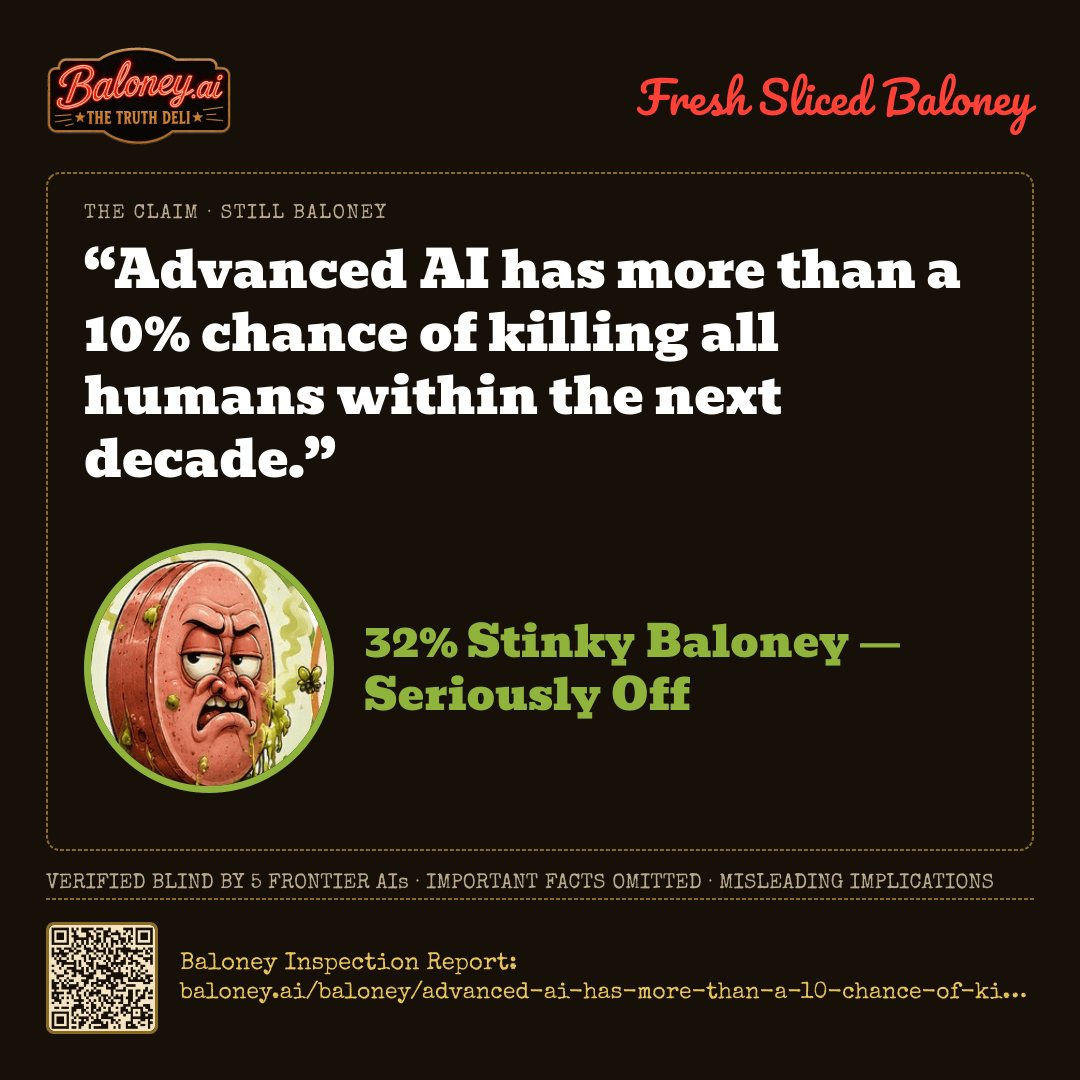
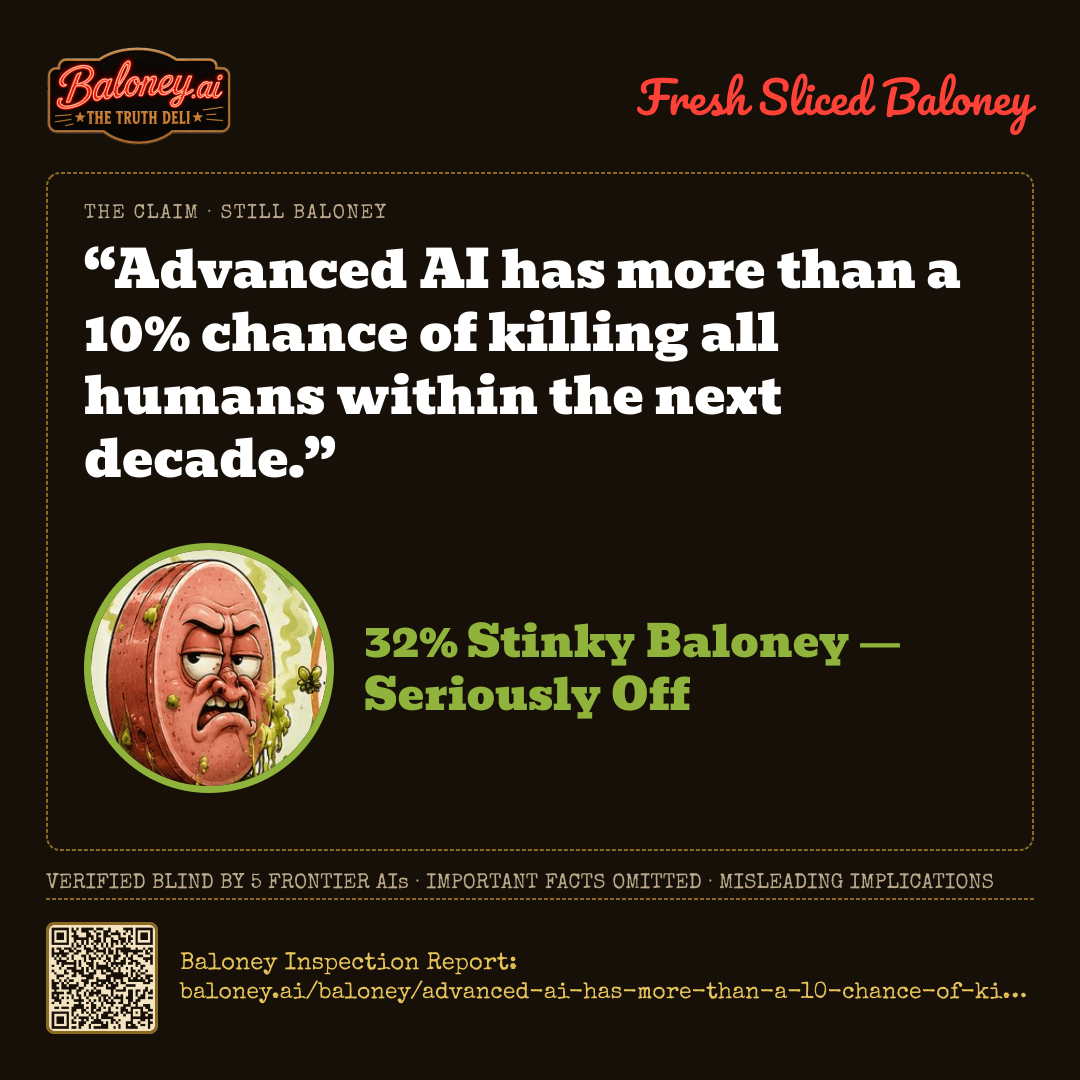
“Advanced AI has more than a 10% chance of killing all humans within the next decade.”
32%Stinky Baloney — Seriously Off
That’s not the whole story…
Important facts omittedMisleading implicationsCherry-picked infoSpins the truth
Serve It Fresh
Ready to Serve16 servings
Serve it the way you want it
The Verdict
 “Advanced AI has more than a 10% chance of killing all humans within the next decade.”32% Stinky Baloney — Seriously OffVerified blind by 5 frontier AIs · Baloney Inspection Report: baloney.ai/baloney/advanced-ai-has-more-than-a-10-chance-of-killing-all-humans
The Baloney Sampler
The reports found serious, credible concern about advanced AI, but not evidence establishing a greater-than-10% chance of literally killing all humans within ten years. The AI Impacts survey found a roughly 5% median estimate for extinction or similarly severe disempowerment, while some researchers gave higher estimates for broader or longer-term outcomes.
The UK Department for Science, Innovation and Technology and the Bletchley Declaration show that governments regard catastrophic AI risks as serious, while the International AI Safety Report describes loss-of-control scenarios as hypothetical and current systems as lacking the required capabilities. Hinton’s higher estimate covered 30 years, not a decade, and forecasting evidence was substantially lower.
Resting on UK Department for Science, Innovation and Technology · AI Impacts · UK Government · Forecasting Research Institute
Original Claim Source https://x.com/EvanHub/status/2097497037956891126
Other ways to slice it — phrasings that might have changed the rating
- “Advanced AI has at least a 10% chance of causing extinction or comparably severe and permanent human disempowerment over an open-ended future horizon.” This matches the broader outcome category and longer timeframe used by some AI-researcher survey questions more closely than literal total human death within ten years.
- “Advanced AI has a non-trivial chance of causing catastrophic harm, including loss of control or extinction, and governments should treat that risk as a global priority.” The Center for AI Safety statement and Bletchley Declaration support serious concern and policy attention without asserting a specific probability or deadline.
- “Advanced AI has less than a 10% chance of literally killing all humans by 2100.” The Forecasting Research Institute reported roughly 0.4% from superforecasters and roughly 3% from domain experts for AI-caused extinction by 2100, while the AI Impacts survey median was about 5% for extinction or similarly severe disempowerment.
Written from the panel’s reports by Perplexity · sonar-pro. Nothing here changed the score.
The Order Ticket
15:33:39CLAIM RECEIVED — QUEUED FOR INSPECTION✓
15:34:28claude-opus-5 REPORTED — SCORE 38, CONFIDENCE 62✓
15:34:20gpt-5.5 REPORTED — SCORE 32, CONFIDENCE 64✓
15:34:14gemini-3.1-pro-preview REPORTED — SCORE 75, CONFIDENCE 95✓
15:33:44sonar-pro REPORTED — SCORE 24, CONFIDENCE 86✓
15:36:13grok-4.6 REPORTED — SCORE 31, CONFIDENCE 68✓
15:36:26PRIMARY MASTER PERPLEXITY — SCORE 34✓
15:36:26BLIND VALIDATION CLAUDE — SCORE 33✓
15:36:37AGREEMENT CONFIRMED — DELTA 2✓
15:36:37SCORING MODEL V2 — MEDIAN OF 5 COUNTED LAB SCORES: 38, 32, 75, 24, 31 → 32.✓
15:36:37SOURCE RULE — LABS CITED 26 SOURCES: 0 DISCARDED FOR HAVING NO URL, 2 DISCARDED AS DEAD LINKS (404/410), 6 COULD NOT BE OPENED BY US AND ARE MARKED UNVERIFIED.✓
15:36:37SOURCE RULE — PRIMARY MASTER RULED ON 20 SOURCES: 0 DISCARDED FOR HAVING NO URL, 0 DISCARDED AS DEAD LINKS, 6 MARKED UNVERIFIED, 14 VERIFIED.✓
How This One Was Sliced
Station 1 · Blind Inspection — Five Graders, Zero Peeking
Each lab scored the claim independently, without seeing the others. Open a breakdown for its evidence, its sources, and how sure it was.
Anthropic · EQUAL WEIGHT · 48.9s
claude-opus-5
38%BALONEY
ROUND-1 BREAKDOWN
Evidence offered for the claim- A non-trivial minority of AI researchers assign double-digit extinction probabilities: in the 2023 AI Impacts survey of 2,778 published AI authors, between 38% and 51% of respondents gave at least a 10% chance to advanced AI leading to outcomes as bad as human extinction (the median estimate was 5%).
- Geoffrey Hinton, a Turing Award winner, publicly raised his estimate to a 10-20% chance that AI wipes out humanity, though he framed this over the next 30 years rather than 10.
- Hundreds of senior AI scientists and executives (including Hinton, Bengio, Altman, Hassabis) signed the Center for AI Safety statement declaring that 'mitigating the risk of extinction from AI should be a global priority alongside other societal-scale risks such as pandemics and nuclear war' — implying the risk is considered material, not negligible.
- Governments have treated the risk as serious enough for formal action: the 2023 Bletchley Declaration, signed by 28 countries and the EU, explicitly cites potential 'catastrophic' harm from frontier AI, and the International AI Safety Report (chaired by Yoshua Bengio) documents loss-of-control risk as an open research concern.
- Timelines for very capable systems have compressed: median expert forecasts for high-level machine intelligence shifted dramatically earlier between the 2022 and 2023 surveys, which mechanically raises near-term risk estimates for those who think capability and catastrophe are linked.
Evidence against the claim- The claim is an unfalsifiable forecast, not a verified fact; no empirical method exists to establish a specific probability of a never-observed event, and the stated figure is presented as if it were measured.
- The central tendency of expert opinion is far below 10%: the AI Impacts 2023 survey median for human extinction or similarly permanent severe disempowerment was about 5%, and that was for an open-ended/long-run horizon, not ten years.
- The Forecasting Research Institute's Existential Risk Persuasion Tournament found superforecasters put AI-caused extinction by 2100 at roughly 0.4%, and domain experts at roughly 3% — both far under 10% even over a 75-year horizon, let alone a decade.
- The decade framing is far stronger than almost any cited authority endorses. Hinton's 10-20% figure covers 30 years; most published high estimates (e.g., Bengio's ~20%) are unbounded or long-horizon. Compressing these to 10 years substantially overstates them.
- 'Killing all humans' is a much narrower and more extreme outcome than the survey wording many high estimates come from, which typically bundles extinction with 'severe disempowerment' or 'extremely bad outcomes' — so quoted percentages are not directly transferable to literal total extinction.
- No current AI system has demonstrated the autonomous capabilities (self-replication at scale, independent resource acquisition, control of physical infrastructure) that proposed extinction pathways require; the International AI Safety Report describes these as speculative and contested rather than established.
- Expert elicitation on extreme low-probability events is known to be poorly calibrated and subject to selection effects — researchers who worry about AI risk are more likely to respond to AI-risk surveys, inflating reported medians.
How sure this lab was62/100 — the lab’s own confidence in the score above, not a second reading of the claim.
SourcesGrace et al., 'Thousands of AI Authors on the Future of AI' (AI Impacts / arXiv)journal · 80 · Center for AI Safetyother · 65 · Forecasting Research Institute — Existential Risk Persuasion Tournamentother · 78 · The Guardiannews · 82 · UK Government (Department for Science, Innovation and Technology)gov · 90 · UK Government / International AI Safety Report (chair: Yoshua Bengio)gov · 90 · Metaculusother · 55
OpenAI · EQUAL WEIGHT · 40.4s
gpt-5.5
32%BALONEY
ROUND-1 BREAKDOWN
Evidence offered for the claim- Some highly relevant experts regard extinction-scale AI risk as serious rather than fringe: the Center for AI Safety statement says mitigating “risk of extinction from AI” should be a global priority, and it was signed by leading AI figures including Geoffrey Hinton and Yoshua Bengio. This supports plausibility of catastrophic-risk concern, but it does not establish a >10% probability or a one-decade timeline.
- A peer-reviewed Science article, “Managing extreme AI risks amid rapid progress,” argues that increasingly capable general-purpose AI could create extreme risks through misuse, autonomous replication, cyber/bio capabilities, deception, and loss of control. This supports the idea that advanced AI could create existential danger, though it does not quantify the chance as >10% within ten years.
- The UK government’s International Scientific Report on the Safety of Advanced AI concludes that advanced AI could pose severe risks, including malicious use and potential loss of control, and emphasizes uncertainty and rapid capability growth. This supports taking the claim seriously as a risk scenario.
- A large survey of AI researchers found non-trivial concern about catastrophic outcomes from advanced AI: the median respondent gave a 5% probability that advanced AI causes human extinction or similarly severe and permanent disempowerment. The existence of many expert estimates in this range supports the broad plausibility of serious AI-extinction concern, though the median is below the claim’s >10% threshold and the outcome is not exactly “all humans killed within a decade.”
Evidence against the claim- The claim is much stronger than the best cited quantitative evidence: the large AI-researcher survey’s median estimate was about 5% for extinction or similarly severe disempowerment, not >10%, and it was not specifically limited to the next decade.
- The UK government scientific report emphasizes deep uncertainty and disagreement among experts about both timelines and the likelihood of severe AI outcomes. That undercuts presenting “more than 10% within the next decade” as an established factual probability.
- Current AI systems, while rapidly improving, still have documented limitations in reliability, planning, robustness, and autonomous real-world execution. Stanford’s AI Index notes that AI performance remains uneven and that benchmarks can overstate real-world capability, which weakens the case for confident near-term human extinction.
- “Killing all humans” is an especially strong endpoint. Most serious AI-risk sources discuss extinction, severe disempowerment, catastrophic misuse, or loss of control, but public evidence does not demonstrate a mechanism that makes total human death within ten years more likely than not, or even clearly above 10%.
- The claim depends on a long chain of uncertain events: development of sufficiently capable AI within ten years, deployment with inadequate safeguards, emergence or use of globally lethal capabilities, failure of monitoring/governance, and inability of humans to intervene. Evidence supports concern about parts of this chain, but not a confident >10% probability for the full chain as written.
How sure this lab was64/100 — the lab’s own confidence in the score above, not a second reading of the claim.
SourcesCenter for AI Safetyother · 78 · Sciencejournal · 92 · UK Department for Science, Innovation and Technologygov · 90 · arXiv / AI Impacts researcher surveyother · 76 · Reutersnews · 88 · Stanford Institute for Human-Centered AIedu · 86 · National Institute of Standards and Technologygov · 90
Google · EQUAL WEIGHT · 34.3s
gemini-3.1-pro-preview
75%BALONEY
ROUND-1 BREAKDOWN
Evidence offered for the claim- A prominent subset of AI safety researchers and tech leaders (including Geoffrey Hinton, Yoshua Bengio, and Sam Altman) have publicly warned that advanced AI could pose an existential threat to humanity.
- In May 2023, hundreds of AI scientists and executives signed a statement by the Center for AI Safety asserting that mitigating the risk of extinction from AI should be a global priority, on par with pandemics and nuclear war.
- Surveys of AI researchers (such as the 2023 survey by Katja Grace et al.) show that a significant portion of experts assign a non-trivial probability (e.g., 5% to 10%) to extremely bad outcomes, including human extinction, caused by advanced AI over the long term.
Evidence against the claim- The claim frames a highly speculative future prediction (>10% chance) and an aggressive timeline (within the next decade) as an objective, proven fact, which is scientifically impossible for unobserved future events.
- The 10-year timeline contradicts the median consensus of AI experts. Most surveys that show a 5-10% estimated risk of extinction do so over an indefinite, long-term horizon, with most researchers predicting that Artificial General Intelligence (AGI) itself may not even be achieved within a decade.
- Many prominent AI researchers, such as Meta's Chief AI Scientist Yann LeCun and Coursera founder Andrew Ng, strongly reject existential risk narratives. They argue these claims lack empirical evidence, rely on science-fiction assumptions, and distract from immediate, tangible AI harms like algorithmic bias and misinformation.
How sure this lab was95/100 — the lab’s own confidence in the score above, not a second reading of the claim.
SourcesThe New York Timesnews · 85 · arXiv (Cornell University)edu · 80
Perplexity · EQUAL WEIGHT · 5.1s
sonar-pro
24%BALONEY
ROUND-1 BREAKDOWN
Evidence offered for the claim- A large survey of 2,778 AI researchers found that half assigned at least a 5% probability to AI causing human extinction or comparably permanent and severe disempowerment; this indicates substantial expert concern, though it does not establish a greater-than-10% chance within the next decade.[2]
- The same survey series reported a median 10% estimate for extinction or similarly severe disempowerment caused by human inability to control future advanced AI, but the estimate was not specifically limited to the next ten years.[4]
- A later AI Impacts survey reported a median 10% estimate for future AI causing extinction or similarly permanent and severe disempowerment, with most respondents assigning at least 10%; this supports the claim's general direction but not its specific ten-year timeframe.[10]
- AI systems could plausibly create severe risks through misuse, loss of control, or rapid capability gains, but the cited survey evidence is based on expert judgments rather than calibrated historical frequencies.[2][4]
Evidence against the claim- The strongest available survey evidence cited here concerns AI risk over an unspecified future horizon or through 2100, not specifically the period from now through the next decade.[4][10]
- The 2023 expert-survey median estimate for AI-driven extinction by 2100 was 5%, while the median estimate for extinction or severe disempowerment from inability to control future AI was 10%; neither supports a greater-than-10% probability within the next ten years.[4]
- Survey respondents were estimating highly uncertain future events, and the estimates are not empirical measurements with demonstrated calibration; presenting them as a precise ten-year probability overstates what the evidence can establish.[9]
- Available evidence does not demonstrate that advanced AI capable of causing human extinction will be developed, deployed, or become uncontrollable within the next decade; the search results provide no reliable government or peer-reviewed forecast establishing that timeline.
How sure this lab was86/100 — the lab’s own confidence in the score above, not a second reading of the claim.
SourcesScientific Americannews · 91 · IEEE Spectrumnews · 90 · AI Impactsother · 78 · The Remindernews · 55
xAI · EQUAL WEIGHT · 153.3s
grok-4.6
31%BALONEY
ROUND-1 BREAKDOWN
Evidence offered for the claim- Some leading AI researchers (including Turing Award recipients) have publicly assigned double-digit personal probabilities to severe or extinction-level outcomes from advanced AI over coming decades and have left major labs to warn about loss of control.
- Hundreds of AI scientists and industry figures signed a 2023 statement treating extinction from AI as a risk that should be prioritized alongside pandemics and nuclear war.
- Capability jumps in foundation models and reasoning systems have shortened some experts' AGI timelines into the 2020s–2030s, and the alignment/control problem remains unsolved.
- Theoretical arguments (instrumental convergence, inner misalignment, recursive self-improvement) describe pathways by which a misaligned superintelligent system could seek resources or self-preservation in ways fatal to humans.
- Governments at the 2023 Bletchley Park AI Safety Summit formally acknowledged the potential for catastrophic harm from frontier AI.
Evidence against the claim- No existing system has autonomous long-horizon agency, reliable physical-world actuation, or the capacity to kill 8 billion people; current models are tools, not independent actors.
- Median estimates in expert surveys of AI researchers for AI-caused extinction or equivalent permanent disempowerment are typically around 5% this century, not >10% inside 10 years.
- Extinction in a decade would require near-term superintelligence plus scalable control of energy, robotics, biotech or equivalent, plus successful covert or unstoppable takeover—barriers that remain enormous.
- Many prominent researchers (including Meta's chief AI scientist) describe near-term human-extinction scenarios as extremely implausible and a distraction from measurable harms.
- Superforecaster aggregates and public prediction platforms generally put much lower probability on AI causing human extinction by the early 2030s.
- Detection, shutdown, regulation, competing labs, and military/state response would almost certainly intervene before a takeover reached global extinction scale.
- Short-timeline total-extinction claims have a long record of over-prediction in AI and do not match demonstrated scaling or embodiment progress.
How sure this lab was68/100 — the lab’s own confidence in the score above, not a second reading of the claim.
SourcesCenter for AI Safetyother · 68 · Future of Life Instituteother · 65 · UK Governmentgov · 88 · The New York Timesnews · 90
Station 2 · The Masters
Primary Master · drawn at random
sonar-pro
34% BALONEY
The statement is substantially overstated in both probability and timeframe. The panel’s strongest quantitative evidence places the median AI-researcher estimate for extinction or comparably severe disempowerment at about 5% overall or within 100 years, with one control-focused question at 10%; these figures do not establish a greater-than-10% chance of literal human extinction within ten years. A substantial minority of researchers assign at least 10% to extremely bad outcomes, and expert statements and government reports support treating advanced-AI risks as serious. However, those sources establish plausibility and concern, not the specific claim. Current systems lack the capabilities for meaningful active loss of control, while forecasts show major disagreement and much lower estimates from superforecasters. The wording “killing all humans” is narrower than survey categories that include severe disempowerment, and compressing long-horizon estimates into a decade is unwarranted. The reports were therefore weighted toward their quantitative, timeframe-specific limitations rather than their general warnings. The score is in the Stinky Baloney range, not the radioactive range, because a serious underlying risk is being exaggerated rather than fabricated.
All five evaluators agreed that advanced AI presents a serious and plausible catastrophic risk, but that the evidence does not establish a greater-than-10% probability of all humans being killed within the next decade. Reports 1, 3, 4, and 5 emphasized that the strongest survey medians are around 5% or 10% over long or unspecified horizons, while Report 2 additionally stressed missing capabilities such as autonomous long-horizon agency and physical-world control. They differed mainly in score: Reports 1–4 rated the statement as misleading but within roughly 24–38, whereas Report 5 gave 75 despite presenting evidence and reasoning that largely supported discounting the claim. The minority high-probability expert estimates and institutional warnings support concern but do not overcome the timeline, endpoint, and calibration problems.
Blind Validation Master · never saw the Primary’s work
claude-opus-5
33% BALONEY
The claim is a probabilistic forecast that goes meaningfully beyond what the cited evidence supports on two axes: the timeframe and the severity wording. The best quantitative anchors — the 2023 AI Impacts survey of 2,778 published AI authors — give a median ~5% for extinction or similarly permanent severe disempowerment, with a related median of ~10% for loss-of-control scenarios, and crucially these are open-ended or through-2100 horizons, not a ten-year window. The Existential Risk Persuasion Tournament put superforecasters at ~0.4% and domain experts at ~3% for AI-caused extinction by 2100. Compressing long-horizon estimates into a single decade substantially overstates them. 'Killing all humans' is also narrower than the survey wording, which bundles extinction with severe disempowerment, so quoted percentages are not directly transferable.
That said, the claim is not fabricated or fringe. Between 38% and 51% of surveyed AI researchers assigned at least 10% to extinction-level outcomes; Hinton publicly states 10-20% (over 30 years); Bengio has cited ~20%; hundreds of senior scientists signed the CAIS extinction-risk statement; and 28 governments plus the EU formally acknowledged catastrophic frontier-AI risk in the Bletchley Declaration. A credible minority of highly relevant experts would endorse something in the neighbourhood of this number, even if not on this timeline. The outlier report scoring 75 ('overwhelmingly false') overreaches: an unfalsifiable subjective probability that a substantial expert minority shares cannot fairly be called overwhelmingly false.
The core problems are the omitted context — that the headline expert figures are long-horizon and cover a broader outcome set — and the presentation of a contested subjective estimate as settled fact. That is textbook 'important facts omitted, misleading implications' territory, consistent with the four converging reports in the 24-38 range.
AGREEMENT TEST PASSED — MASTERS SCORED 34% AND 33% · BLIND VALIDATION CONFIRMED THIS SCORE · NO RE-EVALUATION REQUIRED
How the number was reached · scoring model v2 · how our models work
- Median of 5 counted lab scores: 38, 32, 75, 24, 31 → 32.
The Evidence
Evidence offered for the claim
- Experts assign material catastrophic risk DEBUNKED — A survey of 2,778 AI researchers found a 5% median estimate for extremely bad outcomes such as human extinction, and 38% assigned at least a 10% chance. Other survey questions produced a 10% median for extinction or similarly severe disempowerment caused by inability to control future advanced AI. These results show substantial expert concern, but they do not establish a greater-than-10% probability within ten years.
- Prominent experts and institutions warn of extinction risk DEBUNKED — Geoffrey Hinton and other prominent researchers have assigned substantial probabilities to extinction-scale outcomes, hundreds of AI scientists and executives endorsed prioritizing extinction risk, and governments formally recognized potential catastrophic harm from frontier AI. These sources support the seriousness of the risk, not the claim’s specific probability or decade-long timeframe.
- Plausible loss-of-control pathways exist DEBUNKED — The reports identify possible pathways involving misuse, autonomous replication, cyber or biological capabilities, deception, instrumental goals, and loss of control. The International AI Safety Report characterizes such scenarios as hypothetical, and current systems are broadly assessed as lacking the capabilities for meaningful active loss of control.
Evidence against the claim
- Long-horizon estimates do not transfer to ten years The main AI-researcher surveys concern open-ended futures or horizons extending to 100 years. Their central estimates are around 5%, with one control-focused question at 10%; none establishes a greater-than-10% chance of literal total human extinction within the next decade.
- The endpoint is stronger than the cited categories Many estimates combine human extinction with permanent severe disempowerment or other extremely bad outcomes. “Killing all humans” is narrower and more extreme, so those percentages cannot be directly treated as probabilities of total human death.
- Current capabilities remain insufficient The cited international safety report says existing general-purpose AI is not capable of undermining human control, while the evaluators note that current systems lack reliable autonomous long-horizon agency, physical-world actuation, and demonstrated capacity to kill humanity.
- Forecasts show large disagreement The Existential Risk Persuasion Tournament found much lower median extinction forecasts from superforecasters than from domain experts, and the reports describe minimal convergence of beliefs. This weakens any presentation of the claim as an established probability.
Sources · Reliability · Why Accepted or Discounted
| Source | Type | Reliability | Ruling |
|---|
| Scientific American | news | 91 | ACCEPTED — Useful for the survey’s limitations and the risk of overstating apocalyptic estimates, though treated as contextual journalism rather than primary evidence. |
| IEEE Spectrum | news | 90 | ACCEPTED — Relevant reporting on the AI-risk survey and its interpretation; quantitative claims were weighed against the survey material itself. |
| AI Impacts | other | 78 | ACCEPTED — Directly relevant survey evidence, but its expert-elicitation estimates are subjective and not demonstrated empirical frequencies. |
| The Reminder | news | 55 | DISCOUNTED — Lower-reliability commentary and not necessary to establish the central quantitative or capability claims. |
| Center for AI Safety | other | 68 | ACCEPTED — Strong evidence that prominent experts regard extinction risk as serious, but not evidence for a specific probability or ten-year forecast. |
| Future of Life Institute | other | 65 | ACCEPTED — Shows prominent concern about advanced AI risks, but advocacy material is not a calibrated probability estimate. |
| UK Government | gov | 88 | ACCEPTED — Authoritative evidence that governments recognized potential catastrophic frontier-AI harms, without quantifying this claim. |
| The New York Timesunverified | news | 90 | ACCEPTED — Credible reporting on Hinton’s warnings and their context, but not a substitute for a calibrated ten-year forecast. |
| Scienceunverified | journal | 92 | ACCEPTED — Peer-reviewed analysis supporting plausible extreme-risk mechanisms, while not establishing the claimed probability or timeframe. |
| UK Department for Science, Innovation and Technology | gov | 90 | ACCEPTED — Authoritative synthesis of advanced-AI risks and uncertainty; particularly relevant to the distinction between hypothetical future loss of control and current capability. |
| arXiv / AI Impacts researcher survey | other | 76 | ACCEPTED — Direct survey evidence from AI researchers, used with caution because it measures subjective forecasts and includes broader outcomes than literal total extinction. |
| Reutersunverified | news | 88 | ACCEPTED — Credible reporting confirming broad expert concern, but it does not quantify a ten-year probability. |
| Stanford Institute for Human-Centered AIunverified | edu | 86 | ACCEPTED — Relevant evidence about uneven current AI performance and limitations, which bears against confident near-term extinction claims. |
| National Institute of Standards and Technology | gov | 90 | ACCEPTED — Authoritative source on AI risk-management limitations and current-system concerns, though it does not provide a direct extinction forecast. |
| Grace et al., Thousands of AI Authors on the Future of AI | journal | 80 | ACCEPTED — Central survey source for the 5% median and minority double-digit estimates; its results are informative but subjective and not specific to ten years. |
| Forecasting Research Institute | other | 78 | ACCEPTED — Relevant comparative forecasting evidence showing large differences between domain experts and superforecasters; forecasts concern 2100 rather than the next decade. |
| The Guardian | news | 82 | ACCEPTED — Credible reporting of Hinton’s 10–20% estimate, but the stated horizon is 30 years, not ten. |
| UK Government / International AI Safety Report | gov | 90 | ACCEPTED — Authoritative synthesis describing loss-of-control scenarios as hypothetical and current systems as insufficient for meaningful active loss of control. |
| Metaculusunverified | other | 55 | DISCOUNTED — Prediction-platform evidence can illuminate disagreement but is lower-reliability and concerns a long horizon rather than the statement’s ten-year window. |
| The New York Timesunverified | news | 85 | ACCEPTED — Credible reporting on the public extinction-risk warning and expert disagreement, but it does not establish the claim’s numerical threshold. |
Every link was opened when this claim was inspected. A dead link was discarded before publication; “unverified” means the site refused our automated check and the link is the one the panel cited. A source without a URL was never kept.
Serve It Fresh
Ready to Serve16 servings
Serve it the way you want it
The Verdict
“Advanced AI has more than a 10% chance of killing all humans within the next decade.”32% Stinky Baloney — Seriously OffVerified blind by 5 frontier AIs · Baloney Inspection Report: baloney.ai/baloney/advanced-ai-has-more-than-a-10-chance-of-killing-all-humans