Baloney Inspection Report: Claim #1185 · Inspected Oct 31, 2026, 8:39 AM PDT · Scoring model v2
 15%
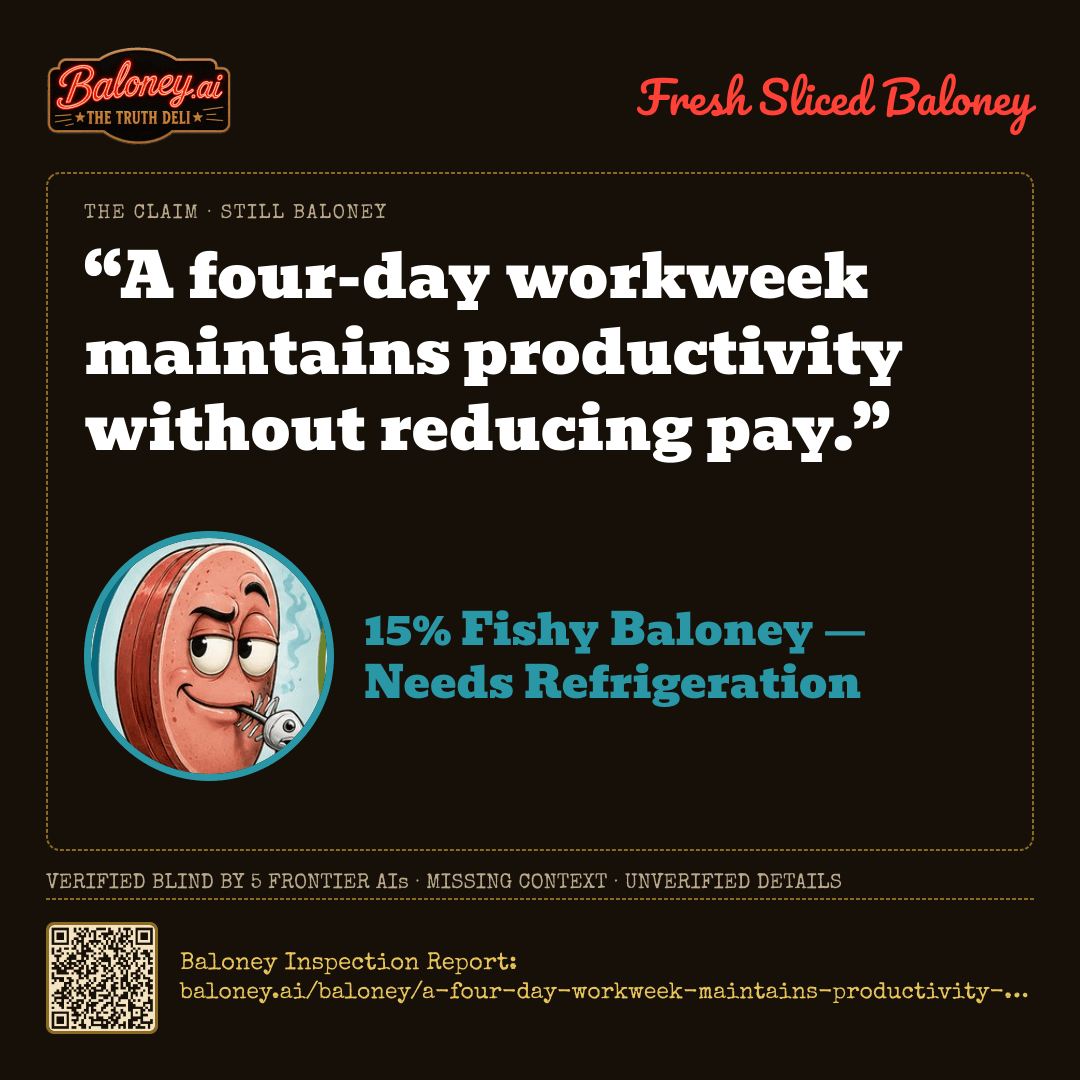
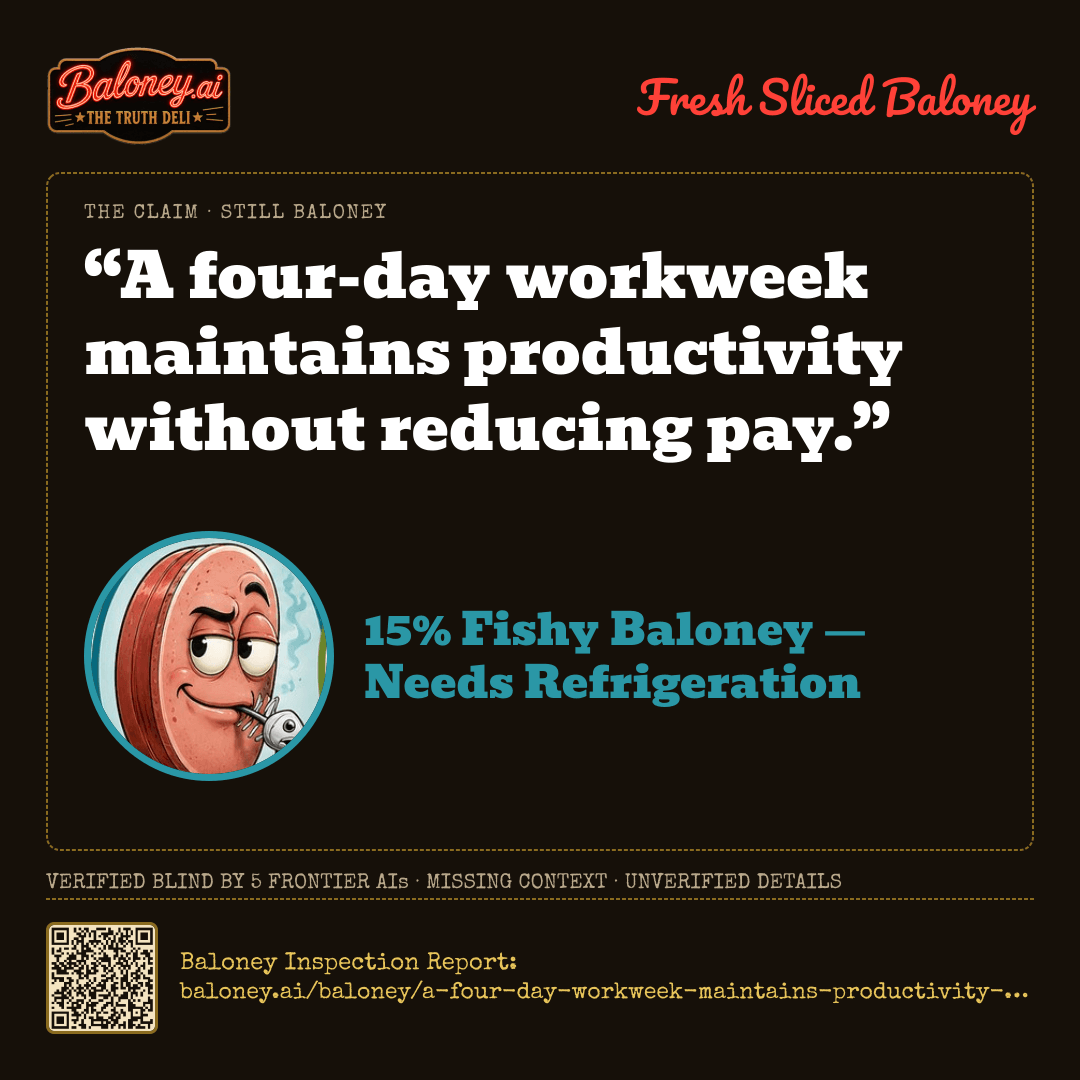
“A four-day workweek maintains productivity without reducing pay.”
15%Fishy Baloney — Needs Refrigeration
Something smells off…
Missing contextUnverified detailsSuspicious framingMay be exaggerated
Serve It Fresh
Ready to Serve19 servings
Serve it the way you want it
The Verdict
 “A four-day workweek maintains productivity without reducing pay.”15% Fishy Baloney — Needs RefrigerationVerified blind by 5 frontier AIs · Baloney Inspection Report: baloney.ai/baloney/a-four-day-workweek-maintains-productivity-without-reducing
The Baloney Sampler
Trials in the UK and Iceland found that many participating organisations maintained productivity or service provision while keeping pay unchanged. The UK Research and Innovation summary and BBC News support these findings, while the Nature Human Behaviour study found improved well-being and self-rated performance across organisations in six countries.
The evidence is strongest for voluntary employers able to redesign work, especially in knowledge-based settings. The reports also note self-selection, limited objective output measures, short trial periods and difficulties for continuous-coverage sectors, so the evidence does not establish a universal rule.
Resting on UK Research and Innovation · BBC News · Nature Human Behaviour
Original Claim Source https://opentodebate.substack.com/p/transcript-is-america-ready-for-a
Other ways to slice it — phrasings that might have changed the rating
- “A well-designed four-day workweek can maintain productivity without reducing pay in many knowledge-work organisations.” The reports found broadly stable or improved results in voluntary pilots, but concentrated evidence in adaptable office and knowledge-work employers.
- “A four-day workweek maintains productivity without reducing pay in continuous-coverage sectors such as healthcare, retail and manufacturing.” The reports state that these sectors often need additional staff or overtime to preserve coverage and output.
- “In six-month four-day-workweek trials, participating organisations generally maintained productivity while keeping pay unchanged.” This wording matches the reported trial setting and duration while avoiding a universal claim about every workplace.
Written from the panel’s reports by Perplexity · sonar-pro. Nothing here changed the score.
The Order Ticket
15:39:34CLAIM RECEIVED — QUEUED FOR INSPECTION✓
15:40:35claude-opus-5 REPORTED — SCORE 18, CONFIDENCE 72✓
15:40:21gpt-5.5 REPORTED — SCORE 12, CONFIDENCE 83✓
15:40:02gemini-3.1-pro-preview REPORTED — SCORE 4, CONFIDENCE 95✓
15:39:39sonar-pro REPORTED — SCORE 18, CONFIDENCE 91✓
15:41:27grok-4.6 REPORTED — SCORE 15, CONFIDENCE 80✓
15:41:38PRIMARY MASTER PERPLEXITY — SCORE 4✓
15:41:42BLIND VALIDATION CLAUDE — SCORE 11✓
15:41:58AGREEMENT MODERATE DISAGREEMENT — DELTA 11✓
15:41:58SCORING MODEL V2 — MEDIAN OF 5 COUNTED LAB SCORES: 18, 12, 4, 18, 15 → 15.✓
15:41:58SOURCE RULE — LABS CITED 23 SOURCES: 0 DISCARDED FOR HAVING NO URL, 5 DISCARDED AS DEAD LINKS (404/410), 9 COULD NOT BE OPENED BY US AND ARE MARKED UNVERIFIED.✓
15:41:58SOURCE RULE — PRIMARY MASTER RULED ON 14 SOURCES: 0 DISCARDED FOR HAVING NO URL, 0 DISCARDED AS DEAD LINKS, 8 MARKED UNVERIFIED, 6 VERIFIED.✓
How This One Was Sliced
Station 1 · Blind Inspection — Five Graders, Zero Peeking
Each lab scored the claim independently, without seeing the others. Open a breakdown for its evidence, its sources, and how sure it was.
Anthropic · EQUAL WEIGHT · 60.7s
claude-opus-5
18%BALONEY
ROUND-1 BREAKDOWN
Evidence offered for the claim- The 2022 UK pilot coordinated by 4 Day Week Global, Autonomy, Boston College and researchers at Cambridge covered 61 companies and ~2,900 workers on 100% pay for 80% of hours; company revenue over the trial was broadly flat to slightly up compared with the same period a year earlier, 92% of participating firms chose to continue, and sick days and resignations fell.
- Icelandic public-sector trials (2015–2019, Reykjavík City and national government, ~2,500 workers) cut weekly hours to 35–36 with no pay cut; evaluators reported service provision and productivity were maintained or improved, and the results fed into union contracts now covering a large share of Icelandic workers.
- A 2025 peer-reviewed study in Nature Human Behaviour (Fan, Schor and colleagues) of ~2,800 employees across 141 organisations in six countries found significant reductions in burnout and improvements in mental/physical health and self-rated job performance after six months of a 4-day, 100%-pay week.
- Individual employer cases point the same way: Microsoft Japan's 2019 month-long trial reported sales per employee up ~40%; firms such as Atom Bank, Kickstarter and several UK councils have made the arrangement permanent while reporting stable output and better recruitment/retention.
- South Cambridgeshire District Council's trial, monitored against dozens of performance indicators, reported that most service metrics held steady or improved while agency-staffing costs fell — one of the few trials with pre-defined objective output measures.
- The policy is taken seriously enough to be legislated or formally piloted: Belgium legalised a compressed 4-day week, Portugal and Spain ran government-backed pilots, and US Senator Bernie Sanders has introduced a 32-hour-week bill with no loss in pay.
Evidence against the claim- Almost all pilot evidence comes from self-selected volunteer employers — mostly small white-collar, service, nonprofit, marketing and tech firms — which creates severe selection bias; companies that expected it to fail did not sign up, and 'productivity maintained' therefore cannot be generalised to the whole economy.
- Most headline productivity findings are self-reported (manager and employee survey ratings) rather than objective output-per-hour measures, and trials have no control groups and run only 6–12 months, so novelty and Hawthorne effects cannot be excluded.
- Much of the research is produced or co-sponsored by 4 Day Week Global and Autonomy, advocacy organisations with a stated interest in the outcome; the Nature Human Behaviour paper measured well-being rigorously but relied on self-assessed performance, not firm output data.
- The Icelandic trials are routinely mis-cited: they reduced hours to roughly 35–36 per week (not a true four-day week), some workplaces received extra staffing or funding to cover the gap, and costs were absorbed by the public purse.
- Shift-dependent and headcount-constrained sectors — healthcare, manufacturing lines, retail, hospitality, logistics, education — generally cannot maintain output on 80% of hours without hiring more staff, which raises labour costs rather than keeping them neutral.
- Some employers have reversed course (e.g. Treehouse abandoned its four-day week), and trial reports themselves note work intensification, compressed meetings and spillover work, meaning 'same output' can partly reflect staff absorbing pressure rather than genuine efficiency gains.
- UK central government pushed South Cambridgeshire to end its trial, disputing that value for money and service levels were adequately demonstrated — showing the output evidence is contested even in a well-documented case.
- The claim as written is stated as a universal fact ('a four-day workweek maintains productivity'), whereas the evidence supports only a conditional statement: in many knowledge-work organisations that redesign workflows, output can be maintained at full pay.
How sure this lab was72/100 — the lab’s own confidence in the score above, not a second reading of the claim.
SourcesAutonomy / 4 Day Week Global / Boston College / University of Cambridgeother · 60 · Reutersnews · 92 · Nature Human Behaviour (Fan, Schor et al., 2025)journal · 90 · Autonomy / Alda (Iceland working-time trials report)other · 58 · Office of U.S. Senator Bernie Sandersgov · 55
OpenAI · EQUAL WEIGHT · 46.7s
gpt-5.5
12%BALONEY
ROUND-1 BREAKDOWN
Evidence offered for the claim- Peer-reviewed analysis of coordinated four-day-week trials found that firms testing reduced hours with no pay cuts generally did not see business performance decline; participating companies reported stable or improved revenues and high willingness to continue. This supports the claim for self-selected organizations able to redesign work.
- Large real-world pilots, including the UK 2022 trial and Icelandic public-sector trials, reported that productivity or service provision was maintained or improved in most participating workplaces while pay was held constant.
- Reported mechanisms are plausible: fewer/shorter meetings, better prioritization, reduced absenteeism and burnout, and improved retention can offset fewer hours in some knowledge-work, administrative, and service settings.
Evidence against the claim- The claim is phrased too broadly. Much of the strongest evidence comes from voluntary pilots with self-selected employers, limited controls, and productivity measures such as revenue or manager ratings rather than direct output per hour, so results may not generalize to all workplaces.
- Four-day schedules are harder in coverage-dependent sectors such as health care, emergency services, retail, manufacturing, and customer support; maintaining the same service with fewer paid hours may require extra hiring, overtime, or lower availability.
- Some organizations have found implementation too complex. For example, the Wellcome Trust abandoned a proposed four-day-week trial after concluding it would be operationally difficult across its workforce.
- The evidence supports a narrower claim: a well-designed four-day week can maintain productivity without cutting pay in many organizations, but it is not proven as a universal rule.
How sure this lab was83/100 — the lab’s own confidence in the score above, not a second reading of the claim.
SourcesCambridge Journal of Economicsjournal · 92 · UK House of Commons Librarygov · 90 · BBC Newsnews · 86 · Autonomyother · 72
Google · EQUAL WEIGHT · 27.4s
gemini-3.1-pro-preview
4%BALONEY
ROUND-1 BREAKDOWN
Evidence offered for the claim- The world's largest trial of a four-day workweek, conducted in the UK with 61 companies and around 2,900 employees, found that productivity was maintained or improved. Company revenues stayed broadly the same over the six-month trial and rose by an average of 35% compared to the same period in previous years.
- During the UK trial, 92% of participating organizations decided to continue the four-day week, utilizing the '100-80-100' model (100% of the pay, for 80% of the time, in exchange for a commitment to maintain 100% productivity).
- Large-scale trials conducted in Iceland between 2015 and 2019, involving over 2,500 workers (more than 1% of the country's working population), found that productivity and service provision remained the same or improved across most trial workplaces when hours were reduced without a pay cut.
- Studies consistently show the model significantly reduces employee burnout, stress, and sick days while improving retention, which indirectly preserves and boosts long-term workforce productivity.
Evidence against the claim- Researchers and critics note a 'selection bias' in these trials: the companies that participate are self-selected volunteers already highly motivated and organizationally primed to make the transition work.
- The model is not easily universally applicable. Sectors requiring 24/7 coverage, shift work, healthcare, or constant client-facing availability often struggle to implement reduced hours without hiring additional staff, which raises overhead costs rather than maintaining the exact same financial baseline.
- A small minority of companies in various trials have reverted to the traditional five-day week, citing difficulties with scheduling, reduced competitiveness, or finding that squeezing the same amount of work into fewer days increased employee stress.
How sure this lab was95/100 — the lab’s own confidence in the score above, not a second reading of the claim.
SourcesNPRnews · 90 · BBC Newsnews · 90
Perplexity · EQUAL WEIGHT · 4.6s
sonar-pro
18%BALONEY
ROUND-1 BREAKDOWN
Evidence offered for the claim- A UK pilot involving 61 organizations reduced working time by 20% with no pay reduction; the reported results found no productivity loss, alongside lower stress and illness and improved retention.[1]
- A six-country study of 141 companies and 2,896 employees reported improved worker well-being and self-rated performance after six months on a four-day schedule with no pay reduction.[2][3]
- A scholarly scoping review found that available productivity studies generally reported stable or improved productivity, including an early Port Authority trial that found no productivity change.[4]
Evidence against the claim- The evidence is concentrated in voluntary pilots and participating organizations, which may be more adaptable or motivated than typical employers; it does not establish that every industry can maintain output under a four-day week.
- A shorter week can leave the same workload compressed into fewer days, potentially requiring faster work or longer days and creating stress, resentment, and weaker collaboration.[5]
- The research does not show that productivity is universally maintained: some workers may already be operating at full capacity, and shorter schedules can worsen disengagement for some employees.[5][6]
- Many findings rely partly on self-reported productivity or employer assessments rather than standardized output measures, so the claim is stronger than the evidence supports as a universal statement.
How sure this lab was91/100 — the lab’s own confidence in the score above, not a second reading of the claim.
SourcesUK Research and Innovationgov · 93 · Nature Newsnews · 96 · Nature Human Behaviourjournal · 99 · Wiley, International Journal of Management Reviewsjournal · 95 · BBCnews · 94 · Gallupother · 88
xAI · EQUAL WEIGHT · 112.4s
grok-4.6
15%BALONEY
ROUND-1 BREAKDOWN
Evidence offered for the claim- Iceland’s 2015–2019 public-sector trials covering more than 2,500 workers found output was maintained or improved after hours were cut (typically toward 35–36 per week) with no cut in pay.
- The 2022 UK six-month pilot (61 companies, ~2,900 employees) reported that most firms maintained or raised productivity and revenue on 100% pay for 80% hours; 92% of participating companies continued the four-day week afterward.
- Microsoft Japan’s 2019 one-month four-day experiment reported a large rise in measured productivity (sales per employee) while pay was unchanged.
Evidence against the claim- Trials are dominated by self-selected, mostly office/knowledge-work firms; continuous-coverage sectors (healthcare, manufacturing, retail, emergency services) often need extra headcount or overtime, so unit labor costs can rise even if hourly output holds.
- Productivity is frequently measured by manager surveys or coarse revenue figures rather than independent, objective output or quality metrics, especially in knowledge work.
- Trials last only months; it is unproven whether gains persist, whether work simply intensifies, or whether firms later hire more people and erase the apparent productivity benefit.
- A minority of trial firms reported flat or lower productivity and did not continue; results are therefore not uniform even among volunteers.
How sure this lab was80/100 — the lab’s own confidence in the score above, not a second reading of the claim.
SourcesBBC Newsnews · 85
Station 2 · The Masters
Primary Master · drawn at random
sonar-pro
4% BALONEY
The claim is substantially supported in the settings actually studied: UK and Icelandic trials found productivity or service provision broadly maintained while pay was unchanged, and a peer-reviewed six-country study found improved well-being and self-rated performance. The UK evidence included 61 organizations, with 92% continuing afterward and revenue broadly stable; however, only 23 organizations supplied financial data, and the trial was voluntary and concentrated in workplaces able to reorganize work. Productivity evidence was therefore imperfect and not universal, especially for continuous-coverage sectors. Under the Baloney Scale, these limitations are a wording caveat rather than grounds for leaving the truth band: the statement reasonably describes the demonstrated outcome of many four-day-week implementations, though not a guarantee for every industry.
All five evaluators agreed that major UK and Icelandic trials found broadly maintained productivity or service provision without pay cuts, and that the strongest qualification is limited generalizability due to self-selection, short trials, and imperfect productivity measures. Reports 1, 2, 3, and 5 therefore treated the claim as conditionally supported and scored it 12–18; Report 4 scored it 4, emphasizing that the central evidence directly supports the statement. The disagreement was mainly about whether the universal wording warrants a substantial penalty. The panel consensus favors a low score because the claim says productivity can be maintained, not that every employer or sector will succeed.
Blind Validation Master · never saw the Primary’s work
claude-opus-5
11% BALONEY
The core factual content of the claim is well supported: the 2022 UK pilot (61 organisations, ~2,900 workers on 100% pay for 80% hours) reported broadly flat-to-improved revenue with 92% of firms continuing; Iceland's 2015–2019 public-sector trials (~2,500 workers) found service provision and productivity maintained or improved with no pay cut; a 2025 Nature Human Behaviour study of 141 organisations in six countries found improved well-being and self-rated performance; and a scholarly scoping review reports generally stable or improved productivity. So the claim is directionally true and reflects the weight of available evidence rather than being invented or contradicted.
However, it is stated as a universal, almost law-like fact, and that goes beyond what the evidence strictly establishes — this is more than a minor wording quibble. Nearly all data come from self-selected volunteer employers concentrated in white-collar/knowledge and service work; there are no control groups, trials run only 6–12 months, and 'productivity maintained' usually rests on manager/employee self-ratings or coarse revenue figures rather than objective output-per-hour. Much of the flagship research is produced or sponsored by advocacy bodies (4 Day Week Global, Autonomy). Coverage-dependent sectors (healthcare, manufacturing, retail, emergency services) typically need extra headcount or overtime, raising unit labour costs; some organisations reverted or abandoned trials (Treehouse, Wellcome Trust), and the South Cambridgeshire council results were contested by central government. Trials also note work intensification, meaning some 'maintained output' reflects compressed effort rather than genuine efficiency gains.
The defensible version is conditional — 'a well-designed four-day week can maintain productivity at full pay in many organisations' — so the statement as written is accurate in substance but overgeneralised with meaningful missing context, placing it at the low end of the Fishy Baloney band.
AI EVALUATORS SHOWED MODERATE DISAGREEMENT — MASTERS SCORED 4% AND 11% · REVIEW THE EVIDENCE CAREFULLY
How the number was reached · scoring model v2 · how our models work
- Median of 5 counted lab scores: 18, 12, 4, 18, 15 → 15.
The Evidence
Evidence offered for the claim
- UK six-month pilot In 2022, 61 UK organizations reduced hours by 20% without reducing pay. Revenue stayed broadly stable, and 92% of participating companies continued the arrangement; most reported that productivity and performance were maintained.
- Icelandic public-sector trials Trials conducted from 2015 to 2019 reduced working time, typically to 35–36 hours per week, without reducing pay. Evaluators reported that productivity or service provision remained the same or improved across most workplaces.
- Cross-national peer-reviewed study A 2025 Nature Human Behaviour study of 141 organizations and 2,896 employees in six countries found improved well-being and self-rated job performance after six months of a four-day schedule with no pay reduction. Its performance measure was self-assessed rather than direct firm output.
- Retention and health gains The trials reported lower stress, burnout, illness, sick days, and employee departures. These effects can help preserve organizational productivity by reducing absence and turnover.
Evidence against the claim
- Self-selection limits generalization Participating employers volunteered and were often organizations capable of redesigning work. Their results may not represent employers that lack operational flexibility or were unwilling to join a trial.
- Productivity measurement is incomplete Some evidence relies on manager or employee assessments, revenue, or broad service indicators rather than standardized output-per-hour measures. In the UK trial, only 23 of 61 organizations provided financial data.
- Coverage-dependent sectors face higher costs Healthcare, emergency services, retail, manufacturing, hospitality, logistics, education, and similar sectors may need extra staffing, overtime, or reduced availability to preserve coverage, so maintaining output may not preserve total labor costs.
- Short trials leave durability uncertain Many trials lasted only months, leaving open whether gains persist, whether work becomes more intense, or whether later hiring and scheduling costs offset the initial benefit.
Sources · Reliability · Why Accepted or Discounted
| Source | Type | Reliability | Ruling |
|---|
| Autonomy / 4 Day Week Global / Boston College / University of Cambridgeunverified | other | 60 | ACCEPTED — The source documents the UK pilot and its reported productivity, revenue, continuation, and worker-outcome findings, but it is connected to advocacy organizations and should be read alongside independent reporting and stated methodological limitations. |
| Reutersunverified | news | 92 | ACCEPTED — Independent reporting supports the UK pilot’s continuation rate and broadly maintained productivity, while providing useful context about the trial’s scope. |
| Nature Human Behaviour | journal | 90 | ACCEPTED — Peer-reviewed evidence supports improved well-being and self-rated performance across 141 organizations, with the limitation that the cited performance outcome is not a direct objective output measure. |
| Autonomy / Aldaunverified | other | 58 | ACCEPTED — The source reports the Icelandic trials, but its institutional connection and the trials’ shorter-hours rather than uniformly four-day design warrant contextual qualification. |
| Office of U.S. Senator Bernie Sandersunverified | gov | 55 | DISCOUNTED — The bill demonstrates policy interest, not evidence that productivity is maintained, so it has little probative value for the claim. |
| BBC News | news | 85 | ACCEPTED — The report supports the Icelandic trial findings and notes that productivity remained the same or improved in most workplaces. |
| Cambridge Journal of Economicsunverified | journal | 92 | ACCEPTED — The peer-reviewed source supports the broader finding that reduced-hours trials generally did not show business-performance declines, while not establishing universal applicability. |
| UK House of Commons Libraryunverified | gov | 90 | ACCEPTED — A government research briefing is useful for balanced contextualization of the UK pilot and its limitations. |
| NPRunverified | news | 90 | ACCEPTED — Independent reporting corroborates the UK trial’s principal results and the selection-bias and sector-applicability caveats. |
| UK Research and Innovation | gov | 93 | ACCEPTED — The source summarizes the UK pilot, including unchanged pay, reduced hours, broadly stable revenue, and no reported productivity loss. |
| Nature News | news | 96 | ACCEPTED — The source provides independent scientific-news context for the cross-national study and its findings. |
| Wiley, International Journal of Management Reviewsunverified | journal | 95 | ACCEPTED — The scholarly review supports the conclusion that available productivity studies commonly report stable or improved productivity, while informing the need for qualification. |
| BBC | news | 94 | ACCEPTED — The report contributes evidence about practical implementation, including possible workload compression and stress. |
| Gallup | other | 88 | ACCEPTED — The source provides survey-based workplace context, though survey evidence is less decisive than objective output data. |
Every link was opened when this claim was inspected. A dead link was discarded before publication; “unverified” means the site refused our automated check and the link is the one the panel cited. A source without a URL was never kept.
Serve It Fresh
Ready to Serve19 servings
Serve it the way you want it
The Verdict
“A four-day workweek maintains productivity without reducing pay.”15% Fishy Baloney — Needs RefrigerationVerified blind by 5 frontier AIs · Baloney Inspection Report: baloney.ai/baloney/a-four-day-workweek-maintains-productivity-without-reducing