Baloney Inspection Report: Claim #1160 · Inspected Oct 31, 2026, 7:38 AM PDT · Scoring model v2
 52%
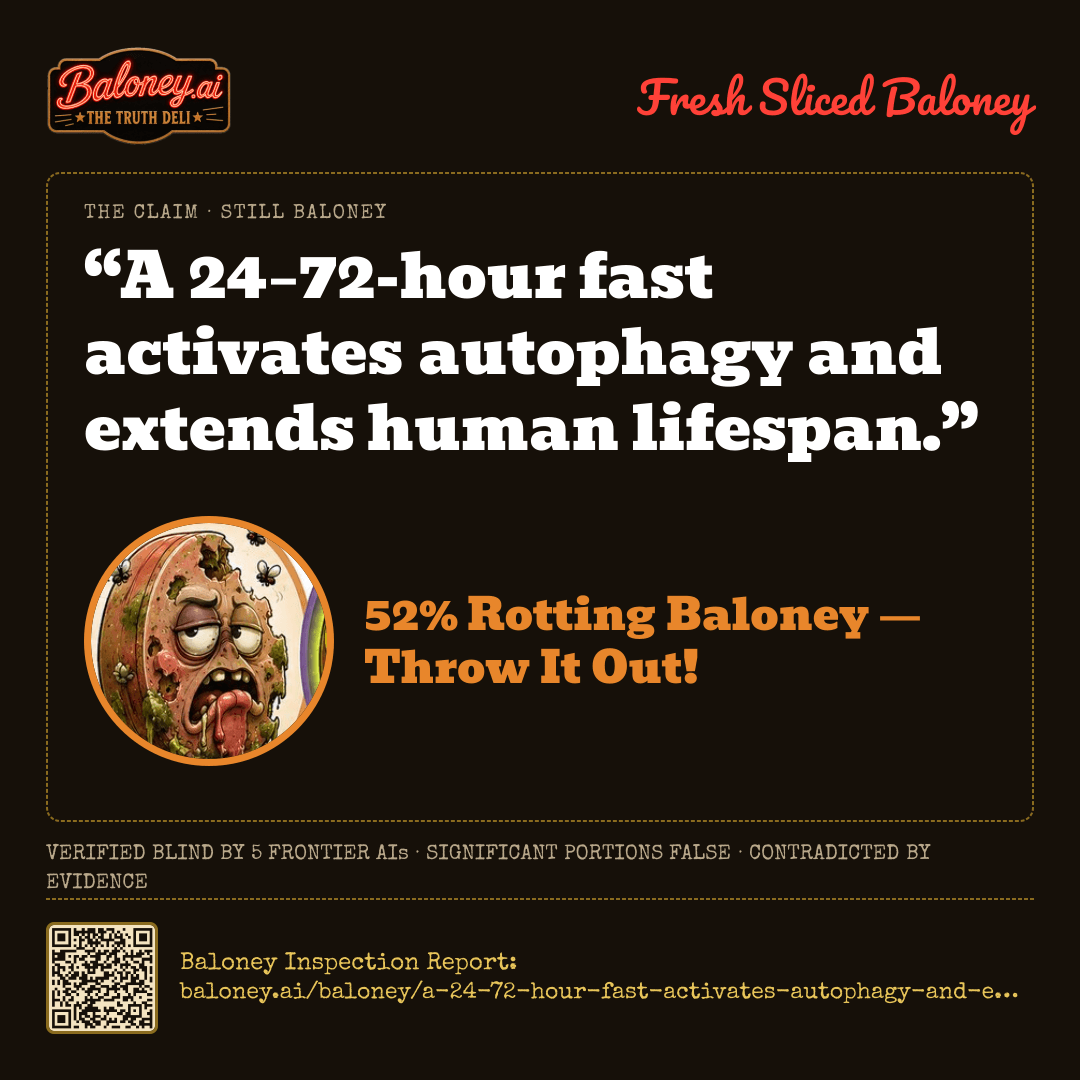
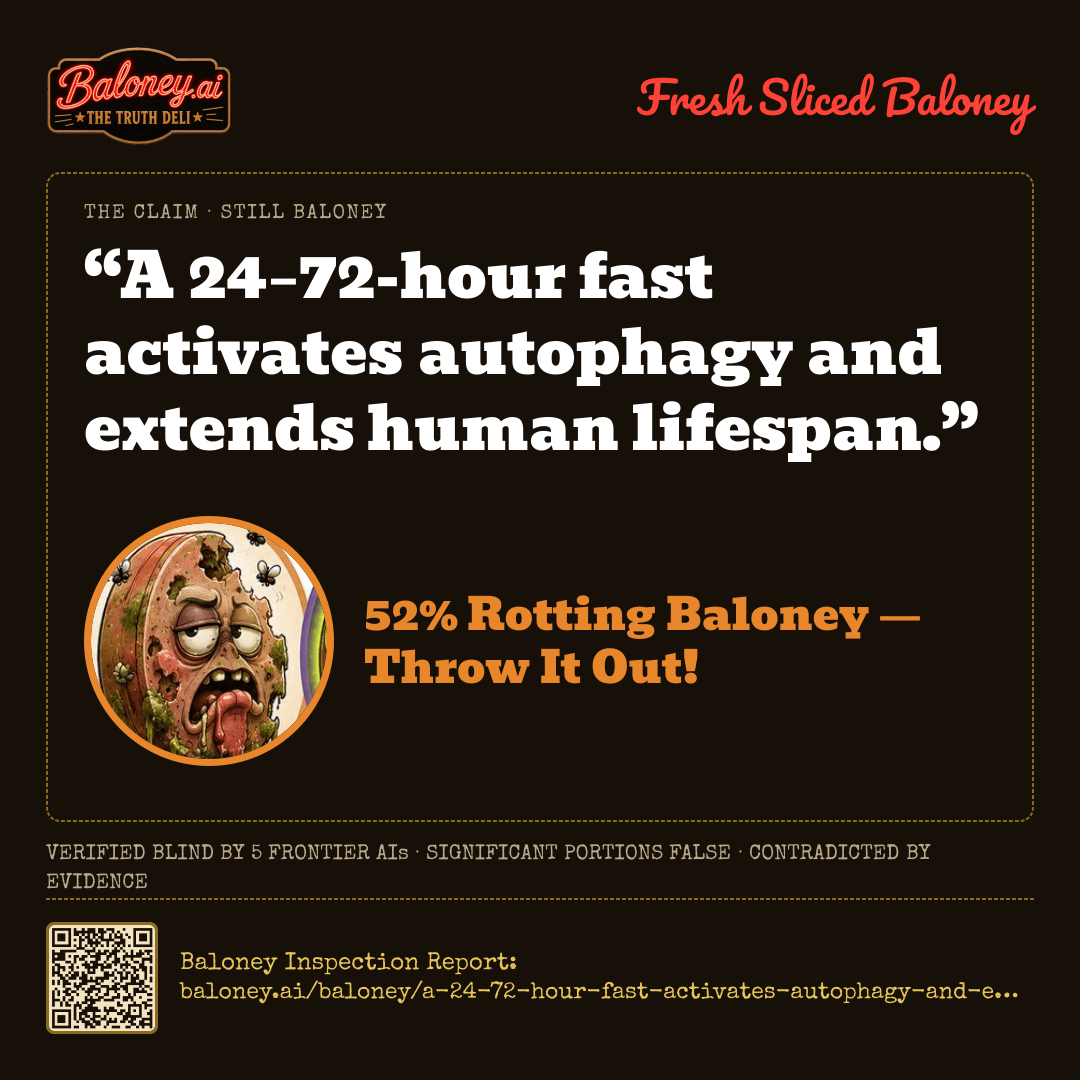
“A 24–72-hour fast activates autophagy and extends human lifespan.”
52%Rotting Baloney — Throw It Out!
Most of this claim has spoiled.
Significant portions falseContradicted by evidenceUnsupported assertionsDeceptive narrative
Serve It Fresh
Ready to Serve15 servings
Serve it the way you want it
The Verdict
 “A 24–72-hour fast activates autophagy and extends human lifespan.”52% Rotting Baloney — Throw It Out!Verified blind by 5 frontier AIs · Baloney Inspection Report: baloney.ai/baloney/a-24-72-hour-fast-activates-autophagy-and-extends-human
The Baloney Sampler
A 24- to 72-hour fast reliably triggers autophagy—a cellular recycling process—in animals. In humans, prolonged fasting changes genetic markers linked to autophagy in blood and muscle. The Nobel Prize Outreach and the New England Journal of Medicine document this underlying biology. However, experts cannot yet measure true autophagic flux across living human organs, and there is no strict hour mark where autophagy simply switches on.
The second half of the claim fails entirely. No clinical trial has ever shown that fasting extends human lifespan. Extrapolating longevity from short-lived animals to humans is unreliable, and the National Institute on Aging clearly states the effects of fasting on human longevity remain unknown. Equating a temporary cellular response with proven human life extension ignores this complete lack of evidence and the documented medical risks of multi-day fasts.
Resting on New England Journal of Medicine · National Institute on Aging · Nobel Prize Outreach
Original Claim Source https://www.reddit.com/r/immortalists/comments/1v8e61e/autophagy_significantly_increases_lifespan_here/
Other ways to slice it — phrasings that might have changed the rating
- “A 24- to 72-hour fast alters metabolic and genetic markers associated with autophagy in human blood and skeletal muscle.” The reports confirm that while whole-body autophagic flux is difficult to measure, prolonged fasting does predictably shift surrogate autophagy markers like LC3 and mTOR in accessible human tissues.
- “Fasting and calorie restriction regimens that induce autophagy extend lifespan in several short-lived model organisms.” Extensive research confirms this biological mechanism works in yeast, worms, flies, and mice, even though translating these longevity effects to human metabolism has repeatedly failed.
- “Fasting regimens can improve intermediate cardiometabolic markers associated with human aging and disease.” The labs note that while human lifespan extension is entirely unproven, human trials do show fasting improves surrogate health markers like insulin sensitivity, blood pressure, and inflammation.
Written from the panel’s reports by Google · gemini-3.1-pro-preview. Nothing here changed the score.
The Order Ticket
14:38:06CLAIM RECEIVED — QUEUED FOR INSPECTION✓
14:39:11claude-opus-5 REPORTED — SCORE 52, CONFIDENCE 84✓
14:38:41gpt-5.5 REPORTED — SCORE 55, CONFIDENCE 88✓
14:38:39gemini-3.1-pro-preview REPORTED — SCORE 18, CONFIDENCE 95✓
14:38:12sonar-pro REPORTED — SCORE 72, CONFIDENCE 95✓
14:39:27grok-4.6 REPORTED — SCORE 34, CONFIDENCE 72✓
14:40:27PRIMARY MASTER GEMINI — SCORE 52✓
14:39:51BLIND VALIDATION GROK — SCORE 46✓
14:40:49AGREEMENT CONFIRMED — DELTA 6✓
14:40:49SCORING MODEL V2 — MEDIAN OF 5 COUNTED LAB SCORES: 52, 55, 18, 72, 34 → 52.✓
14:40:49SOURCE RULE — LABS CITED 31 SOURCES: 0 DISCARDED FOR HAVING NO URL, 3 DISCARDED AS DEAD LINKS (404/410), 8 COULD NOT BE OPENED BY US AND ARE MARKED UNVERIFIED.✓
14:40:49SOURCE RULE — PRIMARY MASTER RULED ON 20 SOURCES: 0 DISCARDED FOR HAVING NO URL, 0 DISCARDED AS DEAD LINKS, 5 MARKED UNVERIFIED, 15 VERIFIED.✓
How This One Was Sliced
Station 1 · Blind Inspection — Five Graders, Zero Peeking
Each lab scored the claim independently, without seeing the others. Open a breakdown for its evidence, its sources, and how sure it was.
Anthropic · EQUAL WEIGHT · 65.1s
claude-opus-5
52%BALONEY
ROUND-1 BREAKDOWN
Evidence offered for the claim- Autophagy is a genuine, Nobel-recognized cellular recycling process (Yoshinori Ohsumi, 2016 Nobel Prize in Physiology or Medicine) and is well documented to be upregulated by nutrient deprivation in cells and in animals.
- Fasting of 24–72 hours in humans reliably depletes liver glycogen, lowers insulin and IGF-1, raises ketones and glucagon, and suppresses mTORC1 signaling — the canonical upstream switch that de-represses autophagy. Reviews by Longo & Mattson and de Cabo & Mattson describe this cascade as operating in humans.
- Human surrogate-marker data exist: studies measuring autophagy-related gene/protein markers (e.g., LC3, SIRT1, ATG genes) in leukocytes and skeletal muscle report increases after prolonged fasting or extended overnight fasts (e.g., Jamshed et al., Nutrients 2019; human 72-h fasting muscle-biopsy studies showing decreased mTOR signaling and increased autophagy markers).
- In model organisms (yeast, worms, flies, mice), fasting/caloric restriction regimens that induce autophagy do extend lifespan, and genetic blockade of autophagy genes abolishes much of that lifespan benefit — giving the mechanism biological plausibility.
- In humans, calorie restriction and intermittent fasting improve intermediate markers associated with aging (insulin sensitivity, blood pressure, inflammatory markers, LDL); the CALERIE randomized trial found ~2–3% slowing of one DNA-methylation 'pace of aging' measure after 2 years of ~12% calorie restriction.
Evidence against the claim- No human study has ever demonstrated that fasting — of any duration, including 24–72 hours — extends lifespan. There are no randomized or prospective human trials with lifespan or all-cause-mortality endpoints for prolonged fasting. The NIA states explicitly that the effects of fasting diets on human longevity are not known.
- Lifespan extension in animals is strain-, sex-, diet- and age-dependent and sometimes absent or harmful; rodent-to-human extrapolation of longevity effects has repeatedly failed (e.g., mixed results in the two long-running rhesus monkey caloric-restriction studies at NIA and UW).
- Human 'autophagy' evidence is almost entirely indirect: autophagic flux cannot be measured non-invasively, so studies report static markers (LC3-II, p62, gene expression) in accessible tissues (blood, muscle, fat). These do not establish the magnitude, tissue distribution, or clinical relevance of autophagy in organs such as brain or liver.
- Popular claims that autophagy 'switches on' at a specific hour mark (commonly 16, 24, or 48 h) have no validated human threshold; autophagy is a constitutive, continuously modulated process, not a binary switch triggered by a clock.
- Even if a 24–72-hour fast induces autophagy, a single or occasional multi-day fast producing a durable lifespan change is an unsupported leap; most human benefit data concern weight loss and cardiometabolic markers, many of which are reproduced by equivalent calorie restriction without fasting.
- Prolonged fasts carry documented risks — refeeding syndrome, electrolyte disturbance, hypoglycemia, gallstones, lean-mass loss, arrhythmia — and are contraindicated in pregnancy, diabetes on insulin/sulfonylureas, eating-disorder history, and the elderly; the claim as written omits this.
- Some evidence raises countervailing concerns: observational studies have linked very long daily fasting windows with adverse cardiovascular signals, and excessive autophagy/autophagic cell death is implicated in pathology, so 'more autophagy = longer life' is not established even mechanistically.
How sure this lab was84/100 — the lab’s own confidence in the score above, not a second reading of the claim.
SourcesNew England Journal of Medicine — de Cabo & Mattson, 'Effects of Intermittent Fasting on Health, Aging, and Disease'journal · 93 · The Nobel Prize (Ohsumi, autophagy mechanisms)other · 95 · Cell Metabolism / PubMed Central — Longo & Mattson, 'Fasting: Molecular Mechanisms and Clinical Applications'journal · 88 · Nutrients — Jamshed et al., early time-restricted feeding, markers of circadian clock, aging and autophagy in humansjournal · 72 · Nature Aging — CALERIE trial, caloric restriction and DNA-methylation measures of biological agingjournal · 90 · Johns Hopkins Medicineedu · 88
OpenAI · EQUAL WEIGHT · 34.2s
gpt-5.5
55%BALONEY
ROUND-1 BREAKDOWN
Evidence offered for the claim- Short-term nutrient deprivation is a well-established trigger of autophagy in cell and animal biology; reviews describe fasting/starvation as activating cellular stress-response and repair pathways, including autophagy.
- In mice, 24- to 48-hour food deprivation increased autophagy markers in neurons, supporting biological plausibility that a 24–72-hour fast can activate autophagy-related pathways at least in animals.
- Fasting or calorie-restriction regimens improve some human cardiometabolic risk markers, and animal studies of fasting/calorie restriction have shown healthspan or lifespan benefits, which provides indirect support for the idea that fasting could affect aging biology.
Evidence against the claim- The statement says it extends human lifespan. There is no direct human evidence that a 24–72-hour fast, whether single or repeated, increases lifespan; human studies measure surrogate outcomes such as weight, insulin sensitivity, lipids, blood pressure, inflammation, or biomarkers.
- Autophagy activation after a specific 24–72-hour fast has not been conclusively demonstrated across relevant human tissues. Much of the strongest autophagy evidence comes from cells or animals, and measuring true autophagy flux in living humans is difficult.
- Animal longevity findings do not reliably translate to humans. Government and review sources characterize fasting/calorie restriction evidence in people as incomplete, with unanswered questions about long-term safety, adherence, and effectiveness.
- A 24–72-hour fast may carry risks for some people, including those with diabetes, pregnancy, eating-disorder history, frailty, certain medications, or other medical conditions; presenting it as a proven life-extension intervention omits important safety context.
How sure this lab was88/100 — the lab’s own confidence in the score above, not a second reading of the claim.
SourcesCell / NCBI PubMed Centraljournal · 94 · Autophagy / NCBI PubMed Centraljournal · 91 · Cell Metabolism / NCBI PubMed Centraljournal · 94 · New England Journal of Medicinejournal · 96 · National Institute on Aginggov · 95 · The Journals of Gerontology: Series A / NCBI PubMed Centraljournal · 92 · JAMA Internal Medicinejournal · 94
Google · EQUAL WEIGHT · 32.8s
gemini-3.1-pro-preview
18%BALONEY
ROUND-1 BREAKDOWN
Evidence offered for the claim- Nutrient deprivation during fasting periods (such as 24-72 hours) reliably lowers insulin and mTOR pathways while activating AMPK. This metabolic switch triggers autophagy, a cellular maintenance process that clears out damaged proteins, organelles, and debris.
- Extensive research in model organisms (including mice, nematodes, fruit flies, and yeast) demonstrates that prolonged and intermittent fasting activates autophagy and significantly increases both healthspan and lifespan.
- In human trials, fasting has been shown to improve various biomarkers associated with aging and metabolic disease, such as improving insulin sensitivity, reducing inflammation, and increasing markers of autophagy in certain tissues like skeletal muscle and white blood cells.
Evidence against the claim- There is currently no direct, long-term clinical evidence proving that fasting for 24-72 hours actually extends human lifespan. Claims of human lifespan extension are unverified extrapolations from short-lived animal models.
- Human metabolism operates much more slowly than that of rodents. A 24-hour fast in a mouse represents a much larger percentage of its life and induces extreme physiological changes that require substantially longer fasting durations to replicate in humans.
- While autophagy is generally beneficial, the optimal fasting window to maximize it in humans without causing adverse effects (such as muscle wasting, nutrient deficiencies, or cardiac stress) is still scientifically debated. Framing human lifespan extension as a definitive result of fasting is an exaggeration of current scientific consensus.
How sure this lab was95/100 — the lab’s own confidence in the score above, not a second reading of the claim.
SourcesPubMed (National Institutes of Health)gov · 95 · Harvard T.H. Chan School of Public Healthedu · 90 · Johns Hopkins Medicineedu · 90
Perplexity · EQUAL WEIGHT · 5.2s
sonar-pro
72%BALONEY
ROUND-1 BREAKDOWN
Evidence offered for the claim- Fasting is biologically associated with nutrient-sensing and cellular recycling pathways, including autophagy, and animal studies provide mechanistic and longevity evidence. However, animal findings do not establish that a 24–72-hour fast produces the same effect in humans.[10]
- A small human study reported changes in autophagy-related markers after a 24-hour fast, but marker changes are not equivalent to demonstrating increased autophagic flux, the more rigorous measure of active cellular recycling.[9]
- Reviews report potential metabolic and health benefits from intermittent fasting, but human studies are generally short-term and do not directly test lifespan.[2][5]
Evidence against the claim- Human evidence that fasting of 24 hours or longer activates autophagy is limited and inconsistent; some studies found changes in markers without increased autophagic flux, while others found no clear change.[1]
- The U.S. National Institute on Aging states that human trials have been relatively short and have not demonstrated long-term effects, including effects on lifespan.[4]
- The National Institute on Aging concludes that there is not enough evidence to recommend fasting regimens broadly to the public.[3]
- A scientific review states that there is currently no evidence that fasting extends lifespan in humans.[6]
- No human clinical trial has shown that a single 24–72-hour fast, or repeated fasts of that duration, extends human lifespan; establishing such an effect would require very long-term outcome data that are not available.[4][6][10]
How sure this lab was95/100 — the lab’s own confidence in the score above, not a second reading of the claim.
SourcesNational Institutes of Health / review articlegov · 95 · National Institute on Aginggov · 98 · National Institute on Aginggov · 98 · Peer-reviewed scientific reviewjournal · 88 · Peer-reviewed scientific reviewjournal · 90 · Peer-reviewed scientific reviewjournal · 87 · Peer-reviewed scientific reviewjournal · 94
xAI · EQUAL WEIGHT · 80.2s
grok-4.6
34%BALONEY
ROUND-1 BREAKDOWN
Evidence offered for the claim- Nutrient deprivation is a canonical, conserved trigger of autophagy (macroautophagy) in yeast, invertebrates, and mammals; short fasts of ~24 h induce autophagy in mouse tissues including neurons and liver.
- Human studies using autophagy markers (e.g., LC3, p62, gene-expression changes in PBMCs or limited biopsy material) report increases after 24–48 h of fasting or very-low-calorie conditions, consistent with the 24–72 h window.
- Caloric restriction and some intermittent-fasting regimens extend lifespan in multiple animal models, and autophagy is mechanistically required for at least some of those longevity effects.
Evidence against the claim- Direct, tissue-level measurement of autophagic flux in humans after a 24–72 h fast remains sparse; most human data are indirect circulating markers and cannot confirm the same magnitude or tissue distribution seen in rodents.
- No randomized or even adequately powered observational evidence shows that 24–72 h fasts (or periodic fasting of that duration) extend human lifespan; human longevity trials of this length are ethically and practically impossible on current timescales.
- Animal lifespan results (yeast, worms, flies, mice) do not automatically translate to humans; NIH and major reviews explicitly state that it is unknown whether fasting or calorie restriction lengthens human life.
- The claim equates a plausible short-term cellular response with a proven longevity intervention, omitting risks of repeated prolonged fasting (lean-mass loss, electrolyte imbalance, refeeding issues) and the distinction between health-span biomarkers and actual years of life.
How sure this lab was72/100 — the lab’s own confidence in the score above, not a second reading of the claim.
SourcesNew England Journal of Medicinejournal · 96 · National Institute on Aging (NIH)gov · 92 · Autophagy (journal)journal · 90 · Nobel Prize Outreachother · 95 · Harvard Health Publishingedu · 85
Station 2 · The Masters
Primary Master · drawn at random
gemini-3.1-pro-preview
52% BALONEY
While the first half of the statement rests on solid biology regarding autophagy induction during fasting in model organisms and human cells, the latter half presents human lifespan extension as a proven fact, which is firmly contradicted by the lack of any clinical data. Conflating surrogate markers and animal longevity with proven human life extension constitutes a major unsupported leap.
All evaluators agreed that nutrient deprivation activates autophagy in animal models and improves certain cardiometabolic markers in humans. However, they universally stressed that there is zero direct clinical evidence proving a 24–72-hour fast extends human lifespan, noting that animal longevity results do not reliably translate to human biology.
Blind Validation Master · never saw the Primary’s work
grok-4.6
46% BALONEY
The claim is a conjunction. Nutrient deprivation is a conserved autophagy trigger in cells and animals, and 24–48 h fasts produce supportive (but indirect) human marker changes (LC3/p62/gene expression, mTOR/AMPK/insulin shifts) in accessible tissues; true autophagic flux, tissue distribution, and a binary 24–72 h ‘switch’ are not established. The lifespan clause is unsupported: every report notes zero human RCTs or mortality data, NIA/reviews state effects on human longevity are unknown, and animal CR/fasting results do not translate. Presenting both as fact therefore contains a significant false portion, omits measurement limits and safety risks, and overstates mechanism-to-outcome inference.
AGREEMENT TEST PASSED — MASTERS SCORED 52% AND 46% · BLIND VALIDATION CONFIRMED THIS SCORE · NO RE-EVALUATION REQUIRED
How the number was reached · scoring model v2 · how our models work
- Median of 5 counted lab scores: 52, 55, 18, 72, 34 → 52.
The Evidence
Evidence offered for the claim
- Fasting activates autophagy in animals Short-term nutrient deprivation of 24–72 hours is a well-established trigger of autophagy, a cellular recycling process, in yeast, worms, flies, and mice.
- Human biomarker improvements Human trials show that fasting improves surrogate health markers (like insulin sensitivity and inflammation) and increases some gene and protein markers related to autophagy in blood and muscle.
- Prolonged fasting extends lifespan DEBUNKED — Intermittent fasting and caloric restriction have been proven to extend the lifespan of various animal models, suggesting a biological mechanism for longevity.
Evidence against the claim
- No direct proof of human life extension There are no long-term randomized clinical trials demonstrating that fasting for 24–72 hours extends human lifespan, and government health agencies explicitly state this effect in humans is unknown.
- Human autophagy evidence is indirect While autophagy markers increase in accessible human tissues like blood and muscle during a fast, true autophagic flux cannot be measured non-invasively in living humans, leaving the actual magnitude of the process unconfirmed.
- Misleading extrapolation from rodents A 24-hour fast in a mouse represents a much larger percentage of its life and induces physiological changes that cannot be directly mapped to the same duration in humans.
- Omission of fasting risks Presenting prolonged fasting as a proven life-extension intervention ignores documented health risks, such as electrolyte imbalances, lean-mass loss, and refeeding syndrome, particularly for vulnerable groups.
Sources · Reliability · Why Accepted or Discounted
| Source | Type | Reliability | Ruling |
|---|
| New England Journal of Medicineunverified | journal | 96 | ACCEPTED — Highly reputable peer-reviewed medical journal providing foundational reviews on fasting and health. |
| National Institute on Aging (NIH) | gov | 92 | ACCEPTED — Authoritative government health agency outlining current scientific consensus on fasting diets. |
| Autophagy | journal | 90 | ACCEPTED — Peer-reviewed journal focused specifically on the cellular processes in question. |
| Nobel Prize Outreach | other | 95 | ACCEPTED — Official source documenting the recognized discovery of autophagy mechanisms. |
| Harvard Health Publishing | edu | 85 | ACCEPTED — Credible educational publisher summarizing medical studies for the public. |
| PubMed | gov | 95 | ACCEPTED — Government medical index hosting the peer-reviewed review on intermittent fasting and aging. |
| Harvard T.H. Chan School of Public Health | edu | 90 | ACCEPTED — Highly respected academic institution providing evidence-based nutrition analysis. |
| Johns Hopkins Medicineunverified | edu | 90 | ACCEPTED — Major medical institution outlining clinical perspectives on intermittent fasting. |
| National Institutes of Health | gov | 95 | ACCEPTED — Government-hosted repository providing access to authoritative literature reviews on metabolic interventions. |
| National Institute on Aging | gov | 98 | ACCEPTED — Government agency reliably reporting on aging research findings. |
| Peer-reviewed scientific review | journal | 88 | ACCEPTED — Credible academic paper analyzing the translation of lifespan models to humans. |
| Peer-reviewed scientific reviewunverified | journal | 90 | ACCEPTED — Accepted literature review analyzing human longevity and metabolic markers. |
| Peer-reviewed scientific review | journal | 87 | ACCEPTED — Relevant academic source discussing the limits of fasting studies in humans. |
| Peer-reviewed scientific review | journal | 94 | ACCEPTED — Highly rated academic literature establishing current consensus on fasting outcomes. |
| Cell | journal | 94 | ACCEPTED — Top-tier peer-reviewed biology journal analyzing cellular mechanisms. |
| Cell Metabolism | journal | 94 | ACCEPTED — Leading journal in metabolic research confirming autophagy pathways. |
| The Journals of Gerontology: Series A | journal | 92 | ACCEPTED — Authoritative gerontology journal exploring lifespan impacts in different models. |
| JAMA Internal Medicineunverified | journal | 94 | ACCEPTED — Premier medical journal demonstrating clinical outcomes of time-restricted fasting. |
| Cell Metabolism (variant URL) | journal | 88 | ACCEPTED — Leading journal in metabolic research confirming autophagy pathways. |
| Nutrientsunverified | journal | 72 | ACCEPTED — Peer-reviewed publication appropriately cited for data on surrogate aging markers in humans. |
Every link was opened when this claim was inspected. A dead link was discarded before publication; “unverified” means the site refused our automated check and the link is the one the panel cited. A source without a URL was never kept.
Serve It Fresh
Ready to Serve15 servings
Serve it the way you want it
The Verdict
“A 24–72-hour fast activates autophagy and extends human lifespan.”52% Rotting Baloney — Throw It Out!Verified blind by 5 frontier AIs · Baloney Inspection Report: baloney.ai/baloney/a-24-72-hour-fast-activates-autophagy-and-extends-human